Pierfishing
Yellow Snake Eel — Eew!
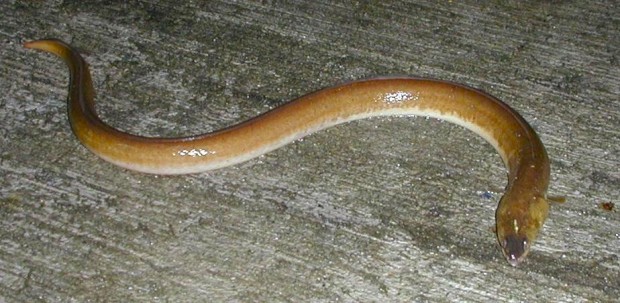
A yellow snake eel from the Balboa Pier
Species: Ophichthus zophochir (Jordan & Gilbert, 1882); Ophichthus, from two Greek words meaning serpent and fish, and the Greek zophochir, for darkness and hand (dark pectoral fins).
Alternate Names: Eww, a snake! In Mexico called Tieso Amarillo; in Peru called Anguila amarilla or Culebra marina.
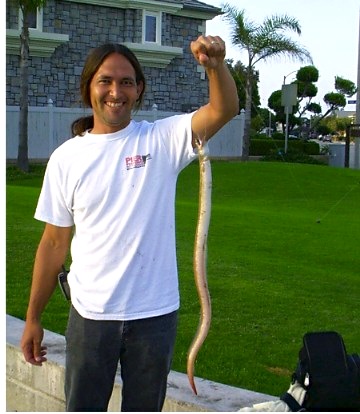 Jimbo Jack and a yellow snake eel from Huntington Harbor
Identification: Typical eel-like shape with a spike-like tail, no fin rays and no spots. Reddish-olive, yellowish-brown or yellow above; lighter below.
Size: Up to 34 ½ inches.
Range: From Huacho, Peru, to Eureka, Humboldt Bay; also seen in the Gulf of California.
 Yellow snake eel from the Dana Harbor Pier
Habitat: Found in both sandy and rocky areas down to a 60-foot depth (although one source says 210 feet). Officially considered rare by the CA Fish and Game (supposedly under 20 ever reported in California) although Pier Fishing in California (pierfishing.com) has had many reports of these eels over the years, most commonly from Newport Bay and Huntington Harbor.
Piers: PFIC has had reports from quite a few piers. Best bets: Oceanside Harbor Pier, Dana Point Harbor Pier, Balboa Pier, Newport Pier, Seal Beach Pier, Belmont Pier, Burton Chace Park Pier, Venice Pier and the small piers inside of Newport Bay and Huntington Harbor. Science records show an Ophichthus zophochir being taken from the Del Mar Pier in 1960 (although the pier was demolished in 1959) and from the Berkeley Pier in 1964. PFIC regular “Mel” caught, photographed, and released a yellow snake eel from the Berkeley Pier in 2006. In 2002 I photographed one that was caught by a fellow angler one night out at the end of the Newport Pier (the same night I caught a basketweave cusk-eel, Otophidium scrippsi). That snake eel and the cusk-eel were given to the DF&G.

Yellow snake eel and basketweave cusk-eel from the Newport Pier
Shoreline: A rare catch by southern California shore anglers.
Boats: An inshore species rarely seen on boats.
Bait and Tackle: Taken incidentally by anglers fishing on the bottom for other species. Most commonly taken at night and with squid as bait (although their preferred food is supposedly fish and clams). Tackle should be kept simple: a medium-sized outfit with light line and a size 6 to 2 hook. Be prepared for a surprisingly spirited tussle.
 Mel’s hands and a “whirling dervish” kind of an eel — Berkeley Pier
Food Value: Don’t know anyone who has eaten one although most eels are considered fair to good eating.
Comments: An unusual, gnarly catch that enjoys twisting its limber body around your arm (and scaring the bejeebers out of you) when you try to unhook it. A related species, considered rare in California, is the Spotted snake eel (Ophichthus triserialis). The spotted snake eel ranges from Peru to Humboldt Bay, including the Galapagos Islands and the Gulf of California.
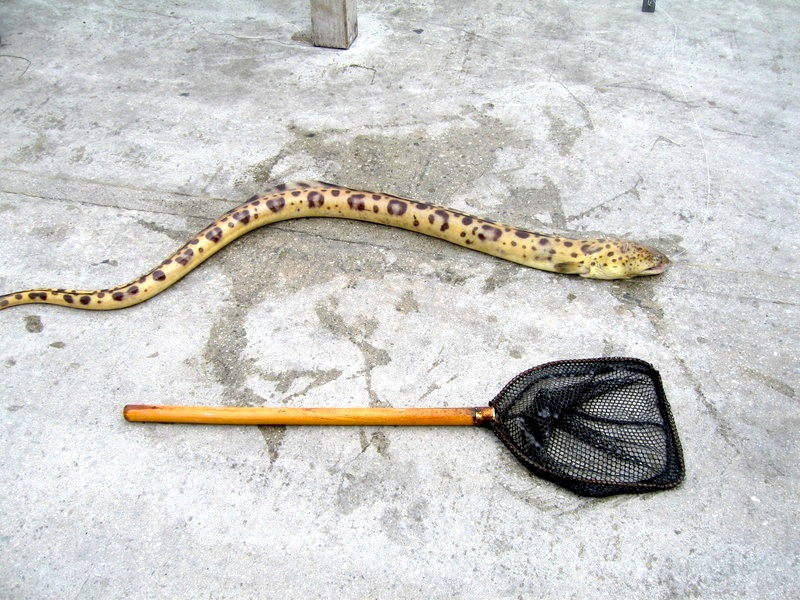 A spotted snake eel from the Hermosa Beach Pier
 The gnarly end of the eel!
Rare fish caught at Belmont Pier — catalufa

Rare fish caught at Belmont Pier
Casting a bait and then sitting down and watching the rod tip on Belmont Pier isn’t the most glamorous and exotic fishing along the Pacific Coast, but it’s restful and sometimes productive for perch, an occasional halibut and other species. Then too, you meet interesting people.
Gerald Osier of 221 Grand Ave., who has worked on the pier and still does some part time work there in the summer months, likes to fish the pier and just loaf. Just recently he caught one of the rarest fishes in the Pacific Ocean. It was small, and there was no way that he could have filleted it and got a dinner for two So he reported to the department of Fish and Game, and one of the DFG biologists came to take a look and carry the fish back to the laboratories at 350 Golden Shore.
The fish was red, looked like a perch, had large blue eyes almost the size of nickels, weighed 11 ounces, and was 9 ½ inches long. Now Osier has a letter from John Fitch, research director of the State Fisheries Laboratories at Long Beach DFG, saying that the fish is a catalufa, extremely rare. In fact, said Fitch, fewer than 15 had ever been caught either by hook and line or in commercial nets in all the time that he has been with the DFG. Fitch, in his letter to Osier, said that the largest that he had ever seen was 13 inches long and weighed two pounds. He also told Osier that the fish was being sent to the Natural History Museum in Los Angeles. It will be made into a mount and displayed.
This is just one sample of what can happen in pier fishing, which can be fun for individuals or a family except for the fact that all piers now are afflicted with vandalism. What public facilities are not endangered the same way? Belmont Pier is the one remaining public fishing facility in Long Beach and it deserves enough security protection to keep it clean.
—Donnell Culpepper, Long Beach Press-Telegram, November 21, 1975
Pacific Electric Ray — the shocking details

Good old sparkie!
Species: Torpedo californica; (Ayres, 1855); from the Greek word torpedo (for numbness—from the electric shock) and californica (for California, where the first specimens were taken).
Alternate Names: Torpedo ray, numbfish, crampfish or torpedo. Called torpedo del Pacifico or torpedo in Mexico.
Identification: An oval disk that is thick and flabby; the tail is short, stocky, with two dorsal fins and a large symmetrical caudal fin. No spines or prickles. Eyes small and round; mouth moderate in size with 4 or 5 rows of teeth in each jaw. Coloring is blue-black to drak gray above; white to slate gray below; often with black spotting.
 Electric Ray — Ventura Pier
Size: Reported to 4 feet in length and 90 pounds. Typical size at piers is from two and a half to three and a half feet.
Range: Worldwide in tropical and temperate seas; in the eastern Pacific from Sebastian Viscaino Bay, southern Baja California, and the Gulf of California, to Wiah Point in Dixon Entrance, Queen Charlotte Islands, British Columbia.
Habitat: Generally in shallow coastal waters but reported to a depth of 900 feet. During the day they will often partially bury themselves in sand before ambushing unsuspecting victims that come a little too close. They capture their prey (fish, invertebrates, cephalopods) by suddenly lunging their heads upwards and simultaneously delivering an electric shock (of up to 45 volts). At night they like to swim mid-level and attack fish that have settled near the bottom in a quiescent state. It’s reported that when “a prey fish enters range, the ray lunges forward and folds the anterior and lateral margins of its pectoral fins over it. It then envelops the prey further by making short kicks with its tail, sometimes performing somersaults and/or barrel rolls, while incapacitating it with electric shocks. The stunned fish is then passed to the weak but flexible mouth with undulations of the disc, and swallowed head-first.” When vision is limited (night or turbid water) they may find their prey by picking up electrical cues with their ampullae of Lorenzini.
 Electric Ray — Ventura Pier
Piers: An uncommon catch at piers although some are taken each year; most common at piers south of Point Conception. Best bets: Ocean Beach Pier, San Clemente Pier, Hermosa Beach Pier, Ventura Pier (#1), and the Gaviota Pier.
Shoreline: Rarely caught by shore anglers.
Boats: Rarely seen by boaters.
 Electric Ray — Venice Pier
Bait and Tackle: Since this is one of the larger fish pier anglers will encounter, you should use at least medium saltwater tackle—twenty pound test line and size 2 to 4/0 hooks. Most electric rays have been taken on cut bait such as mackerel and sardines or on squid.
Food Value: Apparently they are quite tasty (at least according to the French who savor electric rays).
Comments: Milton Love reports that they “hover over the potential tidbits, then stun them with a jolt that can reach at least 45 volts.” These rays are generally a surprise catch on a pier and often the angler is shocked (literally) by the catch. If you must pick them up, do so by their tails; the shocks are produced in organs located in the disk on each side of the ray.
Pier Fishing in California — Concourse d’Pier Carts
Almost every pier rat that I know, or at least those who frequent the long piers in central and southern California, has a pier cart. It’s needed when you’re loaded down with rods and reels, tackle box, bait bucket, cooler, hoop net, magic potents, good luck charms, and your personal copy of Pier Fishing in California (that seems to weigh several pounds itself). Of course you also need something to help you carry off that 30-pound fish that you’re going to take home for dinner. Some are simple (i.e, old grocery carts), some are commercially available models found at most hardware stores, some are elaborate home-made contraptions containing all sorts of personal innovations. However, simple or complex, inexpensive or expensive, they must do the same thing: provide a platform by which to haul that sometimes fairly heavy equipment out to the end of the pier. And, they must be sturdy enough to be hauled up and down stairs as well as over rough-hewn planks. In addition, they must be able to survive the vicissitudes of car trunk and pick-up truck travel. They’re a MUST HAVE piece of equipment.
One day we had a thread on Pier Fishing in California about pier carts and someone sent in the following title (which I’ve changed for this article). We also received a plethora of pictures of people’s favorite carts.


 These first two pictures are of my pier cart (minus the rod holders) and I’ve used this one or similar ones since the ’80s
 KJ Pier Cart 2016 at Citizens Dock in Crescent City
 Art and his pier cart — Newport Pier
 Crabman’s pier cart — Newport Pier
 Matty and Gordo Grande — Hermosa Beach Pier

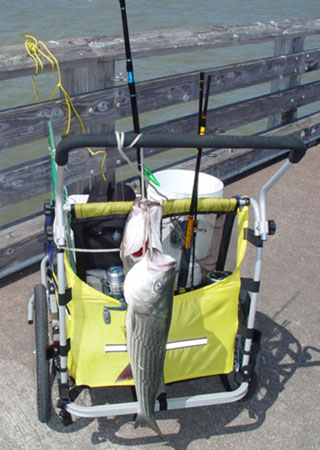 Rockhoppers pier cart — Berkeley Pier
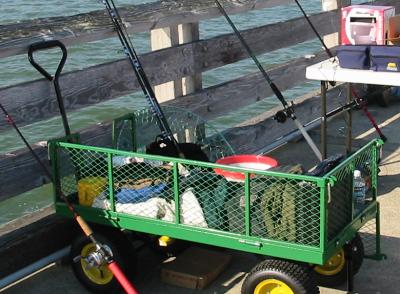 Gyzodude’s “green monster” cart —Berkeley Pier
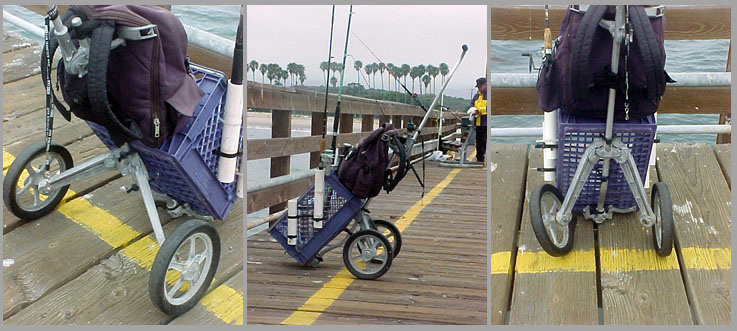 Kim’s pier cart — Goleta Pier
 Dumbarton Dave’s pier cart — Dumbarton Pier
 Jason’s pier cart
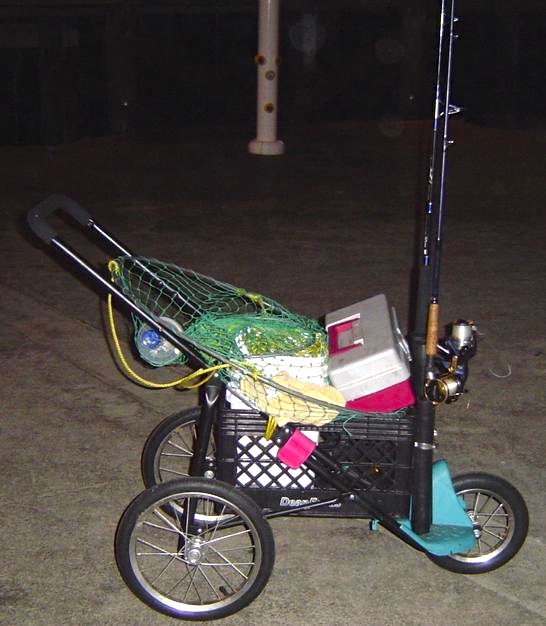 DompfaBen’s pier cart
 Pier cart at Malibu Pier, 2007
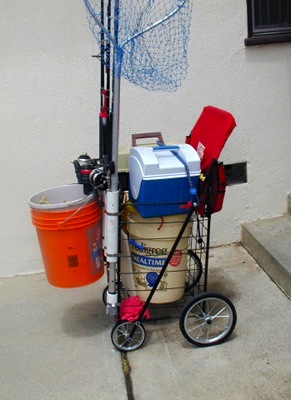 Gordo’s pier cart
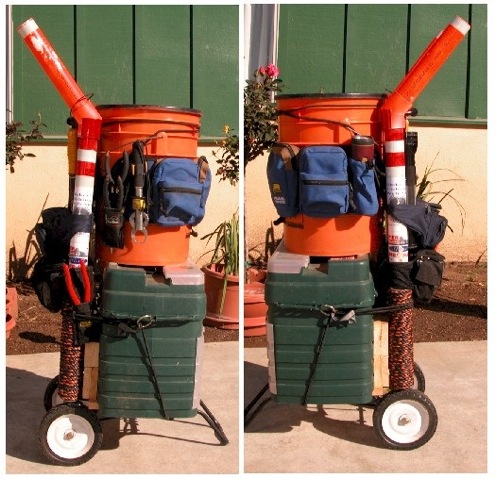 Unknown pier cart
 BigdaddyO57′s pier cart
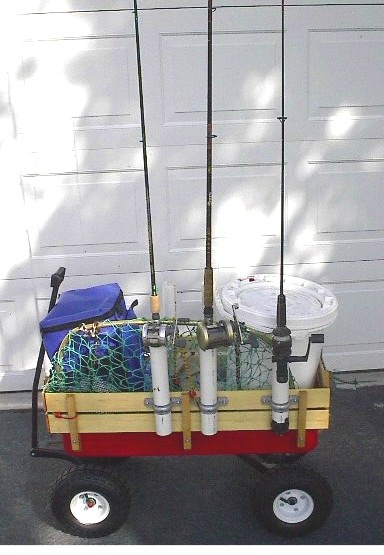 Jimbojack’s Cart
 Riorust’s pier cart
 ReelHabit’s pier cart
 Sinker’s small pier cart
 Mark and the “Magic Pier Cart” — Oceanside Pier

Pier cart at the Huntington Beach Pier in 2015
 Pier cart at Manhattan Beach Pier in 2006
 Pier Cart at the Balboa Pier
 Pier Cart at the Port Hueneme Pier
The Catalina “Get Togethers” & a few designs over the years —
For over a decade the “pier rats” from Pier Fishing In California (pierfishing.com) and United Pier and Shore Anglers of California (UPSAC) got together at Avalon on Catalina Island, caught a few fish, and had a chance to see their friends once again. Every year there was a design for the t-shirts and often there was a contest. Here are some of the designs over the years.
 This was the official 2002 winner!
 This design was a runner-up in 2003
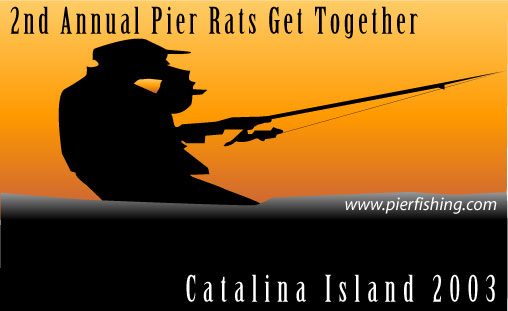 The winner in 2003
 2004 winning entry — a small copy
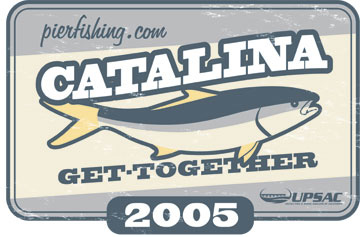 The winning entry in 2005

The winner in 2006
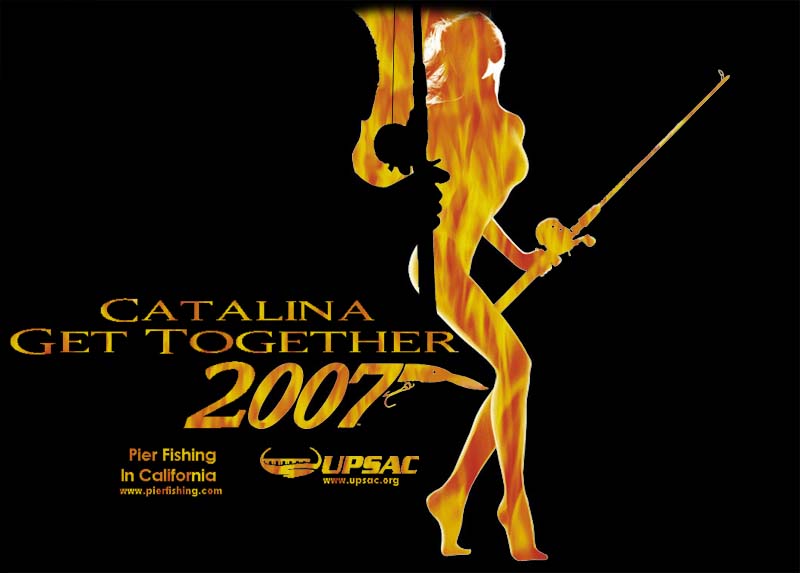 This one wasn’t selected in 2007. Some felt it was in bad taste, some thought it was great.
 This was the winning 2007 entry

We had two winners in 2008, a men’s and women’s version

 The 2009 winner
 The 2010 winner (front)
 The 2010 winner (back)
 The 2011 Winner

The 2012 winner
 The 2013 Winner.
Blog Archives
- September 2025 (1)
- August 2024 (1)
- September 2023 (1)
- September 2022 (1)
- April 2022 (5)
- September 2021 (1)
- February 2021 (1)
- January 2020 (1)
- August 2019 (1)
- January 2019 (1)
- October 2018 (1)
- September 2018 (2)
- August 2018 (1)
- June 2018 (3)
- April 2018 (10)
- March 2018 (22)
- February 2018 (3)
- January 2018 (4)
- December 2017 (2)
- November 2017 (2)
- September 2017 (3)
- August 2017 (2)
- July 2017 (5)
- June 2017 (3)
- May 2017 (5)
- April 2017 (1)
- March 2017 (4)
- February 2017 (1)
- January 2017 (2)
- December 2016 (5)
- November 2016 (10)
- October 2016 (33)
- September 2016 (13)
- August 2016 (1)
- February 2016 (1)
- January 2016 (1)
- November 2015 (1)
- October 2015 (3)
- September 2015 (4)
- August 2015 (27)
- July 2015 (1)
- May 2015 (7)
- April 2015 (13)
- February 2015 (1)
- January 2015 (1)
- December 2014 (2)
- November 2014 (16)
- October 2014 (4)
- September 2014 (8)
- July 2014 (1)
- June 2014 (1)
- May 2014 (2)
- April 2014 (1)
- February 2014 (3)
- December 2013 (3)
- October 2013 (1)
- September 2013 (1)
- August 2013 (1)
- July 2013 (1)
- June 2013 (1)
- April 2013 (1)
- March 2013 (21)
- February 2013 (2)
- May 2012 (1)
- March 2012 (7)
- February 2012 (5)
- January 2012 (8)
- December 2011 (4)
- October 2011 (4)
- September 2011 (1)
- August 2011 (3)
- July 2011 (5)
- June 2011 (1)
- April 2011 (1)
- March 2011 (5)
- February 2011 (2)
- January 2011 (2)
Support Ken Jones
If you appreciate Ken's writings on fishing, please consider making a donation for this unique content. Your support will help Ken to continue publishing knowledgeable and entertaining articles.
Pier Fishing in California, 2nd Ed.

The ultimate pier fishing resource for Pacific Coast pier anglers with Over 350 new photos and illustrations added to this edition, including detailed, species-specific illustrations of fish-cleaning, rigging illustrations, and maps. The history and culture of each pier is thoroughly covered.
Buy the book from pierfishing.com or Amazon!
Recent Photos