Pierfishing
2012 PFIC/UPSAC Catalina Get Together
 The 2012 Catalina Get Together is history; it’s over, kaput, concluded, finis—except in that small part of the brain that controls memory. In that section the memories of good times with friends, the pleasure of the small town of Avalon, the nature around us—the birds, the sea lions, the dolphins, and the fishing—slow but occasionally productive, will merit repeat. All of these things give reason for the name. Not Catalina Fishing Tournament but Catalina Get Together, the once a year gathering of friends on this tiny island just a short one hour journey from Los Angeles but a world apart as far as atmosphere and feel.
This year the group was small. The economy remains stagnant, gas is over $4.00 a gallon, and it can be hard to justify the several hundred dollars needed for the ferry, motel room, and meals. Nevertheless it is something that is worth the effort for many, even when there are no guarantees when it comes to the fishing, and this year, as said, it was slow.
 The Group Photo — 2012 Get Together
For some the event began on Wednesday. Two small town Hoosiers from Indiana, now living in NoTown (Fresno), headed down Wednesday afternoon. The duo, Ken and Mike, planned to get a good night’s sleep in a motel and would arise early to buy some bait that had been ordered from Big Fish Tackle in Seal Beach. Leaving near midnight from the Bay Area would be Rita, Jennica, and Kyle and though Rita had hoped that she and Jennica would share the driving, it was Rita who would pilot the car on the long, lonely freeway drive south.
Thursday morning would see the cars arrive at the Long Beach Downtown Terminal within minutes of one another. The Catalina Express Ferry would leave at 10AM and would wait for no one. Joining them on the ferry would be Hashem, the local boy from Los Angeles.
 Jennica and Kyle practice how to gamble on the way to Catalina
One hour over the gentle, two-foot swells of the San Pedro Channel, and there it was, the magical island of Catalina poking its still-green hills through the clouds. Soon after, the ferry was headed into the slip at the mole, participants eagerly headed down the plank from the ferry, and the hoard began the short walk into the heart of Avalon, the 25 blocks or so that make up the town. Next stop would be the Hermosa Hotel, a quick check in and a short visit to the rooms before heading out to the pier—the Green Pleasure Pier to be precise.
Fishing—Thursday — Green Pleasure Pier
For the last few years Thursday has been dedicated to the Green Pleasure Pier while Friday and Saturday have been spent at the Mole. This year would be the same but the results would be VERY different.
In 2009, 73 fish were landed in 4.25 hours; 2010 saw 55 fish for 6 hours; 2011 saw 86 fish for 5.25 hours. 5 Hours in 2012 would produce only 32 fish
 KJ and ocean whitefish, Green Pleasure Pier
Green Pleasure Pier: 1-6 PM; Fish: 32; Points: 72
16 Senorita, 4 Blacksmith, 3 Jack Mackerel, 2 Garibaldi, 2 Rock Wrasse, 1 Ocean Whitefish, 1 Sheephead, 1 Pacific Mackerel, 1 Kelp Bass and 1 Jacksmelt
 KJ and sheephead, Green Pleasure Pier
*** Noticeable almost immediately was the absence of kelp bass (calico bass). Typically the bass yield fairly steady action at the GPP and traditionally have been (numerically) the number one fish at the pier.
 Mike and a sheephead, Green Pleasure Pier
*** Also missing in action were the rock wrasse even though a couple were landed.
 Senorita, Green Pleasure Piier
 You’ve got to have a few rods and reels — right?
Fishing—Friday — Cabrillo Mole
Friday would see the arrival of most of the participants for the Get Together and they would be arriving on various ferries throughout the day. For those who had arrived Thursday, the day would be spent at the Cabrillo Mole, the platform built over a jetty that serves as the landing platform for passengers disembarking from ferries at Avalon. It also serves a dual purpose as a fishing pier and is the site of our annual Get Together. Although once again the fishing would be slower than the past few years, we did manage to land a few nice fish.
Cabrillo Mole: 6:30-8:30; 10:10-4:40 (8.50 hours); Fish: 51; Points: 114
 KJ and sheephead, Cabrillo Mole
14 Kelp Bass, 10 Pacific Mackerel, 6 Jack Mackerel, 5 Pacific Sardine, 3 Senorita, 3 Blacksmith, 2 Opaleye, 2 Treefish, 2 Sheephead, 1 Cabezon, 1 California Scorpionfish, 1 Kelp Rockfish and 1 Halfmoon
 KJ and cabezon — Cabrillo Mole
*** I like to bounce a sinker on the bottom checking out crevices and holes. This can mean the loss of some sinkers but also can be productive if a hole exists. I found such a hole Friday and off and on visits to the hole the next two days (the tide and movement of the kelp fronds had to cooperate) yielded 4 treefish, 1 scorpionfish and 1 kelp rockfish.
*** I’ve also decided to forsake my traditional high/low leader when fishing the Mole. It’s better just to use just one hook. When you do hook a fish they head right to the rocks (inshore) or the kelp (out from the Mole) and it’s too common to have the second hook catch on the rocks or kelp.
*** An interesting sight seen Friday, while fishing inshore near my “hole,” was a large shark, what appeared to be a horn shark, swimming merrily along obvious to the excited anglers watching from up above. Saturday we would see a four-foot-plus leopard shark swimming along in the same area. Soon after, we saw a school of five mullet swimming along in formation, and, as so often happens, anglers mistook them for small yellowtail (a common happenstance).
 Rita and a sheephead, Cabrillo Mole
*** In ten of the eleven Get Togethers I have caught giant kelpfish and usually it was several of the colorful fish. Several years also produced a mixture of the smaller kelpfish: striped, spotted and crevice kelpfish. This year I failed to catch a kelpfish of any species nor did I see a single kelpfish taken.
 Rita and a bonito, Cabrillo Mole
Fishing—Saturday —Cabrillo Mole: 12:30-1; 2-5 PM (3.50 hours); Fish: 37; Points: 83
Saturday would be the day of the derby and for me most of the time was spent judging. However I did manage to spend a little time fishing and once again caught a few fish.
18 Jack Mackerel, 4 Pacific Mackerel, 4 Blacksmith, 3 Kelp Bass, 2 Treefish, 1 Kelp Rockfish, 1 Garibaldi, 1 Pacific Sardine, 1 Sheephead, 1 Jacksmelt and 1 Senorita
As for the derby itself, fishing was fairly slow. Perhaps it was just too nice as the sunny sky meant crystal clear water which always seems to slow the bite somewhat. In addition, there was absolutely no water movement, another condition that seems to diminish success. Generally on the derby Saturday, fishing always seems to be better in the morning before the derby and later in the afternoon when the water by the mole is in shadow. It would be true again this day.
 Hashem and a bonito, Cabrillo Mole
 Jennica and a kelp bass (calico bass) , Cabrillo Mole
 Thomas and a swell shark, Cabrillo Mole
 Ryan at the Cabrillo Mole

RedKorn at the Cabrillo Mole; he would lose a large fish to the kelp just after the derby ended

Klye makes a cast for bonito at the Cabrillo Mole

Dora aka Mrs. Liu, spent her time watching the kids and serving up an excellent luncheon that she and her hubby had prepared for the group
We always have a raffle and of course give prizes to the derby winners based upon a point scale for different type fish. The winner for the Adult Division turned out to be Mike Granat who had rode down with me from Fresno.
 The Prizes
 Adult Division — 1st Place, Mike
 Adult Division, 2nd Place — Jennica
 Adult Division, 3rd Place — Arcadian
 Adult Division — Honorable Mention — Burger
 Adult Division — Honorable Mention — Hashem
 Junior Division — 1st Place — Kyle
 Junior Division — 2nd Place — Elaine
 Junior Division — 3rd Place — Warren
 Junior Division — Honorable Mention — Amanda
Saturday night, after the days activities and dinner, I would revisit the Mole for a few final hours of fishing. There I would be joined by Rita, Kyle and Jennica. I once again managed a few fish but nothing big and certainly not the moray eel I’ve been seeking the past few years. Nevertheless the weather was beautiful at midnight, Avalon and the lights from the boats in the harbor were reflecting off the water, and it was once again a magical ending to an island visit so close yet so far from Los Angeles; 22 miles and a world apart.
Fishing—Saturday —Cabrillo Mole: 10PM-12:45 AM (2.75 hours); Fish: 26; Points: 54
18 Jack Mackerel, 5 California Scorpionfish, 1 Treefish, 1 Kelp Bass and 1 Kelp Rockfish
 California scorpionfish
Yellowfin Croaker
 Yellowfin croaker, Crystal Pier in San Diego
Species: Umbrina roncador (Jordan & Gilbert, 1882); from the Greek word umbra (shade, referring to its darkened, shady sides) and the Spanish word roncador (a snorer, or to snore). It is, afterall, a croaker.
Alternate Names: Surf fish, golden croaker, Catalina croaker, yellowtailed croaker and yellowfinned roncador. In Mexico they’re called berrugata aleta amarilla or verrugato de aleta amarilla.
 Yellowfin croaker, San Clemente Pier
Identification: Elongated, croaker-like body with a blunt, rounded snout and small subterminal mouth. Yellowfins have a large, fleshy barbel at the tip of the lower jaw that separates it from other croakers with the exception of corbina. Their coloring is a blue to grayish-tan on the back with brassy and golden reflections; silver overlaid with dark yellow-brown wavy lines on the sides and bright yellow or golden fins. The coloring blends in and renders them almost invisible against a sandy background.
Size: Up to 18 inches and nearly 4 pounds, although most caught off piers are less than 14 inches. The California record fish weighed 3 lb 14 oz and was taken from Santa Monica Beach in 2000.
 Yellowfin croaker, Malibu Pier
Range: Bahia Magdalena, southern Baja California and Gulf of California to Point Conception (although reported from San Francisco in the 1800s).
Habitat: Common in shallow-water sandy areas, both oceanfront and in bays.
 Yellowfin croaker, Oceanside Pier
Piers: Caught year round although the summer months, especially July and August, are considered the best months. Best bets: Crystal Pier, Oceanside Pier, San Clemente Pier, Huntington Beach Pier, Seal Beach Pier, Belmont Veterans Memorial Pier, Manhattan Beach Pier and Malibu Pier.
 Yellowfin croaker (top), Spotfin croaker (bottom), San Clemente Pier
Shoreline: One of the main catches by sandy shore anglers in southern California.
Boats: A mainly inshore species although a few are taken by boaters fishing SoCal bays.
Bait and Tackle: Use light to medium tackle; high/low surf leaders with number 6 or 4 hooks. Fish with fresh mussels or ghost shrimp. Other good baits are clams, sand crabs, bloodworms, lug worms and innkeeper worms. Fish from the surf area to midway out on the pier.
Food Value: In the past this was considered a very good, mild-flavored fish. Today there are warnings in many areas against eating croakers. They are a bottom feeder and in polluted areas tend to accumulate toxins in their body (because of the food they eat). If you do eat them, it is best to bake or broil them in such a manner that the fats in the flesh will drop away from the meat. (I must admit it is hard to write this since pan-fried croaker was a delicacy most of my life, but be warned).
 Yellowfin croakers (left), spotfin croaker (right), San Clemente Pier
Comments: Yellowfin croaker are attractive fish that reach a decent size and put up a scrappy battle. By far, the best time to catch yellowfin croaker is around sundown and the early hours of the night. Illegal to take in California with nets since 1909, or to buy or sell since 1915. Of note is a study conducted on surf species by the Fish and Game Department between 2007-2009 in the Bolsa Chica to Hermosa Beach area. The study showed an increase in the number of yellowfin croaker from the 1990s and stated the yellowfin croaker were “much more abundant in the current study than in the 1950s.”
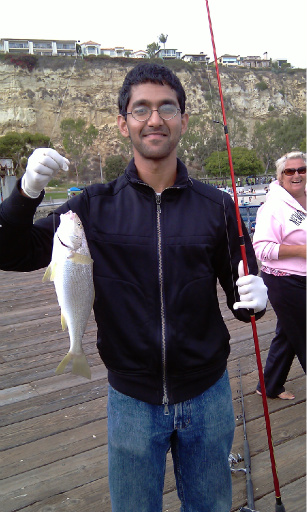 Yellowfin croaker, Dana Harbor Pier
California Halibut — One of California’s favorite fish
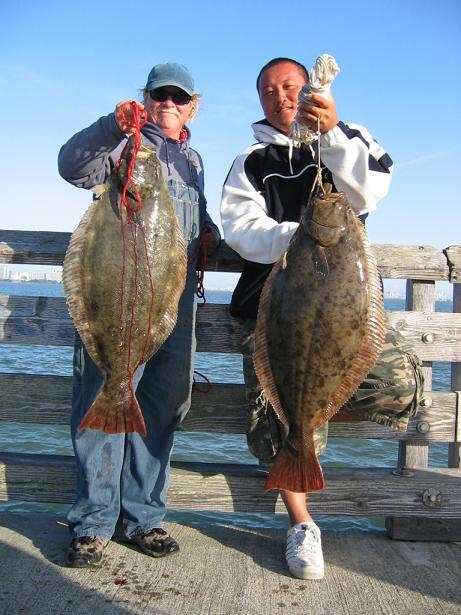 Berkeley Pier halibut
Species: Paralichthys californicus (Ayres, 1859); from the Greek word paralichthys (parallel fish) and californicus (Californian)—a California fish that lies parallel to the bottom.
Alternate Names: Halibut, flounder, hali, flattie (or flatty), chicken halibut, alabato, southern halibut, Monterey halibut, bastard halibut; fly swatter or postage stamp (small halibut); door mats (large halibut); extra large halibut, rarely seen on piers, are called barn doors. Called lenguado de California in Mexico.
 Balboa Pier halibut
Identification: California halibut are in the left-eye flounder family, although nearly half of these fish are right-eyed. Halibut are noted for their sharp teeth, a large squarish shaped mouth, and a high arch in the lateral line above the pectoral fin. Their coloring is normally white or yellowish on the blind side and a muddy brown on the colored side. Often there is splotching or even white spots on the colored side, especially in smaller fish.
Size: To 60 inches and 72 pounds; most caught off piers are under 20 inches. The California record fish weighed 58 lb 9 oz and was caught at Santa Rosa Island in 1999.
 Avila Pier halibut
Range: Cabo Falsa, southern Baja California and Gulf of California to Quillayute River, northern Washington.
Habitat: Shallow-water, sandy-shore areas, oceanfront, and in bays.
 Ventura Pier halibut
Piers: Most common at oceanfront piers. Best bets: Crystal Pier, Oceanside Pier, Balboa Pier, Redondo Beach Pier, Hermosa Beach Pier, Goleta Pier and Cayucos Pier. A few are caught each year at Monterey Bay piers such as Capitola and Seacliff. An increasing number have been caught at Pacifica and at San Francisco Bay piers such as Pier 7 and the Berkeley Pier since the 90s. The Berkeley Pier probably ranks #1 among piers north of Point Conception and perhaps sees more large halibut than any other pier in the state.
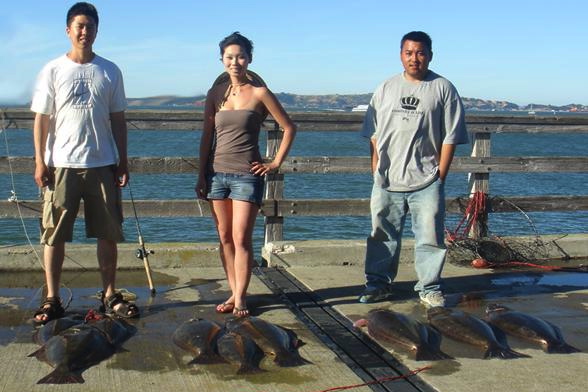 Berkeley Pier halibut
Shoreline: An esteemed shore species from San Diego to San Francisco.
Boats: One of the favorite species for California boat anglers.
Bait and Tackle: Halibut are predatory hunters that will grab almost anything that moves. Still, they prefer other fish—anchovies, sardines, grunion, smelt, small brownbait (queenfish and white croaker), small perch (shinerperch and walleyes), Spanish and Pacific mackerel, Pacific butterfish (pompano), lizardfish and squid. If the fish will fit in their mouth they’ll go after it. Thus, by far, the best bait for California halibut is live bait, one of those fish mentioned previously. Whichever bait is used, the key is to keep it lively and keep it near the bottom. A sliding live bait leader works fine, especially with a small slip-on sinker added to get the bait near the bottom. Another approach is to tie a snap-swivel to the end of the line with a hollow-center egg sinker directly above the swivel. Then attach a three to four foot leader with size 2 to 4 hooks to the snap. High/low leaders can also be used but are far less effective unless the angler keeps his line in motion. Some regulars “drag” or “troll” for halibut; they put a long-shanked hook into a headless anchovy and then walk slowly along the edge of the pier pulling the line behind them. If the pier is crowded, they will cast out and retrieve slowly. In either case, be alert for the soft mouthing of the halibut. Halibut will hit cut bait, including anchovies, mackerel, sardine and even squid; just be sure to keep the bait in motion. Halibut can also be caught on artificials. Lures like Scroungers and Big Hammers should be cast out, allowed to settle to the bottom, and then given a slow to moderate retrieve. Halibut will often follow the lure almost to the surface before striking, so be prepared.
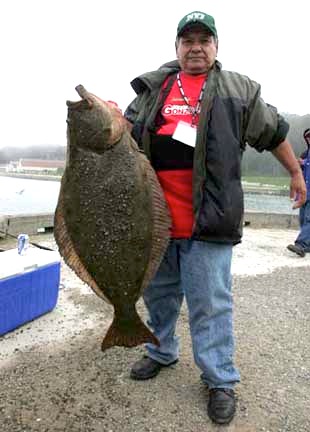 Fort Point Pier halibut
Food Value: Excellent! One of the best tasting fish in our waters. White, lean meat with a very low fat content. One of the best frying fish although considered good using almost any method of cooking.
 Newport Pier halibut
Comments: Probably the most sought after fish for anglers on southern California piers. Unfortunately, most of the fish caught are illegal size and far too many people do not know, or do not care, how to handle them properly. The best way is to quickly reel in or handline in the fish without a net (if possible) and then practice C&R (catch-and-release) or CPR (catch-photograph-release) with as little handling of the fish as necessary. If you’re going to net the fish try to find a net with fine mesh. If you use the typical wide-mesh net the net will often tear up the tail of the halibut leading to infection (tail rot) and eventual death. If you have a fine-mesh net, then the best way to handle the halibut is to net it, bring it up, unhook it, place it back in the net, and lower it back down. It sounds like a lot of work but it’s worth it to preserve these fish and they can live to an age of at least 30 years.
 Berkeley Pier halibut
Do be careful of the sharp teeth of these fish! One guidebook jokingly tells the way to differentiate between small halibut and sole or sanddab: “stick your finger in its mouth. If your finger starts bleeding in a relatively short period of time (don’t keep it there for hours), you probably have a halibut.” DON’T DO THIS!
 Hermosa Pier halibut
 Paradise Park Pier halibut
 Point Pinole Pier halibut

 Oyster Point Pier halibut
 Cayucos Pier halibut
 Avila Pier halibut (may be a Pacific halibut)
Woman falls off pier — texting
I’ve heard of people falling off of piers but most times it was due to careless behavior (often in pursuit of a fish) and/or in conjunction with drinking. I had never heard of anyone falling off a pier due to texting. But, it happened so, as they say, be careful out there.
Texting while walking claims another victim, woman falls off pier
http://news.yahoo.com/texting-while-walking-claims-another-victim-woman-falls-041406079.html
By Mike Flacy | Digital Trends
As reported by an ABC news affiliate in South Bend, Indiana, a woman named Bonnie Miller fell into a river connected to Lake Michigan while she was attempting to walk along a pier and send a text message at the same time. Miller was strolling along the pier with her family and realized that she had to correct an appointment time via a text message. As she was writing the text message, Miller didn’t pay attention to how close she was to the edge of the pier and ending up tripping into approximately six feet of cold water.
Miller’s husband and a 19-year old bystander jumped into the water to help her reach a ladder that led back to the top of the pier. A police officer also used a flotation device attached to a rope to help guide the group to the ladder.
While Miller was definitely embarrassed by the incident, she wants people to understand how texting while walking can be a problem. In an interview with the news affiliate, Miller stated “I couldn’t let pride stand in my way of warning other people to not drive and text or walk and text. It can be dangerous.”
Earlier this year, a research team at Stony Brook University conducted a study around texting while walking and found that participants consistently veered away from walking a straight path by a 60 percent deviation. Wandering to the left or right could easily explain how Bonnie Miller found herself falling off the edge of the pier. The amount of distance traveled by people within the study increased by 13 percent and participants took approximately 33 percent longer to reach a destination when texting while walking. The research team also found that walking while talking on a cell phone increased travel time by about 16 percent.
The number of falling incidents when texting while talking that have been captured on video and published on the Internet has increased over the last few years. During February 2012, a live CBC broadcast caught a woman’s fall down a section of steps while she was texting while walking and the video is nearing four million views on YouTube. During January 2011, a woman named Cathy Cruz Marrero caught national attention after a security guard at a shopping mall released footage of Marrero tripping and falling into the mall’s fountain after texting while walking. Marrero hired an attorney shortly after the incident specifically to go after the mall’s management for allowing the footage to be leaked onto the Internet.
Another study published in the University of Alabama at Birmingham Pediatrics journal during 2009 found that children that text or talk on a cell phone while walking near or on a street are 40 percent more likely to get hit by an automobile. During April 2011, lawmakers in Rexburg, Idaho rolled out a new law that fines pedestrians $50 for texting while walking in order to dissuade people from the practice. Documentary maker Casey Neistat also recently created a somewhat comedic public service announcement for people that text while walking. Within the video, Neistat equates the practice to walking the streets with a blindfold on and recommends that people stop walking to stand against a building while texting.
This article was originally posted on Digital Trends
The Ocean Park Pier & Fishing — “The Way It Used To Be”
 Ocean Park Pier — 1911
Reading the old reports of the fish caught from California’s piers can be both amazing and disheartening. Amazing because of the numbers of fish once encountered on a fairly regular basis. Disheartening because so few of those results are duplicated today. The reasons are multiple but the main reason is simply the number of people in California and the affects that the population has had on the marine environment over the past century. The number of many, if not most, species have decreased and basically we have no one to blame but ourselves.
Still it interesting to read these old reports, to see the way that “it used to be.” In this case the reports are from the Ocean Park Pier, the famous pier located just north of Abbot Kinney’s equally famous Venice Pier.
Pier Fishing at Beach Improves
Southern California’s latest sport, night fishing from the Ocean Park pier, is proving rapidly popular, states Prank Wilson, manager of a pier bait and tackle stand. Wilson reports that a. catch of 23 sea trout by Pat Nolan, sportsman, headed the week’s catches
—Van Nuys News, July 6, 1931
Anglers Aid Bass Reproduction Here
Reproduction of striped bass, the fighting game fish found in San Francisco waters, is being aided greatly by the state fish and game commission, claims Al Camp, Ocean Park fishing authority, who reported that four of the specimens were hooked off the Ocean Park pier yesterday. Camp claims that the four small bass caught yesterday are from the fry planted by the state commission at Newport and in years to come Southland anglers can look for large quantities of this type of fish locally. The bass were immediately thrown back in the water by the sportsmen securing the catch as the reproduction of these fish is greatly desired by Southern California anglers.
—Van Nuys News, November 16, 1931
Pier fishing at the end of the Ocean Park Pier is reported to be at its best with increasing catches of halibut being brought in by local anglers. Bonito, perch, and small jewfish are also numerous with plenty of action being assured the angler.
—Van Nuys News, August 7, 1933
 Fish for Trout Under Spotlight
Can fish see at night is definitely answered by anglers frequenting the pier at Ocean Park Pier each night to fish for sea trout under the bright spotlights. Ed Marshall, in charge of the tackle store and end of the pier fishing, reports increasing numbers of sportsmen taking up this fascinating method of deep sea fishing. Good catches of sea trout are reported, which should reach maximum in a week or so, reports Marshall.
—Van Nuys News, May 3, 1934
Biggest Run of Sea Trout, Bass at Piers in Years
One hundred fifty white sea bass in a single evening’s fishing from the Ocean Park Pier during the past week is positive proof of the biggest run of sea trout in years, reports Commodore Bob Oefmger… A few examples of individual catches are given here: Ten sea trout by Geo. Carlson, Pasadena, end of Ocean Park Pier. Fifteen halibut by L. Weiner, Los Angeles, end of Ocean Park Pier. Thirty sea trout by Bob McKay, Venice, end of Ocean Park Pier.
—Van Nuys News, June 14, 1934
BIG BASS CATCH OCEAN PARK, July 17. (A. P.)—
A one night’s catch of 600 white sea bass, known as the trout of the sea, was reported from the Ocean Park pier here today. It was the biggest run of the season for those who do their angling under the powerful spotlights.
—Bakersfield Californian, July 17, 1934
Charles Ely of Ocean Park is in the limelight with his 300th halibut successfully landed while fishing on Ocean Beach Pier. It is said that the white sea bass run is still on with good catches being made at night.
—Van Nuys News, August 30, 1934
 Fishing out at Ocean Park pier continues good with at least a dozen varieties of deep sea game fish being taken on the pier, on the barge Billings and on the live bait boat Ramona on its run up to Point Dume kelp beds, reports Commodore Bob Oefinger. White sea bass are running now with good catches being made daily both on the Ramona and on the pier.
—Van Nuys News, September 27, 1934
Rod and Reel
Catches on both sardine and big cornfed mackerel are being made from the Ocean Park Pier in large numbers now. Big perch are also being taken in fair to good numbers.
—Jack Adams, Van Nuys News, October 14, 1954
Rod and Reel
Results on the pier showed a strong run of horse sardines and perch.
—Jack Adams, Van Nuys News, March 29, 1955
 Rod and Reel
The hefty run of mackerel on the Ocean Park Pier showed no sign of slackening as huge number were taken.
—Jack Adams, Van Nuys News, October 20, 1955
Rod and Reel
Southern California’s multi–million dollar deep sea sportfishing fleet came to an almost complete halt Thursday as the headman of the sport passed the word to all hands to enjoy the Thanksgiving holiday season around the family table for a change. Fishing was on tap at the Ocean Park Pier as Versal Schuler took over the helm personally and handled the job on his own—while the rest of the organization relaxed with their families. A strong run of perch put in an appearance the past several days at Ocean Park Pier to bolster the record show of mackerel they have enjoyed for the past several months and Schuler had numerous requests to allow anglers to use the closed portion of the pier yesterday. This called for him to hold “open house” which he did until time for the “chow-down” signal to be sounded.
—Jack Adams, Van Nuys News, November 27, 1955
Rod and Reel
Ocean Park Pier drew a by on the deep water stuff — but pier fisherman hit a lick with piling perch up to three pounds landed in nice numbers.
—Jack Adams, Van Nuys News, January 12, 1956
Rod and Reel
Topping this was the run of mackerel at the Ocean Park Pier as anglers enjoyed a quickie run of these popular fish. A good catch was listed on the greenbacks.
—Jack Adams, Van Nuys News, November 20, 1956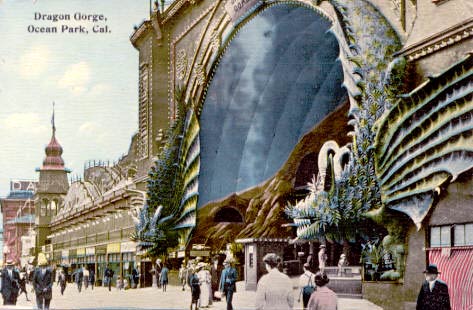
Blog Archives
- September 2025 (1)
- August 2024 (1)
- September 2023 (1)
- September 2022 (1)
- April 2022 (5)
- September 2021 (1)
- February 2021 (1)
- January 2020 (1)
- August 2019 (1)
- January 2019 (1)
- October 2018 (1)
- September 2018 (2)
- August 2018 (1)
- June 2018 (3)
- April 2018 (10)
- March 2018 (22)
- February 2018 (3)
- January 2018 (4)
- December 2017 (2)
- November 2017 (2)
- September 2017 (3)
- August 2017 (2)
- July 2017 (5)
- June 2017 (3)
- May 2017 (5)
- April 2017 (1)
- March 2017 (4)
- February 2017 (1)
- January 2017 (2)
- December 2016 (5)
- November 2016 (10)
- October 2016 (33)
- September 2016 (13)
- August 2016 (1)
- February 2016 (1)
- January 2016 (1)
- November 2015 (1)
- October 2015 (3)
- September 2015 (4)
- August 2015 (27)
- July 2015 (1)
- May 2015 (7)
- April 2015 (13)
- February 2015 (1)
- January 2015 (1)
- December 2014 (2)
- November 2014 (16)
- October 2014 (4)
- September 2014 (8)
- July 2014 (1)
- June 2014 (1)
- May 2014 (2)
- April 2014 (1)
- February 2014 (3)
- December 2013 (3)
- October 2013 (1)
- September 2013 (1)
- August 2013 (1)
- July 2013 (1)
- June 2013 (1)
- April 2013 (1)
- March 2013 (21)
- February 2013 (2)
- May 2012 (1)
- March 2012 (7)
- February 2012 (5)
- January 2012 (8)
- December 2011 (4)
- October 2011 (4)
- September 2011 (1)
- August 2011 (3)
- July 2011 (5)
- June 2011 (1)
- April 2011 (1)
- March 2011 (5)
- February 2011 (2)
- January 2011 (2)
Support Ken Jones
If you appreciate Ken's writings on fishing, please consider making a donation for this unique content. Your support will help Ken to continue publishing knowledgeable and entertaining articles.
Pier Fishing in California, 2nd Ed.

The ultimate pier fishing resource for Pacific Coast pier anglers with Over 350 new photos and illustrations added to this edition, including detailed, species-specific illustrations of fish-cleaning, rigging illustrations, and maps. The history and culture of each pier is thoroughly covered.
Buy the book from pierfishing.com or Amazon!
Recent Photos