Great White Sharks at Huntington Beach

What looks to be a great white shark taken at the Huntington Beach Pier  (Photo from Daily Pilot-Los Angeles Times)

Roughly a decade ago, during the time of the MLPA meetings, I wrote a letter to the editor of Western Outdoor News. The gist of my letter was that anglers were sometimes their our own worst enemies. At a time when public support of fishing was needed, too many anglers broke the rules. Too many kept fish that were too small, too many kept over the limit numbers of fish, and too many broke the seasonal regulations, i.e., for lobster. And unfortunately, too much of this was taking place on the piers where casual passersby could note the actions. It might happen as often on boats or kayaks but they were generally out of view of the public.

Not much seems to have changed in the intervening years. In fact, a recent incident at the Huntington Beach Pier once again brought down the wrath of the public on anglers—and especially pier anglers.

In late February a shark, probably a great white shark, was hooked from the pier, gaffed using a treble-hook pier gaff, and brought up to the pier to cheers from a crowd of interested onlookers. Pictures were taken and then, apparently, the fish was thrown back into the ocean where it probably died.

The entire episode was filmed by a visitor to the pier who then posted it to YouTube. Soon after someone showed the film to local lifeguards who then contacted the California Fish and Wildlife Department. By then the film had gone viral.

The headlines and reporting summed up the situation—and the feelings. “Possible catch of great white shark at Huntington Beach Pier brings state investigation.” “Video, selfies with baby shark caught off Huntington Beach pier leads to calls for penalties.” “Brutal Treatment of Great White Shark at Huntington Beach Under Investigation”—[the footage is disturbing—a rabid crowd jeers as the shark gets pulled up and placed on the pier.]

The comments that followed were predictable and give evidence of the problem—”Great White Life’s matter. These sportsmen’ need to be investigated, savages…” “This is not sport fishing but the gratuitous torture of an animal.” “Bunch of barbarians.” “The shark died… irregardless if released. If hoisting the shark onto the pier like that didn’t suffocate it, gaffing it in the gills killed it. Those idiots should’ve known better considering the heavy set ups they had.”

“The LA TIMES shows ‘anglers pulling a shark onto the pier as a crowd of people with cameras gathers to watch.’ I love the representation that these guys are anglers. Like they’re in any semblance of the definition a sports fisher. They are two thugs in California with nothing better do to with their time then hang out at a pier versus a bar and kill against the law a protected species that has way more class than these two excuses for humanity will ever have!”

“Protected species– not protected from morons.” “These idiots give all fisherman a bad name. That isn’t something to brag about it’s a protected species.”  “What is wrong with people, this is not the first time this has happened so don’t allow fishing off piers if government cannot control the situation.”

Understandably the Fish and Wildlife Department is investigating with a certain amount of caution. Was it a great white shark whose capture is prohibited? Was it a mako shark, which is legal to catch? Bottom line—does the department feel it can successfully prosecute the anglers for breaking the law? A lot of time and expense can be invested, and lost, if the department can’t prove it was a great white.

A quote in the Orange County Register from the Department of Fish and Wildlife gives evidence of the problem. Spokesman Andrew Hughan, indicated the caution. “It hasn’t yet been determined to be a great white. There are many sharks that look similar,” he said. “I would ask the public to be patient. We are working diligently, investigations take time. Just because everybody says it’s a white shark, doesn’t mean it’s a white shark. We are very well trained and experienced and we’re wildlife experts, but this isn’t ‘CSI,’ we can’t determine things overnight.” In time we will know their conclusion and what legal steps will be taken.

Judgement from local pier anglers was much quicker to reach a conclusion—one of guilt. Many were incensed and convinced that the anglers were seeking out the great whites. One of the regulars I talked to asked the question: “What does it say when an angler is using 12/0 to 16/0 hooks and a 200-pound wire leader? What else could they be fishing for? Given that new, more critical attention is now focused on local pier fishermen, especially those who target large thresher sharks and bat rays, there was little sympathy shown to the anglers under investigation.

The odds do seem to favor the notion that it was a great white. The catch of the (assumed) great white from the pier followed an unprecedented increase of great whites seen in the area during the past few years.

In 2015 scientists working with Chris Lowe of Long Beach State University, the local expert on sharks, spotted 21 great whites off of Huntington Beach and tagged 16 of the fish.     .

On Memorial Day 2016, an unidentified shark bit a woman swimming in the surf at nearby Newport Beach. She lived but evidence from the size of her wounds suggested it was a great white over ten feet in length.

2017, a new year and more sharks. On February 14 a (supposed) juvenile great white, just 6-7-feet-long, was hooked and lost from the Huntington Beach Pier.

On February 20 or 21 an 8-foot-long great white shark was reeled in by anglers targeting thresher sharks while fishing from the surf in Sunset Beach (near Huntington Harbor). The shark was released.

Just a few hours later on the same day the great white that has caused the current controversy was hooked from the Huntington Beach Pier. Its capture was documented on a YouTube video by Mike Hefner, a visitor who just happened to be on the pier that day. The YouTube video has now been seen by more than 100,000 viewers.

https://www.youtube.com/watch?v=Yp1xo0245KY

As mentioned, viewers brought the YouTube video to the attention of local lifeguards who then brought it to the attention of the California Department of Fish and Wildlife.

The drama wasn’t over. On February 23, a helicopter crew spotted an 11-to-14-foot-long shark swimming 100 feet off of Bolsa Chica State Beach. A few hours later a 6-7-foot-long great white was spotted in the same area. In response, swimmers were banned from using a two-mile stretch of waters along the Huntington Beach shoreline.

None of this surprised regulars on the pier who have reported seeing great whites many times. Their conclusion was that the great whites were feeding on the sting rays in the surf area — and they may be right.

In regard to the capture of the shark at the pier, the questions are fairly simple. Was the angler targeting great white sharks? Of course not according to the angler. Did they know it was a great white when they saw the fish at the top of the water? Of course not according to the angler. Why did they gaff it with a pier gaff and bring it up to the surface of the pier?  They said it was too big for a net so they used the gaff but that doesn’t answer the question about bringing it up to the pier in the first place. Some witnesses said they tossed the fish back into the water after celebratory pictures although no one seems to know if the shark was still alive. Why did they release it if they didn’t think it was a great white? No answers that I’ve seen.

What should have been done? A quote reported by CBS Los Angeles gives the best response. “As soon as they have a visual of the fish on the surface and they determine that it’s not legal to fish for, they need to cut the line right way,” said Lt. Claude Panis, a safety officer with the Huntington Beach Marine Patrol.

What is not in question is the fact that great white sharks have been a protected species since 1994 and that their catch can result in a fine up to $10,000.  It’s also known that while most “shark” anglers on piers are seeking out thresher sharks, leopard sharks, or big bat rays there are some anglers who hope to catch a great white and purposely target them (and it can be hard to tell the difference simply based on gear).

The incident brought back memories of the controversy that took place at the Manhattan Beach Pier in May of 2015 when a great white shark was hooked by an angler on the pier. A swimmer than ventured out by the hooked shark and was, in turn, bitten by the agitated fish. No one blamed the swimmer or the fish; all blamed the angler who had hooked the fish (while fishing for bat rays).

The city exploded! The pier was illegally closed, hearings were held, and the city council issued several new city ordinances that were, in themselves, illegal. These included banning all fishing for sharks, prohibiting wire leaders, and prohibiting certain types of fishing line. The California Coastal Commission and the Department of Fish and Wildlife said they couldn’t do what they did but as of 2017 those rules are still in effect.

The situation at Manhattan Beach as well as an earlier incident was reviewed in articles I wrote for my kenjonesfishing.com blog.

Great Whites at the Manhattan Beach Pier?

http://kenjonesfishing.com/2013/12/great-whites-at-the-manhattan-beach-pier/

 Manhattan Beach, Sharks, Swimmers — Redux

 http://kenjonesfishing.com/2015/05/manhattan-beach-sharks-swimmers-—-redux/

Long term the situation made the city, anglers, and the state departments look bad. And, the situation has still not been resolved. More meetings are scheduled but progress has been nil to date.

As to the sharks, white shark versus mako, it turns out I had written an article on the differences in 2011.

 Great Whites & Makos

http://kenjonesfishing.com/2011/10/great-whites-makos-—/

Both incidents, the one at the Huntington Beach Pier and the one at Manhattan Beach have, unfortunately, made anglers look bad to a certain segment of society at a time when anglers need all the support they can get.  Some day we’ll learn.

The issues involved in these two stories do bring up the corollary question of what to do when you hook an illegal fish.It’s not that uncommon to hook illegal fish, i.e., garibaldi or silver salmon, but you need to know your fish and know what to do if you hook an illegal fish.

Sometimes you want to remove the hook or tackle from the mouth of a fish and for small fish like a garibaldi you might be able to net the fish and carefully remove the hook before putting it back down into the water with a net. For big fish like a giant (black) sea bass, a sturgeon, or a large shark simply cutting the line is probably the best answer.

As said though you need to know your fish species. I have my own species name for ignorant anglers—Knuckleheadus californicus: California anglers who through ignorance, or purposeful negligence, fail to follow California’s fishery laws. Especially egregious are those who purposely target and catch “illegal” species and whose actions lead to the death of those fish (even if attempting to return them back to the water).

Anglers today must know the species and must follow not only the rules but also best practices as far as catch and release and the proper handling of fish. Failure to do so not only can mean the loss of the fish but also the loss of support of the public who far too often sees anglers as harming the environment instead of people who usually are trying to preserve it.

Most anglers I know are ethical and support conservationist efforts but there are also those that don’t. It’s our job to reach out and teach those who are still acting like knuckleheads and harming the reputation of reputable anglers.

By the way, here’s one more article on great whites, a story I wrote after a lady was killed at Avila when she decided to swim by the sea lions at the pier. It wasn’t a wise choice since great whites like nothing better than seals and sea lions and a swimmer in a wet suit can look a lot like a seal.

Great Whites, Avila and San Luis Obispo Bay

http://kenjonesfishing.com/2011/07/great-whites-avila-and-san-luis-obispo-bay/


Posted in Daily musings... · Tagged , , , , , , , , , , · Leave a comment

Bat Rays & a Brouhaha in Lodi

Bat Ray logo developed by esteemed “Pier Rat” Lucy Phillips in 2004.

I’ve been a fan of bat rays for many years and for over a decade Pier Fishing In California (PFIC) and the United Pier and Shore Anglers of California (UPSAC) held an annual “Mud Marlin Derby” at the Berkeley Pier.

Given my affection for the big old beasts, it stood to reason that I was offended by the following story in my hometown (at the time) newspaper, the Lodi News-Sentinel. I felt the story was so filled with errors that I had to respond.

Bat ray taken from the Morro Bay North T-Pier in 2006.

LODI’S ‘STINGRAY HUNTER’ — Local says his passion is capturing ‘ghetto fish’, By Scott Kaul, Lodi News-Sentinel Staff Writer

At the age of 13, Lodi resident Kevin Burns made his way from his father’s house to the nearby San Francisco Bay and set up for what he thought would be a normal day of fishing for striped bass. After resting his fishing rod against a trash can, he sat back and enjoyed the cool Bay air. Minutes later, the rod leapt off the can and down the shore with Burns darting after it.

After about half an hour of wrestling with the mystery fish in the water, Burns reeled in his strangest catch ever. It was a stingray. “And boy was it ugly,” he said. But that ugly fish set him on his lifelong passion.

Now 43 and residing in Lodi, Burns is a self-described “stingray hunter.” He makes his living marketing timeshares, but he said catching stingrays is his life’s work.

Burns said he was shocked to hear the news that Steve Irwin, the famed “crocodile hunter” was recently killed by a stingray. Though he said the creatures are generally not hostile and will only attack when bothered, they are relatively easy to control when they do attack. “It must have just been a freak accident,” he said.

Using his own combination of squid and anchovies as bait, Burns said he regularly makes the trek back to the Bay to hunt what he and his friends call the “ghetto fish.”

The name comes from the fact that most fishermen avoid hooking the rays, which they see as troublesome and mostly useless — stingrays are practically inedible and rather poisonous. Burns and his buddies, however, actively seek them out, if mostly just for the thrill of the catch.

“Stingrays are probably the hardest-fighting fish out there,” he said. “Reeling one in is like a full workout at the gym.” After he’s caught the stingray and taken a picture with it, he usually throws it back, he said.

Neither Burns nor any of his friends have ever been seriously injured by a stingray, but he says they have been stung several times. He keeps pictures of the wounds and paper towels spotted with blood as mementos from the one time a stingray’s barbed tail caught him across his right knee. Burns regularly fishes at his secret spot on the bay to catch the poisonous rays. “I was lucky, though,” he said, rubbing the scar the attack left behind. “The barb didn’t stick in, so it only bled.”

Since the incident, Burns said he has learned to properly handle his prey without getting stung. The trick, he said, is to hold the ray by small “port holes” located on either side of its head near the eyes. “That way, they can’t get to you,” he said.

The stingrays Burns and his hunting pals usually snare at his “secret fishing spot” in the Bay range from tiny to enormous, with the largest he’s ever caught weighing close to 240 pounds. Though generally, he said, they are closer to 100 pounds.

Burns said hunting stingrays requires no special equipment. “Just a pole and 30-pound test line,” he said. “And about 45 minutes to reel it in.”

Aside from the stingrays, Burns also seeks out sand sharks and leopard sharks, which he said are “good eatin’.” His largest catch, he said, was a 6-foot leopard shark, which he nicknamed Jaws after the film, which had been released around the time he caught it. “I got it just barely in the water, and I had nothing to keep pulling it out of the water with,” he said. “So I just grabbed its gills and pulled it, saying ‘you are not going to be a fish-that-got-away story!’”

Hunting stingrays and sharks is his life, but Burns said his ultimate dream is to go after big game fish in Cabo San Lucas, Mexico, or compete in ESPN’s “Monster Shark Tournament” where contestants pull in sharks weighing up to 1,200 pounds. “I want to get out there and have proof, instead of just talking about it.” He said. “I refuse to tell fish stories.”

A bat ray at the Elephant Rock Pier in Tiburon

Stingrays at a glance: Stingrays generally do not attack, but if they do they use their poisonous barbed tails to sting predators.

• A sting will usually cause intense pain and swelling to the victim, but in very rare cases it may kill. Only two other reported instances of a sting directly to the heart, as occurred in the death of Crocodile Hunter Steve Irwin, have been reported.

• Only 17 deaths related to stingray stings total have been reported.

• Rays can grow up to 6 feet in diameter. Their diet consists mostly of squid, small fish, and crabs. Their natural predator is the shark.

• Most of the stingray is considered inedible or flavorless, but some people do eat it the wing-like fins and the meaty area around the eyes called the cheek.

Source: http://www.discovery.com.

Lodi News-Sentinel, September 6, 2006

The newspaper article almost demanded a response.

To The Editor, Regarding Lodi’s ‘Stingray Hunter’

As a Lodi resident, and a subscriber to the Lodi News-Sentinel, I was flabbergasted and rather disgusted this morning when I opened the paper to see your story on Lodi’s ‘Stingray Hunter.’ The story is filled with inaccuracies and unfortunately does harm and disservice to a species that is not a ‘ghetto fish’ as you suggest but instead is a quite charming species. In fact, if you have ever taken your children to the Monterey Aquarium (or several other coastal aquariums) a highlight was probably the “petting pool” where “sting rays”—generally bat rays, allow the children to pet them and actually will come up to the children in a non-fish-like manner.

About now you may be questioning my credentials to criticize your story. I am the author of Pier Fishing In California, 1st and 2nd Editions. I am president of United Pier and Shore Anglers of California, the largest organization dedicated solely to pier and shore anglers. I am vice president of the Outdoor Writers Association of California (OWAC). I am also an angler who has several thousand fishing trips under my belt (yep, I’m old) and one who has caught several hundred bat rays—your so-called ‘ghetto fish.’

A bat ray caught at the Fortman Marina Pier in 2012

I also own and run a website—Pier Fishing In California, pierfishing.com—that was started nine years ago to educate fellow pier anglers and to serve as a home base for those same anglers.

One of our main goals has been education regarding the marine environment and the development of ethical and conservationist attitudes toward fishing. Early on there developed a special focus on bat rays because (1) they are a common catch from piers and shoreline areas, (2) they were abused more than almost any other fish, and (3) they’re neat little (and big) creatures.

Many, many posts and threads on the website have focused on bat rays and I believe I can say that today they are a respected species. In fact, we have had a “Mud Marlin” Derby at Berkeley Pier for the past five years with upwards of one hundred people in attendance at most of the events. At the derby, any bat rays that are caught (called mud marlins for their hard fighting character) are netted, measured, and then returned via net back to the water.

What are the factual errors that need correction? In chronological order —

1. “Though he said the creatures are generally not hostile and will only attack when bothered, they are relatively easy to control when they do attack.” I have NEVER seen a bat ray attack a person nor does my extensive library of books on fish document actual “attacks” on people. If stepped upon, sting rays (and bat rays) will, in reflex, swing up their tail that contains the barb and people can be hurt. And, careless anglers are sometimes stuck with the barb when inappropriately handling the rays. But I do not think I would call these attacks.  In addition, I would suggest that bat rays are not only not hostile, but indeed fairly gentle in manner most of the time.

2. “Burns said he regularly makes the trek back to the Bay to hunt what he and his friends call the ‘ghetto fish.’ The name comes from the fact that most fishermen avoid hooking the rays, which they see as troublesome and mostly useless — stingrays are practically inedible and rather poisonous. Actually there are a vast number of anglers (i.e., Burns) who fish specifically for sharks and rays mainly because of their fighting ability. In fact, the term mud marlin has become a favorite name for these hard fighting fish.

Inedible and rather poisonous? No, no, no. Many people find bat ray meat delicious and in days gone by you may have found yourself eating their meat disguised under another name. Indeed, in Pier Fishing In California, 2nd Ed., I show how to clean bat rays and give recipes on how to eat them.

3. “Since the incident, Burns said he has learned to properly handle his prey without getting stung. The trick, he said, is to hold the ray by small ‘port holes’ located on either side of its head near the eyes.” Although not technically a factual error, most experienced bat ray fisherman, those who are conservationists, do not hold the rays in such a manner. Instead they actually hold up the rays by their mouth (and we can show you how to do it).

 The correct way to hold a bat rat. A bat ray taken at the “Mud Marlin Derby” at the Berkeley Pier in 2015.

4. “The stingrays Burns and his hunting pals usually snare at his “secret fishing spot” in the Bay range from tiny to enormous, with the largest he’s ever caught weighing close to 240 pounds. Though generally, he said, they are closer to 100 pounds.” The official California record fish weighed 181 lb 0 oz and was taken at Huntington Beach in 1978. Bat rays to 240 pounds have been reported while most that are caught from piers and shoreline areas are under 50 pounds in weight.

From Pier Fishing In California, 2nd Ed. —

Bat Ray

Species: Myliobatis californica; from the Greek words myl (a tooth or molar), io (an arrow or poison), batis (a skate or ray) and the Latin word Californica  (referring to location).

Alternate Names: Stingray, stingaree, sea ray, eagle ray, batfish, big black, sea bird, flapper, rat tailed sting ray, mud marlin (my favorite), and monkey face ray.

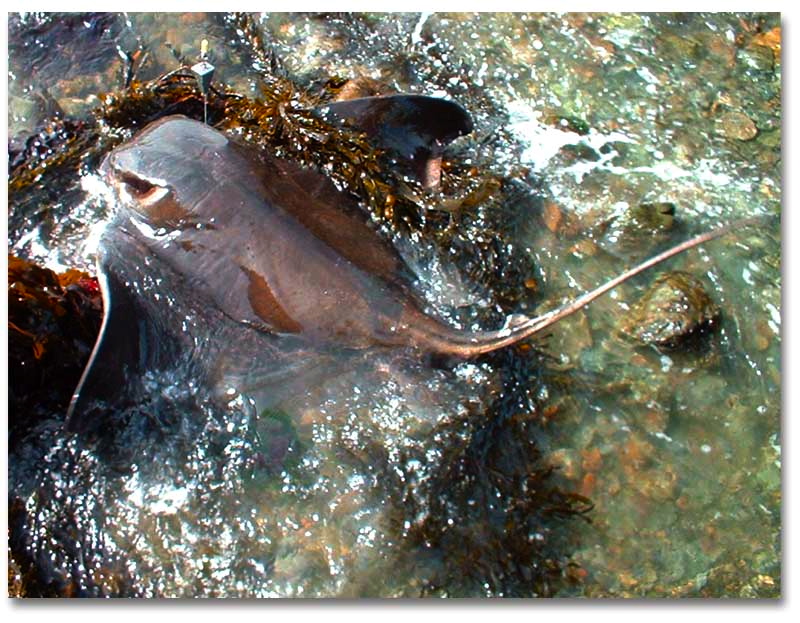
Identification:  Bat rays have a very heavy raised head and a dorsal fin at the base of a long whip-like tail with a stinger just behind it. Their coloring is blackish or blackish brown above and white below. Beware of the stinger.

A bat ray stinger

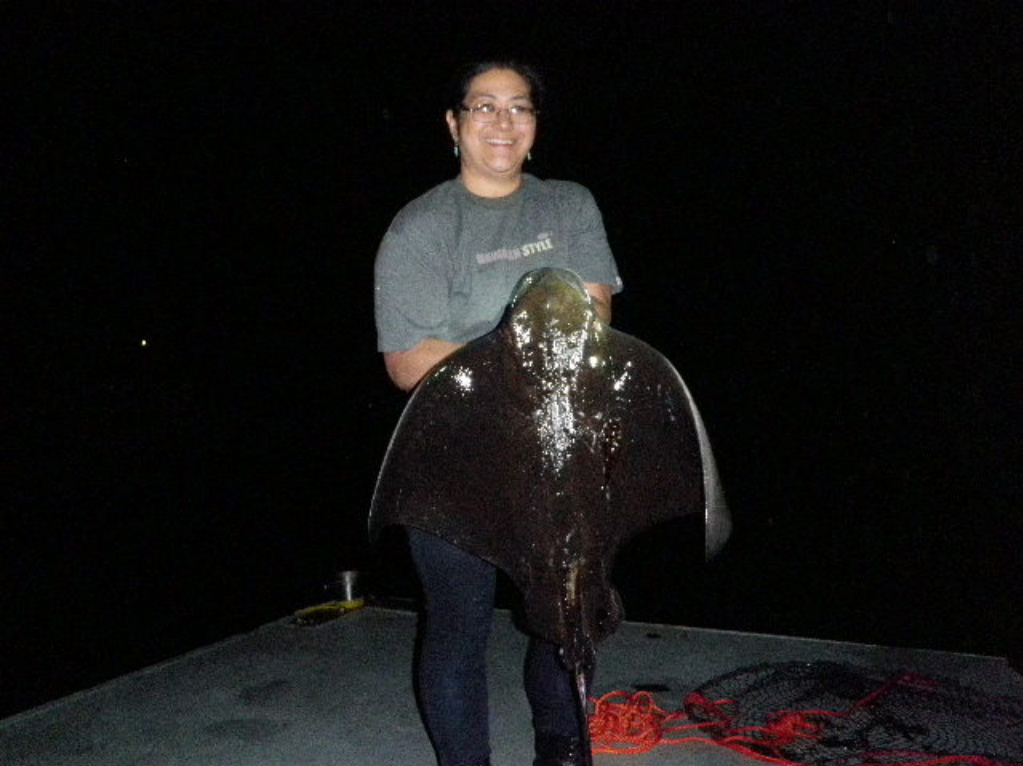
Size: To six feet across and over 200 pounds; a 240-pound bat ray was reported from Newport Bay in 1957. Most bat rays caught off piers are under 50 pounds, but many in excess of a hundred pounds are caught every year. I’ve seen pictures of a 176-pound bat ray from the Newport Pier and a 175-pound bat ray from the Aliso Beach Pier. (I also received a report on the Pier Fishing in California Message Board of a 246-pound fish with an 8.5-foot wingspan that was reputedly taken from the Newport Pier in the ’80s). The official California record fish weighed 181 lb 0 oz and was taken at Huntington Beach in 1978.

Range:  From the Gulf of California to Oregon.

Habitat: Prefers a flat, rocky bottom or sand among rocks. Most commonly caught in bays and the deeper water areas around piers.

Piers:  Bat rays are caught at almost all piers in California, both oceanfront and those in bays. Best bets: Shelter Island Pier, San Clemente Pier, Balboa Pier, Newport Pier, Huntington Beach Pier, Redondo Beach Pier, Hermosa Beach Pier, Stearns Wharf (Santa Barbara), Gaviota Pier, Cayucos Pier, Berkeley Pier, Elephant Rock Pier (Tiburon), Angel Island Pier, and Del Norte Street Pier (Eureka).

Bait and Tackle: Oysters, clams, crabs, shrimp, abalone, snails and worms are their main food, but bat rays will take almost any bait. However, live bait such as anchovies, ghost shrimp, mud shrimp and grass shrimp work best. Frozen squid also works well and is probably the least expensive and easiest bait to use. Central California anglers like to fish at night with a whole cut fish (small croaker or mackerel). It’s reported by the way that these strong rays use their pectoral fins to lift their body rapidly up and down to create a suction that sweeps away the sand and gives easy access to their food on the bottom. Because of the potential large size, anglers wishing to fish specifically for bat rays should use heavy tackle and have a net available to bring the fish up onto the pier. 

Food Value:  Excellent.

Comments: Many anglers concentrate on bat rays because of their large size. The bat rays also put up a strong fight and are delicious to eat once the fight is over. Of interest are the bat ray pools found at several aquariums (including the Monterey Aquarium and the Chula Vista Nature Center). The bat rays can be petted and in fact are rather pet-like; some even seem to like to have their backs stroked. Yes, their stingers have been removed! The stingers are cut off about once a month before they reach a length long enough to hurt anyone. The bat rays evidently suffer no harm from this minor surgery. However, bat rays in the wild still have their spines and can do a lot of damage if handled in a careless manner, so be very careful if you catch one (and some bat rays have two or even three stingers). For some reason Stearns Wharf in Santa Barbara sees a lot of small, immature bat rays and they’re usually called monkey face rays.

Scientists report that bat rays move into inshore waters to breed during the summer then tend to move offshore in the winter (so guess when they are more likely to be caught from a pier). While inshore, they are sometimes found in large concentrations. At times these bat ray gatherings contain several thousand individuals. The sea bottom holding these creatures must look a little weird and would certainly have a somewhat alien feeling; not sure if it would be more like a black-cloaked Darth Vader convention, a Raider Nation convention, or something even more outlandish (and scary), a political convention.

One additional thought concerns your use of the term ghetto, and I must admit that I hate to bring it up. It’s a legitimate word but the context in which it was used here is suspect. Although I myself cringe at how easily people can get upset over the use of a word, as a former teacher I also realize that words do have an impact. Too often the word ghetto is used imputatively in relation to a race or to a certain culture. I’ve rarely heard it used in reference to a fish, or a type of fishing, unless used in a pejorative manner. Hopefully here it was just carelessness but again I think it opens you to criticism.

In conclusion, please be careful when you write a story such as this. There’s enough sensationalism, exaggeration and poor reporting in the newspapers today without including yourself in the mix. And, as for the poor bat rays, I’m sure there will be some determined anglers that set out to avenge the Croc Hunter by killing a few of the creatures. Stories such as yours may encourage such fools.

Rita Magdamo and a bat ray taken at the Green Pleasure Pier in Avalon

In response to my letter I was asked to write a short article.

The Mighty Mud Marlin, By Ken Jones, Lodi Sentinel-News, September 8, 2006

Fish are just fish, right? That might have been the accepted opinion at one time but today with whole industries devoted to black bass, trout, and billfish, it seems a slightly outdated concept. Some fish are big bucks, some are not, and in our consumer-dominated society that simple fact often translates into publicity and sharp distinctions as to what fish are good and what fish are bad.

One fish that has recently begun to gain attention in California, and to buck this trend, is the Darth Vader imitatin’ bat ray, Myliobatis californica, a ray found from the Gulf of California to Oregon. Long maligned, and still abused by some ill-informed anglers, it has begun to attract a new legion of admirers even though it wouldn’t seem to be able to compete with the better-known species.

Perhaps in part this is due to the various aquariums around the state. Bat rays, minus their stingers (they’re generally trimmed down once a month), are allowed to be in petting pools that kids can reach. The rays almost always display a nose nuzzlin’, non-fish-like behavior loved by most kids. Happy kids = happy parents.

 It may be due to the publicity surrounding the fighting ability of the bat rays, a trait that has led to the popularization of a second name—mud marlin. They are often the largest and strongest fish in the areas in which they are found and even though a Huntington Beach fish weighing 181 pounds 0 ounces holds the state record, several fish approaching or exceeding 200 pounds in weight have been reported.

Another reason for their popularity may be the Mud Marlin Get Togethers that have been held at the Berkeley Pier for the past five years. Most years see upward of a hundred anglers and also a medley of concoctions (including anchovy-stuffed squid) cast out by anglers eager to lure the hard fighting fish to their hooks. When hooked, the crowd follows the fight, although only about one in three fish actually is netted and makes it up to the pier. Once measured, the fish are gently returned via the net to fight another day.

Lastly, a major reason for their popularity may be the discussions and posted threads on the Pier Fishing In California Message Board (pierfishing.com). Often the neophyte anglers simply admire the fighting ability of the fish or their size. Several of the more experienced anglers though have noted their special traits and some have even decided to no longer pursue the fish. One long time expert, Boyd Grant of Goleta, stopped completely after catching a large ray—and giving it away—to a fellow angler in Morro Bay. He said the fish had watched him with its Bette Davis eyes and he couldn’t get the thought out of his mind. Strange talk from an experienced angler with nearly fifty years fishing California’s south coast.

The bat ray, often given such nicknames as stingray, sea ray, eagle ray, batfish, big black, sea bird, flapper, and monkey face ray (not to count the derisive term ghetto fish used in a Lodi Sentinel story), just seems to glide along winning converts and respect.

Attention though must be given to their stinger. The stinger, located on their whip-like tail, can cause a painful wound. And, as seen in the recent case of Steve Irwin, the noted crocodile expert who was stung by an Australian species of stingray, even death is a possibility.  However, most anglers who seek out the fish are careful and most have never been stung.

Aside from the stinger, the fish is a harmless fish never known to attack a person. They tend to prefer a flat, rocky bottom or sand among rocks and most commonly are caught in bays or in waters around coastal piers. The distinctive rays have a very heavy raised head and a dorsal fin at the base of their tail. Their coloring is blackish or blackish brown above and white below.

Oysters, clams, crabs, shrimp, abalone, snails and worms are the rays’ main food but bat rays will take almost any bait. Frozen squid seems the favorite bait of most anglers but live bait such as anchovies, ghost shrimp, and grass shrimp often work best.

Catch and release has become the model for an increasing number of ray hunters but some people still keep and eat the rays. Their flesh is good eating but has a strange texture, much like scallops, and they do take time to clean. Recipes on the Pier Fishing In California web site have ranged from teriyaki smoked bat ray to bat ray chowder so the meat is versatile. Still though you have those Bette Davis eyes and many prefer just to release the fish gently back into the water.

Posted in Daily musings... · Tagged , , , , , , , , , , · Leave a comment

Can You Eat Spider (Sheep) Crabs?

Eating Spider Crabs — From the pages of Pier Fishing In California (pierfishing.com)

A large spider crab taken by SanClementeEric at the Redondo Beach Pier in 2005

Date: September 4, 1999
To: PFIC Message Board
From: Sarcastic Fringehead
Subject: If it’s edible, somebody will eat it….

People eat anything and everything…I’ve seen guys catch turtles out of dirty inner-city ponds and take them home…and I’ll bet ya it wasn’t for a pet. I once saw this guy catch this stinking, ugly looking spider crab. The thing looked like the grandfather of spider crabs…. it was covered with some kind of slimy algae and barnacles…the guy was soooo happy cause it’s legs were like three feet long each… he told me he was going to break out the lemon and butter. I didn’t have the heart to tell him that they were hollow. I’m sure mullet is edible… they sell em in Asian fish markets. Let us know how they taste…. couldn’t be any worse than sardines or anchovies.

Posted by Snookie

Dear Sarcastic Fringehead, The big crab you mentioned is quite edible especially that size. Of course you won’t be eating that outer area with the growth on it. Boil the legs for about 10 -20 minutes. You will need an anvil or something similar and of course a hammer. Do not do this in the house. The meat from those legs is delicious and plentiful. When there is a red tide in the area it is wise not to eat the crab or any other shellfish until the tide has dissipated, and the shellfish has had a chance to filter out the dinoflagellates—Just in case. Snookie

A nice spider crab taken by Daniel at the Redondo Sportfishing Pier in 2007

Posted by finkelstien on October 19, 2000
Subject: Balboa Pier

I fished from 6pm till midnight and boy were the small mack’s hitting at one point it took five seconds after the bait hit the water to get a bite — yippee! I put most back but i did have a crab net down and caught 10 spider crabs !!! One was so big that with the legs extended it was bigger than the hoop net (36″) There is going to be a feast tonight !!!

Posted by ghsu

What are the regulations for Spider Crabs? Or can they be caught all year? The ones I ran into are often very dirty looking. Are they any good eating? Thanks.

Posted by zen

You better watch out if ur gonna eat its orange stuff inside the shell, taste kinda good but that’s packed with cholesterol

Posted by asegoria

They are really tasty, but their shell is so thick you need a few good whacks from a respectable hammer to crack it. They also take a longer time to cook. I have never heard of any reg’s regarding them. They can also get incredibly large; I’m sure finkelstein’s description is no exaggeration.
tomba

Posted by baitfish

What part do you eat and how do you clean them? I caught one at Santa Barbara Wharf, one time when I was fishing. Reeled him right up onto the pier, guess he really wanted that squid. Anyway, when I looked at him he had a heavy algae coating on top with worms. Not to appetizing! Didn’t think to try and eat one. But when I was leaving I noticed the sold them live at the fish market right on the pier. Maybe I should have sold it to them:-)  So do you just boil them or how do you prepare them? I have a crabbing/ landing net, so I could always through it over and see what happens. any suggestions for bait, technique etc.? Tight Lines, Baitfish

Posted by ISO LUNKERS

Well, as far as cooking I am not sure, but I was told about 7-8 min per pound; the last spider crab I caught was about 8-9lbs. The technigue I used was tying just the leg of a panty house filled with sardines. Worked great! I have been told by many locals that in the winter Port Hueneme pier is a hot spot for them. Hope this helps.

Posted by finkelstien

Ok, the reason people don’t eat them is they are a lot of work to clean but this is how I do it. 1st clean as much of the “stuff” off of them (i do this while waiting for the water to boil).
2nd drop them in boiling water for 3 mins then remove them and brush them with a stiff brush and remove as much of the debris from off of them. 3rd discard the water and start another pot boiling (always change the water after the first boil); boil four mins per pound.
Be sure to get the meat from the leg joints of the body. It’s a lot of labor but the meat is the greatest oh and get the slip joint pliers to crack the legs open. As for bait I use four large hooks to keep my bait on the net (4/0 or bigger) and I use squid and anchovies mostly.

Spider crab from the Balboa Pier in 2004

Posted by fishfinder on April 16, 2001
Subject: Spider Crabs

Anyone know where I can catch some spider crabs this time of year?  Also what bait? Any DFG regs on Size or Bag Limits? I live in the L.A. area. thanks Pat

Posted by baitfish

Try Stearns Wharf in Santa Barbara, I’m not sure about the regs, but there is a link below to the DFG site… Adam

Posted by SurFan

Seen them at Balboa Pier. Some people use chicken as bait or cans of fish based cat food(just punch a bunch of holes in the can and use the can as the bait container). Locally caught fish will probably get you the best results as bait. I’ve also seen frozen mackerel in two pound bags at Stater Bros Market for $2.50. Plastic tie downs are useful to attach the bait to the nets. There is probably a good chance you’ll find spider crabs at just about any pier in Southern Califonia. Good luck!

Posted by Snookie

Balboa Pier is a good place for catching spider crabs. They can be all around the pier from past the surf to the end of the pier. This time of year is the best time to get them. I have always caught mine on live bait and a single hook, but your umbrella net or a somewhat flat landing net will do well too. Lace these with dead bait. Dead anything will do however. Do no keep the small crabs. They are only trouble to fix. I usually try to have crabs with a carapace size of from 7 too 9 inches in diameter. These are the tastiest. They are also the hardest to work with. The legs are surrounded with 1/4 inch thick armor, but it is worth the effort. When the crabs are caught, you can remove the legs and put them into a cooler to be cooked when you get home. Steam as you would any crab. They are deeeeelicious. Good luck. Snookie

Posted by fishfinder

Thanks guys. I think I will maybe try for them later this week. Haven’t decided where though. Tight Lines, Pat

Posted by CK

I catch loads of them at Hueneme pier. I was just there and ended up catching about two dozen but only kept the biggest three. I would literally pull up three at a time. They are all over right now.

Posted by anomaly

What type of net or contraption are you using? I have a hoop net. Will that work for me at Hueneme? Thanks Anomaly

Posted by CK

Ya, everyone else uses the hoop nets and they catch alot of crabs. You will find you catch quite a few Dungeness crabs as well. Most are small but every once in awhile you’ll get a nice one.

Posted by baitfish

How do you cook them and for how long? Adam

Posted by fishfinder

I have read that you can cook them whole. Drop them in boiling water for 3-5 min. and then scrub the shell with a wire brush or some steel wool to get all the plant matter and other little creatures off. Then start a fresh pot boiling and cook them 8-9 min. a pound. You can also just ripp off the legs and cook them for 8-9 min. a pound. The shell is very tough so they have to cook a long time. This is just what I’ve read. Never actually done it though. Hope this helps. Pat

Posted by baitfish

Thanks for the info! I have caught a couple of huge ones of of Fisherman’s Wharf in S.B. Just never ate one. I wonder how they taste/texture… Adam

Posted by CK

Baitfish, I use the Pyramid traps. You can pick them up at Big 5 for 8 bucks. They look cheap but if you replace the string they come with, they work great. You boil them for 30-45 minutes. They taste great.

Posted by baitfish

Cool deal! Thanks CK… I have a hoop net, the Big 5′s around me are pretty lame, so they don’t have much. I’ll keep an eye out for them though. TL Adam

Good-sized spider crab taken by Mike Katz at Stearns Wharf in Santa Barbara in 1997

Posted by mmmmfiiiish on October 20, 2002
Subject: San Clemente Pier

I got to the pier about 3:30pm and caught two jacksmelt that went to waste on a sliding rig in the first two hours. At 5:30, I walked back to my car and grabbed my hoop net, and stopped by the store for a mackerel and some squid. From 6:00-1:30, the squid never even got a nibble. As for the net, all it produced was a big ugly barnacle encrusted crab. Yes, those ARE 12″ planks. Unfamiliar with crab species and regs, I played it safe and released it. Anyone have any idea what kind that is? Also, how long does it take a barnacle to get that big(about an inch and a half wide next to the front right leg)? The only other signs of life were a small white sea bass caught by another angler and a 2′ leopard shark which I unhooked and released for a guy who landed it but was scared to touch it. Conditions were, for the most part, as baitfish described Santa Monica for the 18th. Overcast with a lot of currents and some wind. On the other hand, I think I can thank the World Series for the fact that there weren’t more than 12 people on the pier at any one time. Oh well, I’ll give it another try tonight. Hopefully it will pan out better. Tim

Posted by tombaAtwork

It’s a Sheep Crab and that is a small one. They taste really good, but one that size has very little meat. The shells are so thick you need a ‘real’ hammer to break them. Bigger ones have much meatier claws.

Posted by baitfish

Too bad the conditions were ripping for you to. BTW, it’s a spider crab.

Posted by tombaAtwork

I think Spider Crab and Sheep Crab both refer to the same species on the West Coast. I have heard people call them Spider Crabs.

Posted by baitfish

Interesting, I have never heard of it being called a sheep crab, but spider crab is also the common name for this crab. After doing some searching, it looks like both names are used, but that is a first for me. Adam

Posted by das limpet

Does kinda look like a sheep. baaaaaaaa. A SHEEP FROM HELL!

Posted by kcruise

In England, the spider’s we catch are sheep crabs. They are considered quite good and eaten in France. Lots of crabbing in the Channel for these.. The males tend to weight in between 8-15lbs, with large powerful pincers. Females will weigh up to 5lbs. Thier pincers are smaller. I keep crabs over 3.5-4lbs. The real secret to eating these monsters is in the cooking. I give them an hour minimum in boiling water. They will smell terrible while cooking, but the smell will change to a sweet smell when they are ready to crack. I use an old canning pot, the type used for boiling canning jars. You’ll want to scrub them down with wire bristle brushes before you cook them. To clean them, remove them from the pot and let cool water run on the bodies for a few minutes. Ready two bags, one for the good parts, the other for the guts and whatnot. First, remove the legs. You’ll have to twist them to get them off. Next, you need to remove the bottom flap on the shell. On the females, this is where the eggs are. It should be popped open with you remove them. The trick is to remove it and the piece of shell on the back of the top shell. Once this is off, you can wash out alot of the guts. Now use a butter knife and work your way around the shell to remove the top shell. Once this comes off, you’ll have the bottom of the crab, the mantibles, gills and other gross stuff! Remove the gills and mantibles with you hands. Be careful around the mantibles, they can be sharp. You should now see the meat, which will be an off-white color. Anything yellow or beige needs to be removed. Also, some of the carpice in side can be broken off. I also break the bottom in two, making it easier to clean. Once it’s all cracked, you should have at least 1/2-1 cup of crab meat. You may have to crack the shell with a mallet. Use a dish towel to wrap the crab and give it a few whacks! You can freeze the cooked crab and use it later, or fridge it. My favorite dish is crab pasta in alfredo sauce. Use the crab, pine nuts, alfredo sauce and any style pasta. Cook the pasta, add the crab, pine nuts and sauce, mix and serve. It also goes well with any other seafood dish. Crab salad can be made, and a 8lbs male will have enough meat to feed 5 people, with left overs. This comes from catching crabs almost every weekend in the summer of 2001.

Spider crabs from the Port Hueneme Pier in 2007

Posted by kcruise on February 23, 2003
Subject: Pier Report, Santa Monica

My daughter and I loaded up early in the morning for Santa Monica Pier, our old haunt. The sky was overcast, and the tide was out. I dropped my first crab net in and set the second one up. The first pull have three spiders in the net, and the day went like that from there. We wound up with 6 total that came home, and caught at least 18. Bait of choice was chicken drumsticks, for $3.76 at Vons. One pull came up with 5 crabs in the net at once. See the photo. Fishing was okay, but I spent more time crabbing. The end result of the day: Six well cooked crabs… I had called the wife and warned her what I was bringing home. Kel

Posted by gyozadude

I’ve never had a spider crab… but I’ve always wondered. How are they eating wise? The picture does give them a flattering red hue.

Posted by donblaze420

Are the Spider crabs good for eating? I have only tasted them once and it seemed as if the shells were harder to break and there was little meat. Looks like a nice day of crabbing though! Good fishing to ya.

Posted by anomaly

I think spider crab meat is quite good. Flesh is very firm. Not as sweet as Dungeness, but it has it’s own unique and distinct flavor. Only drawback is getting to the meat. The crab has to be fairly large to get any meat out of the legs since the shells are so thick. If you are fortunate to catch one, give it a try. That’s what I did, and now I’m hooked.

Posted by Anthony

What’s the best why to crack open the shell? They do taste good but the shell is just a pain that why I don’t catch them anymore.

Posted by kcruise

Cooking and preparing spiders… Okay, the question has been asked… Here’s the skinny. Spider crab is really under enjoyed by pier fishermen. Since I’ve got a ton of these beasts before, there are some tips for them. One, I don’t keep any under 4 lbs. The ones in the sink are in the 5 lbs range. Males can come in at 15+ lbs. My rule of thumb is the shell should be as big as my hand from thumb tip to the end of my pinky stretched. The other tip is cooking. My wife tried a new way last night that she got from the Santa Barbara Shellfish Co. She cooked them for 20 mins, cleaned them, then cooked the legs and body for another 10-15 mins. When you clean them, the lower body where the legs attach is filled with meat. Not all of it’s in the legs! BTW, I watched the SBSC do this with spiny lobster, then grill them. Yum!! Cracking requires at least nutcrackers. A rolling pin may work. Also, a towel and a wooden mallet will work. The body can be broken easly to get the meat with a fork. Some markets sell crab crackers with picks. Good Cook is one brand. This meat can be used for anything that requires crab. A 5lbs crab should give you at least a cup of meat, provided you’re willing to work a little for it! The wife two favorites are crab salad and crab in alfredo sauce, pine nuts and noodles. Enjoy! Kel

Spider crabs at the Fort Baker Pier in 2003

Posted by Bent Barrel on May 19, 2003
Subject: Crabbing

Back east I would tie a chicken neck to a string and hang it off the boat or either the bank and scoop up blue crabs when you pull the line close to you slowly. I have also used the round nets that you tie or clip bait to and pull it up fast to trap them in the net. I like crabbing and was curious about the various methods employed here. I mentioned it before but I was more or less asking if anyone goes crabbing and catches anything… I’ve read through several things and there seems to not be a lot of info available for it.

Posted by geckomd

If you recently migrated to our neck of the woods up here in NorCal, Ft. Point Pier, Fort Baker Pier and Pacifica (SF locations) all offer some good crabbing action. However, the crabs here are not as “dingy” as the blue crabs. You can still use the ring net, however, you may also want to invest in a $3.00 bait cage (or make your own) to use with it as well since the seals around these parts are experts at stripping tie-on bait off these nets. Be certain to check the regulations for legal takes.

Posted by kds99

I do some crabbing at Balboa, mostly just to pass the time, Mostly it is spider crabs. I use a crab net and will catch 3-4 every time I go fishing.

Posted by Bent Barrel

I can see how the seals/sea lions would present a problem, I didn’t think about that… I like low country boil, put some cleaned crabs (clean them before you cook them) in a pot after the potatoes (whole little red new potatos), corn on the cod, and sausage are done. Put in shrimp, clams, crab legs, or crawfish or whatever you want in there after the longer cooking stuff is boiled… Old Bay or comparative seasonings are added before the water boils with a few good drinking quality beers… Great with blue crabs or Dungeoness or rock crabs (East Coast rock crabs)… Maybe one day…

Posted by joey805

Hooping at Hueneme Pier Last Night – Blah! Last night from 6pm – 9pm me and a buddy tried out our hooping skills from Huememe Pier and to much avail we ended up with a ton of small crabs. Nothing even worth keeping! Does anyone ever do any good here? I heard there are a ton of large spider crabs here. If you manage to catch one of these beasts, are they worth keeping and eating?

Posted by CK

I have taken my wife and loaded up on large spiders. They are definitely worth catching and eating.

Posted by joey805

What kinda bait do you use? Is it better to go during the day or at night? What location on the pier? How long are you leaving the hoops down for? Can you tell I’m new to this? Thanks for your help, Joey

Posted by joey805

Use a big whole cut mackerel. I tried that last night. It the bait bag we had squid, a whole cut mackerel and a handfull of sardines. All we were pulling up were small spiders and some other Dungenous-looking type crab. Everything so small though!

Small spider crab from the Malibu Pier in 2014

Posted by fishnchips

Try this for hooping… since the sharks are moving in, try using smoothhounds for crabs. Keep them in your freezer for future crab bait. I just chop the head 90% off and expose the guts. I dunno, it’s something about their scent, that works well on crabs. A huge plus is also, the sea lions have never touched my hoop net when I used sharks. If there are no sharks around, you seem to be on the right track with the fishy cut bait inside a bag. Remember, crabs will only stick around your net, if they can actually feed off of your offering. Make sure crabs can actually get to some bait too! The spiders are moving in more and more everyday it seems like. When I went to Pier II in Monterey, I could see huge spider crabs in about 10 feet or less of water. So they don’t only stay in deep water. Keep trying, you’ll get fatties soon. It seems like one night you can make a killing and the very next night, nothing. They seem to like full moons too! Hope some of this info helps!

Posted by joey805

Do you just eat the meat in the legs?

Posted by CK

Yes. The knuckle where the legs attach to the body have meat as well.

Posted by pierangler8787

Crabbing is better during the day time. Some like night time, but IMHO, the day time is better, preferebly in the afternoon hours, before sunset. Like Fishnchip said, spiders will ne in shallow water, but the best crabbing is near or at the end. The end is usually packed, but there is still good crabbing 3/4 way down. It seems the right side is a little better (west), I see a lot of mainly small crabs on the other(east). I think THE bait for humongous spider crabs, is by far, chicken legs. Relatively cheap, and last very long(non frozen is the best). You may spend a little more than what you would for a box of squid, but you will get more and bigger crabs. Mackerel is really good, as is squid. If you buy those big macks in bait shops, then it is a good idead to cut of portions of it and use those one at a time. Example, the head, guts, tail, and finally, chunked or steaked body. Try combinations of the two, and try just mackerel at one time and just chicken legs on another. The chicken legs are more effective with the skin on, but Stuffing a head of mackerel with some skin trailing out the mouth, and eyes, is really good. One more note, please lower the net in the water gently without a ruccus, I’m not saying that you did, it’s just annoying to other anglers when people do this, thanks.

Posted by fishnchips

Chicken… .of course… that used to be my bait of choice, and I never had a problem taking a good amount of crabs over by Ghiradelli Square in SF. Also, the side you fish almost always seems to matter. Like in SF, if a harbor is on one side of the pier, fish the opposite side of the harbor. For some reason, the crabs are noticably smaller on the inside as opposed to the outside of the harbor (depth difference)… might want to take that into consideration too. Also, it does not seem to matter how far you throw the net. Lowering it calmly into the water is much better, as it does scare crabs away when you throw it out and let it splash. Often people think too deep about crabbing….my point of view is: when fishing, how pesty can them crabs be?…. Pretty darn frustrating. And, they always seem to find your little piece of bait on your hook, almost right away. So, take that into consideration…. crabs are easy to attract. It’s just getting some big one’s that’s the hard part. Keep trying and don’t give up!

Posted by anomaly

Redondo Pier/Hermosa: I crab these piers several times a year with some decent results. I use mackerel, chicken wings, and raw pork for bait.

Spider crab from the Crystal Pier in San Diego in 2010

 Posted by Sheldon on February 23, 2011

My brothers and I used to make all night trips out to the Santa Monica Pier back in the 80′s. We would get the last bus on Wilshire Boulevard out to the pier and stay all night and fish. I remember on time we got there and there spider crabs all over the place incuding the trash cans. I guess they were getting hooked up by people who didn’t eat them and were tired of hooking them. We had a blast throwing them all back into the water.

 Posted by Mahigeer

If one goes to the trouble of cleaning them and only keeping the males that have arms at least 3/4″ in diameter–one can enjoy a taste similar to lobsters. That is what I have experienced.

Posted by SranW

Spider crab (Sheep crab) are much better steamed vs. cooked in boiling water. The meat taste as if pre-seasoned, with a little bit of sweetness. You need ~20 min of hot steam to fully cook the crab. The purplish roe (cooked) is very tasty, similar to sea urchin roe, except firmer but sweeter. If you which to try this steamed by a restaurant, you could try Quality Seafood at the Redondo Beach Pier (across from the arcade), 130 S International Boardwalk, Redondo Beach, CA 90277; (310) 372-6408

Posted in Daily musings... · Tagged , , , , , , , , , · 1 Comment

Green Sturgeon

Order Acipenseriformes

 Sturgeons—Family Acipenseridae

Green sturgeon caught by Matty at the McNear Pier in 2006

Species: Acipenser medirostris (Ayres, 1854); from the Latin words Acipenser (bony cartilage), medi (moderate), and rostris  (snout).

Alternate Names: Golden sturgeon. Called esturión verde in Mexico.

Identification: Green sturgeon have streamlined, shark-like bodies with a pointed head that is longer than white sturgeon (shovel-shaped in young) and small eyes. Instead of scales they have five rows of scutes (bony plates) on the body; one row on the back, one at the middle of each side, and one on each side of the belly). Green sturgeon have 8-11 dorsal scutes, 23-30 midlateral scutes, and 7-10 ventral scutes. There are four whiskers (barbels) under their snout, usually closer to the mouth than to the tip of the snout. Their coloring is grayish white to olive-green, although some are caught every year that are almost golden in color (and thus given the name golden sturgeon). To differentiate between green and white sturgeon (from the California Department of Fish and Wildlife): (1) Dorsal scutes (bony plates) – Green sturgeon have 1-2 trailing the dorsal fin, but on white sturgeon they are absent; (2) Vent – Green sturgeon vent is between the pelvic fins, but on white sturgeon it’s found toward the tail; (3) Belly stripe – Present on green sturgeon but absent on white sturgeon; (4) Scutes along the side – Green sturgeon have 23-30 scutes while white sturgeon have 38-48

Green sturgeon taken at the McNear Pier in 2006

Size: To 7 feet in length and 350 pounds. Most green sturgeon caught from piers are less than 25 pounds; most caught in the ocean are small fish under 10 pounds. Two 36-inch fish were caught off of the Belmont Shores Pier in Long Beach; one weighed 6.6 pounds, the other only 5.1 pounds.

Range: From Ensenada, northern Baja California, to the Pacific coast of Kamchatka, Bering Sea, and Gulf of Alaska, to Peter the Great Bay, Sea of Japan.

Habitat: Anadromous, spending most of its adult life in salt water but ascending up fresh water streams in the winter to spawn. Most commonly found in bays and brackish water (part fresh water and part salt water). Their diet emulates that of white sturgeon with young greenies primarily feeding on insects, worms, amphipods, and other small invertebrates. Adults become more piscivorous, feeding on fish as well as bottom dwelling crustaceans and mollusks (crabs, shrimp, clams).

Green sturgeon taken at the Martinez Pier by John Mason in 2004

Piers: Although less common than white sturgeon, a few greens are still caught each year, primarily from piers in San Francisco Bay-Delta waters. Best bets: Point Pinole Pier, McNear Beach Pier, Paradise Park Pier, Eckley Pier, Martinez Pier, Antioch Marina Pier, and Antioch Pier.

Shoreline: Sometimes taken by anglers in the San Francisco-Bay Delta although now illegal to keep.

Boats: A few are seen each year from boats in the San Francisco-Bay Delta waters but they no longer can be kept.

Bait and Tackle: None since they are now illegal to keep.

Food Value: None since they no longer can be kept! In states where they are still legal they are considered to have mild-flavored meat that contains no bones and cuts up nicely into steaks for broiling, baking or frying. Some people feel the meat of the green sturgeon is inferior to that of white sturgeon since it is somewhat stronger flavored, containing more red muscle. Others say there is little difference.

Young green sturgeon at the Martinez Pier in 2004

Comments: Perhaps endangered and currently illegal to keep in California. It’s amazing that we have let the number of sturgeon reach this crisis point but it’s been happening for the last couple of centuries.

“We tend to dismiss the sturgeon, if we think of it at all, as a primitive fish, and allow that to account for its rarity. In our collective memory we forget that as recently as 1890 the biomass of Atlantic and short-nosed sturgeons in Deleware Bay were in the neighborhood of 48 million pounds; that at the same time fishermen in Washington’s Columbia and Baker rivers were unable to use their gillnets in the spring because hordes of white sturgeon would have burst through them; that in Austria, on the Danube River, members of the Viennese royal court amused themselves by firing cannonballs into fleet-sized squadrons of migrating beluga sturgeons. But the sturgeon is geologic time made flesh, and the length of its tenure on earth is impossible to comprehend. The fossil record presents completely modern forms of sturgeon dating back to the Upper Cretaceous, 100 million years ago.”

—Richard Adams Carey, The Philosopher Fish

Posted in Daily musings... · Tagged , , , , , , , · Leave a comment

California Scorpionfish

Order Scorpaeniformes

 Scorpionfishes and Rockfishes — Family Scorpaenidae

 Genus Scorpaena

California Scorpionfish

Species: Scorpaena guttata (Girard, 1854); from the Greek word scorpaena (scorpion, referring to the poison spines), and the Latin word guttata  (a form of small drops or spotting).

Alternate Names: Commonly called sculpin although also called scorpionfish, scorpion, little poker, rattlesnake and scorpene. Early records show stingfish and spinefish as favorite appellations. In Mexico they’re called escorpión Californiano.

Scorpionfish caught by KJ from the Cabrillo Mole in Avalon in 2010

Identification: Typical rockfish shape, heavy-bodied and with strong head and fin spines. Their coloring is red (deeper water) to brown (more shallow water) with dark spotting over the body and fins. Fin spines are venomous and can cause a very painful, although not fatal, wound.

Size: To 17 inches, although most caught from piers are less than 12 inches long. The California record was for a fish weighing 3 lb 0 oz. It was caught at the Silver Strand Beach in 1997.

Scorpionfish from the Mole in 2010

Range: Uncle Sam Bank, central Baja California, and the Gulf of California, to Santa Cruz. They are uncommon north of Point Conception.

Scorpionfish from the Oceanside Pier in 2012

Habitat: Most abundant in shallow rocky environments such as rocky reefs, sewer pipes and wrecks; frequently found in caves and crevices. Some are also found on sand. Found from fairly shallow water down to 620 feet. May travel over 200 miles in annual spawning migrations (spring and early summer) that see them form large spawning aggregations on or near the bottom (at a variety of depths)

Scorpionfish missing a piece out of its tail — Green Pleasure Pier in Avalon in 2013

Piers: Although scorpionfish are most common around rocky areas and reef areas, I have seen them caught at almost every oceanfront pier in southern California. Best bets: Balboa Pier, Newport Pier, Redondo Beach Pier, Redondo Sportfishing Pier, Hermosa Beach Pier, Santa Monica Pier, Green Pleasure Pier (Avalon) and the Cabrillo Mole (Avalon).

Shoreline: Occasionally caught by shore anglers fishing rocky areas in southern California.

Scorpionfish caught by Kien at the Cabrillo Mole in 2011

Boats: A common catch by boaters in southern California, especially those fishing at Catalina and the Horseshoe kelp area of Los Angeles.

Bait and Tackle: Scorpions are carnivorous, ambush predators that are primarily nocturnal, feeding at night. Their main diet consists of small crabs, octopus, shrimp, and small fish. A high/low leader with size 4 hooks baited with squid or shrimp seems to work best although they also really like ghost shrimp. Still, I’ve caught them on cut anchovies, strips of mackerel, pile worms, and one on a live queenfish that seemed almost as large as the scorpionfish; they’re not too discriminating as far as food.  

Scorpionfish caught at the Oceanside Pier in 2013

Food Value:  An excellent eating, mild-flavored fish that is best fried (although they are a favorite fish for sushi and command top prices when fresh fish are available).

Scorpionfish caught by KJ from the Cabrillo Mole in Avalon in 2014

Comments: Handle with extreme care. California scorpionfish are the most venomous member of the family found in California. If handled in a careless manner and a puncture wound does occur there will usually be pain (sometimes intense) and perhaps swelling that should subside after a few hours. If possible, soak the affected area in hot water as soon as practical (since the hot water alters the toxin and makes it less harmful). Multiple punctures may require doctor’s attention or even hospitalization. The worst story I ever heard of such multiple punctures concerned a middle-aged angler fishing from a boat near Catalina. This lady had caught upwards of a dozen scorpionfish that were dutifully deposited into her gunnysack. Unfortunately, many of the long spines were protruding from her bag when a heavy wave caused her to lose her footing and to fall, bottom-first, onto the bag. The result was butt-porcupine and a helicopter trip back to a hospital.

Ed Roberts of the California Department of Fish and Wildlife and his son Daniel’s first scorpionfish. At the Belmont Pier Kid’s Derby in 2006.

Although studies showed a decline in population before 1980, they seem to have increased and today have a healthy population.

A nice scorpionfish caught at the Green Pleasure Pier in Catalina in 2002

A scorpionfish caught at the Hermosa Beach Pier by Mahigeer (Hashem) in 2006

Scorpionfish caught by Eugene Kim at the Cabrillo Mole in Catalina in 2010

A scorpionfish caught at the Goleta Pier by SteveO in 2003

Not the way I would hold a scorpionfish since even the small ones can inflict a painful sting

Scorpionfish caught at the Coronado Mini Piers in 2003 by OBPier.rat

16-inch scorpionfish from the Oceanside Pier in 2012

A baby Scorpionfish caught at the Cabrillo Mole in Avalon by Cole in 2010

You look’in at me? 

Posted in Daily musings... · Tagged , , , , , , , , , · Leave a comment