Pierfishing
White Sturgeon — America’s Largest Freshwater Fish
White Sturgeon — From Pier Fishing in California, 2nd Ed.
 Species: Acipenser transmontanus (Richardson, 1836); from the Latin words Acipenser (bony cartilage), trans (across), and montes (mountains).
Alternate Names: Pacific sturgeon, Sacramento sturgeon, Oregon sturgeon and Columbia sturgeon. Called esturión blanco in Mexico.
Identification: White sturgeon have a long, streamlined body with a broad, flattened head, blunt snout, tiny eyes, and a shark-like tail, all features that help it maintain position in large, fast flowing water conditions. Sturgeon do not have scales, instead they have five rows of scutes (bony plates) on the body, one row on the back, one at the middle of each side, and one on each side of the belly. White sturgeon have 11-14 dorsal scutes, 38-48 midlateral scutes, and 9–12 ventral scutes. There are four whiskers (barbels) located on the underside of the snout, closer to the tip of the snout than to the mouth. Their dorsal color is gray, pale olive, or gray-brown, the fins are a dusky, opaque gray, and the underside is white.
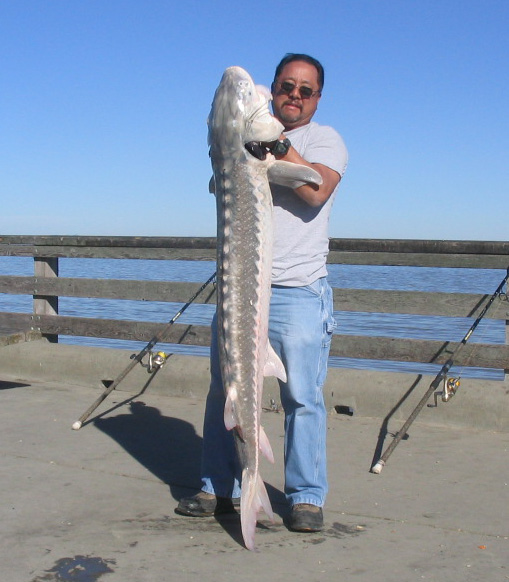
Size: Recorded to nearly 20 feet in length and 1,800 pounds although few are seen today longer than ten feet in length. Most caught from piers are less than 100 pounds. The California record fish weighed 468 pounds and was caught in San Pablo Bay by Joey Pallotta in 1983. It’s a record that cannot be broken since California’s slot limit now requires the release of the bigger fish.
This is the largest freshwater fish in North America and third largest sturgeon in the world. The beluga (Huso huso), found primarily in the Caspian and Black Sea basins, and occasionally in the Adriatic Sea, is the largest sturgeon reaching 24 feet in length and 3,250 pounds. (Although a monster measuring 28-feet long and weighing 4,570 pounds was reportedly taken from the Volga River near the Russian city of Astrakhan in 1736 but there is no verification of that fish). The Kaluga sturgeon (Huso dauricus), found in the Amur River basin, is the second largest sturgeon (22.6 feet and 2,200 pounds).
Range: From Ensenada, northern Baja California, to Cook Inlet, Gulf of Alaska. Although rare to the south, and less prevelant in saltwater than green sturgeon, a 47.9 inch (14-pound cleaned-weight) fish was taken at Isla de Todod Santos near Ensenada in March of 2003. Another white sturgeon, 75.7 inches long (45.2 pounds) was collected at Flat Rock, Rancho Palos Verdes in Los Angeles County on April 24, 2003.
Habitat: Anadromous, meaning they spend part of their lives in fresh water (where they spawn) and part in salt water; unlike most fish they may make the journey from fresh to salt water and back many times. They spend most of their lives in brackish bays, estuarine areas, and slow-moving rivers. Sturgeon are considered “benthic cruisers” that roam the bottom searching for food. The food is rarely detected by sight. Instead, they use the sensitive barbels under the snout, and ampullary (electric) organs, also located under the snout, to detect prey/food. The sturgeon feel and taste the food first and then suck it up into their bottom-oriented mouth by way of their “protruisible jaw” that can quickly shoot out (extend) and suck in whatever food they’ve chosen.
Young sturgeon feed mainly on insects, worms, amphipods (shrimp-like crustacea), and other small invertebrates such as copepods and mysid shrimp (opossum shrimp). Older fish become true gourmands feeding on a wide variety of bottom dwelling crustaceans and mollusks (crabs, shrimp, clams) as well as whatever fish are convenient (can they grab them?). Although they will often feed on the more sentinent, bottom-hugging fish (i.e., gobies and sculpins), they also include in their menu such species as herring (and herring eggs), shad, striped bass and salmon. Given the poor eyesight of sturgeon, and their manner of detecting food, it’s theorized that most of the fish eaten by sturgeon are captured at night. Countering the gourmand claim are those that say sturgeon are nothing more than indiscrimate bottom-feeders, akin to Uncle Ed’s “Fish-style” vacuum cleaner, sucking up anything that seems edible. Given that house cats, squirrels, seal pups, waterfowl, and carcasses of spawned-out salmon have been found in sturgeon stomachs, they may be right. Of note was the horse’s head supposedly found in a Russian beluga sturgeon. Don’t know if the horse head had anything to do with the Russian mafia. Nor is it easy to imagine how big that beluga’s mouth had to be to swallow a horse head. Questions, questions, questions.
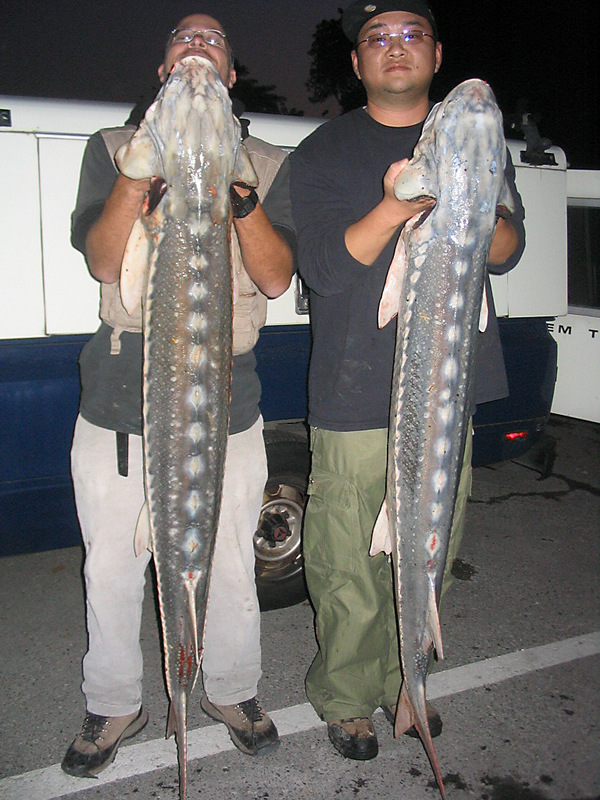
Piers: In California, sturgeon are only common to San Francisco Bay Area piers, the piers in the Sacramento-San Joaquin Delta, and, to a much less extent, piers in Humboldt Bay. Best Bets: Point Pinole Pier, Eckley Pier, Martinez Pier, Point Benicia Pier, Antioch Marina Pier, Antioch Pier, McNear Park Pier, Paradise Park Pier and Elephant Rock Pier. Seasonally common at the Candlestick Point Pier, Brisbane Pier, Oyster Point Pier, and the Dumbarton Pier.
Bait and Tackle: Caught with heavy tackle, a sliding bait leader, and live bait such as ghost, mud, or grass shrimp. Large Kahle hooks can be used and several shrimp can be impaled on the hook. When herring are spawning in nearby areas, herring and herring eggs make excellent bait. Use eel when crabs are are in full force and grabbing softer bait. Am told the best way to use the eel is to cut off a 2-3-inch-long chunk. Then cut the chunk into four strips before attaching to the hook. The strips will flutter and hopefully attract Mr. Sturgeon.
Surprisingly, given their size and manner of sucking in food, sturgeon have a very gentle bite that is hard to detect. Regulars seem to acquire the ability to spot the subtle “pumps” that indicate a bite but it can take newbies time to figure out when to strike.
Food Value: Excellent, mild-flavored meat that contains no bones and cuts up nicely into steaks for broiling, baking or frying.

Comments: Many sturgeon are hooked from Bay Area piers but hooking them is just part of the battle. An angler must have stout tackle, knowledge, a bit of luck, and the understanding of how to get the fish onto the pier, assuming it hasn’t stripped the reel of line or wrapped the line around a piling. However, large sturgeon are indeed landed: George Gano landed a 194-pound, eight-foot-long sturgeon while fishing from the old Vallejo Pier and a 170-pound fish was reported from the McNear Park Pier.
Philosopher fish? Sturgeon are considered very special fish by many people. Why? (1) They are considered an ancient fish that have changed little over the past 175 million years. (2) Though classified as a bony fish, they are more cartilaginous than bony, with an internal bone structure similar to that of sharks. (3) They can reach over 100 years of age. (4) They can reach a very large size and are desired by both sports and commercial fishermen. (5) They are a valuable species due to their eggs (caviar), a high priced delicacy for many people. (6) Although reaching an old age, sturgeon in California do not spawn until middle age, typically 10-15 years of age for males (3.6-6 feet long) and 12-20 years of age for females (4.6-6.6 feet long). And while females may spawn more than once it occurs only about every 4 to 10 years. Over fishing (often illegal poaching) in many areas of the world has led to an alarming decrease in the number of females and juvenile fish. (7) Almost all species of sturgeon are endangered, including several sub-species of white strurgeon, and many are close to extinction.

For all of these reasons sturgeon rank high in the hierarchy of piscatorial species as seen in the following:
One thinks of the sturgeon as a kind of philosopher among fishes, as if its ancient lineage had bred, over the thousands of centuries, a curious old wisdom and a quiet acceptance of change. The sturgeon has seen more years when it first spawns than many fish see in a lifetime.
—Howard Walden, Familiar Freshwater Fishes of America
The Cayucos Pier Through The Years
As a former history teacher I’ve always enjoyed studying the actual history of the piers (in fact I am working on a new book about the history of the piers). Of course the history has to include some pictures.
 This picture is from a California Dept. of Fish and Game pamphlet.
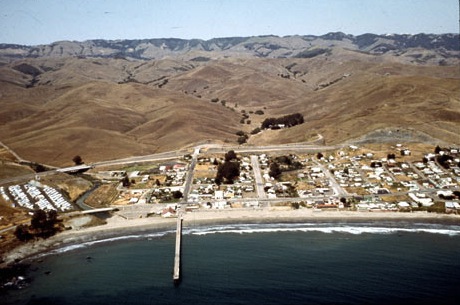 This is from 1972.
 This is from 1989
 A shot from 2005
 Taken on a crisp January morning in 2009
 A morning shot
 Morro Rock in the background
Red Tide
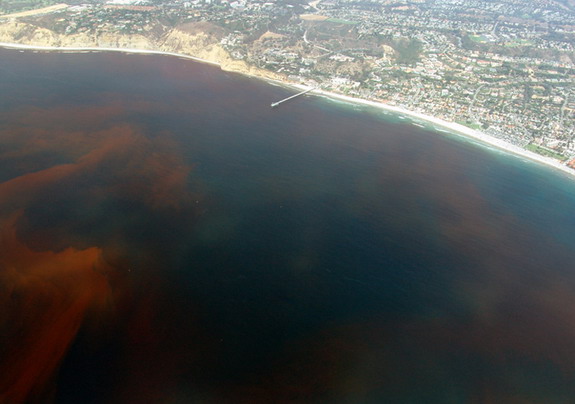
I think it was ‘Ol Casey, although it might have been Yogi, who once said, “hit it where they ain’t.” Much of fishin’ is learning to cast it where they is! Luckily there is usually some type of fish around a pier at all times—with one exception. That exception is the dreaded “red tide.” This nasty little condition develops when tiny (really, really tiny) organisms called dinoflagellates start to multiply at a phenomenal rate (bloom) and saturate the water with their itsy bitsy bodies. Millions of these dinoflagellates, and there are several different types, may exist in a single liter of water. If it is only a half-million to a million per liter of water, the coloring may be brown (or yellowish), if it hits the maximum concentration of 50 million per liter, the water will have a distinctly reddish color. Imagine a liter bottle containing 50 million little Lenins or Stalins (commies/reds—get it?). If you’re non-political, imagine 50 million tiny little red rockfish squeezed into one of those liter-size bottles. Unfortunately, as the number of these organisms increase they begin to use up the oxygen in the water. At the upper number limits, the dissolved oxygen in the water drops virtually to zero. Initially, as the water quality begins to decrease, the more mobile organisms (like fish) begin to leave the area. Eventually, as the water reaches zero oxygen levels, death results to the creatures still in the area.
Occasionally the result is a massive “die off” of fish. One of the most famous in California occurred in 1964 when an estimated 50 tons of anchovies became trapped in Santa Cruz Harbor during a “red tide” invasion (dinoflagellate counts of Gonyaulax polydera reached 20-35 million per liter). The fish died, the smell was unbearable, and oil from the bodies of the decaying anchovies pitted the hulls of boats in the harbor. There have been many such occurrences in California, some recorded back to the 1800s. Obviously, conditions such as this are bad for our trusty pier fisherman. Any fish with half an ounce of brain (poor simile) would try to swim away to cleaner water. If it is a small bloom that may be possible, if it is a large bloom (one reported off Mexico extended 170 miles) it may be impossible. So, the angler who casts his line out into the waters of a “red tide” is faced with two possibilities: The first is that there are few fish present—since most have moved to safer areas. The second possibility is that there are no fish in the area—they’re dead. In either case the angler would be wise to move on.
Unfortunately, scientists report that the number of “red tides” seems to be increasing, especially in the man-made harbors in southern California. Often these enclosed waters exhibit poor circulation and semi-stagnant conditions, which can act as fish traps during blooms. My observations would tend to confirm these scientific beliefs. Although I have seen “red tide” conditions at almost every pier in southern California, and at the Cayucos Pier in central California, the pier which seems to see these conditions most often is the Belmont Pier in Long Beach. The Belmont Pier sits inside the protected breakwater of the Los Angeles Harbor and receives less movement of water than oceanfront piers.
Luckily most of these blooms don’t last too long and most are fairly small. Once the oxygen level reaches zero the plankton themselves begins to die (and the decomposition of the plankton uses up even more oxygen). With the death of the dinoflagellates, the recovery of the water can begin. Sometimes one part of a pier’s water may be covered while another part exhibits no bloom. Sometimes the bloom is mainly on the top of the water while water underneath is freer of the organisms. Sometimes the entire pier is surrounded with “red tide.” If the pier’s water has a reddish appearance, fish will probably be absent. If the water is more of a brownish appearance you may catch fish, but probably not too many. If the bloom is in patches around the pier, and you can’t stop yourself from “giving it a try,” try fishing in the clearer water where fish may still be present. However, the best advice is simply to avoid fishing from a pier that appears to have “red tide” conditions. A ninth rule might be that if a pier is surrounded with red water, pretend it is a stop sign, and go no further.

Just so you poor pier fisherman don’t feel like you’re being picked on, it should be reported that some scientists feel that the story of Moses, the pharaoh, and the red Nile were simply a “red tide” condition. You do remember when the Nile turned to the color of blood, fish died, and the water was undrinkable—don’t you? Check out the book of Exodus in the Bible.
By the way, dinoflagellates are the same organisms that make it unsafe to eat mussels during certain months of the year in California and lead to prohibitions on the taking of shellfish, generally May 1 to October 31. However, these are a different and more toxic species than those that cause “red tide.” And, just so I don’t flunk the baseball exam, turns out it wasn’t Casey or Yogi who made the statement that opens this section. A Pier Rat informed me that it goes all the way back to “Wee Willie” Keeler. Guess I should stick to fishing.
—From Pier Fishing in California, 2nd Ed.
California Scorpionfish: When a sculpin is not a sculpin?
Fish names can be confusing and even though I preach the value of keeping a “Fish ID” book with the tackle, it’s a sermon rarely followed. The result is that too many anglers simply never learn the true names of fish even if at times it might prevent a citation — or a nasty sting. Compounding the problem are the local names often assigned to species. Thus a white croaker is called a tom cod in SoCal, a roncador in the Santa Barbara area, and a kingfish in CenCal; only a few anglers seem to actually call it a white croaker. Rare though is the distinction given to the fish commonly called a “sculpin” by most Southern California anglers. The fish, whose true name is California scorpionfish, is a member of the Scorpaenidae family that includes the scorpionfish and rockfish species; it’s only remotely related to the true sculpin family Cottidae, a family that includes many small species of sculpin and the larger cabezon. Given the fact that using the name scorpionfish might prevent some unsuspecting newbie from being stung, it seems logical to use the right name. But it’s doubtful if it will ever happen. The fish have been called sculpin for many, many years and even scientists seem to accept the fact that the name is going to stick with the fish. It’s tradition and few anglers seem interested in change.
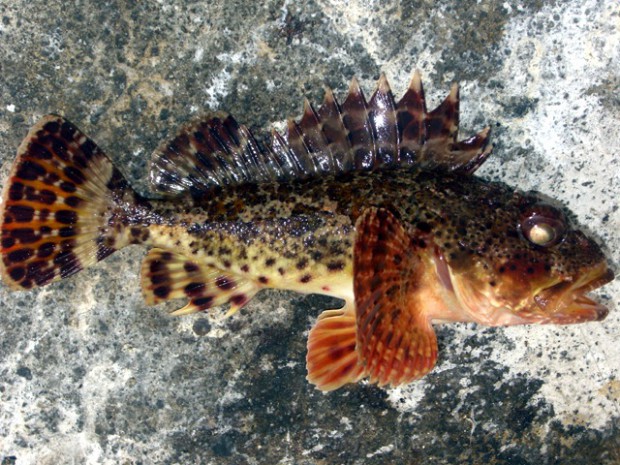
California Scorpionfish
Species: Scorpaena guttata (Girard, 1854); from the Greek word scorpaena (scorpion, referring to the poison spines), and the Latin word guttata (a form of small drops or spotting).
Alternate Names: Commonly called sculpin although also called scorpionfish, scorpion, little poker, rattlesnake and scorpene. Early records show stingfish and spinefish as favorite appellations. In Mexico they’re called escorpión Californiano.
Identification: Typical rockfish shape, heavy-bodied and with strong head and fin spines. Their coloring is red (deeper water) to brown (more shallow water) with dark spotting over the body and fins. Fin spines are venomous and can cause a very painful, although not fatal, wound.

Size: To 17 inches, although most caught from piers are less than 12 inches long. The California record was for a fish weighing 3 lb 0 oz. It was caught at the Silver Strand Beach in 1997.
Range: Uncle Sam Bank, central Baja California, and the Gulf of California, to Santa Cruz. They are uncommon north of Point Conception.
Habitat: Most abundant on hard bottoms such as rocky reefs, sewer pipes and wrecks; frequently found in caves and crevices. Some are also found on sand. Found from fairly shallow water down to 620 feet. May travel over 200 miles in annual spawning migrations (spring and early summer) that see them form large spawning aggregations on or near the bottom (at a variety of depths).

Piers: Although scorpionfish are most common around rocky areas and reef areas, I have seen them caught at almost every oceanfront pier in southern California. Best bets: Balboa Pier, Newport Pier, Redondo Beach Pier, Redondo Sportfishing Pier, Hermosa Beach Pier, Santa Monica Pier, Green Pleasure Pier (Avalon) and the Cabrillo Mole (Avalon).
Bait and Tackle: Scorpions are carnivorous, ambush predators that are primarily nocturnal, feeding at night. Their main diet consists of small crabs, octopus, shrimp and small fish. A high/low leader with size 4 hooks baited with squid or shrimp seems to work best although they also really like ghost shrimp. Still, I’ve also caught them on cut anchovies, strips of mackerel, and even pile worms, so they’re not too discriminating.
Food Value: An excellent eating, mild-flavored fish that is best fried (although they are a favorite fish for sushi and command top prices when fresh fish are available).

Comments: Handle with extreme care. California scorpionfish are the most venomous member of the family found in California. If handled in a careless manner and a puncture wound does occur there will usually be pain (sometimes intense) and perhaps swelling that should subside after a few hours. If possible, soak the affected area in hot water as soon as practical (since the hot water alters the toxin and makes it less harmful). Multiple punctures may require doctor’s attention or even hospitalization. The worst story I ever heard of such multiple punctures concerned a middle-aged angler fishing from a boat near Catalina. This lady had caught upwards of a dozen scorpionfish that were dutifully deposited into her gunnysack. Unfortunately, many of the long spines were protruding from her bag when a heavy wave caused her to lose her footing and to fall, bottom-first, onto the bag. The result was butt-porcupine and a helicopter trip back to a hospital.
Although studies showed a decline in the scorpionfish population before 1980, their numbers seem to have increased and today have a healthy population.
The Many Faces & Colors of Black Seaperch
Black seaperch, Embiotoca jacksoni, are one of my favorite fish. They’re readily available throughout much of California, scrappy fighters, pretty little fish, and fair to eat (although I no longer eat them).
Black Seaperch
Species: Embiotoca jacksoni (Agassiz, 1853); from the Greek word embiotoca (bringing forth living young), and jacksoni (in honor of A. C. Jackson of San Francisco, who first noted that these perch give birth to living young and brought it to the attention of Alexander Agassiz who described the species. Family Embiotocidae, subfamily Embiotocinae.
Alternate Names: Buttermouth perch, black surfperch, black seaperch or bay perch. Often called pogie by anglers in the Bay Area. In Mexico called mojarra negra or perca negra.
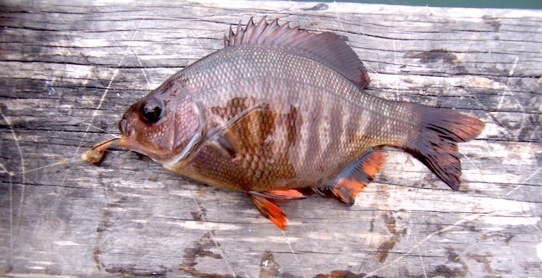
 Identification: Typical perch shape. Although variable, their coloring is usually black or brown to reddish, and yellowish on the belly. They have dark vertical bars on the side and are especially identified by a large patch of enlarged scales between the pectoral and pelvic fins.
Size: To 15.4 inches; most caught off piers are under a foot. The California record fish weighed 1 lb 11 oz and was taken from San Carlos Beach in 2006.
 Range: Punta Abreojos, central Baja California, and offshore Isla Gudalupe to Fort Bragg, Mendocino County.
Habitat: Most common in eelgrass beds of bays and rocky-shore areas; both in bays and along the coast.
 Piers: Common at most piers north to Bodega Bay. Generally caught at bay piers or inshore piling areas of oceanfront piers. Best bets: Imperial Beach Pier, Shelter Island Pier, Oceanside Harbor Pier, Dana Harbor Pier, Long Beach Finger Piers, Redondo Harbor Sportfishing Pier, Hermosa Beach Pier, Venice Pier, Santa Monica Pier, Cabrillo Pier (jetty side), Malibu Pier, Paradise Cove Pier, Goleta Pier, Gaviota Pier, Morro Bay T-Pier, Monterey Coast Guard Pier, Capitola Wharf, Fort Point Pier, San Francisco Municipal Pier, Candlestick Pier, Berkeley Pier, Ferry Point Pier, Paradise Beach Pier, Elephant Rock Pier, Angel Island Pier, and Fort Baker Pier.
 Bait and Tackle: Prefers fresh mussels, bloodworms, pile worms, small pieces of shrimp or small rock crabs. Size 8 or 6 hooks fished on the bottom with a high/low leader seem to work best.
 Food Value: In the past this was considered a fairly good, mild-flavored fish. Today, because of our polluted waters, they are considered unfit to eat in some locales.
 Comments: Once a favorite spring fish for Bay Area pier fishermen; today there’s a perch closure during the spawning months.
Blog Archives
- September 2025 (1)
- August 2024 (1)
- September 2023 (1)
- September 2022 (1)
- April 2022 (5)
- September 2021 (1)
- February 2021 (1)
- January 2020 (1)
- August 2019 (1)
- January 2019 (1)
- October 2018 (1)
- September 2018 (2)
- August 2018 (1)
- June 2018 (3)
- April 2018 (10)
- March 2018 (22)
- February 2018 (3)
- January 2018 (4)
- December 2017 (2)
- November 2017 (2)
- September 2017 (3)
- August 2017 (2)
- July 2017 (5)
- June 2017 (3)
- May 2017 (5)
- April 2017 (1)
- March 2017 (4)
- February 2017 (1)
- January 2017 (2)
- December 2016 (5)
- November 2016 (10)
- October 2016 (33)
- September 2016 (13)
- August 2016 (1)
- February 2016 (1)
- January 2016 (1)
- November 2015 (1)
- October 2015 (3)
- September 2015 (4)
- August 2015 (27)
- July 2015 (1)
- May 2015 (7)
- April 2015 (13)
- February 2015 (1)
- January 2015 (1)
- December 2014 (2)
- November 2014 (16)
- October 2014 (4)
- September 2014 (8)
- July 2014 (1)
- June 2014 (1)
- May 2014 (2)
- April 2014 (1)
- February 2014 (3)
- December 2013 (3)
- October 2013 (1)
- September 2013 (1)
- August 2013 (1)
- July 2013 (1)
- June 2013 (1)
- April 2013 (1)
- March 2013 (21)
- February 2013 (2)
- May 2012 (1)
- March 2012 (7)
- February 2012 (5)
- January 2012 (8)
- December 2011 (4)
- October 2011 (4)
- September 2011 (1)
- August 2011 (3)
- July 2011 (5)
- June 2011 (1)
- April 2011 (1)
- March 2011 (5)
- February 2011 (2)
- January 2011 (2)
Support Ken Jones
If you appreciate Ken's writings on fishing, please consider making a donation for this unique content. Your support will help Ken to continue publishing knowledgeable and entertaining articles.
Pier Fishing in California, 2nd Ed.

The ultimate pier fishing resource for Pacific Coast pier anglers with Over 350 new photos and illustrations added to this edition, including detailed, species-specific illustrations of fish-cleaning, rigging illustrations, and maps. The history and culture of each pier is thoroughly covered.
Buy the book from pierfishing.com or Amazon!
Recent Photos