Pierfishing
The Environment of Pier Fishing
 Understanding the environment of the pier is the most overlooked aspect of pier fishing, and the most critical. The pier fisherman is at the mercy of the pier. One cannot simply move down the beach like a surf fisherman or move to a new rock like a rock fisherman. Nor can a boat, kayak or tube be utilized to follow a school of fish or to locate a new school. The pier fisherman’s domain is the area underneath and around the pier. Because of this, the angler who wishes to be successful must know as much about the pier itself as possible and understand both the techniques and the bait and tackle which are specific for piers.
Luckily, most piers themselves attract fish. Pilings are covered with barnacles and mussels, crabs and tube worms, hydroids, anemones and sea spiders—a plethora of sometimes strange-looking creatures that represent food for the fish that the anglers seek. In addition, the water under a pier is often calm, sheltered by the various pilings, and it’s frequently full of food dropped from above. The mélange attracts small fish and these attract bigger fish. Fish, of any size, attract fishermen.
The first rule to remember in the Pier Fishing Analects, the most basic rule for pier fishing, is that fishing close to a pier (rather than engaging in a casting contest) usually provides the best results.
If in doubt, ask yourself the following question: why do so many boat anglers try to fish structure areas like piers? Because they realize fish are attracted to structure because of the food and protection offered by that structure.
But do not stop there! Ask yourself and then determine the answers to the following questions:
• What is the base under the pier, is it a sandy beach pier or is it located over mud or rock?
• If it is sand, are there rocks nearby or scattered under the pier?
• Were any artificial reefs constructed around the pier—and if so, where are they located?
• Is the pier short, offering only a surf area fishery, or is it long, offering access to deeper water and more pelagic species?
 Answering these questions will give you a clue as to what type of fish can be expected on a particular pier and if that is the pier you wish to visit. Generally, sandy-shore areas offer a smaller variety of fish but often larger schools of these fish, especially schools of the smaller perch. Rocky areas offer a greater variety of fish and often larger fish, but these tend to be non-schooling fish or fish found in smaller schools.
The second rule is that sandy areas, especially where there are also some rocks or reefs nearby, offer a better chance of catching fish. Rocky areas offer a better chance of catching large fish. Piers that are long and poke out into fairly deep water often offer access to pelagic species (which can mean both quantity and quality) and the largest resident species.
 Of course, there are exceptions. In southern California some of the largest pier fish are the sandy-area, shallow-water surfperch (barred) and croakers (corbina and spotfin croaker). An important point to remember is that natural food is different in sandy and rocky areas and the angler must match his bait to the natural food found in the area he’s fishing. Match the hatch (as they say in trout circles) and you stand a better chance of catching the species inhabiting the environment.
Pier Fishing In California in the news — 1997
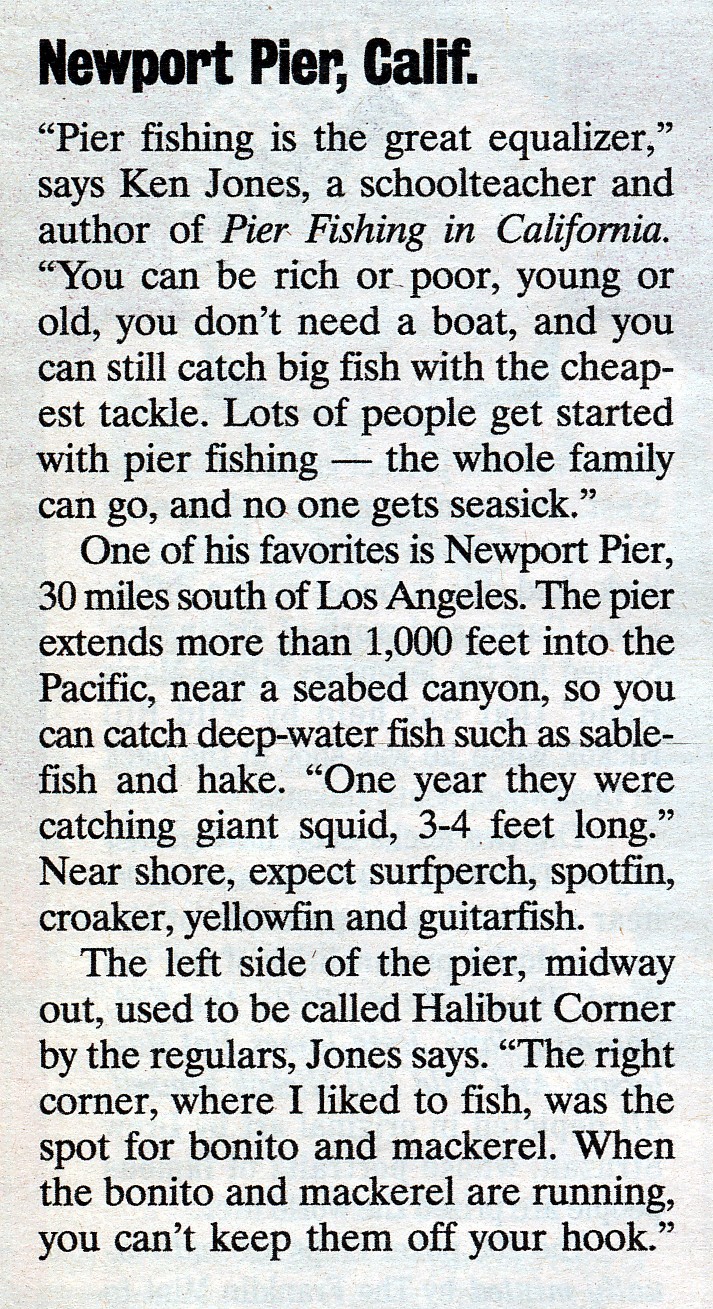
I remember getting a call from a reporter one day who was doing an article on fishing in the USA for USA Weekend magazine. She had noticed the Pier Fishing In California website and wondered if I would make a few comments about my favorite pier. Of course. The article appeared in the May 9, 1997 edition of the magazine and it was, I believe, the first publicity about PFIC.

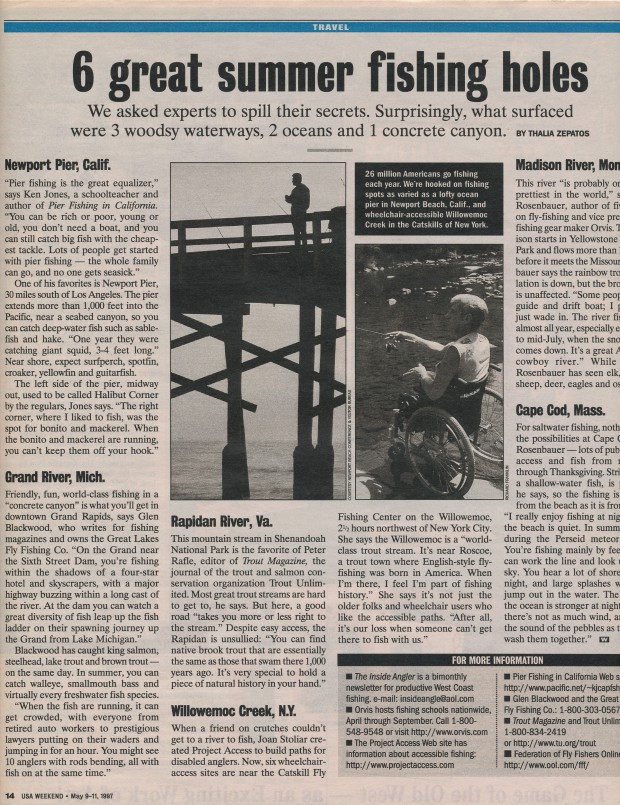
Funny How Things Go Around!
This picture of the Imperial Beach Pier in 1910 shows the “wave energy machines” out at the end of the pier. The idea was to use the “free” energy of the ocean to provide the electrical needs for the local area (see below). Unfortunately it didn’t work. BTW, several other SoCal piers saw similar attempts at”wave energy” but all for one reason of another failed. Today, in 2013, newspapers have reported several “new” schemes to harness the power of the ocean to generate electricity.
 From Pier Fishing In California— History of the Imperial Beach Pier
In 1909 a boardwalk was built, as was a 500-foot-long pier at the foot of Date Street. The Imperial Beach Improvement Association built both and the two became the centers of beachfront activity. In 1912 the ferry ceased operation but direct electric inter-urban train service began from San Diego to Imperial Beach—an event that affected the pier. Passengers would ride the San Diego and South Eastern Railway to Otay Junction, today’s Main Street in Chula Vista, where they would transfer to the Mexico and San Diego Railway to finish their journey to Imperial Beach. To power the electric cars, six wave motors, designed by Charles E. Edward, were built on a dogleg extension at the end of the pier, and, so, for a period of time, the pier was called the Edwards’ Wave Motor Pier. The machines were used to power the electric train cars with excess electricity being sold to subscribers. Eventually these wave machines lost favor but the pier continued to be used for recreational fishing until 1941 when the pier was damaged by winter storms. In 1948 storms finally washed the pier away for good and then, in 1953, the boardwalk suffered a similar fate.
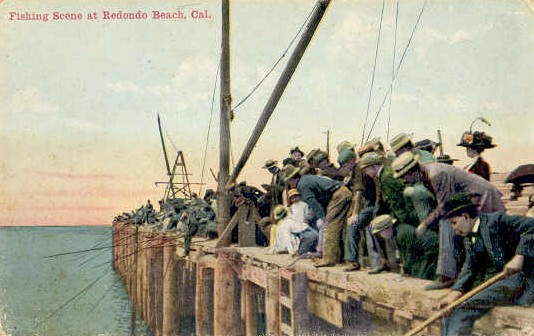


Snookie — Balboa Pier


 One of my favorite people is “Snookie,” a “Lady” that I have had the pleasure of fishing with many times and one who has been a reporter for the Pier Fishing In California website for over a decade. I included the following in Pier Fishing In California, 2nd Ed., but it really doesn’t tell how special she is. Although she’s a fantastic angler, she’s also an artist, a nurturing mother (to many), and a person who helps keep an eye of the pier. Just wish we had the ability to clone people because every pier could use a person like Snookie.
From PFIC, 2nd Ed. — The Balboa Pier has a special group of “pier rats” that I’ve had the pleasure to get to know. One of them is “Snookie,” the reporter for my Pier Fishing in California web site. The following newspaper story is about her and her gang of “pier rats.”
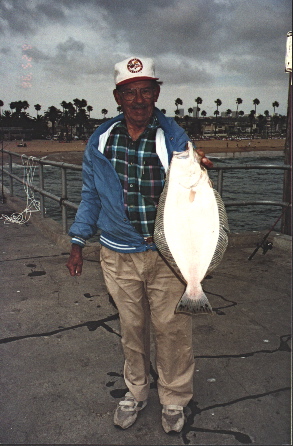
 Reeling in the years You should have been at the pier the day Warren hooked a near-keeper halibut. Oh, Warren has hooked plenty of keepers in his time, but he’ll tell you fishing isn’t about what you take, it’s about what keeps you coming back. Anyway: This one halibut a couple of weeks ago–turned out to be 20 inches, two short of legal limit–had Warren moving. Bad hip and all, dang thing, he raced that halibut, staying just ahead of the hooked fish’s efforts to reach the pylons and wrap itself to freedom. Thirty feet below Warren’s bowed fishing rod, the young feisty halibut with the white belly challenged the 81-year-old fisherman, tanned like leather from so many long days in a sun that precocious halibut wouldn’t survive a minute. Noble had a line dropped several feet up the pier (toward Ruby’s) and had to hustle to raise his rig to let Warren and the halibut scamper underneath. Snooky abandoned her reel and went for the drop met. She lowered the net in sync with Warren raising the halibut. Reeling, lowering, reeling, lowering until the flopping captive popped from the water and into the wide, circular net fixed to a thick rope, Snooky’s good with the net. Snooky’s good with everything out here. Out came the measure, up-short came the halibut, over the edge went the 20-incher and back for more bait went Warren, his old, small face lit as if a boy again. Milton was there that day. Cass might have been. Bob wasn’t though; he’s off fishing his way toward Washington or something. And Sunny. Well, she’s not out much this summer. Came out a lot last year and fished from her wheelchair, but even the Queen of the Halibuts has to give it up at some point, and this may be the summer—her 82nd—marked as Sunny’s retirement. If it is Tuesday or Thursday, and if the Balboa Pier is standing, this bunch will be on it. Usually gathered near the second “T” with carts and coolers and buckets and memories that go way back, to the days, even, before sardines got fished out; back to when barges were anchored three miles out and a water taxi would take you to them for two bits and you could catch barracuda so big they called them logs. Oh, yeah. This summer there are about five or six regulars: Snooky, Noble, Warren, Milton, Cass.
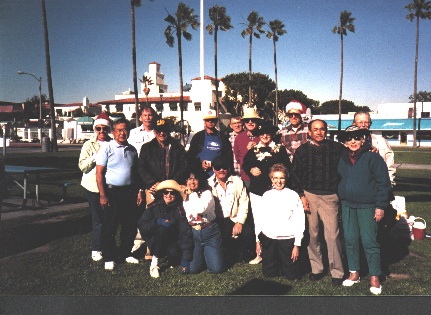
  They all have last names. But not out here. Snooky’s thick photo book shows the whole gang that has grown over the years to about 20, sometimes—if the scene of past Christmas parties is accurate. And, being that it’s Snooky’s book, you can bet it is. She’s got another book, without photos but with as many memories. It’s the record book she keeps— the one that cost $12.95 but is worth it because it has tide information for each day of the year. Even shows what time of day is best for fishing, although as Warren says: “I’ve never seen a halibut wearing a wristwatch.” Every summer, Snooky records each halibut caught by her pier peers, and at the end of the season, the person who has caught the most keepers gets…nothing. Midway into the summer Warren and Snooky have four apiece; Cass, two, Noble, three. Milton mostly comes to visit. Snooky, Sunny’s daughter is the baby of the bunch. She’s 60. Warren, you know, is 81. Milton is 80. Noble is 71. Most are retired: from real estate, insurance, nursery management. They get here about 10 A.M., break for their lunch precisely (well, as precisely as retired fishermen) at noon, stay sometimes till late afternoon. This is not a hobby for any of them. Hobby? No. Something else. Something more life giving. Or so it seems. “The camaraderie,” Snooky says she comes for. Which is something, considering how much she likes fishing and how good she is at it. Can’t remember a time when she didn’t fish. Goes to Vegas for international fishing conventions. Said Milton: “I come down to see the gang as much as anything.” Among the gang there are about 300 years of fishing experience, gathered on piers from Belmont Shore to here at Balboa, where they are a well-known sight. After all these years, a pool of anchovies can still excite them. Like last week, when the waters near the pier were darkened with thousands of the smelly baitfish. Milton and Noble and Warren and Snooky left their main rigs propped on the pier railing and gathered their bait-catching lines, aiming leaded monofilament laced with tiny hooks into the school and yanking up cigar-shaped silver that shot sharp reflections at the midday sun. See, game fish like anchovies best, it seems. Better than smelt, anyway. Maybe, Snooky figures, because anchovies have a softer scale. So, when the anchovies come through, the excitement of getting bait is nearly as good as the thrill of a keeper catch. Nearly. You need a lot of bait out here. Not that it’s anything like it was 50 years ago, mind you, but a person who knows what he’s doing can keep busy, This pier fishing is not as passive as you might think. There’s bait to be caught, leaders to be strung, territory to be guarded against the occasional fisherman who wanders out here not knowing that the second “T” is the crowd’s unofficial squat. “If you want nuts,” Warren says, “come to the pier.” The deranged come here, the drugged, the street preachers claiming to be fishers of men. The ill and ill intentioned and the ill-conceit of the well-intentioned mix with those who fish for fun and those who fish for food and those who fish because it’s what they’ve always done. They watch after one another in this group. A few years ago, Snooky says, it got so that if you didn’t keep an eye on your equipment, it would disappear. So now, they all look out for one another and take lunch at the same time so they can watch their gear while they eat.
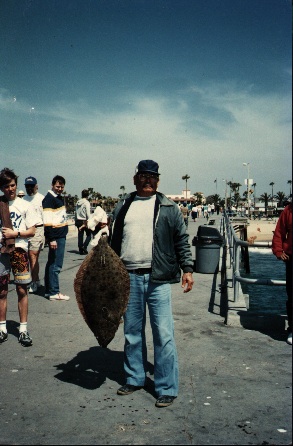
Things change. Things don’t. Warren’s been fishing these waters 72 years and says the thrill at 81 is the same as when he was 9. The same it’ll be at 90. He’s seen a lot out here. Still, he dreams. “It’s always been a dream of mine to go to the Florida Keys and fish for those big tuna,” he says. “Man, to get hold of one of those big things, boy, oh boy…” Man, Boy oh boy. Warren says he wants to die fishing. Almost did. In 1993, he’d just landed a 27-inch halibut, and Snooky was taking a picture when Warren collapsed. Noble and Snooky took him to the hospital. Heart attack. He was back in two weeks, more convinced of how he wants to go out. “I want to die with a 100-pound fish at the end of the line,” Warren says. “For a fisherman, that’s the way to go out…But I’d be happy to get a 10-pound bonito out here.” Fishing, fishing, fishing. Tuesday, Thursday. Tuesday, Thursday. Toss, reel, bait, clean, eat. Visit. Keepers. John Hughes, Subculture, The Orange County Register, August 2, 1997
Snookie says most of the group has been together for over thirty years, although some members have known each other for 55 years. Sunny, Snookie’s mother, was the matriarch of the group (until she died in 2001) and fished on both the Balboa and Newport piers before Snookie was born, a time when you “had to have a license just for catching yellowfin croaker.” Snookie’s daughter also grew up on the piers. “When she was in a stroller on Newport Pier, Grandma Sunny would make her play with live anchovies so she wouldn’t be afraid of them later,” said Snookie. Although all had fished the local piers, they more closely banded together back in the ’80s when thievery was at its height on the piers. Today, as seen in the article, the group is sort of a nurturing, extended family whose togetherness exemplifies what I sometimes affectionately call the Loyal Fraternity of Pier Rats. Their group should serve as a good example for other piers.  By the way, my
first day of fishing with the group, in June of ’99, highlighted several points that have been mentioned before but bear repeating. When Snookie arrived around 10 A.M. she brought with her the nets, live bait buckets, and other materials necessary to be a successful halibut angler these days. Soon Snookie had made some bait—lively small smelt—and the group was fishing. Snookie quickly caught a sub-legal halibut, which was returned to the mighty Pacific. A few minutes later a second halibut was caught, and then a third, while I was still fishless and hoping I wouldn’t be embarrassed. But then my bait, which was patiently swimming in the depression down between some pilings, began to act up, followed by the characteristic strike from a toothy halibut. I hooked the flattie, quickly realized it was a good fish, and asked Snookie to get the net ready. 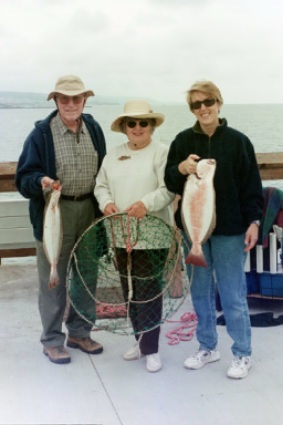
Soon the fish was headed toward a waiting net, it made a final run after spotting the net, and then it was guided into the net. Within a couple of minutes a beautiful, 27-inch keeper halibut was sitting under a wet towel on the pier. Point one was to always have someone present who knows how to correctly use a net or pier gaff to get the bigger fish, and Snookie was an expert at the task. The second point was the great advantage of using live bait. Within a three-hour time span the group of six people caught 10 or 11 halibut (including two by this lucky angler). I didn’t see another angler using live bait, nor did I see another halibut caught. Point three was the simple fact that looks can be deceiving. Most of the halibut were 12-17 inches long and all were returned to the water with the exception of my fish described above. Many anglers looked into our buckets as they headed out toward the end. Since they didn’t see any fish they assumed we hadn’t had much luck. However, nearly everyone in the group had caught at least one halibut, which brings up points four and five. Point four is that regulars like these know how to catch the fish and do so on a regular basis. Point five is that the mid-pier area of the pier, the area where Snookie’s group always fishes, is usually the best area for halibut. It may not produce as many pelagic species as the end areas but it definitely is the best area for the elusive, good-tasting and most-prized flatfish. A point I should repeat is to make sure you have a net (or pier gaff) with you in case you do hook a big fish. 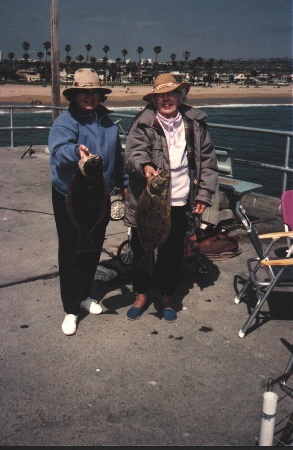 Earlier on the same morning that I met Snookie’s group, I had tried fishing the end area. Not too much was going on except for an occasional mackerel. One of the meat fishermen seeking mackerel was tossing out a multi-hook outfit that had a heavy line and about eight size 2 hooks. On the bottom was a 3 or 4-ounce sinker and a couple of feet above the top hook was a heavy float that kept the rigging floating near the top of the water. The fish (mainly mackerel and a few lizardfish) would hit the bait, his float would disappear under the water, and he would pull in the fish. Since he was using a fairly heavy rod there usually wasn’t much of a fight. However, that would change. One hit yielded resistance that he hadn’t previously seen and it took several minutes before his rig was near the top of the water and the fish could be seen. Imagine his surprise to see two mackerel together with a beautiful salmon that I estimated to weigh 10-12 pounds. Since a net wasn’t present, he tried to hand line the fish to the top of the pier. About half way up to the pier the fish gave a shrug and the line broke. Fish: one, angler: zero. With a net he would have had a rare prize for a southern California pier — though it would have been an illegal fish. As it was, he was left only with the memory.
Blog Archives
- September 2025 (1)
- August 2024 (1)
- September 2023 (1)
- September 2022 (1)
- April 2022 (5)
- September 2021 (1)
- February 2021 (1)
- January 2020 (1)
- August 2019 (1)
- January 2019 (1)
- October 2018 (1)
- September 2018 (2)
- August 2018 (1)
- June 2018 (3)
- April 2018 (10)
- March 2018 (22)
- February 2018 (3)
- January 2018 (4)
- December 2017 (2)
- November 2017 (2)
- September 2017 (3)
- August 2017 (2)
- July 2017 (5)
- June 2017 (3)
- May 2017 (5)
- April 2017 (1)
- March 2017 (4)
- February 2017 (1)
- January 2017 (2)
- December 2016 (5)
- November 2016 (10)
- October 2016 (33)
- September 2016 (13)
- August 2016 (1)
- February 2016 (1)
- January 2016 (1)
- November 2015 (1)
- October 2015 (3)
- September 2015 (4)
- August 2015 (27)
- July 2015 (1)
- May 2015 (7)
- April 2015 (13)
- February 2015 (1)
- January 2015 (1)
- December 2014 (2)
- November 2014 (16)
- October 2014 (4)
- September 2014 (8)
- July 2014 (1)
- June 2014 (1)
- May 2014 (2)
- April 2014 (1)
- February 2014 (3)
- December 2013 (3)
- October 2013 (1)
- September 2013 (1)
- August 2013 (1)
- July 2013 (1)
- June 2013 (1)
- April 2013 (1)
- March 2013 (21)
- February 2013 (2)
- May 2012 (1)
- March 2012 (7)
- February 2012 (5)
- January 2012 (8)
- December 2011 (4)
- October 2011 (4)
- September 2011 (1)
- August 2011 (3)
- July 2011 (5)
- June 2011 (1)
- April 2011 (1)
- March 2011 (5)
- February 2011 (2)
- January 2011 (2)
Support Ken Jones
If you appreciate Ken's writings on fishing, please consider making a donation for this unique content. Your support will help Ken to continue publishing knowledgeable and entertaining articles.
Pier Fishing in California, 2nd Ed.

The ultimate pier fishing resource for Pacific Coast pier anglers with Over 350 new photos and illustrations added to this edition, including detailed, species-specific illustrations of fish-cleaning, rigging illustrations, and maps. The history and culture of each pier is thoroughly covered.
Buy the book from pierfishing.com or Amazon!
Recent Photos