Saltwater Fishing
Evolution Of A Pier Rat — Ken Jones
 Crystal Pier
The Beginning
Pacific Beach was a different place in 1957 when my daddy moved our family into a small rental house located just a few yards off of Garnet Avenue, one of the two main thoroughfares in that beachfront section of San Diego. The house set at the bottom of a hill and, unbeknownst to me at the time, my daddy’s girlfriend owned a house at the top of that hill. It wasn’t too much later that my father moved his belongings to the top of the hill. It was not a particularly good moment in my life.
However, the move to the PB (as it’s called) and that particular location would provide an entryway into a sport that to this day helps define my life. At the ocean end of Garnet sat Crystal Pier. That pier was where my introduction to ocean fishing would take place and where I would catch my first ocean fish.
Reinforcement to my actual fishing experiences was provided by a small used bookstore located just across Garnet, a store that also carried magazines. The fishing magazines it carried—Field and Stream, Outdoor Life, Sports Afield, and especially Saltwater Sportsman—and the stories and images they portrayed helped stimulate and give genesis to a love for a sport that I had actually participated in (with my Dad) from an early age.
Looking back, what I find interesting is that I was never particularly interested in the pictures of the big marlin or tuna. Even then I was more interested in the “odd” fish—giant sawfish, alligator gars, Nile perch, electric eels and rays, and exotic Amazon species. As a youngster I had fished for bass and perch in the Midwest and for trout in the Northwest; now I was looking for something else. Saltwater fishing and the piers would provide an entryway into a different world of fishing, one in which you never knew what new and exciting species might decide to grab your bait. To this day the variety of species is what I find truly amazing at our piers and at last count I’ve caught 123 different species from 123 California piers. In fact, if I had the choice between a larger specimen of an existing species versus catching a new species I would quickly opt for the new species!
My mom liked the ocean and so a few days after our arrival we rode the bus down to the end of our street. The bus stopped at the corner of Mission Boulevard and from there you walked a short half block to the arched blue and white entrance of Crystal Pier. The pier is the only pier on the Pacific coast that has motel rooms right out on the pier but I didn’t know that fact that day. The pier seemed old but had a fresh coat of paint and you could feel the timbers sway as the waves pushed their way ashore on the fairly short pier. We didn’t fish that day; instead we just watched the waves, the swimmers, sunbathers, sea gulls—and fishermen. Eventually we left and walked over to the Oscar’s Drive-In, a restaurant on the corner of Mission and Garnet. They had great milk shakes and burgers and we sampled both.
Of course the discovery of that pier meant a return visit—to fish—was necessary.
It was a long walk from our house to the pier but it seemed like a much shorter journey on my flashy Schwinn Corvette, a bike that seemed to have as much shiny chrome and bright red paint as the Corvette’s after which it was named. It was a gift from my dad and would be my main means of transportation for many years. I don’t know how long the trip took but anticipation seemed to lessen the distance (and it seemed far longer coming home). Garnet Avenue was different then—not quite as crowded, absent the shopping centers of today, and the traffic was actually tolerable. I headed out, tooled past Brown’s Military Academy (wondering what life was like in that starchy school), zipped past the bowling alley where my dad sometimes worked, checked out Oscar’s, and then arrived at the pier. It cost money to fish the pier, twenty-five cents I believe, and you had to go into the motel office to pay your money but soon they would open the gate and you could head out to the end.
As mentioned, I did manage to catch a fish on what would be my initial pier fishing experience. It wasn’t much of a fish, in contrast to the fish I had read about in the magazines, and the fish was caught on a hand-line, not one of the beautiful (and expensive) rods and reels you saw in the magazines. But the rig worked! My mom had given me an inexpensive set-up that consisted of heavy, green Dacron line wound around a wooden contraption that looked like four Popsicle sticks stuck together. To the end of the line I attached a long-shanked Mustad hook and a small sinker, both items I had discovered in the garage next to the house. You had two choices as far as casting, unwind the line and then toss it out, or slowly unwrap the line and drop it straight down. The former was more fun but it seemed like most of the bites were down around the pilings (a lesson I remembered).
It took me a few hours but I finally caught that fish using a small piece of shrimp. It was probably a perch although to this day I am still not sure. The fish didn’t even weigh a pound but I was so excited that I made a spectacle of myself. As soon as I caught that fish I stopped fishing and headed home to show the prize. But before I had even gone a block I made sure to walk through that Oscar’s restaurant proudly showing off my fish. I’m sure the people were a little dumbfounded as to how to respond to a pudgy little kid holding aloft a smelly and quickly drying fish as they tried to eat their double-decker hamburgers. But emotion and logic come from different worlds; I was proud of that fish. To this day I have a picture of the fish but cannot tell what kind of fish it was (a perch or a small halibut?). I do know we ate it for dinner that night after my mom cleaned it.

One of the early fish at Crystal Pier
I also must admit that in looking back that the fish was caught mostly by luck. I actually had few clues as to how to how to catch a pier fish. And, unfortunately, my parents would soon divorce and my mom and I would head east to begin a two-year hiatus at my Hoosier hometown in Indiana. My pier fishing education would have to wait even though there were fish, especially bullheads—of a different sort—to be found by my grandpa’s farm and the nearby Kankakee River.
The Piers of Carolina
Within two years my mom had remarried—to a Marine‚ and my second exposure to pier fishing soon took place. My stepfather was stationed in Cherry Point, North Carolina, just a short distance from Morehead City, site of a number of fishing piers and some top-notch ocean fishing. The piers were private and required a fee and we rented poles—big heavy, bait casting poles—that were equipped with the standard rigging of the day. The leaders were wire or heavy monofilament line, two to three hooks, plastic beads and red bobbers. Surprisingly, we did manage to catch fish—mainly pinfish, spot, croakers, ocean catfish, small fluke, a few baby bluefish and an interesting pufferfish that sure enough puffed itself up into a wacky-looking ball. Interesting but to this day I am convinced that less tackle would have produced more fish. The infrequent visits did not teach me too many new methods of saltwater angling but they did provide an introduction to new species and wetted not only my line but also my desire to learn more about the sport. Unfortunately I was still too young to drive, it was too far to bike, and the trips were few. Nevertheless those visits were introductory lesson number two in my pier fishing life.
Newport Pier — 1962-63
 My third and most lasting introduction to pier fishing took place at the Newport Pier. My stepfather was transferred back to California and then sent to Vietnam. Soon after, my mother, brother and I moved to Costa Mesa.
Adjacent Newport Beach wasn’t always the capital of the “Big Orange.” There was a time when it was more the home of proletarian fishermen and others whose lives were connected in some way to the briny deep. Luckily, I was able to experience a few of those days in the early-’60s, a time when an average person might actually be able to afford a simple domicile along the narrow peninsula that separates the bay from the deep blue sea. Good thing! Mom loved the beach and when she would take my brother to the beach alongside the Newport Pier, I would head out to the pier to go fishing.
In April of ’62, I was a freshman in high school, a poor boy from the wrong side of the road—Costa Mesa—going to the affluent and preppy Newport Harbor High School. Times were a little tough and I needed a job to supplement the income in our home. One day I noticed a help wanted sign at the Coffee Haven Café near the front of the pier (today’s Charlie’s Chili) and I applied for and got the job. I was now provided the perfect excuse to go fishing and I date my true addiction to pier fishing to the spring and summer after I got that job. The routine varied little: during the school year I was on the pier during the weekends, during the summer it was several days a week.
Still too young to drive, that trusty old Schwinn Corvette bicycle was put to use hauling me down the seven mile or so trek to my job and the pier. I would get up very early, gather together the various and necessary accouterments, and head down to the pier. Typically I wore a hooded sweatshirt and it was a good thing due to the moisture that likes to call the seaside its home. Down the street, past the high school, and then down the steep hill that led to the PCH. If traffic was light (and it usually was at 4:30 in the morning) a quick dash up and across the roadway, across the bridge at the arches, and then the morning ride out Newport Boulevard to the Newport Pier. The bike would be parked in back of the restaurant and then I would head out to the end of the pier and the coveted right corner spot, Mecca to the regulars. That spot presented access to the deepest waters and the biggest fish or so we thought. It certainly was a top spot for the bonito, the fighting boneheads that were so common in those years.
 Foggy mornings were common at the Newport Pier
All summer long I was out on that pier fishing and watching the “old pros aka regulars aka pier rats” and their techniques. I did catch fish but it took some time before I became proficient. My first few trips saw an occasional small halibut or more often a sculpin (scorpionfish). It wasn’t until my seventh trip that I caught a decent-size fish, a barracuda, and it wasn’t until the tenth trip that I caught as many as ten fish. However, I soon began to understand the needed baits and proper presentation and with those skills began to catch a variety of fish: bonito, mackerel, jack mackerel, queenfish, jacksmelt and several varieties of perch. Deep-water fish like sanddabs and hake were added to the mix. I was finally becoming an angler.
At last, on an early September morning, I had my first “big day.” I had arrived, as usual, at the crack of dawn, and was fishing just down from the northwest corner. I was using squid for bait and had experienced very little early success. However, around 5:30 a.m., I had a strike and pulled in an ebony-colored fish—a type I had never seen nor caught before. The next cast yielded two more of these strange colored fish and I continued to catch fish, nearly every cast, for the next two hours. Strangely, only two other anglers were having similar success. Most anglers were going fishless in Newport. Later, I found out the fish were sablefish, a deep-water fish more common to northern waters and a fish sold as black cod by the dory boats near the entrance to the pier. Upon cleaning the fish, I also found the reason for my success. The fish were stuffed with squid that were schooling in the waters near to the pier. Anglers who were using squid for bait, and there were only a few of us, were catching the fish. I caught 47 sablefish that day, but it was only a start. I continued to catch fish: large jacksmelt, Pacific mackerel and jack mackerel— 77 fish in all. It was, mirabile dictu, one of the best days I ever had at the pier even though the fishing probably would have been considered poor for most of my fellow anglers that day.
That day showed that I had begun to learn and understand the basics of pier fishing. I had, by September, put in the time at the pier to be considered a regular myself. I had also developed the addiction, “the Jones,” to call myself a true pier rat (and I note with some satisfaction and bemusement that today some of my website regulars use the term Jonesin’ to indicate that they are going pier fishing).
You just never know what is going to happen at that pier. The deep-water Newport Canyon slopes down sharply from the end of the pier and species rare or uncommon to most piers sometimes make the journey up from the hidden depths to partake of the yummy offerings cast out by the hoards of anglers who visit the pier (it’s almost always crowded). That variety by the way has resulted in over 40 species of fish for me from the pier, one of the main reasons why I still hold it so special.
 Queenfish, Pacific Hake and Jack Mackerel — Newport Pier, 1962
Most days that summer I would be able to get in a few hours of fishing before work. What fish I caught were stored in the café’s cooler and quite often I was also able to get in a few hours of fishing after work. Of course the ride back home wasn’t nearly the same exhilarating ride that I had experienced in the pre-dawn hours. The ride was now up the hill, fighting the traffic, and (hopefully) carrying home some fish for dinner.
I never knew how poor we were, I just knew that the fish I brought home made up a large portion of our military diet—fish and macaroni and cheese (three or four nights a week). I learned how to clean and cook fish and discovered that not all fish taste the same— halibut good, hake bad, croakers good, mackerel not so good. I began a life-long interest in cooking and eating fish that parallels to some degree my interest in fishing.
 Costa Mesa 1963 — My brother John taking some pictures of my barracuda
In the summer of ’63 we moved down to San Diego where I would search out and fish from several new piers—Shelter Island, Imperial Breach, Ocean Beach (after 1966) and the pier where it had started—Crystal Pier. Each would provide new experiences and new chances to learn but I still consider the relatively short time I had at the Newport Pier as the nexus point that led to my life-long addiction to pier fishing. Just as certain, my love for three species certainly dates from those days—the hard fighting bonito, the tasty halibut, and the tasty but dangerous sculpin. Most important though, I learned the discipline of working from that job at the café and the discipline of fishing from those visits to that venerable old pier.
I’ve detailed my experiences in greater detail in Pier Fishing In California but important were several lessons that every angler should remember. The first is to listen and learn from those that came before you. The regulars will generally share their information once they have confidence in you, but you may need to be humble and the key term here is to listen. Second is to tone your observational skills. What works, what doesn’t, what differences are needed for different species and different conditions? Watch the regulars, jot down what you see, and learn to predict what will work for you. Third is to practice, practice, and practice. There is nothing that is as stimulating and meaningful as the time you actually spend on the pier. Regulars are people that are out on their favorite piers day after day, week after week, and they normally know what will work based on experience. So become a regular. Last, but not least, is to be cognizant of the fact that life is truly a lifetime venture in learning. As you traverse the nooks and crannies that will confront you over the years be willing to have an open mind and realize that there is always someone out there from which you can learn. Learning and then practicing what you have learned will produce over time a master angler, one who can then impact and teach the new generation of anglers.
 My first yellowtail — San Diego, 1966
 An early kelp bass — San Diego, 1967
Spotfin Croaker —
 Spotfin Croaker — Oceanside Pier
Species: Roncador stearnsii (Steindachner, 1876); from the Spanish word roncador (in reference to a snorer) and stearnsii (referring to Robert E. C. Stearns, a 19th Century sea shell expert in San Francisco).
Alternate Names: Spot, spotties, golden croaker or roncador. Called roncador aleta manchada in Mexico.
 Yellowfin Croaker (Top), Spotfin Croaker (Bottom) — San Clemente Pier
Identification: A heavy-bodied croaker which has a large black spot at the base of the pectoral fin; the mouth is underneath the head (subterminal); they do not have a barbel on the chin (unlike most California croakers). Their coloring is metallic gray above and brassy on the sides. Occasionally you may see a beautiful, bright “golden” spotfin. This color phrase by larger males is during spawning and led, at one time, to the mistaken belief that there were two distinct species of spotfins. I’ve only caught a few spotfins over the years that had the bright gold coloring but each was a truly beautiful fish. Apparently the females do not acquire this golden coloring, instead they develop blackish streaks on their bellies during the spawning season.
 Spotfin Croaker — UPSAC/IGFA Kid’s Fishing Derby, Oceanside Pier, 2010
Size: Reported to reach a length of 27 inches and a weight of 10 1/2 pounds (although the record fish would seem to contradict this usually given factoid). Most caught from piers are less than 20 inches and range from one to three pounds. A 26 ½-inch, 9 ¼-pound fish was 15 years old; reaches 18-19 years in age. The California record fish weighed 14 lb 0 oz and was taken at Playa del Rey in 1951 (and was apparently a freak of nature).
Range: Mazatlan, Mexico to Point Conception. Most common from Los Angeles south. (One specimen reported from south San Francisco Bay.)
Habitat: Shallow-water sandy areas, both in bays and along the coast. In coastal conditions they tend to be in the slightly deeper waters beyond the innermost line of breakers (out to about a 30-foot depth). A difference in body shape, together with an air bladder, prevent their feeding in the backwash of the surf, the common area of corbina and sand crabs.
Piers: Common at most bay and oceanfront piers north to Los Angeles Harbor; those that have a sand or mud bottom. Best bets: Embarcadeo Marina Pier, Shelter Island Pier, Crystal Pier, San Clemente Pier, Oceanside Pier, Oceanside Harbor Pier, San Clemente Pier, Dana Point Harbor Pier, Huntington Beach Pier, Seal Beach Pier, Belmont Veterans Memorial Pier, and lately—the Santa Monica Pier.
 Spotfin Croaker — Crystal Pier
Shoreline: One of the main catches by sandy shore and bay anglers in southern California. Favored areas include Mission Bay, Newport Bay, and Alamitos Bay.
 My dad and a spotfin from Mission Bay
Boats: An inshore species but some are taken by boaters fishing the various bays in southern California.
Bait and Tackle: Spotfin croaker have pharyngeal (throat) teeth made for crushing heavy shells and primarily feed on the bottom for clams, although polychaete worms and mussels are also a popular diet (studies on fish captured in Long Beach also revealed crabs, shrimp, serpent star fragments, scallops, sand stars and lots of crushed shells and sand in the bellies). Therefore, the best bait is clams, but ghost shrimp, fresh mussels, bloodworms, lugworms and innkeeper worms can also be good. Best tackle is a high/low leader with number 6 or 4 hooks fished directly on the bottom. Although spotfin may be caught year-round, the best time is late summer to fall. In addition, spotfin follow the tides, so fishermen should do the same. Fish two hours before and after a high tide, especially a late afternoon or evening tide. Late evening and night is often the best time to catch spotfin croaker.
 Spotfin Croaker — Ventura Pier
Food Value: An excellent mild-flavored fish that shares the same problems with pollution as the other croaker species. They may be unsafe to eat in certain localities.
Comments: Spotfin croakers are one of the favorite inshore fishes of southern California. In bays, spotfin croaker tend to congregate in croaker holes; when these are discovered, the anglers can often return time after time for fish. It is much harder to find these holes and depressions around piers, but it can be done. Look for spots where the surf-line seems to flatten out; this often indicates a depression in the sand. Illegal to take in California with nets since 1909, or to buy or sell since 1915. Scientific studies indicated an increase in numbers in the late 1990s while anecdotal PFIC reports have shown a startling number of large spotfins being caught at piers in 2006-2010, especially those at Oceanside, Huntington Beach and Santa Monica.
Swell Shark — Ain’t so Swell
Order Carcharhiniformes — Cat Sharks—Family Scyliorhinidae
 A swell shark from the Cayucos Pier
Species: Cephaloscyllium ventriosum (Garman, 1880); from the Greek words cephalo (with a head) and scyllium (like a dog or monster) and the Latin ventr (referring to the belly).
Alternate Names: Catshark, puffer shark and balloon shark. Called tiburón inflado, pejegato globo or gato hinchado in Mexico.
 Identification: Swell sharks have a broad flat head with a rounded snout, and sharp, pointed little teeth. Their first dorsal is back of the middle of body and directly above pelvic fins; second dorsal above anal fin. Their skin is rough and appears flabby while coloring is yellowish-brown to creamy, with black or brownish spots and saddles; sometimes with white spots. When caught, the swell shark may inflate its belly with air or water until its circumference nearly triples in size. However, young swell sharks are not able to duplicate this neat little trick. So see, sometimes it pays to be an adult.
Size: To a little over three feet in length.
Range: Acapulco, Mexico and the Gulf of California to Monterey Bay; most common in southern California.
Habitat: Usually found near kelp beds or rocky areas that contain some kelp; likes to spend the daytime hours holed up in crevices or caves. A nocturnal feeder, they emerge at night to search for food—mainly small fish. But they seem a little lazy. Although sometimes they suck other fish into their mouth (as would a normal feeding fish), some reportedly simply open their mouths and wait for the smaller fish to swim in. It’s called yawning and perhaps explains why swell sharks have less than an athletic looking body (afterall, how much energy can be expanded in yawning for your food?). The next question becomes how often do you think bait is going to swim into their mouths, especially dead bait? Perhaps this is one reason that they are not more commonly caught.

Piers: Rarely a common species although good numbers are reported from the Avila Pier, Port San Luis Pier, and the Cayucos Pier. Best Bets: Ocean Beach Pier, Green Pleasure Pier (Avalon), Hermosa Beach Pier, Santa Monica Pier, Goleta Pier, Gaviota Pier, Avila Pier, Port San Luis Pier and Cayucos Pier.
Shoreline: Occasionally taken by central California anglers fishing near kelp.
Boats: Rarely taken by boaters although kayakers who can fish fairly shallow waters and kelp beds catch a few.
Bait and Tackle: Most swell sharks that are caught from piers are around two feet in length, so medium tackle with a size 2 to 2/0 hook should work fine. Small fish, crabs, and shrimp, seem to be the best bait.
Food Value: It is reported that eating a swell shark is not so swell! The flesh is slightly toxic and causes stomach cramps and nausea as well as acting as a cheap aperient (result: diarrhea) and emetic (result: vomiting). Unless you’re really into the masochistic routine I would avoid puffer stew. Nevertheless, I can see all those sadistic little eyes lighting up. Wouldn’t it be cute to give Henry some puffer steaks for his dinner? Let’s see how long it is before he heads to the head.  Dompfa Bro and a swell shark from Goleta Pier
Of course there’s always the story that’s told in the fascinating book Cod, by Mark Kurlansky. He mentions the unusual methods used by a people (Icelanders) seemingly on the verge of starvation: “They ate what the island produced, which was mainly every conceivable part of a cod-fish and a lamb. They roasted cod skin and kept cod bones until they had decomposed enough to be soft and edible. They also ate roasted sheeps’ heads, particularly praising the eyeballs. Another specialty was hákarl, the flesh of a huge Greenland shark, hunted for the commercial value of its liver oil. The flesh, which contains cyanic acid, a lethal poison, was rendered edible by leaving it buried in the groud until it rotted.” Apparently æstur hákarl (Icelandic for fermented shark) with its ammonia-rich smell and taste is still enjoyed by some of the locals.
Leaving aside this strange diet, and the question of how they discovered these enriching techniques, it makes you kind of wonder if a swell shark could be made edible by burying it in the ground for a few weeks. Anyone want to give rotted swell shark a try? Perhaps the “Iron Chefs” could do a show using æstur hákarl as the featured ingredient?
 Swell sharks — Goleta Pier
Comments: An unpleasant and mistaken belief in some areas, especially the central coast, is that returning a swell shark to the ocean after capture ruins the fishing. It’s a rather stupid idea, and wrong, yet you’ll often find misshapen dying or dead swell sharks littering the piers. Since you don’t want to eat swellies (see above), and since they DO NOT hurt the fishing, please return them to the water. Of course that may not be as easy as it sounds! A puffed up shark returned to the water may simply float away to be attacked by… whatever. Best is to net them and bring them to the top of the pier as quickly as possible. Then, as carefully as possible (since they do have sharp teeth), remove the hook. Try to then keep their mouth shut while returning them to the net and lowering them back down to the water. If successful, they will have gulped as little air as possible and still be able to swim away.
 Dead, discarded young swell sharks at the Avila Pier—what a waste!
The issue of burping a swell shark became an interesting thread on the Pier Fishing In California Message Board.
Date: June 28, 2005
To: PFIC Message Board
From: pierhead
Subject: How do you ‘burp’ a swell shark …
Yesterday at Gaviota I observed a young man walking off the pier with a swell shark that he had just caught. I asked if he was going to keep it as they are not fit for food. He replied that he was going to release it closer to the shore. I reminded him that it was important to get it back in the water before it filled with air. Next thing I know he had dropped it in a trash can. I retrieved it but by then it had doubled in size. Remembering that EddieE had successfully burped them I thought I could do the same … no such luck … they have teeth and no way was I going to put my hand in there like Eddie did. I tried massaging it like burping a baby but that didn’t work either. Finally I held it over the rail by the tail and it expelled quite a lot of air … just as I dropped it (no net around) it gulped more air and swelled up again. As it floated away on its back I tried to enlist some nearby boaters to assist but by then it was too close to the breakers for them to approach.
I’m frustrated … any suggestions?
Posted by scooterfish
Maybe… I know someone had mentioned something about “pliers down the throat,” which sounded a bit primitive, but maybe the right tool, such as a smooth-ended tube (turkey baster without the bulb maybe?) would work…
Scooterfish
ps- never even seen a swell shark in person, so this is purely conjecture…
Posted by eelmaster
Turkey Baster sound feasible. Squeeze the bulb first then insert and release the bulb? Worth a shot. Either that or Rolaids.
Monte, Support the UPSAC
Posted by pierhead
Here is what you are facing… tried to insert a small pole handle but the shark clamped down on it like a pit bull on steroids! Unless the mouth were propped open somehow it would cut through the turkey baster in no time at all. Don’t tell me we are going to have to construct some sort of dental tool just to start the procedure … there has got to be a better way. I considered the procedure used to deflate air bladders on rockfish … but I don’t think we are dealing with an air bladder here. Guess I’ll just have to do some research on swell shark anatomy.
Pierhead, Proud Supporter of UPSAC
Posted by malibooger
Several layperson’s-level websites describe the swell shark as sucking water or air into its stomach- since it can suck up water as well it seems the upper GI is probably where it is going. I haven’t hit the stores here yet, but when I used to hang out at the kitchen supply store on south Willamette St. in Eugene, OR, they had a selection of stainless-steel turkey basters. I always thought they were overkill until now- maybe you could find one of those. The websites mentioned above (just Google ‘swell shark’ and look for sites ending in .edu) say that the sharks will deflate themselves when they no longer feel threatened.
The real question is, what kind of a**hole tosses a live fish in a trash can?
Posted by pierhead
What kind of person would toss a… live fish in a trashcan? Me. When I was just starting to fish 50+ years ago it was common to leave your catch on the deck all day so passerby’s could oogle, gawk and offer congratulations. All sharks were immediately dispatched by multiple stabbings… the more the macho … sure to draw a crowd interested in your proficiency with a knife and fearlessness in combat with a “killer” shark. In my 30′s I returned from a day’s fishing off the barge at Redondo with a huge gunnysack of mackerel … which had rotted by the time I got home … they ended up in the garbage can as well. It wasn’t until after I first logged onto to this board (1997) that I started practicing consistent catch and release. And the truth is, there is still a bit of that attitude in all of us … thankfully through exposure here most of us have evolved to CPR (Catch, Photo, Release). Better to display your catch on PFIC than on the deck. After the advent of digital photography with it’s instant (and repeatable previews) the practice of CPR took off. Next to a net I think a camera is our most important accessory. I saw a young man catch his first fish this past weekend and he started to cry when his father insisted he put it back. I explained to him he gets more credit for releasing fish he isn’t going to eat than keeping them and offered to take his picture and email it. Seemed to satisfy him.
Posted by Salty Nick
Mouth-to-mouth resuscitation? Are they able to deflate themselves on their own, or is it necessary to “pop” them somehow? (I know nothing about them, being too far north to catch any). Salty.
Posted by pierhead
My experience is that they expel any water when you bring them up but if you handle them roughly on deck they will start gulping air. I’m thinking that inducing a ‘tonic state’ by putting it on its back might cause it to relax enough to burp … If it is put back swollen they flop over on their backs and can’t right themselves … and I don’t believe they can breathe either and so end up dead.
Posted by Seabass_Seeker
I’ve heard of them being burped, but as to the process I have no clue. Whenever we caught one at Goleta we just put it in the net full of air and let it swim away. Figured if the shark had a defense mechanism, which allows it to engulf air/water, it should have a natural way to expel the stuff.
Posted by cayucosjack
They will eventually expel the air. It’s just a matter of time but the problem comes on an incoming tide or big swells that push it onto the beach before it can deflate. The more you touch them and handle them the more they puff. The last 2 that I burped I used my boga grip. Just stick it down the throat a little and push the air out. You don’t have to get it all out. If the skin is somewhat lose they usually can swim away fine after a few moments. Sometimes all sorts of other stuff comes out especially if they had puffed up with water during the fight. Smaller ones I’ve been able to burp by pinching their throats a little so it stays open and pushing. Sounds cruel (especially pliers) but those little guys are tough and I’m sure they’d gladly deal with a sore throat over a beaching any day. I’ve caught about a dozen in the last few trips at Cayucos and haven’t had to burp one yet. It’s all about keeping stress levels low in the fish during the fight, landing and release. And I’ve officially debunked the theory that they release a toxin in the water that scares away other fish (I’ve been told this many times by old timers that try to make me throw my catch away or “at least release it way down there away from our poles”). There has been lots of other action each trip so there…
Posted by pierhead
Ahhh … that explains his trashing the fish…just before he dumped it he stopped to show it to several guys. Later those same guys told me swell sharks poisoned the water to keep other fish away. I bet they convinced him not to put it back. BTW … several articles I read this morning said the skin and flesh is toxic and can result in severe gastric distress if eaten. Perhaps that’s where the myth comes from.
Posted by kaveman
I catch at least one almost every trip to Goleta, I’ve tried massaging which sometimes works (one even burped out a smelt when I was massaging them). When that doesn’t I try something down the throat but sometimes they just wont burp, poor little fellas, hope this thread leads to a good consistent way to get rid of the air before they are released
Posted by gsxr750
Hold it up to your shoulder, with it’s head by your neck, and pat it on the back… oh, wait, that’s a baby… sorry
Posted by pierhead
Right … and babies don’t have teeth!
Posted by pierhead
Throw him over your shoulder. Pat on back… wipe off blood from neck. Continuing patting. Wipe off more blood. Hold compress tightly to neck to stop bleeding. Call paramedics.
********************************************************************************************************
Date: November 4, 2007
To: PFIC Message Board
From: yakattack
Subject: Goleta
Me and my son hit Goleta Friday night, about 7:30 to midnight… About 10:45 the college kids nailed a swell shark and thought it was a leopard; once it was identified it went back in (he wanted a leopard shark skin, something about class credit). From 11 to 11:15 another 5 swellies came over the rail (I got one too) but that was the extent of the shark action, and the crab trap yielded larger spiders but still nothing of real interest. Saturday night, I showed up about 7pm, sans six year old and crab trap. The spanish mack were running heavy so I filled up a bucket with them, waiting for the other guys to start getting clicker runs before I switched over to shark fishing. Unfortunately, very little happened in the shark arena, with three more swellies coming over the rail… At about 10pm one of the gang brought a 4-foot soupfin to the surface but it was farmed while they were trying to gaff it. The company was good both nights, the bait was happenin’ but the shark were elsewhere.
Question: Rumor has it that the swellies are poisonous, also that once released, when they expel the air/water they use to blow up, they regurgitate a semipoisonous (definately noxious) mass of stuff which drives other fish away. I really would like clarification on the second point as sop on the pier right now is to kill the sharks, leaving them on the pier to die so they won’t affect the night’s fishing and I’d like to avoid this if possible, education is the key. When someone is feeling spry enough, we’ll walk the shark to the shallow water for release but that doesn’t happen very often.
Posted by Ken Jones
Release them gently back into the sea. They are not in any way noxious to the water and do not drive other fish away. It is true though that if you eat them the flesh will cause stomach cramps and nausea—to you. Unfortunately the belief you mention is an urban legend that refuses to die
Posted by yakattack
Thanks Ken, I had a feeling it might be something like that… I will endeavor to kill the myth re: the swellies and get them released back into the water when caught. I’m much more comfortable with that for lots of reasons, including the smell!
****************************************************************************************************************
Date: February 28, 2009
To: Ken Jones
From: fishboy
Subject: Swell Sharks
Just saw your revised swell shark article. You mentioned that small swell sharks are not able to puff up like the adults. Was just wondering where you found this bit of information. My understanding from those working at the miniature UCSB aquarium/touch-tank is that even with newly hatched swell sharks under a foot long, gulping air is a problem. While I am not sure if they are able to gulp in enough air to create a distended stomach like the adults, it is something they try to avoid, and if one of the small swell sharks does gulp air, they need to burp it. Which leads me to another interesting thing that you may consider adding to your article. They prevent these small swell sharks from gulping air by holding their mouth closed when they are out of water. Because swell sharks are actually gulping air/water, holding their mouth shut prevents them from doing this. I have been using this technique fairly successfully with the swell sharks we catch off of Goleta Pier as well. After we pull a swell shark to the surface, we try to keep it in the water until we can get our crab net ready. As soon as we net the shark and pull it out of the water, we pull it up as fast as we can and grab the mouth and hold it shut. This gives us all the time we need to untangle the lines from the net and remove the shark. Then allow the mouth to open for only as long as we need to remove the hook, and then again lower it as fast as we can in the net to get it back under water. Before learning this trick, we had numerous incidents where released swell sharks had gulped so much air that they were unable to submerge themselves and were left floating belly up, but since learning this technique almost 100% of the swell sharks we release have been able to swim down to the bottom. Roy
Hi Roy,
In Probably More Than You Want To Know About The Fishes Of The Pacific Coast, Milton Love says “Curiously, small swell sharks, which you would think would benefit from the ability, don’t seem to be able to puff up.” That’s my source on the info but I find your note of great interest.
Lobsterilla — A Giant Lobster From The Oceanside Pier
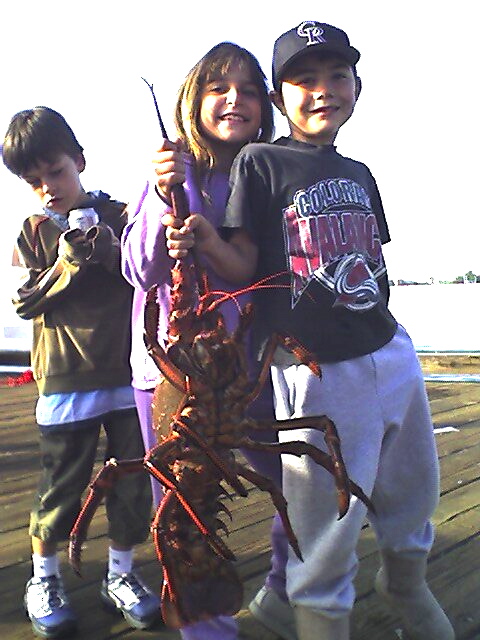 Persevering twins reap late reward of one giant lobster
One of the very best writers that I know from my time in the “Outdoor Writers Association of California” is San Diego’s Ed Zieralski. Here’s a story he wrote about a little lobster.
By Ed Zieralski, San Diego Union-Tribune, October 20, 2002
It was another marathon Saturday with dad, starting with a 6:30 a.m. tee time and finishing at midnight at the Oceanside Pier.
But it turned into a very special day for Blake and Garett Spencer, a pair of 9-year-old twins who teamed with their father, Todd, to catch a lobster of a lifetime.
“Saturday is my day with the boys, and we started with 18 holes at Temeku (Golf Course),” said Escondido’s Todd Spencer, manager of a collection agency.
From there, it was on to Oceanside Pier for some hoop-netting for lobsters, an activity the boys later told their dad they’d pick over playing video games.
“This was only our second time hoop-netting,” Spencer said. “We went at the end of last season and fished off Ocean Beach Pier. We didn’t get anything, but the boys loved it.”
Last Friday, the boys asked their father: “When are we going lobster hunting again?”
Spencer promised they’d go after his golf outing the next day. They packed their rig with items that don’t necessarily go together like ham and eggs: dad’s golf bag and gear, a couple of hoopnets and 21/2 pounds of mackerel for lobster bait.
Golf and hoop-netting, an outdoorsman’s daily double, for sure.
Golfing done, Spencer said they arrived at the Oceanside Pier at 6 p.m. and started fishing the windward side of the pier.
“We were the only ones with hoopnets, and I was beginning to think the Oceanside Pier wasn’t the right place to hoop-net for lobsters,” Spencer said.
He turned to his boys after a few hours of not getting anything and asked them, “Would you guys rather be home with your new X-Box games, or would you rather be out here on the pier fishing and not catching anything?”
They chose being on the pier over playing video games. This was more fun, and besides, it was quality time outside with dad.
“That made me feel pretty good,” Spencer said. “I’m from Northern California. I grew up in the foothills of Yosemite, out in the country. My kids are city kids, but they have the same interests I have. They love being outdoors.”
Shortly after their talk, Spencer switched to the leeward side of the pier, and the change produced two short lobsters, each about 1/4-inch short, just after 10 p.m. They sent them back like good sportsmen.
Another pick of the net produced a giant spider crab, about a 6- or 7-pounder, Spencer said. He was about to throw it back, but a man told him to keep it because it was very good eating.
“It looked nasty, but he said it was good,” Spencer said. “I cooked it later, and it not only looked nasty, it tasted nasty. Next time, it’s going back into the water.”
The spider crab provided a thrill to Spencer and his boys, and since it was getting close to midnight, Spencer felt it was time to go.
But then Spencer heard the cry of, “C’mon dad, one more pull, one more pull before we go.” “One more pull” to a hoop-netter is what “one more cast” is to a fisherman, what “one more shot” is to a bird hunter.
Spencer gave in. They made a set, left it for a while and made one more pull.
“It was the last pull of the night,” Spencer said.
And what a pull.
As the net came up, Spencer and his boys couldn’t believe their eyes. There in the net was what Spencer later called the “mutant lobster.” He never weighed the giant crustacean, but, including its antennae, the giant bug was at least 46 inches long, nearly as tall as his boys, who are 56 inches tall. He estimated it at 15 pounds.
California spiny lobsters have been known to go as high as 25 to 30 pounds. Biologists figure a lobster that big could be anywhere from 50 to 150 years old.
“I have a friend who dives, and he’s saying it’s a minimum of 15 pounds,” Spencer said. “I wish now I would have taken it to a supermarket or somewhere and weighed it,”
Spencer and his boys celebrated the next day with a lobster feast.
“You know how people say the big old lobsters are tough and not good eating,” Spencer said. “That’s not so. This lobster was tender and sweet. Really god eating.”
Looking back, Spencer said he likely would have quite around 9 p.m. had the boys chosen to go home to play video games.
“It was all because they wanted to stay,” Spencer said. “It was our day out. And what a fantastic day.”
California Yellowtail —
 Yellowtail caught at the Crystal Pier in San Diego by Angel Hernandez in September 2015
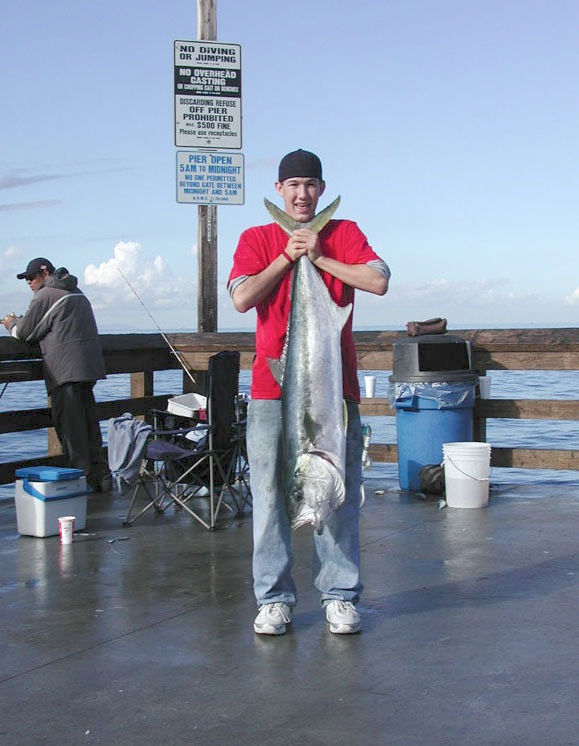 35-Pound yellowtail taken from the Balboa Pier by “Aaron”on November 1, 2003
Species: Seriola dorsalis (Valenciennes, 1833); from the Italian word seriola (for amberjack) and dorsalis (the long dorsal fin). Some sources now use Seriola lalandi.
Alternate Names: Yellowtail, amberjack, white salmon, amber fish, forktail, tails, rats (little fish), firecracker (small fish), mossback (large fish) and cavasina. In Mexico typically called esmedregal or medregal de rabo amarillo.
 Yellowtail from Crystal Pier, August 2016
Identification: Typical jack shape with metallic blue to green above, a brassy horizontal band along the sides from eye to tail; silvery below; some fish are olive-brown to brown. Fins and tail are yellowish
 Yellowtail caught at Crystal Pier on September 21, 2006 by Montre Somsukcharean; reported at 55 pounds. (Photo courtesy of Peggi Straker)
Size: To 80 pounds and over 5 feet long. Most caught from piers are less than 10 pounds, the small fish called “rats” or “firecrackers.” The California record fish weighed 63 lb 1 oz and was caught at Santa Barbara Island in 2000.
Range: Circumglobal in warmer waters and some temperate waters. In the eastern Pacific from Chile to northern British Columbia. Unverified reports from Gulf of Alaska off Kodiak Island and Cordova. Uncommon north of Point Conception.
 48.5-pound yellowtail caught at the Crystal Pier in August 2012 by Tony Troncale
Habitat: Usually found around offshore islands, rocky reefs, or kelp beds. Primarily feeds on squid and fish.
 40 Pound yellowtail taken by Angel Hernandez at the Crystal Pier on June 14, 2017
Piers: Most southern California piers located near reefs or kelp will see a few yellowtail caught during the year. However, they are always a bonus fish and rarely caught in large numbers off of piers. Best bets: Ocean Beach Pier, Crystal, Oceanside Pier, San Clemente Pier, Redondo Beach Pier, and the Hermosa Beach Pier. Cryastal Pier in San Diego is by far the best pier in the state for yellowtail and many fish in the 30-50 pound range have been taken.
 42-pound yellowtail caught at Crystal Pier— October 2004
Shoreline: Rarely taken by shore anglers.
Boats: One of the most prized species for boaters in southern California. The traditional “yellowtail grounds” have been at Catalina and the Coronado Islands.
 34-Pound yellowtail caught at Crystal Pier in August of 2012 by “Hallman”
Bait and Tackle: If an angler wants to try for yellowtail he should have heavy enough tackle to insure a fair chance of landing the fish. Yellowtail like to head for rocks or kelp as soon as they’re hooked so line should test 20-30 pounds, hooks should be small (size 6 or 4) but strong, and the angler must make sure the fish is played out before it nears the pier and the pilings. Although lures work well on boats, almost all of the pier-caught yellowtail are taken on live bait—especially on small jack mackerel, Pacific mackerel or Pacific sardines.
 A small “firecracker-size” yellowtail taken from the Redondo Sportfishing Pier in 2011
Food Value: A fairly good tasting fish that is usually broiled or bar-b-cued.
 34 Pound Yellowtail caught by Angel Hernandez at Crystal Pier, August 2016
Comments: One of the favorite southern California sport fish but much more common out in deeper water.
 What remains of a 54″, guesstimated 40-pound yellowtail that was hooked and then hit by a sea lion at the Redondo Beach Pier in October 2008
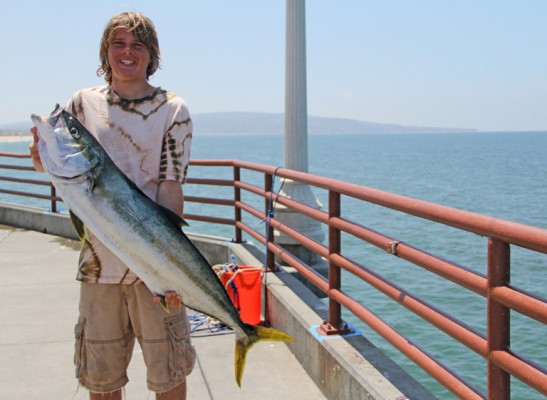 Yellowtail taken at the Manhattan Beach Pier in 2012
 46-Pound yellowtail taken at the Crystal Pier by Thomas Shinsato in August 2015

A small “rat-sized” yellowtail caught by Rita Magdamo during the James Liu Memorial Derby at the Cabrillo Mole in Avalon in September 2014
 Another small “rat-sized” yellowtail caught in Avalon. The fish was caught at the Green Pleasure Pier in September 2014 although the picture is at the Cabrillo Mole.
 A pretty-colored yellowtail taken at the Crystal Pier in August 2016
 Tony Troncale’s 48.5-pound yellowtail from Crystal Pier, August 2012
 Hard to believe, but a yellowtail taken from Monterey’s Wharf #2 in 2012.
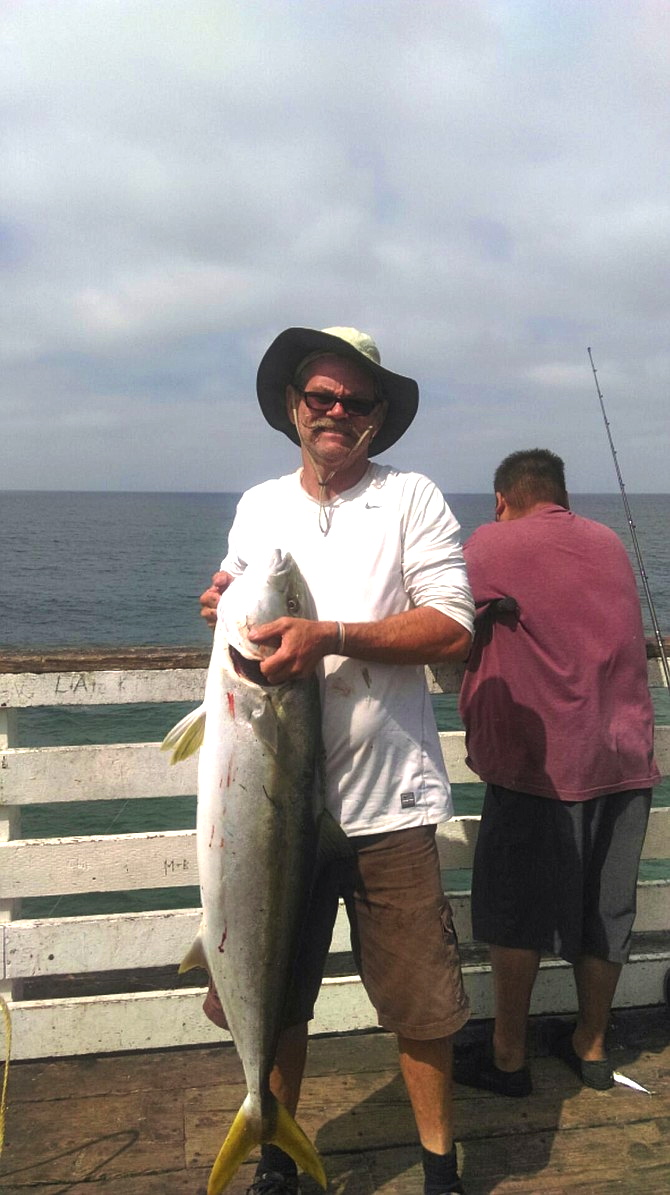 36-Pound yellowtail caught at Crystal Pier in August 2016 by Studman

53.46-pound yellowtail taken by Big Angel at the Crystal Pier in August 2019

Yellowtail taken by Angel at the Crystal Pier in August 2019

Yellowtail taken by Angel at the Crystal Pier in August 2019

53.46-pound yellowtail taken by Angel at the Crystal Pier in August 2019
 My very first yellowtail. Taken in San Diego many, many years ago.
 Aaron leaving the Balboa Pier with a 35-pound yellowtail in 2003
Some large yellowtai caught from piers
55 Lbs. — Crystal Pier (San Diego), Montre Somsukcharean, September 21, 2006—Source: Source: James Barrick, Crystal Pier Bait Shop & Peggi Straker
53.46 Lbs. — Crystal Pier (San Diego), Angel, August 12, 2019—Source Pam, Crystal Pier Bait Shop
52 ½ Lbs. — Pine Ave. Pier (Long Beach), D. W. Fletcher, September 19, 1896—Source: Los Angeles Herald, September 19, 1896
50 Lbs. — Pine Ave. Pier (Long Beach), Al Decker, July 1894—Source: Los Angeles Herald, July 3, 1894
48.5 Lbs. — Crystal Pier (San Diego), Tony Troncale, August 6, 2012—Source: James Barrick, Crystal Pier Bait Shop & Tony Troncale
46 Lbs. — Crystal Pier (San Diego), Thomas Shinsato, August 2015—Source: Source: Crystal Pier Bait Shop & Thomas Shinsato
42 Lb. 1 oz. — Oceanside Pier, Elmo Nealoff, July 1955—Source: Oceanside Pier Bait Shop
42 Lbs. — Crystal Pier (San Diego), October 2004—Source: James Barrick, Crystal Pier Bait Shop
40 Lb. — Crystal Pier (San Diego), Angel Hernandez, June 14, 1917 — Source: Personal communication
≈ 40 Lbs. — Redondo Beach Pier, October 2008 — Source: bloodydecks.com
40 Lbs. — Avalon wharf, W. M. LeFavor, May 21, 1908—Source: Los Angeles Herald, May 22, 1908
40 Lbs. — Wharf No. 3, Redondo Beach, Japanese fisherman, August 1907—Source: Los Angeles Times, August 18, 1907
40 Lbs. — Avalon wharf, Mrs. Boyce, June 9, 1897—Source: Los Angeles Herald, June 10, 1897
≈ 40 Lbs. — Redondo Beach Pier, October 2008—Source: bloodydecks.com
≈ 40 Lbs. — Hotel del Coronado Pier, September 21, 1899—Source: Los Angeles Times, September 22, 1899
40 Lbs. — Wharf No. 1 (Redondo Beach), Seth Owens, August 22, 1897 — Source: Los Angeles Herald, August 22, 1897
40 Lbs. — Avalon wharf, Mrs. Boyce, June 9, 1897 — Source: Los Angeles Herald, June 10, 1897
36 Lbs. — Crystal Pier (San Diego), August 2016—Source: Crystal Pier Bait Shop
35 Lbs. — Crystal Pier (San Diego), August 2012—Source: James Barrick, Crystal Pier Bait Shop
35 Lbs. — Balboa Pier, Aaron, November 1, 2003—Source: PFIC
34 Lbs. — Crystal Pier (San Diego), Hallman, August 2012 —Source: James Barrick, Crystal Pier Bait Shop
34 Lbs. — Crystal Pier (San Diego), Angel Hernandez, August 2016—Source: Angel Hernandez
34 Lbs. — Wharf No. 3 (Redondo Beach), William Codie, September 26, 1910 — Source: The Redondo Reflex, September 29, 1910
34 Lbs. — Avalon Wharf, Al Delaney, August 17, 1908 — Source: Los Angeles Times, August 16, 1908
33 ½ Lbs. — Wharf #3 (Redondo Beach), August 24, 1910—Source: Santa Ana Register, August 25, 1910
33 Lbs. — Newport Wharf, E. P. Deffley, May 1909—Source: Los Angeles Herald, May 22, 1909
32 ½ Lbs. — Redondo Wharf, August 23, 1891—Source: Los Angeles Herald, August 24, 1891
32 ½ Lbs. — Avalon Wharf, W. M. LeFavor, May 20, 1908—Source: Los Angeles Herald, May 22, 1908
30 Lbs. — Huntington Beach Pier, Earl Nelson, May 7, 1934—Source: Santa Ana Register, May 8, 1934
30 Lbs.— Hotel del Coronado Pier, Joe Larnel, August 31, 1898—Source: Los Angeles Times, September 1, 1898
Blog Archives
- September 2025 (1)
- August 2024 (1)
- September 2023 (1)
- September 2022 (1)
- April 2022 (5)
- September 2021 (1)
- February 2021 (1)
- January 2020 (1)
- August 2019 (1)
- January 2019 (1)
- October 2018 (1)
- September 2018 (2)
- August 2018 (1)
- June 2018 (3)
- April 2018 (10)
- March 2018 (22)
- February 2018 (3)
- January 2018 (4)
- December 2017 (2)
- November 2017 (2)
- September 2017 (3)
- August 2017 (2)
- July 2017 (5)
- June 2017 (3)
- May 2017 (5)
- April 2017 (1)
- March 2017 (4)
- February 2017 (1)
- January 2017 (2)
- December 2016 (5)
- November 2016 (10)
- October 2016 (33)
- September 2016 (13)
- August 2016 (1)
- February 2016 (1)
- January 2016 (1)
- November 2015 (1)
- October 2015 (3)
- September 2015 (4)
- August 2015 (27)
- July 2015 (1)
- May 2015 (7)
- April 2015 (13)
- February 2015 (1)
- January 2015 (1)
- December 2014 (2)
- November 2014 (16)
- October 2014 (4)
- September 2014 (8)
- July 2014 (1)
- June 2014 (1)
- May 2014 (2)
- April 2014 (1)
- February 2014 (3)
- December 2013 (3)
- October 2013 (1)
- September 2013 (1)
- August 2013 (1)
- July 2013 (1)
- June 2013 (1)
- April 2013 (1)
- March 2013 (21)
- February 2013 (2)
- May 2012 (1)
- March 2012 (7)
- February 2012 (5)
- January 2012 (8)
- December 2011 (4)
- October 2011 (4)
- September 2011 (1)
- August 2011 (3)
- July 2011 (5)
- June 2011 (1)
- April 2011 (1)
- March 2011 (5)
- February 2011 (2)
- January 2011 (2)
Support Ken Jones
If you appreciate Ken's writings on fishing, please consider making a donation for this unique content. Your support will help Ken to continue publishing knowledgeable and entertaining articles.
Pier Fishing in California, 2nd Ed.

The ultimate pier fishing resource for Pacific Coast pier anglers with Over 350 new photos and illustrations added to this edition, including detailed, species-specific illustrations of fish-cleaning, rigging illustrations, and maps. The history and culture of each pier is thoroughly covered.
Buy the book from pierfishing.com or Amazon!
Recent Photos