Saltwater Fishing
Cabezon — King of the Sculpin

A nice cabezon from the Redondo Sportfishing Pier
Species: Scorpaenichthys marmoratus (Ayres, 1854); from the Greek words scorpaena (a related species) and ichthys (fish), and the Latin word marmoratus (marbled).
 Great picture of a cabezon caught from the rocks in Mendocino County by FireRidge in 2016
Alternate Names: Commonly called bullhead; also marbled sculpin, cab, cabby, bull cod, blue cod, giant sculpin, giant marbled sculpin, scorpion, marble sculpin, salpa and scaleless sculpin. Called scorpion or biggy-head by 19th century Italian fishermen.
 A cabezon at the Trinidad Pier
Identification: Cabezon have a very large head with a broad bony support from the eye across the cheek, no scales, a cirrus (fleshy flap) on the midline of the snout, and a pair of longer cirrus just behind the eyes. The coloring is brown, bronze, reddish, or greenish above, whitish or turquoise green below, with dark and light mottling on the side. The lining of the mouth is a translucent turquoise green. The color may correlate to their sex with 90% or greater red-colored cabezon being males, 90% or greater green-colored cabezon being females. The mouth is broad with many small teeth.
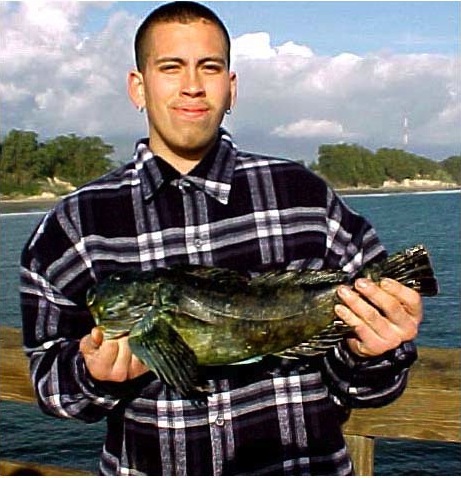 A cabezon from the Goleta Pier
Size: To 39 inches and 25 pounds; most caught from piers are less than two feet. The California record cabezon was a fish weighing 23 lb 4 oz; it was taken near Los Angeles in 1958. The cabezon is the largest member of the cottid (sculpin) family.
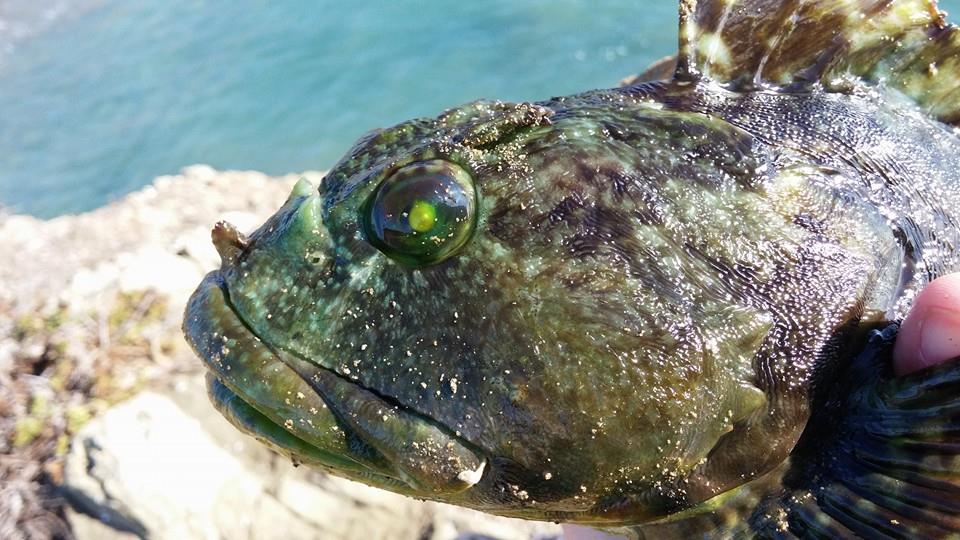 Up close and personal with a cabezon’s head — picture taken by ChemFish in 2014
Range: Punta Abreojos, central Baja California, to Samsing Cove, near Sitka in southeastern Alaska.
 A Goleta Pier Cabezon
Habitat: Typically found in shallow-water rocky areas, from intertidal pools to jetties, kelp beds and rocky reefs, any area with dense algal growth. Older fish tend to move to deeper water, as deep as 250 feet. Typically inhabits the tops of rocky ledges as contrasted with rockfish and lingcod that prefer the sheer faces of ledges. Cabezon like to sit and it doesn’t seem to matter if it’s in a hole, on the reef, or on vegetation, they sit versus actively swimming.
 A cabezon taken from the Cabrillo Mole in Avalon on Catalina Island in 2012
Piers: Cabezon are one of the premier fish for northern California pier anglers with lesser numbers taken from southern and central California piers. Best bets: Cabrillo Pier, Goleta Pier, Monterey Coast Guard Pier, Santa Cruz Pier, San Francisco Municipal Pier, Point Arena Pier, Trinidad Pier and Citizens Dock (Crescent City).
 A cabezon from the Elephant Rock Pier in Tirburon
Shoreline: A favorite catch for rocky shore anglers throughout California. A small cabezon from the Elephant Rock Pier
Boats: A prize species for boaters in central and northern California.
 Another small cabezon from the Elephant Rock Pier
Bait and Tackle: Although most of the cabezon caught from piers will be fairly small fish less than two feet in length, most years also see some larger fish in the 8-12 pound category. Because of this, you should use at least medium sized tackle; line testing at least 15 pound breaking strength and hooks around 2/0 in size. The best baits are small crabs and fresh mussels but cabezon will bite almost anything that looks like food. Their normal diet includes crabs, small lobsters, abalone, squid, octopus, small fish and fish eggs. Although they often reach good size, they can be frustrating to catch. Cabezon will often tap or mouth bait and spit it out; patience and a feel for when to set the hook is required. Also remember that cabezon like to congregate around “cabezon” holes; if you catch one, there will often be more around.
 A Monterey Cabezon from the Coast Guard Pier
Food Value: Excellent mild-flavored meat that can be prepared in almost any manner; many feel it is best fried. Although few fish are better eating, anglers should not eat the roe (eggs) of cabezon—the eggs are poisonous and can make a person violently ill. Don’t worry if the flesh is blue colored, this is a common occurrence and the flesh will turn white when cooked.
 A cabezon from the Point Arena Pier — 1988
Comments: A “lie-in-wait” predator. Their coloring lets them blend in with the surroundings where they lie motionless. When food passes by they use their large, powerful pectoral fins and tails to lunge after the prey engulfing it in their large mouths. In Spanish, cabezon means big headed or stubborn and it well describes both their looks and temperment. Cabezon can live to about 20 years of age and I imagine an old cabezon would be a real grouch.
 A cabezon caught by “Dwight” at Citizens Dock in Crescent City in 2013
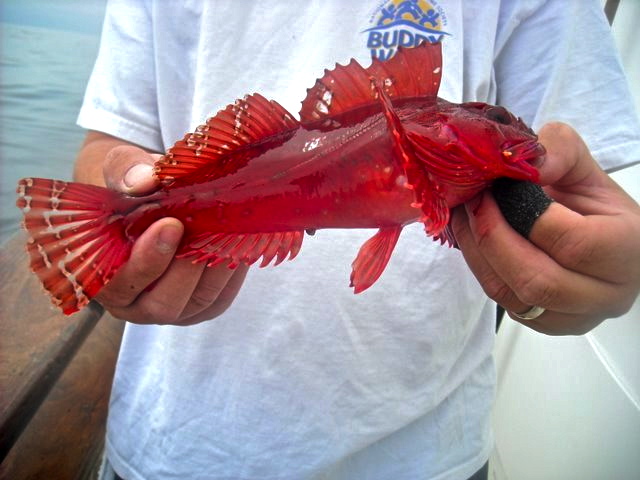 A beautiful red-colored cabezon (Picture courtesy of makairae)
 A SoCal cabezon caught at the Santa Monica Pier
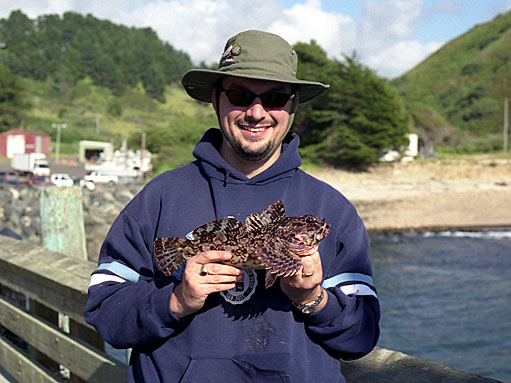
A Point Arena Pier cabezon caught by Dan
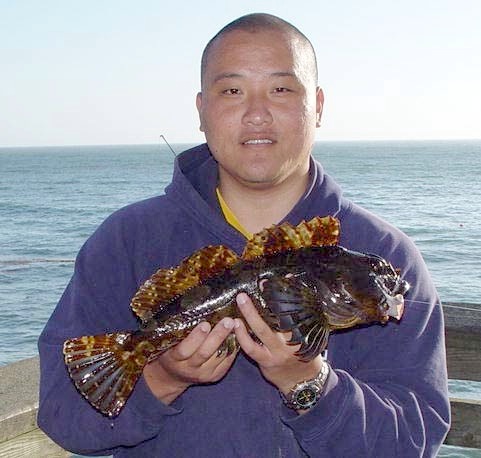
Cabezon taken at the Point Arena Pier by calrat in 2003
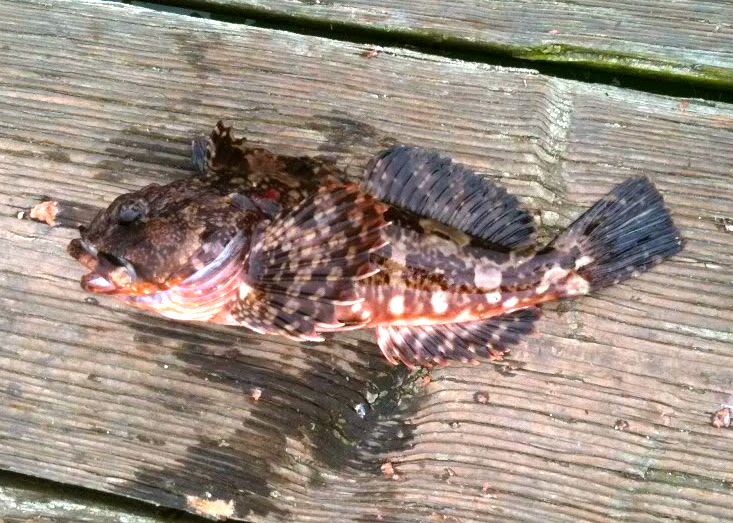
A cabezon caught by norcal at the Pillar Point Pier in 2012
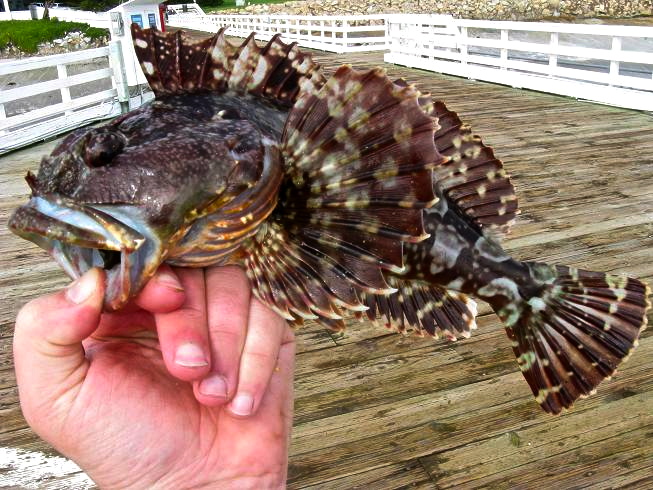 A cabezon taken at the Stillwater Cove Pier by Freeman in 2010
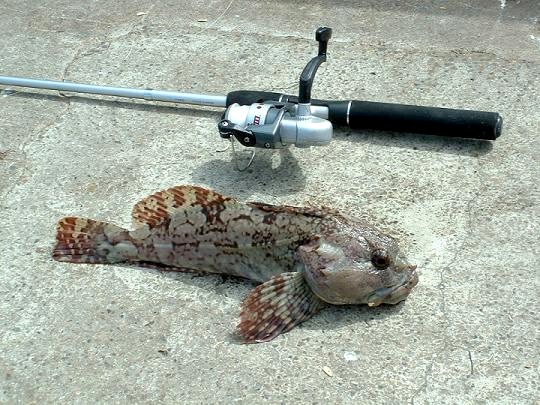 A cabezon from the Ocean Beach Pier in San Diego in 2010
 A “baby” cabezon, this one from Citizens Dock in Crescent City in 2015
 A juvenile cabezon, this one a product of the small pier at Brookings Harbor, Oregon
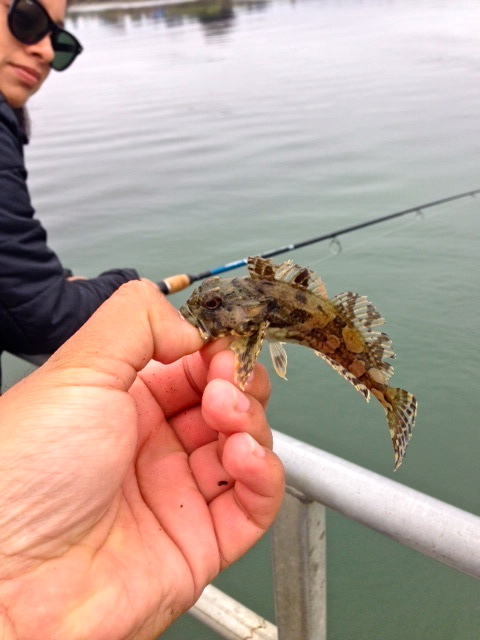 And the winner in the smallest fish category — a cabezon taken at the Del Norte Street Pier in Eureka by qchris87
 A cabezon caught at the Trinidad Pier Kids Derby in 2013
 Another cabezon caught at the Trinidad Pier Kids Derby in 2013
 A cabezon caught at the Trinidad Pier Kids Derby in 2014
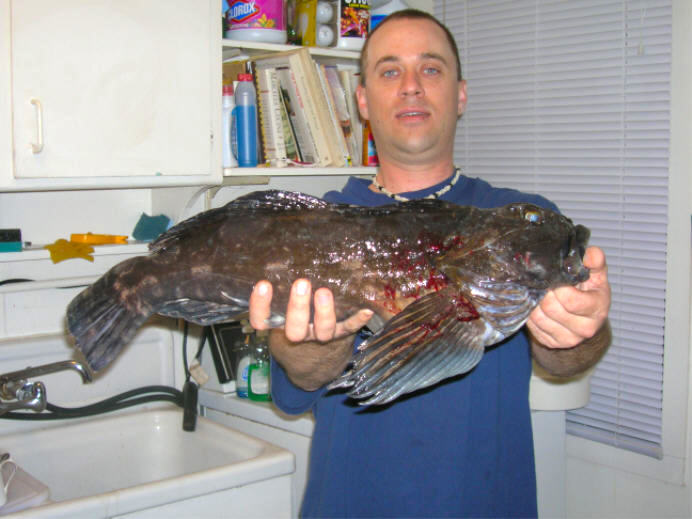 A large cabezon caught by Sebastes2 in 2009

Oceanside Businessman Pulled from Pier —
Angler Fails To Land Fish — Large Catch Wins in Fight For Freedom — Rescuers Save Fisherman from Drowning
 Oceanside Pier — 1935
Oceanside, July 17—When a big fish, hooked off the end of the Oceanside pier about 6:30 o’clock last evening, decided he did not like fishermen and did not want to leave his happy home in the waters of the Pacific, he came very near making one less fisherman instead of one less fish.
C.A.Peddicord, Oceanside businessman, intent upon catching a large fish, bought brand-new fishing tackle, baited the hook with a pound and a half mackerel, and proceeded to wait. He caught it all right, but the fish objected to being taken from the water and proceeded to throw Peddicord over the railing of the pier, break his leg, land him in the deep water, and leave him to flounder desperately to keep afloat until he was saved by Cal Young coming to his rescue in a skiff and getting him aboard. Just before the skiff arrived to avert a drowning tragedy, Jim Donnell, popular high school graduate of this year, made a quick dash for a life preserver near by and threw it to the struggling man. He could not reach it, however, but the appearance of a man below the pier encouraged the drowning man just enough that he continued to fight to keep above water until he was rescued.
Peddicord had fished more or less for years, but had never caught a big fish. He got the heavy tackle with the intention of getting the thrill of the big-fish catch. As he waited for the fish to bite, he received instructions about how to set his drag, not too heavy, he was told, and learned how to hold the rod. He waited and waited but the fish seemed unconcerned so he tightened up his drag a few turns and thought it would be easier to slip the pole under his leg and be ready for business if any surprise came. The surprise arrived and he proceeded to reel in his fish and had it fairly up to the pier when it made a dart underneath. He leaned over to see what was happening down there when the fish gave a big lurch and Peddicord made a flip over the rail, the pole acting as a lever, the fish on the long end, he on the short. As he went over he grabbed for support, struck his leg on the cross beam of the pier, breaking his leg halfway between the ankle and the knee.
Just what kind of a fish it was that he caught is unknown. He had a regular jewfish outfit, but it is believed not to have been a jewfish that put on this surprise exhibition of fish ingenuity and activity.
Los Angeles Times, July 18, 1930
Great Whites & Makos —
Stories like the following seem to crop up every few years, especially at piers in Santa Monica Bay such as Hermosa Beach Pier and the Manhattan Beach Pier. Great whites are illegal, makos are legal, and too many fisherman don’t make the effort to learn the differences.
Great white shark isn’t a great catch
By Ed Zieralski, San Diego Union-Tribune, June 10, 2003
A Los Angeles fisherman who caught a 1-to 2-year-old great white shark from the Hermosa Pier will be cited by the State Department of Fish and Game for killing a protected species.
Abraham Ulloa, a general contractor from Los Angeles, posed with the estimated 61/2 -foot white shark on the pier June 7 along with two Hermosa Beach lifeguards.The photo appeared with a story in the Easy Reader, a Hermosa Beach newspaper, and even though the caption identified the catch as a “200-pound mako,” the story and headline identified it as a “great white shark.”
The story described Ulloa’s two-hour battle with the shark on 40-pound test line and heavier leader and how two fishing buddies helped haul the fish up with grappling gaffs.
 Abraham Ulloa and his shark
Outraged by the story and photo, sport and commercial fishermen called Fish and Game officials and media. Many criticized the Hermosa Beach lifeguards for their involvement.” We received a lot of tips from the public on this,” said Carrie Wilson, a marine biologist with the DFG. Lauren Gangle,notified her supervisors at California DFG. She works as a Pacific States Marine Fisheries Commission regional supervisor and is graduate student in marine biology. Mrs. Gangle collects data from commercial fisherman without their fear of any report of mismanagement. Ms. Gangl was present in Hermosa Beach at time of the capture of the Great White and contacted Ms. Wilson to report data. “Lauren gave me data and then I decided to proceed with violation proceedings.”
Department of Fish and Game warden Rebecca Hartman investigated and traced Ulloa to his home in Los Angeles. Ulloa told her his family had eaten some of the fish, and he had distributed portions to friends. But he still had the fins and jaws of the shark. Hartman didn’t cite Ulloa because he claimed he thought it was a mako shark. She confiscated the fins and jaws and took them to a marine biologist for identification.”At that young age, the teeth are somewhat like a mako’s, but the great white has serrated bottom teeth,” Lowe said. “And its uppers are more triangular than a mako’s.”
Hartman plans to cite Ulloa even though he professed ignorance. “It’s a violation even though he claims he didn’t know what it was,” Hartman said. “The law is set up to protect the animal. If you don’t know what it is, don’t take it. In this case, this individual took a great white shark, a predator that keeps sea lions in check and fills a certain niche in the ocean.”
Ulloa could not be reached for comment. He faces a misdemeanor charge, a fine of $1,000 and/or six months in county jail. Hartman said the Hermosa Beach lifeguards in the picture with Ulloa won’t be charged because they arrived after the shark was killed. They played no role in the killing of the fish, she said. Lifeguards Charlie Piccaro and Bill “Shark” Harkins’ only “crime” is they posed with Ulloa over a dead protected great white shark.
Lowe said Southern California is a nursery for great whites, and he estimates six to eight young great whites are caught each year by sport and commercial fishermen between Dana Point and Ventura.*** He said it’s important that laws stay in place to protect them. “The best guess is that great white sharks take 12 to 18 years to mature and give birth,” he said. “And when they do give birth, it’s only to one or two pups at a time. These fish have a life span of humans.” *** I think the number has gone up since then.
•••••••••••••••••••• Great White Shark ••••••••••••••••••••
 Species: Carcharodon carcharias (Linnaeus, 1758); from the Greek carcharodon (rough and tooth), and carcharias (the ancient Greek name for the species). Class Chondrichthyes, Subclass Elasmobranchii, Superorder Galea, Order Lamniformes, Family Lamnidae—Mackerel sharks.
Alternate Names: It has many names throughout the world. Most common are great white and man-eater. Others include great white death, white pointer, Mango-ururoa (New Zealand), and Grand requin blanc (France). Called Tiburón blanco in Mexico.
 Identification: Large, powerful body with the 1st dorsal fin over rear of of pectoral fin; 2nd dorsal fin begins in front of anal fin. Dark metallic-gray, slate-blue, brownish or blackish above, lighter on side, white below. Sometimes has a black spot at the base of the pectoral fin or on the underside of the pectoral fin near the tip. The teeth are very large and triangular, with serrated, saw-tooth edges.

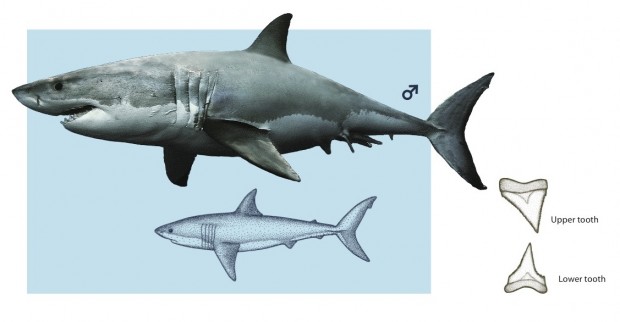 Size: Although reported to 36 feet, and over 4,000 pounds in weight, most are under 21 feet in length. In California reported to nearly 20 feet in length.
Range: From Gulf of California to Gulf of Alaska.
Habitat: Inshore and offshore areas, especially near seal or sea lion rookeries.
Piers: White sharks have been taken at several piers including those at Manhattan Beach, Hermosa Beach, Huntington Beach and Goleta. A great white was reported hooked and lost at the Pacifica Pier in 1991. Almost all were young pups under six feet in length although the one that decided to visit Pacifica grabbed a hooked salmon of ten pounds or so and was estimated at 12 feet in length and 700 pounds. The carcass of a small, four-foot-long baby white floated by the Point Arena Pier in March of 1997 until grabbed by a couple of the local local youth.
Bait and Tackle: None, illegal to take
Food Value: None, illegal to take.
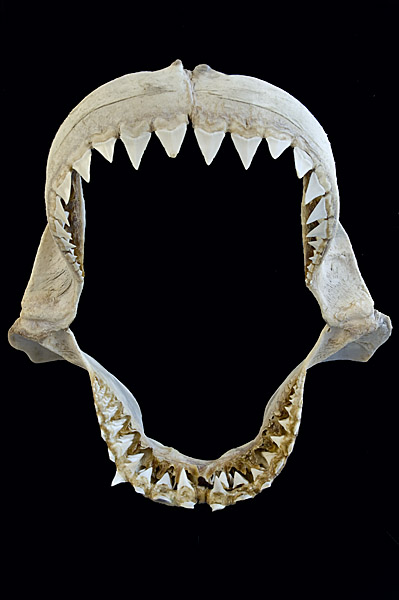 Comments: Among the swimmers killed by great whites in California was one who decided to swim with the sea lions next to the Avila Beach Pier. It was a bad idea.
Great quote by Quint in “Jaws” — Sometimes that shark, he looks right into ya, right into your eyes. Y’know, the thing about a shark, he’s got lifeless eyes, black eyes, like a doll’s eyes. When he comes after ya, he doesn’t seem to be livin’ until he bites ya, and those black eyes roll over white, and then – aww, then you hear that terrible high-pitch screamin’, the ocean turns red, and in spite of all the poundin’ and the hollerin’, they all come in and rip ya to pieces…
•••••••••••••••••••• Shortfin Mako ••••••••••••••••••••
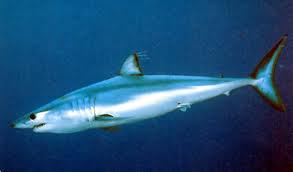 Species: Isurus oxyrinchus (Rafinesque, 1810); from the Greek word isurus (equal and tail) and the Greek word oxyinchus (sharp snout). Class Chondrichthyes, Subclass Elasmobranchii, Superorder Galea, Order Lamniformes, Family Lamnidae—Mackerel sharks.
Alternate Names: Mako is the work used by the Maori in New Zealand to describe sharks, but this is another shark with many names. In California it’s often called bonito shark, mackerel shark, or simply mako. Also called blue pointer, bue dynamite paloma, spriglio, sharp-nosed shark, pointed-nose shark, and snapper shark (Australia). Called Tiburón marrajo, in Mexico.
Identification: Body more slender than great white. A long, conical-shaped snout with the 1st dorsal fin beginning or slightly behind the rear corner of the long pectoral fin; 2nd dorsal fin small, beginning slightly ahead of the anal fin. A prominent keel on the sides of the caudal peduncle extending from the tail to a point above the pelvic fins. Dark gray or metallic-blue above and on the sides (fading to gray after death), white below. Has a black spot at the base of the pectoral fin. Fang-like, non-serrated teeth.
 Size: To 13 feet and over 1,530 pounds; a mako caught by commercial fishermen in Massachusetts in 1997 weighed 1,530 pounds—after being gutted. Most makos seen in California are 6-8 feet long.
Range: Gulf of California to Columbia River, Oregon but rare north of Point Conception.
Habitat: Epipelagic, aka sunlit or euphotic zone, the top layer of the ocean zones. Typically found in the open ocean, from the surface down to 492 feet, but will also occasionally venture inshore. Eats pelagic schooling species such as mackerel and sardines but also will eat squid, other sharks, dolphin, and even billfish; mako are considered apex predators.
Piers: Uncommonly seen at piers but several have been reported from Santa Monica Bay piers—Hermosa Beach Pier, Manhattan Beach Pier, Venice Pier and the Santa Monica Pier. Makos have also been reported from the San Clemente Pier and Belmont Pier.
Bait and Tackle: Taken on live bait, especially live mackerel. Will also hit trolled mackerel and lures. Usually taken in deeper water with hooks size 6/0-10/0. Makos are the fastest swimming sharks reaching a sustained swimming speed exceeding 22 mph and spurts of nearly 50 mph. They are considered a top sportfish often leaping like a billfish when hooked.
Food Value: Good eating. According to Raymond Cannon in his excellent book How to Fish the Pacific Coast, “thousands of pounds of bonito shark were sold during the meat scarcity in city markets and served in restaurants as ‘swordfish’ and ‘sea bass’ at fresh-fish prices.”
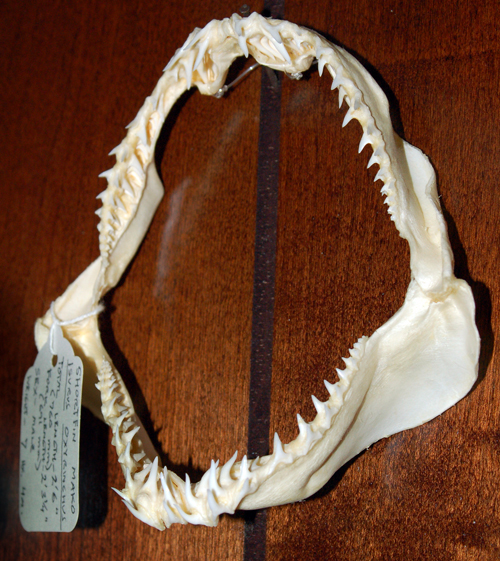 Comments: Richard Ellis in his excellent book, The Book of Sharks, writes, “The mako is the quintessential shark. It is probably the most graceful of all sharks, the most beautifully proportioned, the fastest, the most strikingly colored, the most spectacular game fish, and one of the meanest-looking animals on earth.”
Opaleye
Sea Chubs—Family Kyphosidae
 A chubby opaleye taken at the Cabrillo Mole in 2009
Species: Girella nigricans (Ayres, 1860); from the French word girelle (a derivative of julis, an old word used to denote a number of small wrasse in Europe), the Latin word nigr (dark) and the Greek word ikanos (becoming, in reference to its pleasing appearance).
Alternate Names: Blue-eye perch, green perch, opaleye perch, bluefish, blue bass, greenfish, Jack Benny, Catalina perch, button-back, button-eye, and button bass. Called chopa verde in Mexico.
 An opaleye from the Oceanside Harbor Pier caught in 2009
Identification: Opaleye are perch-shaped but heavier bodied. Their coloring is usually dark olive green and commonly they have two light spots at the base of the dorsal fin. Some fish are pale green or bluish-green while a few almost all white fish have been observed. The eyes are distinctive: large and an opalescent, blue-green color.
 An opaleye’s head
Size: To 25.4 inches and 13.46 pounds (a 10-11 year old fish that was speared by David Williams off south Laguna Beach (near Aliso) in 1964). That monster-sized fish, more than double the size of the previous state record, shattered the belief of biologists who had felt that opaleye only reached about six pounds in size. It may be a freakish-record that stands for a long, long time. The California “rod and reel record” fish weighed 6 lb 4 oz and was taken near Los Flores Creek in Malibu in 1956. Most opaleye caught from piers are less than 14 inches in length.

KJ and an opaleye caught at the Cabrillo Mole in 2007
Range: Cabo San Lucas, southern Baja California and the Gulf of California to Otter Rock, Oregon. Uncommon north of Point Conception.
Habitat: Shallow-water, rocky areas and kelp beds.

Minnow Magnet and a nice opaleye taken from the Cabrillo Mole in 2009
Piers: Can be caught from almost any pier in southern California located near rocks, reefs, or kelp. Less common north of Point Conception although taken occasionally at piers in Morro Bay. Uncommon north of Cayucos but a population seems established near the Coast Guard Pier in Monterey. Considered rare north of Monterey. Best bets: Shelter Island Pier, Ocean Beach Pier (inshore), Oceanside Pier, Oceanside Harbor Pier, Dana Harbor Pier, Cabrillo Pier (jetty side), the Green Pleasure Pier and Cabrillo Mole (Avalon), Redondo Sportfishing Pier, and Paradise Cove Pier. Most of the fish caught at SoCal piers are fairly small to mid-size opaleye. The exceptions are the two piers in Avalon that almost always have good-sized fish available for the opaleye-seekers.
 An opaleye from the Green Pleasure Pier in Avalon, 2017
Shoreline: One of the main goals of rocky shore anglers in sourthern California.
Boats: An inshore species rarely taken by boaters unless targeting them at places such as jetties and breakwaters.
Bait and Tackle: Some anglers specialize in opaleye, and many of them swear that moss or frozen peas are the best bait. I’ve actually caught more on ghost shrimp but I must admit that I’ve watched, many a morning, while a group of opaleye “pros” from Los Angeles (I recognize them by now) were filling large coolers with opaleye at the Cabrillo Mole and they almost always use moss as their bait du jour. I think all three baits are excellent for opaleye (although the ghost shrimp are more expensive). Fresh mussels, pile worms, bloodworm, and small rock crabs also make good bait. I also managed to hook a few opaleye using garden snails during an experiment testing different baits at Catalina in 2005. Medium tackle works fine but use a light line, small hooks, and fish the bait under a float of some type since the opaleye will be a mid-depth.
 Opaleye caught at the Green Pleasure Pier by Mahigeer in 2011
Food Value: A good eating fish that is generally fried.
Comments: Primarily herbivores (vegetarians), opaleye eat a variety of plants including feather boa kelp, giant kelp, sea lettuce and coralline algae. Evidently they also grab organisms attached to seaweed as they’re making their rounds, tasty little items like tube worms and red crabs. Opaleye are a favorite of many anglers; they’re hard to hook but once hooked put up a very good fight for their size.
The crystal-clear waters at Avalon present quite a challenge for the sagacious, line-shy opaleye. Big schools of 2-4 pound fish hang around the Green Pleasure Pier and the Cabrillo Mole but they can be very hard to catch. They seem more cautious of line at the Green Pleasure Pier but if you use a light line, perhaps 2-4 pound fluorocarbon, you might get them. (Actually, to be fair, I catch them every year at the Pleasure Pier and I usually am using 8-10 fluorocarbon). Of course the 1,794 ropes, tangled lines, pilings, floats, shore boats and yellow submarines that surround and hang under the GPP might also get your line.
At the Mole it’s the long fronds and blades of the giant kelp that sway (tidally) in or out near the railing. If the opaleye are allowed to encircle the kelp it’s pretty much over. As soon as they are hooked apply pressure and try to keep them coming toward you while having a person ready with a net. You need to use light line but can also pay the consequences if you’re unwilling to apply enough pressure.
 A large opaleye taken at the Cabrillo Mole in 2014
The opaleye “pros” who come over to Catalina from Los Angeles take the ferry over for one day, fish exclusively at the Mole, fish for one species—opaleye, and are almost always successful (coolers are crammed with fish). You learn from such experts and a few things should be mentioned. The first is that the opaleye are typically at a mid-water depth, five to ten feet under the surface of the water depending upon the depth of the water. They are rarely caught on top and infrequently caught on the bottom (although I’ve caught several fishing on the bottom at night and they are often caught on the bottom by anglers casting out from jetties). Second is that if you want to fish the correct depth a float is desirable and long slip-line floats are the preferred tackle for the opaleye hunters (although bobbers will also work). Third is when you see the float go down, strike and, as mentioned, try to keep the fish out of the kelp. Fourth is that light line (preferably fluorocarbon) and small hooks (size 6 or smaller) are key.
 An opaleye from the Cabrillo Mole in Avalon in 2016
Opaleye, especially the older, larger fish can be frustratingly difficult to catch. Chum with peas and a whole school may come up to check out the bait and fish after fish will approach the bait before turning away in seeming disapproval. But, the challenge of out smarting the fish is part of the fun.
 An opaleye caught by Amanda at the Cabrillo Mole in 2013
 KJ and an opaleye caught at the Green Pleasure Pier in 2014
 Mahigeer and an opaleye taken at the Green Pleasure Pier in 2010
 Opaleye taken at the South T-Pier in Morro Bay in 2018
 Large opaleye taken at the Palos Verde rocks by dcc in 2008
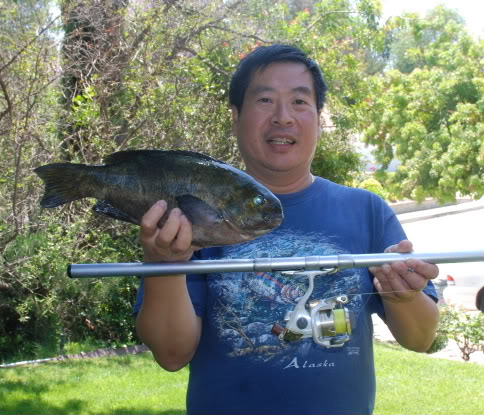 Large opaleye taken at the Palos Verde rocks by dcc in 2008


 Four pictures of opaleye taken from the Palos Verde rocks by dcc in 2009

KJ and an opaleye from the Green Pleasure Pier in Avalon in 2015
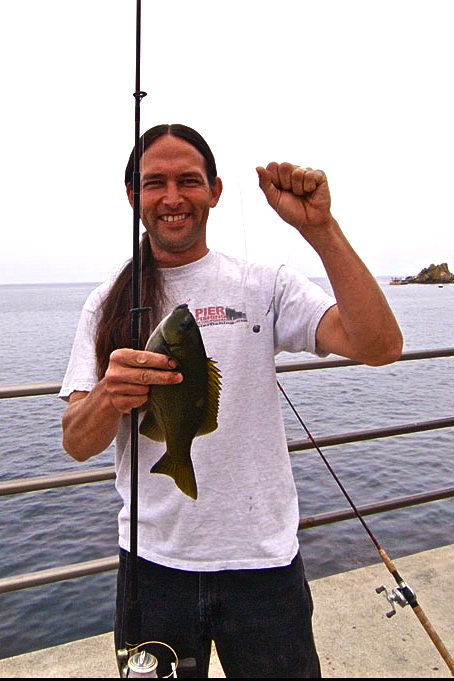 Jimbojack and an opaleye from the Cabrillo Mole in 2006
 Brightly colored opaleye from the Shelter Island Pier in San Diego in 2009
 Less colorful opaleye from the Redondo Sportfishing Pier in 2002
Garibaldi aka Ocean Goldfish — “Don’t keep ‘em”

Garibaldi
Species: Hypsypops rubicundus (Girard, 1854); from the Greek word hypsypops (high area below the eye) and the Latin word rubicunda (red).
Alternate Names: Golden perch, ocean sunfish and ocean goldfish. In Mexico called jaqueta garibaldi. As for the name garibaldi, it apparently was a name bestowed upon the fish by California’s Italian commercial fishermen in the 1800s. Giuseppe Garibaldi was one of the main leaders in the unification movement to create an Italian nation and his followers were known as the “Redshirts” for the bright red shirts they wore. He was considered a hero to Italians throughout the world and apparently the fish, at least to some, were reminiscent of those red shirts.
Identification: Garibaldi are easily distinguished by the brilliant golden-orange coloring on the whole body and are considered by many the prettiest fish in our coastal waters. They are perch-shaped but very deep-bodied with large fins. The young (up to about 6 inches in length) are reddish orange with bright blue spots.
 A juvenile garibaldi
Size: To 14 inches (some books say 15 inches) but most pier-caught fish are under a foot in length.
Range: Bahia Magdalena, southern Baja California to Monterey Bay. Uncommon north of Santa Barbara and rare north of Point Conception. Very common at Catalina Island (which is sometimes referred to as “Garibaldi Central” by scientists and divers).
 My daughter Kim and a garibaldi at the Mole in 2003
Habitat: Generally found in shallow-water, rocky-shore areas although they have been encountered down to a depth of almost 100 feet. Fitch and Lavenberg, Tidepool and Nearshore Fishes of California, report that “A wide variety of food items has been found in garibaldi stomachs, including sponges, sea anemones, bryozoans, algae, worms, crustaceans, clams and mussels, snail eggs, and their own eggs.” No wonder it is sometimes hard to keep them off a hook even though they’re illegal to keep.
Piers: Often hooked at southern California piers located near kelp beds or rocky reefs. Best bets: Oceanside Harbor Pier, Dana Harbor Pier, Redondo Harbor Sportfishing Pier, and the three main piers on Catalina island—the Green Pleasure Pier and Cabrillo Mole at Avalon (where it’s hard not to hook them), and the Isthmus Pier at Two Harbors.

My son-in-law Dave and a garibaldi at the Mole in 2003
Bait and Tackle: None since they are illegal to take.
Food Value: None since you can’t keep them (and they aren’t supposed to taste very good anyway)!
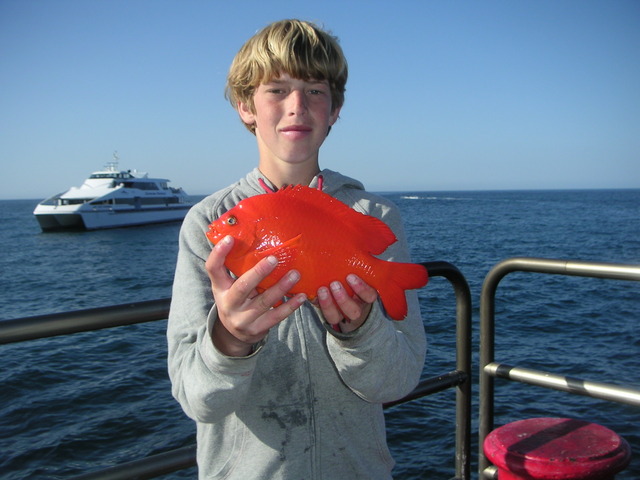 Minnow Magnet with a garibaldi at the Mole in 2009
Comments: Although pretty to look at, they are pugnacious, strong, and not the friendliest fish. They are extremely territorial and will defend fairly large areas. This is especially true during the spring-summer spawning season when males will build a nest and defend it against intruders, both fellow male garibaldi and other species (including humans). Apparently the cute little missy garibaldi are an exception and allowed to invade those spaces and deposit their eggs.
It is illegal to keep these fish, but why? As related to me by a Fish and Game official, the campaign to make them illegal originated in Avalon. It seems that the glass bottom boats, a popular attraction at Avalon on Catalina Island, were worried that anglers (actually divers) were taking far too many of the beautifully colored fish and that it was bad for their business (since garibaldi are one of the most viewable fish from the boats).
According to records, in January 2, 1953 the California Department of Fish and Game presented proposals to “prohibit skin dive fishing along the waterfront of Avalon, Santa Catalina Island.” The proposal was based upon a similar proposal from the Santa Catalina Island Company. That proposal was met with opposition from spear fishermen so the proposed regulation was modified into a statewide prohibition on the recreational take of garibaldi. On January 30, 1953 the California Fish and Game Commission adopted the prohibition against the take or possession of garibaldi by angling or diving (Title 14, CCR, 28.05).
Thus the take of garibaldi by anglers in California has been illegal for over 60 years. However, a limited commercial take of garibaldi was permitted until 1995 when the legislature passed a bill (which Governor Wilson signed) placing a three-year ban on the commercial collection of garibaldi. Eventually the ban was made permanent.
The 1995 legislation also made the garibaldi the official “marine” or saltwater fish of California. Golden trout remain the “freshwater” fish.
Today, most anglers return the fish to the water if they’re mistakenly hooked. Nevertheless, some continue to be speared illegally. It seems colorful fish are required at the wedding dinner tables of some Pacific Islanders and garibaldi are a favorite. Once again long-time cultural tradition clashes with today’s rules.
 Yours truly and a garibaldi at the Cabrillo Mole
The Finny Bachelor by W. E. Cortissoz
I know a little garden, Beneath a green-gold sea
Where bright, bronze plants are growin’, And grow so gracefully.
Amidst their undulations, A flash of gold I spied;
And in and out the waving, Kelp it seemed to hide.
It was a little gold-fish, Who lived there all alone,
In this most lovely garden, In the Bay of Avalon.
Day after day I find him, Alone in his domains;
He darts, then lingers, to and fro, And in his garden reigns.
I see that he is happy, And that—his praise’ to One,
Who caused his life to happen, In the Bay of Avalon.
“Neath the music of the waters, In his garden of the sea,
Long may that garden denizen, Enjoy immunity.
Immunity from humans, And maws of ev’ry gauge;
I want my little goldfish, To pass away from age!
Catalina Islander, March 26, 1924
Blog Archives
- September 2025 (1)
- August 2024 (1)
- September 2023 (1)
- September 2022 (1)
- April 2022 (5)
- September 2021 (1)
- February 2021 (1)
- January 2020 (1)
- August 2019 (1)
- January 2019 (1)
- October 2018 (1)
- September 2018 (2)
- August 2018 (1)
- June 2018 (3)
- April 2018 (10)
- March 2018 (22)
- February 2018 (3)
- January 2018 (4)
- December 2017 (2)
- November 2017 (2)
- September 2017 (3)
- August 2017 (2)
- July 2017 (5)
- June 2017 (3)
- May 2017 (5)
- April 2017 (1)
- March 2017 (4)
- February 2017 (1)
- January 2017 (2)
- December 2016 (5)
- November 2016 (10)
- October 2016 (33)
- September 2016 (13)
- August 2016 (1)
- February 2016 (1)
- January 2016 (1)
- November 2015 (1)
- October 2015 (3)
- September 2015 (4)
- August 2015 (27)
- July 2015 (1)
- May 2015 (7)
- April 2015 (13)
- February 2015 (1)
- January 2015 (1)
- December 2014 (2)
- November 2014 (16)
- October 2014 (4)
- September 2014 (8)
- July 2014 (1)
- June 2014 (1)
- May 2014 (2)
- April 2014 (1)
- February 2014 (3)
- December 2013 (3)
- October 2013 (1)
- September 2013 (1)
- August 2013 (1)
- July 2013 (1)
- June 2013 (1)
- April 2013 (1)
- March 2013 (21)
- February 2013 (2)
- May 2012 (1)
- March 2012 (7)
- February 2012 (5)
- January 2012 (8)
- December 2011 (4)
- October 2011 (4)
- September 2011 (1)
- August 2011 (3)
- July 2011 (5)
- June 2011 (1)
- April 2011 (1)
- March 2011 (5)
- February 2011 (2)
- January 2011 (2)
Support Ken Jones
If you appreciate Ken's writings on fishing, please consider making a donation for this unique content. Your support will help Ken to continue publishing knowledgeable and entertaining articles.
Pier Fishing in California, 2nd Ed.

The ultimate pier fishing resource for Pacific Coast pier anglers with Over 350 new photos and illustrations added to this edition, including detailed, species-specific illustrations of fish-cleaning, rigging illustrations, and maps. The history and culture of each pier is thoroughly covered.
Buy the book from pierfishing.com or Amazon!
Recent Photos