Monkeyface Eel

  Pricklebacks—Family Stichaeidae

Monkeyface eel from the Morro Bay T-Pier

Species: Cebidichthys violaceus  (Girard, 1854); from the Greek cebidichthys (two words meaning Sapajou—a kind of monkey, and fish); and the Latin word violaceus  (meaning violet).

Alternate Names: Monkeyface prickleback, blenny eel, monkeyface blenny. Called abrojo cara de mono in Mexico.

Identification: Typical eel shape. Adult fish have a lumpy ridge on the top of the head. Dorsal fin is about half spines and half soft rays. Uniform dull black, olive or gray with 2 darker bars radiating downward from the eye.  Some fish have been noted with orange spots on the body or orange at the edge of the fins.

Monkeyface eel — Monterey Coast Guard Pier, 2006

Size: Length to 30 inches. Most caught from piers are 12-24 inches long. The California record was a 6 lb 1 oz fish taken at Pescadero in 2005.

Range: Bahia San Quintin Bay, northern Baja California to southern Oregon; rare south of Point Conception.

Habitat: Intertidal to 80 feet deep; common in shallow rocky areas.

Piers: Generally found at piers in rocky areas or where debris has accumulated at the base of the pier. Best bets: Monterey Coast Guard Pier (the best), Princeton Harbor Pier, Fort Point Pier, San Francisco Municipal Pier, Angel Island Pier and Elephant Rock Pier.

Shoreline: A favorite species for anglers fishing rocky areas and jettys from Point Conception to San Francisco (especially poke polers). Favored areas include Shell Beach (near Pismo Beach), rocks and jetties near the Golden Gate, rocks between Stinson Beach and Muir Beach, rocks between Bodega Bay and Dillon Beach, and rocks north of Crescent City.

Monkeyface eel taken by Pinoy at the Monterey Coast Guard Pier in 2005

Boats: An inshore species rarely take from boats.

Bait and Tackle: Medium tackle; size 4-2 hooks; cut bait (squid), shrimp, pile worms or fresh mussels. The eel’s most common food is crustaceans and algae.

Food Value: Excellent eating.

Comments: Very hard to catch from a pier. Will strike bait and then immediately head back to its rocky lair. Anglers must strike quickly and then keep the pressure on the fish to force it away from the rocks. More commonly caught by “poke poling” in rocky areas along the shoreline.

Pinoy’s wife getting ready to prepare some monkeyface eel for dinner.


An interesting look at a monkeyface’s face!

Another monkeyface head on! — Caught by “Turtle”

Kirk Lombard and the state record monkeyface eel

How about eating the monkeyface eels?

Here’s an interesting article on how well they are respected as food in the Bay Area.

Monkeyface eel becoming a star on dinner platters —
restaurants Homely fish is a star on dinner platters

SFGate — Carey Sweet, February 29, 2012

SAN FRANCISCO — As chef Mateo Granados sets the platter on the table at his Mateo’s Cocina Latina in Healdsburg, the “oohs” and “aahs” roll forth. Plus here and there, “yikes.” It’s difficult not to react to the star ingredient of this supper. It’s monkeyface eel, and as Granados serves it whole, the 3-pound creature stares up at the people who are about to consume it.

Imagine the big bulging eyes of Marty Feldman, the bloated collagen lips of performance artist Amanda Lepore, and a lumpy rhino ridge on the head that ends in a blunt bulldog nose. Granados presents it with its downturned mouth propped open, the better to view its tiny spiky teeth. Then he fillets it, and within seconds, the flesh is separated from the nearly 2-foot long body for diners to dig into.

This is one of the more dramatic preparations for the eel, which suddenly has been showing up in restaurants in the North Bay and San Francisco, prized for its delicate yet meaty texture and its clean whitefish flavor. Diners who have discovered it are reserving the limited-catch species in advance, and when guests see it listed on Mateo’s specials chalkboard, it sells out.

Monkeyface eel is not actually an eel, but a fish, from the rock prickleback family. It has two small fins hanging like floppy ears near its head, and a dorsal fin down its back, yet it barely swims, preferring to lurk instead close to shore in rocky reefs and tidal pools along the Pacific coast from Baja California to Oregon.

And as Granados and his curious customers have learned, it is a piscatorial pleasure, roasted in aromatic herbs and smothered in citrus segments with warmed olive oil, Preston black olives, capers and Middleton Farm baby broccoli alongside crispy Tommy Boy’s potato skins.

Kenny Belov was the first to offer monkeyface last summer, at his Fish restaurant in Sausalito, where he sends it out in paella, or sliced and broiled with salt, pepper and olive oil as an appetizer. In November, Nojo chef-owner Greg Dunmore got hooked, putting it on the menu at his San Francisco restaurant.

In December, Granados unveiled his first recipe, dressed in a fusion style of French, Asian and Spanish preparations that he changes nearly every time he serves it.
Beyond tasting good – Dunmore compares the taste to Thai snapper, with none of the chewy oiliness often found in unagi – the chefs say they appreciate that monkeyface offers an excellent local alternative to other overfished species like monkfish or imported mahi mahi, which are both on the Monterey Bay Aquarium’s sustainable Seafood Watch Guide as fish to avoid eating.

“They’re so delicate and mild, they accept all sauces and preparations,” Belov said. Customers snap up Belov’s stock of as many as 10 a day, and even buy the creatures whole from his retail shop at $14.99 a pound. “People love it, they ask a lot of questions, and it’s fun for our staff to tell the monkeyface story,” he says.

Dunmore finds that no one minds the strange name, either. “It’s hard to keep it in the house when guests find out we have it,” he says, noting that he goes through up to 15 orders in an evening. He skins it, fillets it and tempura-fries it, then serves it with a light broth of dashi, soy, mirin and a flourish of his momiji oroshi (shaved carrot and daikon), or barbecues it with ginger and lays it atop crispy rice cake.

For Granados’ kitchen, more is better with the versatile fish. A recent preparation found it grilled, then roasted standing up so both sides could cook evenly. The chef buried it in black hedgehog mushrooms, local Dungeness crab in Meyer lemon cream sauce, Sonoma County vegetables and a crisp knob of Redwood Empire Farm fennel tempura. The family-style meals, served with sides, generally feed four for $125.

The decidedly homely critters are relatively easy to catch, according to monkeyface eel expert angler Kirk Lombard. He holds the California record for the largest monkeyface ever caught (6.1 pounds), and sells to Sausalito’s TwoXSea, a seafood distributing company also owned by Belov.

Lombard uses a method called poke poling, rigging up a long bamboo pole with a short wire leader and a small baited hook on the end, and poking it into rock crevices to find the fish. It may seem like an odd pastime, Lombard admitted, but part of his motivation is to develop the market for underutilized species and help combat the extinction of others. Commercial fishery of monkeyface eels is insignificant, according to the Monterey Bay Aquarium, and Lombard says he believes he is the only angler in California catching them for profit via his Sea Forager business.

“You can’t catch a large number, so no one makes money,” he said. “I can get maybe 14 a day, and that’s ridiculous. Most people may get three.”

So far, the only challenge Bay Area chefs have had selling the kooky-looking catch is trying not to look at each fish as a personality. Dunmore finds himself apologizing to each creature before he slices. “Sorry, buddy.”

________________________

One day a question appeared on the Pier Fishing In California (pierfishing.com) Message Board from astralography, “Any thoughts or tips on cleaning and preparing them [monkeyface eels] for the dining experience?” It was answered by Songslinger one of the board’s oldest members and an expert on many types of fishing:

“The taste is strong and not for everybody. If you like catfish, you will like monkeyface eels. If not…

I make two cuts. Start at the collar right behind the head and go down to the bone, then pull the knife all the way to the tail, but stop before you finish the cut–this makes it really easy to remove the skin. Flip it over and repeat. You will have two filet “belts” that peel away from the fish. Don’t worry if it looks like you missed some bones in the middle of the filet. They are just tendons and they will vanish when the flesh relaxes.

An easy and tasty marinade can be made with chopped garlic and a sweet white wine like Gewurztraminer. Let it sit for an hour.

I think it makes a great fish sandwich. Sour dough roll and melted cheddar cheese. Amazing. But you can scampi it or even fry the hell out of it if you like grease. As fish’n'chips, it is quite distinctive, too. Japanese sweet potatoes will give it a nice edge.”

Posted in Daily musings... · Tagged , , , , , , , · 2 Comments

Dolphinfish aka Dorado aka Mahi Mahi

Dolphinfishes—Family Coryphaenidae

A dorado I caught fishing out of Rancho Buena Vista in the Sea of Cortez

Species: Coryphaena hippurus (Linnaeus, 1758); from the Greek words Coryphaena (helmet and to show) and hippurus (horse and tail).

Alternate Names: Called mahi mahi in Hawaii, dorado or dorado delfin in Mexico.

Identification:   A single dorsal fin extends from above the eye almost to the caudal fin; anal fin extends from anus almost to caudal fin; pectoral fin is more than half of head length. Mature males have a prominent bony crest in front of the head. The color is striking when alive—the dorsal fin is bright blue and the anal fin is golden or silvery; the sides are iridescent blue or blue green on top with golden hues, bluish gold or silvery gold on the lower flanks; silvery white or yellow on the belly; the upper sides have dark blue and green spots. Small specimens have pronounced vertical bars on the sides of the body. The color fades and changes rapidly after capture.

Size:  To 6 foot long and 90 pounds. The California record fish weighed 65 lb 0 oz and was taken at the 209 Spot in 1990.

Range:  Worldwide in warmer seas; in eastern Pacific from Chili to Grays Harbor, Washington, including Guadalupe Islands and Gulf of California.

Habitat: Found in open waters but also near the coast. Forms schools. Feeds on almost all forms of fish, squid, crustaceans and zooplankton. Sexual maturity is reached in 4-5 months

Unfortunately the brilliant colors fade soon after death. This is the same fish seen in the above picture.

Piers: None recorded from California piers.

Shoreline: An offshore species.

Boats: One of the favorite species for California boat anglers although rarely taken.

My Fresno fishing buddy, Jack Holder, and a dorado taken at Isla Espiritu Santo on a boat from the Baja Pirate fishing fleet out of La Paz

Bait and Tackle: Typically taken in deeper waters with live bait or by trolling with lures; often found around kelp paddies.

Food Value: Excellent flesh.

Comments: One of the most beautiful fish in the sea although the color fades quickly after death.

A friend and fellow writer, Mike McKenna,with another dorado taken at Isla Espiritu Santo on a boat from the Baja Pirate fishing fleet out of La Paz

A smaller dorado taken at Isla Espiritu Santo on a boat from the Baja Pirate fishing fleet out of La Paz

Still my favorite fish, the one I caught at Rancho Buena Vista, Los Barriles, Baja California Sur

Sea of Cortez (Gulf of California)

Posted in Daily musings... · Tagged , , , · Leave a comment

California Lizardfish

Order Myctophiformes

 Lizardfish—Family Synodontidae

Lizardfish, Avila Pier in 2013

Species: Synodus lucioceps (Ayres, 1855); from the Greek word synodus (the ancient name of a fish in which the teeth meet), and the Latin word lucioceps  (pike head).

Alternate Names: Gar, barracuda, candlefish. Called lagarto lucio or chile lucio in Mexico.

Identification: They are cylindrical shaped with a broad lizard-like head and a mouth full of large canine-like teeth; the snout is almost triangular. Their coloring is mostly brown or greenish-brown above with a brassy luster on the side; blackish stripes along the lateral line; some criss-cross lines running at angles from the lateral line to the back; sides and belly usually a light gray; lower jaw and fins yellow. Young fish have a series of blue-colored diamonds along the lateral line.

A lizardfish from Stearns Wharf in Santa Barbara in 2013

Size: Up to 25.2 inches and around 4 pounds; most caught off piers are under 14 inches.

Range: From Guaymas, Mexico, and Gulf of California, to Cape Beal, British Columbia. Listed in most “fish books” as an uncommon catch, especially north of Point Conception, and rare north of San Francisco. I used to agree. I fished California piers for 17 years before I caught my first lizardfish, a fish from the Newport Pier in 1978. Four years later I caught my second, a fish at Port Hueneme, and then in 1984 a third was caught at Wharf #2 in Monterey. It would stay that way, basically an occasional, incidental catch into the mid-90s when they began to show up more regularly. Then, in 2006, it seemed their numbers took off and in the intervening years they have become a regular catch at many if not most piers from San Diego north to Santa Cruz. In 2013 reports were coming in of vast numbers of lizardfish from San Diego north, and in personal visits to Stearns Wharf (Santa Barbara), Gaviota, Port San Luis, Avila, the Morro Bay T-Piers, Cayucos, San Simeon and Wharf #2 in Monterey, they seemd to literally cover the bottom and anglers using Sabiki-type bait rigs were bringing in 4-6 fish every cast. Why the change? I haven’t heard a good reason although they do seem to show up most commonly in cold-water years.

A lizardfish from the Goleta Pier in 2007

Habitat: Prefers shallow, sandy areas 5 to 150 feet deep. Lizzies are ambush predators that spend most of their time sitting motionless on the bottom with the body at a slight angle (using their large pelvic fins) waiting for food to swim by. They then dart out at a fairly amazing speed to grab their meal with their long, pointed teeth.

Piers: Once uncommon but now common at many piers—Imperial Beach Pier, Crystal Pier, Oceanside Pier, Balboa Pier, Newport Pier, Venice Pier, Malibu Pier, Port Hueneme Pier, Stearns Wharf, Goleta Pier, Port San Luis and Wharf #2 in Monterey.

A lizardfish caught by sanclementeeric at the Balboa Pier in 2012

Shoreline: Taken occasionally on skiffs and kayaks fishing in bays or in shallow to moderately shallow water areas.

Boats: Rarely seen on boats.

Bait and Tackle: Commonly caught when fishing the bottom for other species. Seems to hit almost any bait but the key is to keep the bait moving. I have caught them on cut bait, strips of squid, pile worms and Sabikis. Use light or medium tackle and a size 6 to 2 hook. Several people have reported that small lizardfish themselves make good bait for halibut, another predator species that mimics the lizard’s behavior.

Yes, lizardfish are sometimes caught on artificial lures — Cabrillo Pier, 2010 (above) and Cayucos Pier, 2005 (below)

Food Value: Reportedly, they are good to eat but quite bony. Some people say the flesh has a strong “fishy” odor and an iodine taste, but others say they are good eating. I’m not sure. There is however a large market for dried lizardfish in Asia. According to Wikipedia, “The Bombay duck or bummalo (Harpadon nehereus, Bengali: bamaloh or loytta, Gujarati: bumla, Marathi: bombil: Bombeli, Sinhala) is, despite its name, not a duck but a lizardfish. It is native to the waters between Mumbai (formerly Bombay) and Kutch in the Arabian Sea, and a small number are also found in the Bay of Bengal. Great numbers are also caught in the South China Sea. The fish is often dried and salted before it is consumed, as its meat does not have a distinctive taste of its own. After drying, the odour of the fish is extremely powerful, and it is usually transported in airtight containers. Fresh fish are usually fried and served as a starter. In Mumbai, Konkan and the western coastal areas in India this dish is popularly known as ‘Bombil fry.’”

Lizardfish head seen at the Cryustal Pier in San Diego, 2005

Comments: With the influx of lizardfish people keep asking what they are good for. One answer is that they make decent live bait for halibut (and a big money halibut tournament was won one year by an angler using a lizardfish as live bait). Other fish will also hit a lizardfish being used for bait; most surprising was a 40-pound giant (black) sea bass that was taken in San Diego Bay in July of 2013 on a lizardfish (and returned to the water since they are illegal). You just never know.

You can’t always choose your relatives (and luckily mine are a nice group). But consider the poor lizardfish. Lizzies are a cyclosquamate fish placed in the order, Aulopiformes, along with a dozen or so other families. Nothing strange about that except that all of those other families are deepwater fish, what one Ichthyology book (Fishes, Moyle and Cezh) calls “a mixed bag of odd fishes.” Included are the barracundinas, sabertooths, pearleyes, lancetfishes, greeneyes, spiderfishes and grideyes. All of these either occupy the water column of the deep sea or are actual deepsea bottom-dwellers. Only the various lizardfish are considered inshore fish (although two species are deepwater fish). And while both the California lizardfish and Atlantic lizardfish reach fairly cool waters, most lizzies call tropical and subtropical waters their home.

I found that out during a trip to Hawaii in 1993 while chaperoning a group from Anderson Valley High School. We were staying near Waikiki Beach and several of us headed over to the beach to do a little surf fishing. In two hours I only managed three fish but one surprised me by being a lizardfish—a variegated lizardfish (Synodus variegates). It was the only lizardfish I caught on that trip although a return trip to Waikiki Beach two years later yielded up another variegated lizardfish. Two trips doesn’t mean they’re common for that beach but they were certainly common for me.

Notwithstanding their oddball cousins, lizardfish do have one honor. Not too many fish have had Naval vessels named after them. Not so with the typically maligned lizardfish. The USS Lizardfish (SS-373) was a Balao-class submarine commissioned December 30, 1944. Built in Illinois, she was towed down the Mississippi River to Algiers, Louisiana before putting out to sea where she traveled through the Panama Canal on way to Pearl Harbor. Soon after, she was headed out to the Java Sea and South China Sea where she was successfully engaged in several battles. The ship earned one battle star for World War II but the end of the war brought an end to the need for her service. The ship was decommissioned on June 1946 after less than two years of service.

The Kids Corner 

Kids love Lizardfish since they are easy to catch

This youngster was amazed with the lizardfish — Cabrillo Pier in 2009

Grandson Adam seemed to like this lizardfish — Avila Pier Kids Tournament 2013

Granddaughter Katie can take ‘em or leave ‘em — Avila Pier Kids Tournament 2013

A friends daughter — Avila Pier Kids Tournament 2013

One more, Avila Pier Kids Tournament 2013

Stearns Wharf (Santa Barbara) Kids Tournament, 2013

Stearns Wharf (Santa Barbara) Kids Tournament, 2013

A happy kid is a happy mom — Stearns Wharf (Santa Barbara) Kids Tournament 2013

Posted in Daily musings... · Tagged , , , , , , , , , , , · Leave a comment

Giant Kelpfish

Kelpfishes and Fringeheads—Family Clinidae

Giant kelpfish from the Cabrillo Mole in Avalon i 2011

Species: Heterostichus rostratus (Girard, 1854); from the Greek words heter  (different) and ost (extra bone), and the Latin word rostratus  (beaked or hooked).

Alternate Names: Kelpfish, eel, iodine fish, butterfish, and kelp blenny. Called sargacero gigante in Mexico.

Identification: The body is long and compressed. The dorsal fin is very long and continuous with many more spines than soft rays. The caudal fin is deeply forked (rounded in spotted kelpfish and striped kelpfish). Their coloring varies from light brown to green to yellow to purple depending on the habitat; typically those in kelp are usually kelp-colored, those in eelgrass bright green with brilliant silvery stripes.  Apparently these fish can change colors rapidly, at least juvenile fish, with browns and greens seeming to be the preferred colors. Adult females also have the ability to change from red to brown to green, however, it takes them a little longer than the kids. Alas, the adult males seem to have forgotten how to perform this party-pleasing trick.

Giant kelpfish from the Cabtillo Mole on Catalina in 2010

Size: To 24 inches long; most caught off piers are 10 to 14 inches.

Range: Cabo San Lucas, southern Baja California to British Columbia.

Habitat: Shallow-water areas near rocks or kelp.

Giant kelpfish from the Cabrillo Mole in 2009

Piers: Found at piers that have a heavy growth of kelp or seaweed. Best bets: Ocean Beach Pier, Cabrillo Pier, Green Pleasure Pier (Avalon), Cabrillo Mole—by far the best  (Avalon), Redondo Sportfishing Pier, Paradise Cove Pier, and Gaviota Pier.

Shoreline: An occasional catch by rocky shore anglers in southern California.

Boats: An inshore species occasionally taken by boaters and kayakers fishing kelp beds.

Giant kelpfish from the Cabrillo Mole in 2013

Bait and Tackle: Light to medium tackle and small, size 8 to 6 hooks. The best bet is to tie the hooks directly onto the line. Preferred baits appear to be small crabs, pieces of shrimp, live bloodworms or pile worms, and fresh mussels (although I have caught some on small pieces of abalone).

Food Value:  Reported to be fair eating although with an unusual flavor. I’ve never tried them myself but would expect them to be good fried. The flesh assumes the external color of the fish.

Comments: Although generally considered uncommon north of Point Conception, I have caught a number of these pretty fish while fishing inshore at the Berkeley Pier. The fish were caught right in among the shoreline rocks and the usual bait was small pieces of pile worm. Two related species, striped kelpfish and crevice kelpfish are also common at Bay Area piers; both though have rounded tails and their coloring is different from giant kelpfish.

 Giant kelpfish caught at the Cabrillo Mole by Mahigeer (Hashem Nahid) in 2012

Giant kelpfish taken from the Capitola Wharf in 2013 (Photo courtesy of Capitola Boats and Bait)

Martin from Denmark and his first Catalina fish, a giant kelpfish in 2003

KJ and a giant kelpfish at the Cabrillo Mole in 2010, a day when the fishing was good but the weather offered high, high, red-flag winds and what seemed to be the coldest day in Catalina in 25 years

A giant kelpfish from the Capitiola Wharf in 2013

Giant kelpfish at the Cabrillo Mole with Mahigeer in 2010

A giant kelpfish from the Cabrillo Mole in 2003

A nice-sized giant kelpfish taken at the Goleta Pier in 2004

A giant kelpfish from the Paradise Cove Pier in 2004


Giant kelpfish taken at the Cabrillo Mole in 2003


Big giant kelpfish taken in 2013 by bad1sh

Posted in Daily musings... · Tagged , , , , , , , , , · Leave a comment

Soupfin Shark

Cartilaginous Fishes—Class Chondrichthyes — (A skeleton of cartilage that is not true bone)

Subclass Elasmobranchi—Sharks and Rays

Order Carcharhiniformes — Hound Sharks—Family Triakididae

Picture courtesy of the Oregon Department of Fish and Wildlife

Species: Galeorhinus zyopterus (Linnaeus, 1758); from the Greek words galeos  (a kind of shark), rhinos (nose or snout), zuon, (animal) and pteron  (fin-large pectoral fin).

Alternate Names: Tope, oil shark, vitamin shark, snapper shark. Called tiburón aceitoso in Mexico.

Identification: They have a slender body with two dorsal fins, the second much smaller than the first and located nearly over the anal fin (which is about the same size). . They have a large subterminal lobe on the caudal fin (tail) that creates the appearance of a “doubled” tail. They have a long, pointed snout and elongate eyes. Their coloring is dark, bluish or bronze gray above and white below with black on the forward edges of the dorsal and pectoral fins; the caudal fin is usually black tipped with a white spot.. Youngsters, like you sometimes see on piers ,have a white edge on the pectoral fins.

A soupfin shark caught at the Berkeley Pier by Redfish (Robert Gardner)

Size: To 6.5 feet and about 100 pounds but most caught from piers are under four feet.

Range: From San Juanico Bay, southern Baja California, and the Gulf of California, to northern British Columbia.

Habitat: Found in both bays and oceanfront water; normally found in deeper parts of bays but frequently in shallower water, especially at night. Tends to feed on fish, squid and octopus.

A 55-pound soupfin caught by barracuda76 at the San Clemente Pier in 2007

Piers: An infrequent catch at some San Francisco Bay piers. Best bets: San Francisco Municipal Pier, Berkeley Pier, Elephant Rock Pier, Angel Island Pier, and the Fort Baker Pier.

Shoreline: Occasionally taken by shore anglers in San Francisco Bay.

Boats: A frequent catch by boaters in San Francisco Bay.

A soupfin caught at the Manhattan Beach Pier in 2011

Bait and Tackle: Medium tackle, line at least 20-pound test line, and hooks 2/0 or larger. The best bait is a live midshipman, mudsucker or staghorn sculpin fished near the bottom. Live shrimp, grass shrimp or ghost shrimp, and frozen squid or anchovies will also tempt a few soupfin.

Food Value:  A mild flavored flesh suited to several methods of cooking. The best method is probably grilled. It does need to be cleaned properly and kept cool before cooking.

Comments: Never as common as smoothhounds or leopard sharks. Females give birth in the spring to 15-50 young and soon after many of the small pups will be caught by anglers (and hopefully will be returned to the water to grow).


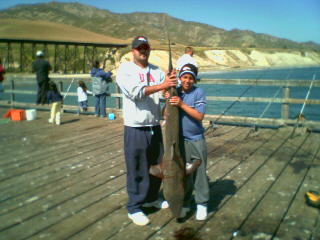
 A soupfin shark and one happy angler at the Cayucos Pier

A nice soupfin caught in the surf in north San Diego Count by lowprofile in 2012

A 5’10″ soupfin caught by “Mr. Happy” at the Venice Pier in 2006

Soupfin shark taken at the Gaviota Pier in 2005 by eddog who said he is 5’10″ tall

Posted in Daily musings... · Tagged , , , , , , , · Leave a comment