Sevengill Shark

Subclass Elasmobranchi—Sharks and Rays

 Order Hexanchiformes —  Cow Sharks—Family Hexanchidae

A sevengill taken from the Oyster Point Pier by Matt Shockley in 2003

Species: Notorynchus cepedianus (Perón, 1807); from the Greek roots noto (back) and r(h)ynchos (snout); and the Latin cepidianus (spotted).

Alternate Names: Broadnose sevengill shark, cow shark, spotted cow shark, mud shark, bluntnose shark, broad-snout, sevengill, k’wet’thenéchte (Salish, British Columbia), and my personal favorite (from Australia) Tasmanian tiger shark. This is another shark with an almost worldwide distribution and as a result it has many foreign names including cação-bruxa (Portuguese), cañabota gata (Spanish), gatita (Spanish), gevlekte zevenkieuwshaai (Dutch), brednæset syvgællet haj (Danish), kammzähner (German), koeihaai (Afrikaans), platneus-sewekiefhaai (Afrikaans), minami-ebisuzame (Japanese), ebisuzame (Japanese), platnez (French), requin malais (French), siebenkiemiger Pazifischer kammzähner (German), siedmioszpar plamisty (Polish), tiburón de 7 gallas (Spanish), tiburón pinto (Spanish), tollo fume (Spanish), and tuatini (Maori).

A sevengill from the Dumbarton Pier in 2004

Identification: The only California shark with 7 gill slits. The body is somewhat heavy and flabby, tapered with a broad head, blunt snout, and small eyes. They have a single dorsal fin far back on the body; upper lobe of tail is very long. Five rows of small, sharp, pointed teeth in the upper jaw—except for one middle tooth (effective for holding prey); lower teeth saw-like (effective for tearing and cutting prey). Color seems to vary depending upon location and they may be able to slightly alter their color. Fish from San Francisco Bay are typically olive brown to a muddy gray color, those from Humboldt Bay are usually a pale silvery gray to reddish brown; all have black spots on body and fins. An unusual albino seven-gill was caught in the San Mateo Shark Derby back in 1952 and later displayed at the Steinhart Aquarium.

Size: Length to over 9 feet and nearly 300 pounds in size. Most sevengills caught from piers are young fish 2-4 feet in length and under 50 pounds in weight. However, most years seem to see at least a few large 6-foot plus fish taken.

A good-sized sevengill taken from the Goleta Pier in 2009

The largest sevengill reported to PFIC was a sevengill taken from the Cayucos Pier in December of 1998. Pictures show a large 7 ½-foot-long fish but the reported weight of 180-pounds seems far too high. Two large 7-gills were reported from the Ocean Beach Pier. In May of 2006, a nearly 8-foot-long, 112-pound 7-gill shark was landed, while May of 2008 saw the capture of a 7-gill estimated to be 10-10 ½ feet long. The only problem is that 7-gills are only supposed to reach about 9 feet in length. (Perhaps it was a 6-gill (they’ve been reported to 15 feet in length?) In October 2009 the Goleta Pier saw the capture of both a six-foot and eight-foot 7-gill. Just a month later saw another 7-gill, this one a seven-foot, nine-inch fish. The California record fish weighed 276 lb 0 oz and was taken in Humboldt Bay in 1996.

The large sevengill taken from the Cayucos Pier by Wayne in 1998. Although the weight is disputed by many, it was still a LARGE sevengill for a pier.

Range: Found in temperate waters of the Pacific, Indian and South Atlantic Oceans (and very common off South Africa and Namibia). Found in North America from the Gulf of California to northern British Columbia off Butedale and Bonilla Island. Common in central California.

Habitat: A bottom oriented shark common to inshore areas (especially rocky areas near kelp) and in bays, especially San Francisco Bay, Tomales Bay and Humboldt Bay. Most common from the spring to the fall; may migrate to deeper water during the winter. In San Francisco Bay, springtime sees mama sevengill dropping her pups (up to 82 young ‘uns) and that’s when small, immature fish make a regular appearance at several piers.

Most sevengills caught from piers are smaller fish such as this one taken from the Berkeley Pier in 2004

Piers: Mainly caught at piers that sit close to fairly deep water, or deep-water channels in a bay. Best bets: Ocean Beach Pier, Redondo Beach Pier, Goleta Pier, Morro Bay T-Piers, Cayucos Pier, Candlestick Pier, Oyster Point Pier, Dumbarton Pier, Berkeley Pier, Elephant Rock Pier, Angel Island Pier, and the Del Norte Street Pier (Eureka).

Shoreline: Sometimes caught from shoreline areas in San Francisco Bay, most commonly early spring or late fall when the fish appear to move into shallower areas to spawn.

Showing that large sevengills are occasionally seen on piers and in shoreline areas is this large sevengill that was caught from the shoreline at Pismo Beach in 2010

Boats: A common goal for anglers fishing from boats in San Francisco and Humboldt Bay.

Bait and Tackle: An opportunistic predator that feeds on many other fish including salmon, sturgeon, smaller fish, rays and fellow shark. It’s reported that 7-gills sometimes hunt in packs and use teamwork to capture larger food such as seals and dolphins. However, the use of seal meat and dolphin meat for bait by humans tends not to be PC (it’s also illegal). Instead, typical baits include whole fish such as mackerel and sardines, whole squid, small sharks, and salmon bellies.  Typically anglers seeking out sevengills use heavier tackle—50+ pound line and steel leaders baited with a whole fish (and I heard of one angler using a live small brown smoothhound shark as bait). Although most of the 7-gills that are caught are captured by anglers specifically fishing for sharays (sharks and rays) and using this fairly heavy equipment and large baits, quite a few smaller “youngsters” are caught in San Francisco Bay, especially during the spring months.

A sevengill taken at the Dumbarton Pier in 2004

Food Value: Considered one of the best eating sharks.

Comments:  One of the most primitive of sharks as well as one of the largest and more dangerous sharks handled by California pier fishermen. Watch out for the teeth! David A. Ebert, in Sharks Rays, and Chimaeras of California, writes that “Other than the Great White Shark they appear to be the dominant elasmobranch in the nearshore marine environment.”

Another sevengill from the Dumbarton Bridge Pier, this one taken in 2006.

In addition, “Sevengills have been implicated in about a dozen attacks on dogs in and around San Francisco Bay. A bather in at least one attack was playing with his dog in shallow water when a 1.5- to 1.8-m-long ‘spotted’ shark attacked. Although the shark was unidentified, the attack occurred inside San Francisco Bay in an area in which sevengills are fairly abundant.” It’s also reported that 7-gills have bitten aquarium divers.

Shark teeth at the Berkeley Pier in 2008

Sevengill caught at the Robert Wooley Pier (Burlingame) in 2007

A sevengill taken by Rock Hopper at the Berkeley Pier in 2004
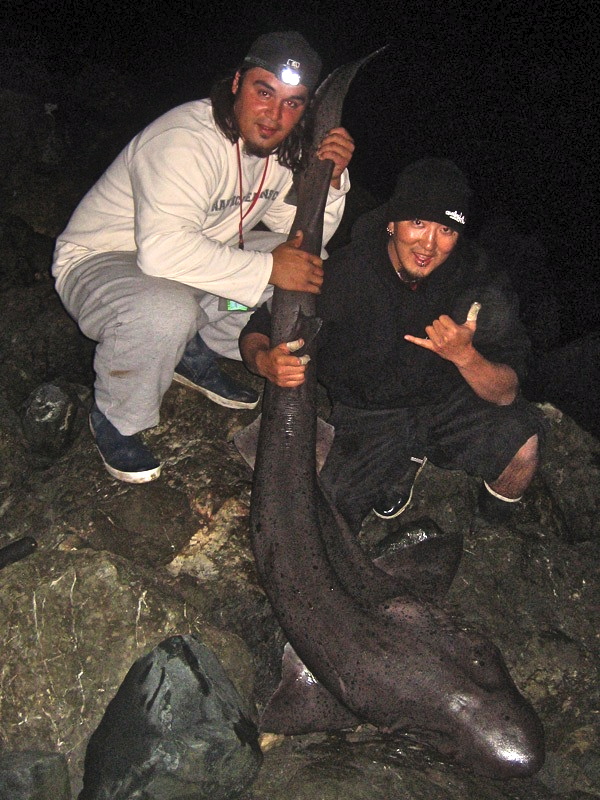
The capture of a large sevengill by Matty and Dom in 2012; picture by capt.raysharking


Posted in Daily musings... · Tagged , , , , , , , , , · Leave a comment

Common Thresher Shark

 Order Lamniformes — Thresher Sharks—Family Alopiidae

Small thresher shark from the Pacifica Pier in 2006

Species: Alopias vulpinus (Bonnaterre, 1788); from the Greek word alopos and Latin word vulpes, (both meaning fox).

Alternate Names: Thresher, blue thresher, longtail shark, swiveltail, fox shark, sea fox, fish shark, sea ope, pesca pavone. A worldwide range with a worldwide list of foreign names—pez zorro (Spanish), cação-pena (Portuguese), faux (French), fuchshai (German), aleposkylos (Greek), big-eye thresher (English), budenb (Maltese), cacao-raposa (Portuguese), chichi espada (Spanish), coleto (Spanish), coludo (Spanish), coludo pinto (Spanish), drescherhai (German), grayfish (English), grillo (Spanish), guadaña (Spanish), guilla (Catalan), jarjur (Arabic), kalb (Arabic), karage (Swahili), kettuhai (Finnish), Kosogon (Polish), K’wet’thenéchte (Salish), Langschweif (German), Loup de mer (French), mango-ripi (Maori), ma’o aero (Tahitian), mao-naga (Japanese), papa kinengo (Swahili), pas lisica (Serbian), pating (Tagalog), pèis rato (French), peixe-rato (Portuguese), peje sable (Spanish), peje zorra (Spanish), pejerrabo (Spanish), pesce volpe (Italian), peshkdhelpën (Albanian), pez espada (Spanish), pez palo (Spanish), pichirata (Spanish), pixxivolpi (Maltese), poisson-épée (French), psina lisica (Serbian), qatwa al bahar (Arabic), rabilongo (Portuguese), rabo de zorra (Spanish), rævehaj (Danish), raposa (Spanish), raposa marina (Spanish), raposo (Portuguese), rävhaj (Swedish), rechin-vulpe (Rumanian), renard (French), renard de mers (Creole), renard marin (French), requin renard (French), revaháur (Faroese), revehai (Norwegian), romano (Portuguese), romão (Portuguese), sapan (Turkish), sapan baligi (Turkish), seefuchs (German), singe de mer (French), skylópsaro (Greek), squalo volpe (Italian), tærsker (Danish), te bakoa (Kiribati), te kimoa (Kiribati), thon blanc (French), tiburón zorro (Spanish), tubarão raposo (Portuguese), volpe de mar (Italian), voshaai (Dutch), watwa albahar (Arabic), whip-tailed shark (English), zoro cauda longa (Portuguese), zorro (Spanish), and zorro blanco (Spanish).

Thresher taken from the Half Moon Bay Jetty in 2009

Identification: Easily identified by the long tail (caudal fin) that is as long as the rest of the body. The only other similar shark in California water is the rare, deep-water, big-eye thresher. Their coloring is brown to bluish gray to black to purplish on the back shading to white below. Their overall shape is spindle-shaped with two dorsal fins, a tiny anal fin, and curved pectoral fins. They have a short snout with a mouth full of small but sharp teeth.

Size:  To 18 feet and possibly 25 feet. Most caught from piers are youngsters (practically babies) under 6 feet in length. The California record fish was a 575 lb 0 oz fish caught off Carlsbad Canyon in 2007.   

Range: Circumglobal in warm waters. In the eastern Pacific from Chile to southeastern Alaska, and Goose Bay, British Columbia. Most threshers caught in California are taken south of Point Conception.

A thresher taken by red805 at the Goleta Pier in 2015

Habitat: Most common in deeper offshore water but young threshers venture into shallower water. A number are caught by southern and central California pier rats  every year.

Piers: Most common on oceanfront piers south of Point Conception although some are taken every year from Central Coast piers. Best bets: Ocean Beach Pier, Oceanside Pier, San Clemente Pier, Balboa Pier, Newport Pier, Huntington Beach Pier, Redondo Beach Pier, Hermosa Beach Pier, Venice Pier, Santa Monica Pier, Malibu Pier, Ventura Pier, Gaviota Pier, and Pismo Beach Pier. The Gaviota Pier may be the best pier in the state for threshers (and some feel the nearby waters are a “pupping” area) but the pier is currently closed and no one seems to know when or if the state will reopen it?

A thresher taken by Wayne at the Cayucos Pier in 1997

Shoreline:Rarely caught from shore unless near deepwater areas.

Boats: A major species for both boaters and kayakers in southern and central California. Live bait is preferred but they aren’t easy to land from a kayak.

Bait and Tackle: Bony fish make up 97% of the thresher’s diet. Mostly these are small, schooling species such as mackerel, jack mackerel and sardines. As a result, the recommended bait is a live whole fish with mackerel and sardines leading the list. A whole squid also makes excellent bait. Anglers specifically fishing for them land the great majority of threshers. Tackle should be heavy and include a net to bring the fish onto the pier. Line should be at least 40-pound test, a wire leader is preferred and hooks can be 4/0 or larger.

Thresher taken at the Ventura Pier in 2010

Food: An excellent, mild flavored flesh! Threshers can be prepared many ways but one of the best is to simply cut the meat into steaks and broil them on a grill. The meat does need to be cleaned properly and kept cool before cooking.

Comments: The high demand for thresher steaks, accompanying high prices, over-fishing, and low number of pups birthed each year by females (two to four), have led to a dramatic drop in the thresher population in the last twenty years. Many people feel there should be either a ban or severe limits imposed on the take of threshers. 


Thresher — Seacliff State Beach Pier in 2009

Posted in Daily musings... · Tagged , , , , , , , , · Leave a comment

Horn Shark

 Order Heterodontiformes — Bullhead Sharks—Family Heterodontidae

Horn shark from the Cabrillo Mole in Avalon in 2015

Species: Heterodontus francisci (Girard, 1855); from the Greek hetero (different) and odont (tooth) and the Latin francisci (referring to San Francisco). (They have a small pointed tooth at the front of their jaw and a blunt tooth at the rear.)

Alternate Names: Bullhead Shark, Port Jackson shark, horned shark, hornback shark. Called tiburón cabeza de toro, tiburón cornudo or tiburón puerco in Mexico.

Identification: Horn sharks are spotted sharks with a somewhat pig-like snout. They have a strong spine at the front of each dorsal fin (which accounts for their name) and an anal fin. Their coloring is tan to dark brown or grayish with black spots above, pale yellowish below.

Horn shark from the Cabrillo Mole on Catalina Island in 2015

Size: Reported to 48 inches, but the largest verified was just over 38 inches long and 22 pounds. Most hornies caught from piers are under 30 inches in length.

Range:  Found from the Gulf of California to San Francisco.

Habitat: Prefers rocky areas although also found near sandy areas that contain kelp. They are nocturnal, bottom-feeding foragers who prefer to spend their daylight hours resting on the bottom or in caves and crevices. At night they head out in their search for food—primarily squids, urchins, crustaceans, anemones and mollusks—but rarely are they found more than six feet from the bottom.

A horn shark taken at the Long Beach Finger Piers in 2011 by MrWoodstream

Piers: Most are caught at southern California piers but a few are caught as far north as the pier at Cayucos. Generally found near piers that are close to reefs or kelp. Best bets: Ocean Beach Pier, San Clemente Pier, Hermosa Beach Pier, Green Pleasure Pier (Avalon), Cabrillo Mole (Avalon), Santa Monica Pier, Paradise Cove Pier, Gaviota Pier and Goleta Pier.

Shoreline: Occasionally caught by anglers fishing rocky areas near kelp.

Another Catalina horn shark, this one caught by Kyle Pease in 2015

Boats: Sometimes taken by boaters and kayakers fishing the southern California kelp beds.

Bait and Tackle: Crabs, shrimp, squid and small fish are prime baits but hornies appear to take almost any natural bait. Most horn sharks taken by pier anglers are fairly small fish so light-to-medium tackle equipped with size 2 to 2/0 hooks will suffice.

Food Value:  Reported to be quite tasty, similar to most other sharks.

A horn shark taken at the Morro Bay North T-Pier in 2004

Comments: An interesting little shark. Small horn sharks are frequently sold in aquarium shops where they command top prices. They are generally harmless but anglers should be careful of the dorsal spines and be aware that agitated fish may try to bite careless handlers.

Horn sharks are in the Class Chondrichthyes and Subclass Elasmobranchii (as are all sharks and rays) but in the Superorder Galea, which only includes some of the sharks found at California piers. Many of the sharks found at piers are in the Superorder Squalea, which includes sharks as well as guitarfish and rays. Thus some of the sharks are more closely related to rays than to other sharks.

A horn shark taken at the Belmont Veterans Pier in Long Beach in 2009


A small horn shark taken from the Goleta Pier in 2008

Horn shark caught at the Redondo Beach Pier in 2003

Posted in Daily musings... · Tagged , , , , , , , , , , , · Leave a comment

Pacific Tomcod

Order Gadiformes — Cods—Family Gadidae

Three Pacific tomcod  (2nd, 3rd and 4th fish) together with a barred surfperch and six white croaker (generally called tomcod in southern California and kingfish in northern California), all from the Pacifica Pier in 1976

Species: Microgadus proximus (Girard, 1854); from the Greek words micros (small) and gadus (codfish), and the Latin word proximus  (next).

Alternate Names: Tomcod, piciata and wachna.

Identification: Typical cod-like shape with three dorsal fins and two anal fins. Tomcod have a short chin barbel. Their coloring is usually brownish above (although some are olive colored), and white below.

Size: To 12 inches; most caught off piers are 9-10 inches long.

Range: From Point Sal, California, to Unalaska Island, Alaska.

Habitat: Prefers a soft bottom (sand or mud), near-shore environment, although caught out to 700-foot depths.

Piers: Pacific tomcod may be seen at almost any pier north of Monterey Bay. However, I believe their numbers have decreased. Best bets: Pillar Point Harbor Pier, Pacifica Pier, San Francisco Municipal Pier, Fort Baker Pier, Point Arena Pier, Eureka Municipal Wharf, Trinidad Pier and the “B” Street Pier in Crescent City.

Shoreline: Rarely caught by inshore anglers.

Boats: A small, inshore species rarely taken by boat fishermen.

Bait and Tackle: When schools of tomcod move in, anglers can expect fast and furious action. The best bait appears to be pile worms, a small strip of anchovy, or a small strip of squid. Hooks should be small, size 6 or 8, and the best technique is to cast out, allow the bait to sink, and begin to retrieve as soon as the bait hits bottom. The tomcod usually will hit the bait mid-depth as it is being pulled up.

Food Value: Most tomcod are really too small for eating although some people like to pan-fry them as they would any small fish and they are said to have a sweet, delicate flavor.

Comments: When I lived in the Bay Area in the ‘70s one of my main fishing spots was the Pacific Pier and one of the most common fish I caught was Pacific tomcod. I caught them during every month of the year but the summer months were generally the best. I caught a few at other piers—primarily Fort Point and Fort Baker, but never in the numbers seen at Pacifica. I moved north to Mendocino County in 1979 and soon after began to fish the Point Arena Pier. Once again good numbers of Pacific tomcod began to show up. However, that pier was destroyed in a winter storm in 1983 and did not reopen until 1987. After the reopening of the new pier I never saw the same numbers of tomcod that I had seen previously. Visits to Pacifica in the past 30 years have shown much of the same — few if any Pacific tomcod. I’m not sure if I just missed them or if their numbers have decreased.

Small tomcod are fun to catch on light tackle and they provide a major source of fun for children angling in northern areas (Washington north). They are not to be confused with white croaker (Genyonemus lineatus) that are generally called tom cod in southern California.

According to Milton Love (one of our favorite marine biologists), “this species is very closely related to saffron cod.” Although I’ve heard of cod cooked in saffron, I had never heard of THE saffron cod! It turns out saffron cod, Eleginus gracilis (Tilesius, 1810), is a small, similar-looking fish found in Pacific arctic waters (the arctic-boreal Pacific). The range is from Korea and the Sea of Okhotsk in the west to the northern Gulf of Alaska and Banks Island in the east. Although small, they’re commercially fished with the major fishing grounds for Russian boats in the western North Pacific: Peter the Great Bay, Sakhalin region, Sea of Okhotsk and Kamchatka waters. Alaskan fisherman typically fish in Norton Sound. Most of the commercial catch winds up in Russia although the fish is also popular in Japan.

Posted in Daily musings... · Tagged , , , , , , , , , · 3 Comments

Sargo

Grunts—Family Haemulidae

A sargo caught at the San Clemente Pier in 2015

Species: Anisotremus davidsonii (Steindachner, 1876); from the Greek word anisotremus (unequal aperture, in reference to the pores on the chin), and davidsonii (for George Davidson, a 19th Century astronomer at the California Academy of Sciences).

Alternate Names: China croaker, black croaker, blue bass, grunt, perch, sargo raiado. Called burro piedrero or sargo rayado in Mexico.

A sargo caught at the Santa Monica Pier in 2013

Identification: General perch shape but heavy bodied. The dorsal fin is long and ddeeply notched with spines longer than rays. They have 9 to 11 soft rays in the anal fin (perch have at least 13), and the second anal fin is strong and as long as the soft anal rays (anal fin spines of perch are weak and only half as long as the rays).  Their coloring is entirely metallic silvery; iridescent with a grayish tinge above, plain silver below. A dark vertical bar runs across the body in the pectoral area. The shape and similar dark bar can, at times, lead to confusion with pileperch but sargo have a shorter anal fin and a different shape to the dorsal fin. In addition the bar is farther back on the perch and the tail of the perch is very forked. Sargo caught in bays tend to be darker in color. Both “golden” and “albino” sargo have been recorded in California.

Size: To 17.4 inches and just over 3 1/2 pounds; most caught off piers are under 14 inches in length.

Two sargo taken from Malibu in 2009

Range: Bahia Magdalena, southern Baja California, and Gulf of California to Santa Cruz. Sargo are uncommon north of Point Conception.

Habitat: Primarily found inshore and in bays around rocky areas.

Piers: Common at both oceanfront and bay piers north to Gaviota. Best bets: Embarcadero Marina Park Pier, Shelter Island Pier, Oceanside Pier, Oceanside Harbor Pier, Dana Harbor Pier, Seal Beach Pier, Belmont Veterans Memorial Pier, Long Beach Finger Piers, Cabrillo Pier, Redondo Harbor Sportfishing Pier, and the Santa Monica Pier.

A sargo taken at the Crystal Pier in San Diego by Angel H in 2015

Shoreline: A common catch by southern California shore anglers especially when fishing near rocky areas. Favored areas include Mission Bay and San Pedro Bay.

Boats: An inshore species rarely taken by boaters unless they are fishing in bays—San Diego Bay, Mission Bay, and San Pedro Bay.

Small sargo caught by KJ at the San Clemente Pier in 2015

Bait and Tackle: Sargo are bottom feeders that prefer ghost shrimp, fresh mussels, and worms, but they can be caught on almost any bait. Use size 8 to 4 hooks and fish on the bottom or a couple of feet above the bottom. The most commonly used rigging is a high/low leader.

Food Value: Good meat, similar in taste and texture to croakers. Best fried, baked or broiled.

Comments: A good sport fish, very similar to the larger croakers.  The first sargo you catch may surprise you when you hold it and feel it grunt—not surprising since it belongs to the grunt family.

Sargo caught at the Oceanside Harbor Pier in 2013

Large sargo from the Redondo Sportfishing Pier in 2012

A sargo taken at the Long Beach Finger Piers in 2013

My grandson Adam’s first sargo, a fish caught in 2009 from the Crystal Pier

KJ and a sargo from the Crystal Pier in 2010

A sargo from the Belmont Veterans Pier in Long Beach in 1998

Tom and a pair of sargo from the Santa Monica Pier in 2003

Sargo from the San Clemente Pier by Domphabro in 2009

Sargo taken by IsoGure in 2014 from the Dana Point Jetty

Posted in Daily musings... · Tagged , , , , , , , , , , , , · Leave a comment