Silver Salmon

Order Salmoniformes

Trouts and Salmon—Family Salmonidae

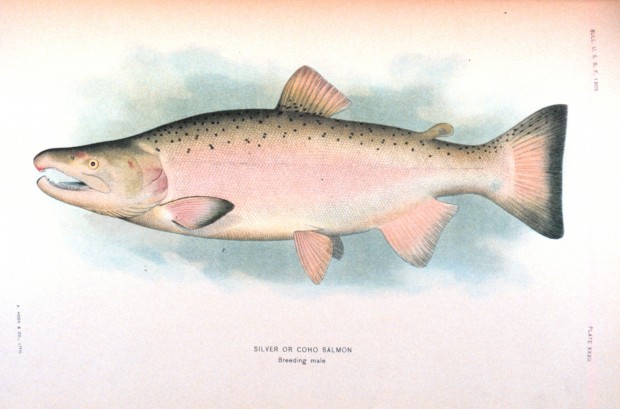
Adult male — Picture courtesy of NOAA

Species: Oncorhynchus kisutch (Walbaum, 1792); from the Greek roots onkos (hook), rhynchos (nose), and kisutch (the vernacular name for the species in Alaska and Kamchatka, USSR).

Alternate Names: Coho salmon, silversides, hooknose, hookbill, blueback (young salmon), jack salmon, tschaviche, showitz, quisutsch, and bielaya ryba. Called salmón plateado in Mexico. The English name coho appeared as early as 1878 as co-hu and presumably descended from such similar Indian dialect names as kwahwult (Chilliwack and Musqueam) and kúchuks (Sooke and Saanich). [Pacific Fishes of Canada, J. L. Hart]

Identification: Body elongate, mouth terminal, large, and needlelike teeth. They have irregular black spots on the back and on the upper part of caudal fin; gums are white at base of teeth. Their coloring is metallic blue above and silvery on sides. However, when spawing in freshwater their color changes. Males become dusky or bright green on their upper back and head, bright red on sides, and generally blackish below. The females are less bright—bronze to pinkish red on the sides.

Adult breeding male — Picture courtesy of NOAA

Size: To 38 1/2 inches and 31 pounds. Most taken from piers are under eight pounds.

Range: From Punta Chamalu Bay (or Bahia Camalu), northern Baja California, to Point Hope, Chukchi Sea, Alaska with strays to Prudhoe Bay, Beaufort Sea, Alaska. Along the Pacific Asian coast from the Anadyr River, Russia to northern Korea and northern Honshu Island, Japan.

Habitat: Spends time in both fresh water and salt water. Tends to be near the surface of the water.

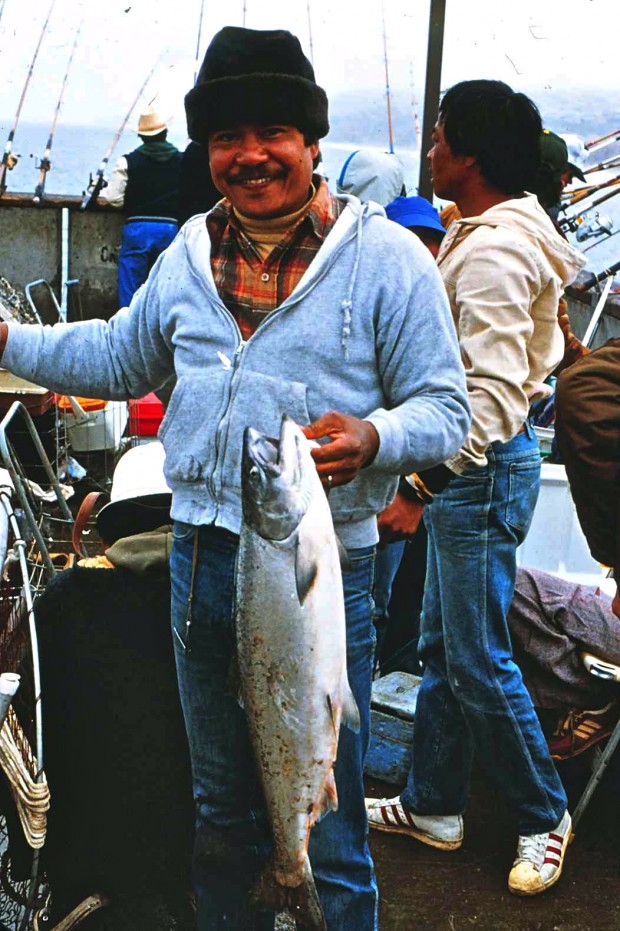
Silver Salmon from the Pacifica Pier, 1970s

Piers: Relatively few silver salmon are taken from piers compared to king salmon. Nevertheless, a few are hooked each year north of Monterey Bay. Best bets: Pacifica Pier, Point Arena Pier, Trinidad Pier, and the B Street Pier in Crescent City.

Shoreline: Genereally not taken by shore anglers in ocean areas but caught by anglers in streams and rivers; illegal to keep.

Boats: Once a major goal of boaters but now illegal to keep.

Silver Salmon taken near the surfline at the Capitola Wharf

Bait and Tackle: None since they are illegal.

Food Value: None since they are illegal.

Silver Salmon from the B Street Pier in Crescent City

Comments: A favorite salmon due to its aerial acrobatics. It is now illegal to keep silver salmon in California. Handle with care and return them to the water.

Silver Salmon from the B Street Pier in Crescent City

Posted in Daily musings... · Tagged , , , , , , · Leave a comment

Sablefish

Sablefishes—Family Anoplopomatidae

Adult sablefish caught by fishermen in the “Dory Fleet” that sits next to the Newport Pier

Species: Anoplopoma fimbria (Pallas, 1814); from the Greek words anoplis  (unarmed) and poma (operculum or gill cover), and the Latin word fimbria  (fringe).

Alternate Names: Commercially called blackcod in Washington and butterfish in California. Other names include Alaska blackcod, coalfish, coal cod, candlefish, black candlefish, bluecod, deep sea trout, zipperfish, sable, skil-fish, skil, and skill. Called t’thémekwe by the Salish in British Columbia, sqel or skil by the Haida, and hádání  by the Heiltsuk. Called bacalao negro in Mexico.

Identification: Elongate (cod-shaped) tapering to the tail. Two widley-spaced  dorsal fins. Adult coloring is usually blackish-gray on the back and sides, gray to white below; young fish taken from piers are generally pale greenish-colored on top and sides fading to white.

Typical juvenile sablefish seen on piers —  Monterey Wharf #2 on July 20, 2013

Size: To over 40 inches and 56 pounds although most caught from piers are young fish under a foot in length. Sablefish can live to about 55 years of age so the bigger fish are generally old fish.

Range: Islas San Benito and Isla Cedros, central Baja, California to the Aleutian Islands and the Bering Sea south of St. Lawrence Island, Alaska. Also, Kamchatka, Russia, south to Hatsu Shima Island, southern Japan; usually in extremely deep water.

Habitat:  Adult fish are caught in deep water, often over a thousand feet deep, and prefer areas of blue clay or mud. Young fish, to a foot long or so, are often found in fairly shallow areas, especially to the north. There is also a difference in habitat north and south; in southern California, sablefish are almost always found in deep-water areas, in northern California, Eureka north, sablefish will sometimes be found in shallower water.

Piers: Sablefish are never really common to California piers although piers adjacent to deep-water canyons may see a few each year. At times, vast schools will move in around piers and thousands of the fish will be caught. Best bets: Newport Pier, Balboa Pier, Redondo Beach Pier, and Monterey Wharf No. 2. In the far north, where sablefish become a more shallow-water fish, they will sometimes show up during the summer months in Humboldt Bay and a few will fall to anglers fishing from Eureka area piers.  I have seen small specimens taken from the Pismo Beach Pier, the Capitola Wharf, and Monterey Wharf #2, all in Central California.

Sablefish taken from the San Simeon Pier on August 17, 2015

Shoreline: Rarely taken by shore anglers.

Boats: Rarely taken by boaters in southern California although they’re sometimes taken by rockcod anglers fishing in deep waters off Santa Cruz and Monterey.

Bait and Tackle: On piers a high/low rigging baited with strips of squid is the preferred method. On boats they are generally taken on typical rockcod tackle.

Food Value:  Adult sablefish are one of the best tasting smoked fish. In fact, many people like the rich buttery flavor of sablefish better than salmon. For a period of time when I worked in the corporate world one of the areas I visited was Seattle and I soon found a fish restaurant on the waterfront, Ivar’s Acres of Clams, that served smoked sablefish. That one dish prompted several additional visits. Since then I do not believe I have ever seen sablefish on a restaurant menu although I have seen smoked sablefish for sale in Santa Cruz, Morro Bay and Fort Bragg. In addition, fresh sablefish is one of the staple items at the dory fleet at the foot of Newport Pier (although you need to get there early in the morning before the fish is sold out). Unfortunately the young sablefish that occasionally visit piers are not quite as rich flavored. Nevertheless they are still best smoked or broiled, methods which gives the flavor a chance to show itself. Do not, repeat, do not, pan-fry or deep-fry sablefish. The results will be an inferior piece of over oily meat.

Sablefish caught by “PolishfromtheDeep at the Pismo Beach Pier on August 8, 2010

Comments: One of my favorite fish simply because it is an uncommon treat!

My first big day pier fishing took place at the Newport Pier in September 10, 1962 and involved sablefish. I had arrived, as usual, at the crack of dawn, and was fishing just down from the northwest corner. I was using squid for bait and had experienced very little early success. However, around 5:30 A.M., I had a strike and pulled in an ebony-colored fish—a type I had never caught before. The next cast yielded two more of these strange colored fish and I continued to catch fish, nearly every cast, for the next two hours. Strangely, only two other anglers were having similar success. Most anglers were going fishless at Newport. Later, I found out the fish were sablefish, a deep-water fish more common to northern waters. Upon cleaning the fish, I also found the reason for my success. The fish were stuffed with squid that were schooling in the waters near to the pier. Anglers who were using squid for bait, and there were only a few, were catching the fish. I caught 47 sablefish that day, but it was only a start. I continued to catch fish: large jacksmelt, Pacific mackerel and jack mackerel—77 fish in all. And, quite appropriately, I also caught a small squid. It was, mirabile dictu, one of the best days I ever had at the pier even though the fishing probably would have been considered poor for most of my fellow anglers that day. Six weeks later, October  27, saw the catch of six additional sablefish although this time it was in the evening.  It was the only times I have ever caught sablefish at a pier.

As said, they are a deep water fish and generally only encountered if you are fishing really deep waters. During the ’70s, I frequently fished on the Stagnaro rock cod boats (Stagnaro #1 and Stagnaro #2) out of the Santa Cruz Wharf and we would fish some really deep water reefs. Occasionally, when the boats would drift over a muddy area, we would pull in some big sablefish and some big Pacific hake. No one wanted the hake but everyone wanted the sablefish. Generally though they are primarily taken by commercial fishermen fishing in REALLY DEEP water. Another place I caught them, although this time from a barge, was in Redondo Beach. A trip on the barge California in July 1978 saw me catch five sablefish (if you catch one you’ll usually catch more) during a full night of fishing that produced 77 fish of six different species.

Sablefish taken from the Capitola Wharf on July 2, 2013

Perhaps the best example of deep-water fish showing up at a California pier was a run of sablefish that took place at Wharf #2 in 1947. The numbers of both fish and anglers seems unbelievable—but the invasion was well documented!

Sablefish Run At Monterey Bay

 For the first time in history, sablefish (Anoplopoma fimbria) appeared in vast numbers in the vicinity of Monterey and were caught by the thousands from the municipal pier. The run was first discovered on the afternoon of July 11th; word of the bonanza spread rapidly, and the pier was soon crowded with anglers. Men, women, and children stood shoulder to shoulder, with a varied assortment of tackle, all hauling in fish as fast as they could throw in their lines. Boxes, sacks, five-gallon cans, and washtubs were rapidly filled with 12 to 20-inch fish. Slack periods occurred during the morning and again in the afternoons, but they were of short duration usually lasting only half an hour or less; then the fish would be back seemingly in greater numbers than before. Each day the pier would be jammed with crowds of from 2,000 to 3,500 fishermen and spectators, some having driven as far as 200 miles.

On July 26th, the run stopped as abruptly as it had begun, and although over 5,000 fishermen were on hand the next day, only a few fish were caught. During the 15 days of the run, the Bureau of Patrol Division of Fish and Game, estimated that over 110 tons had been landed.

 — Keith W. Cox, Bureau of Marine Fisheries, California Division of Fish and Game, September, 1947

One of the best places to see sablefiish is at the Newport Dory fleet that sits next to the Newport Pier.

An interesting article on the increasing popularity of sablefish at upscale restaurants is one by Marian Burros in the New York Times. Titled “The Fish That Swam Uptown,” it calls sablefish “the Cinderella of the seafood world” and “discusses the popularity of sablefish and several ways it is prepared.

http://www.nytimes.com/2001/05/16/dining/the-fish-that-swam-uptown.html

Some sablefish taken on the Stagnaro #2 partyboat out of Stagnaro Sportfishing in Santa Cruz on June 6, 1975

Posted in Daily musings... · Tagged , , , , , , , , , , , , , , · Leave a comment

Striped Bass

 Order Perciformes

 Temperate Basses—Family Moronidae 

Striped Bass taken from the Fort Point Pier 

Species: Morone saxatilis (Walbaum, 1792); from Morone (a word of unknown origin attributed to Samuel Latham Mitchell who named it in 1814) and the Latin saxatilis (to live among rocks). CA Fish Bulletin #28 (1930) uses the name Roccus lineatus. CA Fish Bulletin #157 (1972) uses Roccus saxatilis.

Alternate Names: Striper, linesider, rock bass, rock fish, streaked bass and my favorites—squidhound or “rock.” Called lubina estriada in Mexico.

Striped Bass taken from the Paradise Beach Park Pier in 2016

Identification: Typical bass shape with two dorsal fins. Brownish, copper, or steel bluish with brassy reflections; more silverish on the sides; seven or eight blackish, horizontal stripes on the side of the body.

Size: Up to 4 feet and 90 pounds in California. Most striped bass caught off piers are the smaller schooling stripers under five pounds in size. Each year will see a few lucky anglers catching large fish—some up to 40-50 pounds.

Striped Bass taken from the Marin Rod & Gun Club Pier by Preston in 2013

Range: From 25 miles south of the California-Mexico border to Barkley Sound in British Columbia.

Habitat: Shallow-water areas, both sandy and rocky.

Striped Bass taken at the McNear Park Pier by Mel in 2006

Piers: Really only common at Bay Area and Delta piers and even here fewer and fewer are caught each year. Striped bass are anadromous, spending part of their life in fresh water and part in salt water. Most California stripers spend the winter months in the fresh water of the Sacramento-San Joaquin Delta; they then move down to salt water in the spring, spend the warm months in the bay or adjacent ocean areas, and return upstream again in the fall. Spring and fall see catches of stripers at piers on both the west and east sides of San Pablo Bay as the fish head toward the Golden Gate. Summer is the prime time for piers throughout San Francisco Bay as well as areas out to Pacifica Pier. Best bets depend on the season. During the mid-to-late summer, I would try Pacifica Pier or any pier along the western side of San Francisco Bay. During the spring, I would try East Bay piers including Berkeley Pier and the Point Pinole Pier. During the fall, hit mainly Marin County piers (the World Series bite in October is famous) and piers near the Carquinez Strait area including the Eckley Pier and Martinez Pier. Fall is a prime time to try the various piers in the Pittsburg and Antioch area for the larger stripers that are passing through. Almost all of the piers in the Antioch area (but especially the Antioch Bridge Pier) out to the Rio Vista and Isleton piers seem to yield an unending number of small (mostly illegal) stripers from spring to fall.

Striper taken at the Capitola Wharf by Mark Spencer in 2016 (Photo courtesy of Capitola Bait and Boat)

Shoreline: One of the main goals for shore anglers in the San Francisco Bay-Delta. For many years the beaches south of San Francusco were considered the top striper areas in the West.

Boats: One of the main species sought out in the San Francisco Bay-Delta. Both live bait and lures attract striped bass.

Striped Bass taken at the Point Pinole Pier by “Stan the Man” in 2003

Bait and Tackle: The main idea here is to have heavy enough tackle that you can fight the unexpected big fish. Although most of the fish you catch will be less than 10 pounds, be prepared for the 30-pounder. Tackle should be medium size, line should be at least 25-pound test, and hooks may vary from size 2 to 2/0. Best baits are live small fish such as shinerperch, staghorn sculpin (bullheads), other small sculpins, or live shrimp. Cut bait including sardines, anchovies and even mackerel will often work as well. Stripers will also hit worms, but worms are used mostly for the smaller fish. Several regulars have mentioned that dead “bullheads” are also very effective as long as they still retain the slime on their skin. Although artificials can be deadly in a boat and on shore, they are used less frequently on the piers and tend to be less effective. To avoid the small stripers at the Antioch piers you need to use larger baits and regulars tell me that live bluegills and Sacramento squawfish fit the bill.

Striped Bass taken at the Malibu Pier in 2009

Food Value:  Stripers have a mild, flaky flesh that is delicious almost any way you prepare it. However, the flesh of larger fish (above about 12 pounds in size) tends to be a little more coarse and becomes less flavorsome with age. In addition, if taken from the bay, it is best to broil the meat so that some of the harmful toxins will melt (and drop) out of the meat.

Striped Bass taken at the Dumbarton Pier by Thomas Orozco in 2006

Comments: Striped Bass were introduced from the Atlantic Ocean in 1879; the first fish were released in the Carquinez Straits near Martinez. For many years striped bass were the most sought after fish in San Francisco Bay; today they share that honor with white sturgeon and California halibut. Although very rarely taken from southern California piers; they have been planted in San Diego, Mission, Newport and Anaheim bays since 1974. For some, still unexplained reason, there was an unusual invasion of southern California beaches by stripers in the warm-water year of ’98. Linesides were caught all the way south to San Diego.

Striped Bass taken at the Pacifica Pier in the 1970s

Stripers at the Pacifica Pier in 2009

Striped Bass taken by Miliyah at the Capitola Wharf in 2016 (Photo courtesy of the Capitola Bait and Boat)

Striped Bass taken at the Redondo Sportfishing Pier in 2012

Striped Bass taken at the Berkeley Pier by Rock Hopper in 2002

Striper taken at the Point Pinole Pier in 2006

Striped Bass taken at the Berkeley Pier by Bob Griffin in 2006

Striped Bass taken at the Capitola Wharf by Nick in 2016

Striper taken at the Pacifica Pier by Matt Shockley in 1996

Although rarely taken from the pier, these two striped bass were caught at the Cayucos Pier in 2003

Striped Bass from the Berkeley Pier, 2003

Striped Bass at the Seacliff State Beach pier in 2005

Striped Bass and Barred Surfperch taken at the Seacliff State Beach Pier in 2009

And the way it used to be…

Posted in Daily musings... · Tagged , , , , , , , , , , , · 2 Comments

White Seabass

Typical juvenile White Seabass aka “seatrout” taken from a pier, this one from the Ocean Beach Pier in August of 2013

Species: Atractoscion nobilis (Ayres, 1860) from the Greek words atrax (spindle) and skion (from sciaena, an old name for a European croaker) and the Latin word nobilis (noble).  Called Cynoscion nobilis until the 1990s

Alternate Names: King croaker, Catalina salmon, bull tomcod, croaker, weakfish, or seatrout (young fish). Called   corvina cabaicucho or corvina blanca in Mexico.

Identification: Large, elongated body with a large mouth in which the lower jaw protrudes slightly beyond the upper jaw. Unlike the shortfin corvina that has large, fanglike-canine teeth, the canine teeth in the upper jaw of white seabass are small and barely noticeable. Very young white seabass are somewhat variable in color—silvery, brownish, golden or even reddish, but as they age their color becomes more standard—silver or gray. Up to two feet in length (most of the fish seen on piers) the young white seabass have three to six broad black vertical bars on their sides and dusky yellow fins. Adults tend to be blue to gray on the back, with silvery sides and a dark spot on the inner base of the pectoral fin. Young white seabass are sometimes (somehow) confused with white croaker but the juvenile white seabass have bars on their sides and do not have a barbell on their chin. White croaker lack bars on their sides and do have a barbell. White seabass are perhaps most easily separated from other croaker by the presence of a ridge running the length of the belly.

Whte Seabass taken by Humberto at the Newport Pier in November 2002

Size: White seabass are the largest of the California croakers. To five feet and over 90 pounds; those caught off piers are usually the young “seatrout” ranging up to 24 inches in length. The California record fish weighed 78 lb 0 oz and was caught in Monterey Bay in 2002. A fish weighing 93 lb 4 oz was speared by a diver near Malibu in 2007.

Range: Bahia Magdalena, southern Baja California, and the Gulf of Califonia to Juneau and the Boca de Quadra, southeastern Alaska. Considered uncommon north of Monterey Bay  (although recent years have seen an increasing number of white seabass taken in San Franciso Bay) and rare north of California. White seabass were fairly common in both San Francisco Bay and Tomales Bay until the late 1940s when they seemed to disappear for many decades.

 Nice-sized White Seabass taken from the Malibu Pier in 2004

Habitat: White seabass migrate along the coast according to their spawning habits. Although some may be caught in southland waters year-round, they tend to move north in the spring and south in the fall, spending the winter months in Baja California. The best fishing is usually June to September. They’re most common around offshore islands. Typically schools over rocky bottoms from 10-40 feet feeding on squid and small fish.

Piers: Commonly taken at southland piers, although rarely if ever caught in the huge numbers seen 60-70 years ago. Runs of the smaller sea trout do occasionally occur in late summer and fall, however, these are usually fish that are under the legal minimum size of 28 inches and must be returned to the water. Best bets: Crystal Pier, Oceanside Pier, San Clemente Pier, Seal Beach Pier, Hermosa Beach Pier, Malibu Pier, Paradise Cove Pier and Ventura Pier. The last decade has seen quite a few taken from the Seacliff Pier and Capitola Wharf.

Large White Seabass taken from the Imperial Beach Pier in October of 2014 (Guesstimated at 50 pounds)

Shore: A favorite but infrequent catch by southern California shore anglers.

Boats: One of the most prized species for boaters in southern California.

A juvenile White Seabass taken from the Ventura Pier in 2003

Bait and Tackle: Unlike other California croakers, white seabass prefer the pelagic habitat rather than inshore areas. They prefer to feed in mid-depth areas rather than on the bottom like most croakers. They’re favored meals appear to be squid, pelagic crabs, and small fish As a result, anglers should seek them from the deepest waters of the pier and be willing to try different depths. In addition, the early morning hours have traditionally been the best time for white seabass. Tackle should be medium to heavy with at least 20-pound test line and size 2 to 2/0 hooks fished near the bottom. The best bait is live bait: anchovies, smelt, queenfish or shinerperch. Next, would be frozen anchovies, sardine or mackerel strip bait, or squid (one of their favorite foods). If specifically seeking these fish, try using a live bait sliding leader and cast out a considerable distance from the pier. At the Hermosa Beach Pier, and other piers where artificial reefs have been constructed, a favorite ploy is to cast out a live jack mackerel as close to the reef as possible.

White Seabass taken from the Goleta Pier in 2006

Food Value: Excellent, mild-flavored meat that can be prepared in many ways. Unfortunately, it tends to discolor rather rapidly and there’s traditionally been a limited market for the frozen form.

A “young” White Seabass taken from the Malibu Pier in 2009

Comments: Large white seabass are one of southern California’s top partyboat gamefish. Unfortunately, the numbers of these fish decreased markedly in the 1970s and 1980s. However, with an increased legal size, a decreased daily limit, and efforts by several groups to pen raise juvenile white seabass, a comeback is being made. It is important that all sportsman, and especially pier fishermen who catch the small illegal “seatrout” adhere to the existing laws. If so, large white seabass may once again be a common catch of pier fishermen.

Some large white seabass caught from piers

83 Lbs. — Newport Pier, 1920s—Source: Personal communication, Patrick Kennedy, Baldy’s Tackle (1990)

61 Lbs. — Newport Pier, Roger Jackson, December 1, 1927—Source: Santa Ana Register, December 1, 1927

50 Lbs. — Imperial Beach Pier,  “Oyuki”, October 2014—Source: sdfish.com (October 28, 2014) and Oceanic Angler (oceanicangler.com), November 11, 2014

48 Lbs. — Newport Pier, June 1, 1934—Source: Santa Ana Register, June 2, 1934

47 Lbs. — Redondo Wharf, Charles McGehee, May 19, 1914—Los Angeles Times, May 19, 1914

45 Lbs. — Capitola Wharf, September 2000—Source: Capitola Wharf Bait Shop

45 Lbs. — Avalon Pleasure Pier, Pat Casey, May 5, 1936— Source: Catalina Islander, May 14, 1936

45 Lbs. — Redondo Wharf No. 3, August 5, 1919—Source: Los Angeles Times, August 8, 1919

42 Lbs. — Santa Monica Pier, 1957—Source: Santa Monica Pier Bait Shop? Newspaper: DF&G

41 ¼ Lb. — Pacifica Pier, July 1992—Source: Pacific Bait Shop

41 Lbs. — Point Mugu Pier, Charles S. Leonard, August, 1959—Source: Oxnard Press-Courier, August 5, 1959

40 Lbs. — Avalon Pleasure Pier, A. E. Eaton, July 3, 1916—Source: Catalina Islander, July 4, 1916

40 Lbs. — Hueneme Wharf, Charlie Chambers, October 1895—Source: Los Angeles Herald, October 27, 1895

≈ 40 Lbs. — Monterey Wharf No.2, October 2009—Source: PFIC

36 ½ Lbs. — Balboa Pier, Ed Steif, May 30, 1928—Source: Santa Ana Register, May 31, 1928

35 Lbs. — Redondo Wharf No. 1, Harold Rempe, June 3, 1909—Source: Los Angeles Herald, June 6, 1909

32 Lbs. — Hueneme Wharf, Charlie Chambers, October 1895—Source: Los Angeles Herald, October 27, 1895

30 Lbs. — Redondo Wharf No. 3, A. J. Bell, May 25, 1909—Source: Los Angeles Times, May 26, 1909

Posted in Daily musings... · Tagged , , , , , , , , , · 2 Comments

Richmond Ferry Point Pier

This is the only pier that I ever fished “before” its official grand opening. I had been eagerly awaiting its opening when I received an e-mail early in 2002 announcing that yes indeed it was finally open. Soon after, I headed down to the pier to try it out. What I found was unexpected: a smallish pier devoid of fish cleaning stations, adequate trash cans, bait cutting stations or even well designed railings. The pier was a major disappointment even though I was glad it was finally open. Overall it gave the appearance of an ill conceived, hastily constructed, Mickey Mouse-job. It surprised me because the East Bay Regional Park District normally does a good job with its piers. What was expected was a group of anglers fishing and they already had a few perch to show for their efforts. However, upon leaving I noticed a sign laying face down near the entrance stating that the pier was not yet open. And upon arrival back home I received another e-mail message, this one stating that there was some confusion about opening dates and that anglers might possibly receive tickets if they fished from the pier. A little confusing and it didn’t get any better during the next couple of months as anglers continued to use the pier and authorities kept saying it wasn’t officially open. A plethora of reasons were given for the confusion but no conclusive explanation was ever really received as to the cause of that initial delay (although a shutoff of promised funds may have been the reason). By the way, my first visit, on February 27, 2002, a short hour and a half trip, produced an unimpressive 7 fish: 5 blackperch, 1 bonehead sculpin, and a shinerperch. However, subsequent trips later in the spring proved to be much more productive.

It’s a relaxing pier to fish and generally not crowded

The pier is built on the site and remains of the old Santa Fe Ferry Landing, residue that still dominates the scene at the end of the point. It became a popular site for local fishermen as the railroad activities decreased in the ’70s but was partially burned down in 1984. After that, the inshore section of the pier was removed and the pier’s use by anglers ceased.

“This will be the crown jewel of fishing piers,” said Jean Siri, a director for the park district. “There is deep-water access, that’s the beauty of it. It’s really good fishing. Families and kids will love it.”

—Tom Stienstra, Outdoors, San Francisco Chronicle February 28, 2001

I do not think anyone today would say that it turned out to be the “crown jewel of fishing piers” but public relations rarely are accurate when it comes to promoting a product. After all, no one would have expected him to say that the pier would not be built as big as planned or that fishing might not be all that good.

Environment. The pier itself and Ferry Point Park are part of the larger Miller/Knox Regional Shoreline area in Point Richmond. The pier extends 550 feet into the bay in waters that are home to perch, jacksmelt, kingfish (white croaker), brown rockfish, starry flounder, halibut, sharks and rays. In addition, these waters are prime migratory paths for striped bass, sturgeon and salmon during the appropriate seasons.

The shoreline is rock-lined and there are quite a few rocks on the bottom to attract fish but for the most part anglers will be fishing the deeper waters hoping for larger fish. The bottom is mud, pilings contain some mussels (but mainly barnacles) and water currents can be strong when there is a strong incoming or outgoing tide.

An angler with a Striped Seaperch

Fishing Tips. Most of the year anglers should expect the predominate local species to make up a majority of the catch. Thus winter and spring can see decent runs of perch—pileperch, blackperch, rubberlip seaperch, white seaperch, rainbow seaperch and some striped seaperch. Small hooks baited with pile worms will probably catch most of the perch, but grass shrimp, ghost shrimp, and small shore-crabs (look under the rocks) often work better for the large pileperch and rubberlip seaperch. Do remember to keep your hooks small—size 6 or 4—and your line fairly light (although when the perch are in a feeding frenzy it sometimes doesn’t seem to make much difference). A few surfperch—calico surfperch and redtail surfperch—may enter the action but they will be far less in number. Later in the year, spring through fall, the smaller walleye and silver surfperch will show up, sometimes in pretty impressive numbers.

Note the following — Fish and Wildlife Regulation No. 28.59: “surfperch may not be taken or possessed by a person in San Francisco Bay and San Pablo Bay between April 1 and July 31, inclusive. Shiner surfperch (Cymatogaster aggregata) are exempt from this seasonal closure and may be taken and possessed up to their daily bag limit in these areas during the closure period... The special limit for shiner surfperch is 20, which may be taken or possessed in addition to the overall daily bag limit of 20 finfish specified in sub-section 27.60(a).’

Blackperch

Jacksmelt are a common catch and when one makes an appearance there will generally be more, in fact usually many, many more. Use two or three size 8 or 6 hooks baited under a float and be prepared to strike as soon as the float disappears under the water’s surface. As often as not you’ll have two or three fish on your line at a time. Why do I say no more than three hooks even though the common Sabiki-type bait rigs contain six hooks? Easy! Three hooks is the maximum number you can use in San Francisco Bay.

Flatfish are always a possibility with halibut being the most hoped for prize and some years will see quite a few of the flatties. However, a number of smaller flatfish may also be encountered—sanddabs (some years during the winter months), sand sole, and starry flounder (primarily in the winter and spring months). Most of the flatfish will be caught on pile worms, ghost shrimp, grass shrimp or cut anchovies. If you’re seeking out the larger halibut catch yourself a small smelt, shiner perch, or dwarf perch and use it as a live bait with a sliding sinker rigging.

Kingfish (white croakers) seem to increase in numbers each year and will be one of the most commonly fish caught. Unfortunately, they should not be eaten in these waters, or if eaten, only in very small quantities. They are most commonly caught on a high-low rig baited with cut anchovies although pile worms, shrimp and other cut baits will also attract in some of the non-discriminatory kingfish.

Ferry Point, the bay, and the pier

From spring to fall, young anglers can expect to find a hoard of small fish—brown rockfish, topsmelt, shinerperch and a few dwarf perch—down around the pilings. Drop a size 8 hook baited with small pieces of pile worms and you should get almost non-stop action. However, mixed in occasionally will be small cabezon, blennies, gobies and other odd creatures, some not so small, so be prepared.

Dwarfperch

Striped bass are, of course, one of the most popular species. Best times will be the spring and fall months with a variety of baits and lures producing the fish. Favorite baits include cut anchovies and sardines, pile worms, ghost shrimp, bullheads (staghorn sculpins) and mudsuckers (longjaw gobies). Popular lures include Fish Traps, Hair Raisers, Rapalas and Kastmasters.

The pier and the old entrance to the ferries

Another prize fish is white sturgeon. Winter and spring, especially when there is a good run-off from inland waters, may produce an occasional sturgeon but they are not common (although two sturgeon were reported during the first month the pier was open). Mud shrimp, grass shrimp and ghost shrimp produce the most fish although herring and herring eggs will also produce fish when the herring are in the bay. Be sure to have stout tackle and a net with you if you plan to fish for the elusive diamondbacks.

Most common, especially during the spring through fall months, will be brown smoothhound sharks, leopard sharks and bat rays. The sharks prefer cut bait, especially baits that are oily or bloody—anchovies, sardines and mackerel. The bat rays prefer squid but will also hit fish baits. Since the pier is near deep water, a number of 7-gill sharks will also be landed and some may approach pretty good size. As with all sharks and rays, have a medium to heavy size rig and a way to bring them up onto the pier.

Typical-size Bat Ray

Finally, there is the possibility of seeing king salmon passing through the area, generally in the fall months as they head inland toward their birth streams. Although common in the area, few will be hooked or landed. Salmon generally have stopped eating by the time they reach these waters and (wisdom has it) can only be hooked by lure. Since few anglers use lures, or specifically seek out the salmon, it stands to reason that few of the trophy fish will be hooked.

The pier at sunset

History Note. This pier is built on the remains of the old Santa Fe Ferry Terminal that was the western terminus of the Atchison, Topeka, and Santa Fe Railroad. As the story goes, Augustin S. MacDonald had the vision of the site as a port and railroad terminal. It was he who broached the idea to the movers and shakers at Santa Fe. They apparently were receptive when they found out it was 12 miles closer by rail than the Peralta Street Terminal for ferries in Oakland. On July 4, 1900, after construction of ferry slips and tracks to the site, the Santa Fe inaugurated service by delivering 200 passengers from San Francisco to Point Richmond on the Santa Fe’s first ferry, the Ocean Wave. After arrival, many of the people boarded the railroad’s first through train to Chicago. To handle freight connections, terminals were built at the foot of Channel Street in China Basin, a “car float” slip was built adjacent to Pier 54 in San Francisco, and further landing facilities were constructed in Oakland and Alameda. Connections were made to the Northwest Pacific Railroad facilities in Tiburon.

For three decades these various terminals (passenger, car and freight) were busy with traffic—but that would change with the opening of the Bay Bridge in 1936. Nevertheless, even though the Santa Fe discontinued its own passenger ferries in 1933, ferries and other boats transported rail cars, cargo and people from the terminal to San Francisco until 1980 (and nearby sat the Southern Pacific Golden Gate Ferry Terminal which operated during the 1920s and 1930s).

During much of the pier’s history, local anglers with the know how and connections were able to go out and catch fish at the pier. Later, after the demise of the ferry operations, it became an even more important home for local fisherman—until the fire in 1984. Since that time local fishermen repeatedly spoke of the need for a new local pier and apparently the East Bay Regional Park District listened.

In February of 2001, the Wildlife Conservation Board announced the final grant ($500,000) needed to complete the pier project that had been in the works for nearly ten years. The cost of more than $2,000,000 includes rehabilitation of nearly 3,000 square feet of structure area—replacement of wooden piers and steel piles—and repainting of the historic gallows structure and machinery house (as well as interpretive signs showing the history of the pier and how the machinery worked).  Money for the project came from the Wildlife Conservation Fund, the California Coastal Conservancy ($492,000), Caltrans ($376,000) and funds raised by the East Bay Regional Park District itself ($713, 000).

Point Richmond itself was long the home of native Americans before being coming under control of the Spanish in the early 1800s. The area became known as The Potrero (pastureland) of Don Francisco Castro’s huge Rancho San Pablo; later the point was called Point Stevens, appearing on charts of the Bay in 1850. Finally, a U.S. Government survey party designated the point of land jutting into the Bay as “Point Richmond.”

Ferry Point Pier Facts

Hours:  Open 24 hours a day.

Facilities:  The pier includes lights but little else. The park itself contains restrooms near the parking lot. The park, by the way, appears a favorite place for people to bring their dog for a romp as well as people who like to fly kites.

Handicapped Facilities:  Railings are 42 inches high.

How To Get There:  From I-580, there are two main Point Richmond exits, Canal Boulevard and Castro Street (also the south terminus of the Richmond Parkway). Take either into the center of town where you should see Dornan Drive and a tunnel that says Ferry Point. Go through the tunnel and continue out to the end of Dornan Drive. The park is intersected by Dornan Drive and Brick Cove Road.

Management: East Bay Regional Park District


Posted in Daily musings... · Tagged , , , , , , · Leave a comment