Sand Sole

Small Sand Sole from the Trinidad Pier in northern California

Order Pleuronectiformes — Righteye Flounders—Family Pleuronectidae

Species: Psettichthys melanostictus (Girard, 1854); from the Greek words psetta (flounder), ichthys (fish), melas  (black) and stictos  (specks).

Alternate Names: Halibut, sand flounder, spotted flounder, fringe sole or fringe flounder.

Identification: Sand sole are in the right-eye flounder family. Most easily identified by the fact that the first four to five dorsal rays are long and free (seemingly disconnected). Their coloring is generally gray to tan above with light speckling.

Size: To 21 inches; most caught off piers are under 16 inches.

Sand Sole from the Capitola Wharf

Range: Balboa Pier to the southeastern Bering Sea and Aleutian Islands from Unalaska Island to Port Heiden and Gulf of Alaska. (And, I believe, the southern range designation came about due to PFIC. On February 3, 2005 our PFIC Reporter Snookie caught a 15-inch-long sand sole at the Balboa Pier, which was followed by a report on the message board that night.)

Habitat: Shallow-water areas, both sandy shore and rocky shore.

Piers: Primarily landed at piers from Monterey Bay north. Best bets: Seacliff State Beach Pier, Capitola Wharf, Santa Cruz Wharf, Pacifica Pier, Candlestick State Park Pier, Berkeley Pier, Point Pinole Pier, Fort Baker Pier, Del Norte Street Pier in Eureka and the “B” Street Pier in Crescent City.

Sand Sole from the Capitola Wharf

Shoreline: An occasional catch in sandy shore areas in central California

Boats: Only occasionally taken from boats.

Bait and Tackle: Generally taken on cut bait such as anchovy, sardine or squid. Live grass shrimp and pile worms also make good bait. Most often landed on high/low leaders fished on the bottom but many are also taken in the Bay Area by fishermen using the live bait sliding rigging common for flounder. Hooks should be size 6 to 4.

Food Value: Excellent! Mild flavored flesh that is best fried or baked.

Comments: Sand sole are an excellent sportfish and are good eating. However, many of these sole are mistaken for California halibut and unnecessarily returned to the water because they do not meet the minimum size requirements for halibut. Learn to differentiate between the different flatfish species. Sandies live to about ten years of age.

Sand Sole from Pismo Beach Pier (caught by polishfromthedeep—PFIC)

Posted in Daily musings... · Tagged , , , , , , , , · Leave a comment

Fantail Sole

Fantail Sole from the Malibu Pier

 Order Pleuronectiformes — Lefteye Flounders—Family Bothidae

Species: Xystreurys liolepis (Jordan & Gilbert, 1880); from the Greek words Xystreurys (meaning raker and wide), and liolepis (smooth and scale).

Alternate Names: Long fin sole, long finned flounder, fantail halibut, fantail flounder, true petrale.

Identification: Oval-shaped with a highly arched lateral line. The mouth is small and the pectoral fin is longer than the head. Uniform brown or tannish above with blue spots and generally two larger and darker spots (ocelli), one located near the pectoral fin and the other farther back.

Size: Length to 21 inches. The California record fish weighed 8 lb 8 oz and was taken at San Clemente Island in 2001.

Range: Gulf of California to Monterey Bay; according to Milton Love they are most common from Isla Creciente (near Bahia Magdalena), southern Baja California to Bahia de Sebastian Vizcaino, central Baja California.

Habitat: From the surf to 446 feet but generally in water 20-164 feet deep.  Generally found on sandy spots among eelgrass beds, kelp or rocks. Favorite foods include small shrimp, crab and squid.

Piers: More common to deeper water, fantails are an infrequent catch at piers, most being taken from Santa Barbara south. I have only taken four from piers—Huntington Beach Pier (1994), Malibu Pier (2014), Gaviota Pier (2008), and Pismo Beach Pier (1977).

KJ and Fantail Sole at Malibu Pier

Shoreline: Rarely caught from shore.

Boats: An occasional catch from boats.

Bait and Tackle: Most often caught on fairly small hooks (size 4 or 2) and a variety of baits including strip bait (squid and fish) and sea worms.

Food Value: Good.

Comments: Primarily taken by recreational fishermen and fisherladies; there’s no commercial fishery for fantails.

Posted in Daily musings... · Tagged , , , , , , · Leave a comment

Starry Flounder

Order Pleuronectiformes — Righteye Flounders—Family Pleuronectidae

Photo ID courtesy of Oregon Department of Fish and Wildlife

Species: Platichthys stellatus (Pallas, 1787); from the Greek words platy  (flat) and ichthys (fish) and the Latin word stellatus (starry).

Alternate Names: Rough-jacket, great flounder, grindstone, emery flounder, emerywheel, leatherjacket, English sole, sand paper flounder, diamondback, long-jaw flounder, California flounder, swamp flounder and (too simple) flounder.

Identification: Most easily distinguished by the alternating orange and black stripes on the fins. In addition, there are patches of very rough scales throughout the pigmented side of the body. Considered a member of the right-eye flounder family but sixty percent have eyes on the left side.

The question of left side right side raises a question. Off Japan nearly 100% of the starries are left eyed (sinistral); off Alaska the number drops to 67%; off the West Coast of the U.S. the number drops to 5-60%. Is it environmental or genetic? Scientists don’t know the answer.

Size: To 37 inches and over 20 pounds but most caught from piers are under 18 inches. The California record fish weighed 11 lb 4 oz and was caught at San Simeon in 1993.

A Starry Flounder caught at the Cayucos Pier

Range: Los Angeles Harbor to the Bering Sea and Commander-Aleutian chain, and along the Arctic coast to Bathurst Inlet or the Coronation Gulf, Northwest Territories. The species continues across the Bering Strait to the Arctic Ocean, the Sea of Okhotsk, and the Sea of Japan off the Korean Peninsula and Japan. They are uncommon south of Point Conception. Starries can also travel quite a way up streams. Some were observed in the San Luis Reservoir and O’Neill Forebay apparently having been transported there via the California Aqueduct after traversing the Sacramento-San Joaquin Delta.

Habitat: Although found to a depth of 900 feet, they are most common in shallow-water areas, primarily those with sand, mud and eelgrass. They are a euryhaline species capable of tolerating a wide range of salinities and are frequently found in bays and estuaries and are especially prevalent around the mouths of streams and rivers in the winter and early spring (December to March).
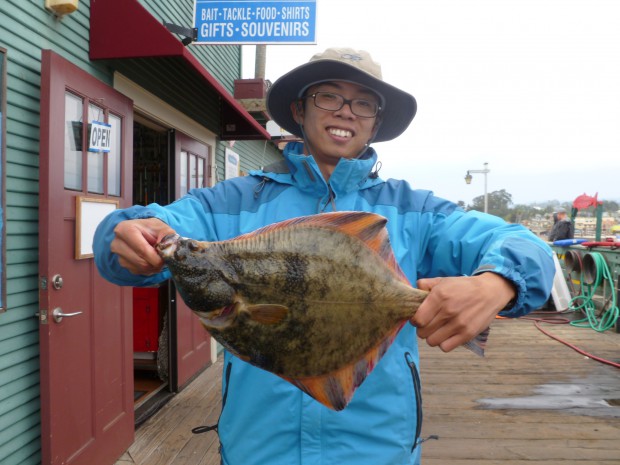
A Starry Flounder caught from the Capitola Wharf in 2013

Piers: Once common in central and northern California but far less common today. Best bets: Cayucos Pier, San Simeon Pier, Capitola Wharf, Santa Cruz Wharf, Pillar Point Pier, Berkeley Pier, Point Pinole Pier, Martinez Pier, McNear Beach Pier, Paradise Beach Pier, Adorni Pier, and the “B” Street Pier in Crescent City.

Shoreline: Once a common shore catch by anglers in San Francisco and Humboldt Bay but today far less common.

Boats: Once a favored fish for boaters in the San Francisco Bay Area but numbers have dropped dramatically over the years.

A Starry Flounder caught from the Pacifica Pier in the ’70s

Bait and Tackle: Once heavily fished in the San Francisco Bay Area although numbers have dropped. The most common rigging is a sliding live bait leader baited with pile worms, live grass shrimp or ghost shrimp. Many are also taken on high/low leaders baited with pile worms, grass shrimp, ghost shrimp, cut anchovy, squid, or even pieces of market shrimp. Medium-size tackle with number 4 or 2 hooks is adequate.

Some are also taken on artificial lures. In Coastal Fishes of the Pacific Northwest by Andy Lamb and Phil Edgell it’s reported that “small spinners slowly retrieved near the sandy bottom also attract this good light-tackle battler. Fly fishermen seeking a novel experience can sometimes catch this inhabitant of shallow water when it rises to the surface at night, attracted either by pier lights or the small prey congregating there.” I’ve never heard of similar fishing in northern California bays but it may be possible.

Another book, one that was a favorite of mine when I was young, is Anglers Guide To The Salt Water Fishes by Edward C. Migdalski. In his discussion of starry flounder he writes, “during one expedition to Unimak Island in the Aleutians, Larry Sheerin and I experienced some wonderful sport with the starry flounder. We were fishing primarily for dolly varden trout as we cast small spoons into a fairly large and rapid river which emptied into the sea a couple of miles further down. We caught many good-sized dolly varden, which put up a splendid battle in such cold swift water, but the occasional large starry flounders that grabbed our lures out-scrapped the trout!”

Another Starry Flounder from the Capitola Wharf

Food Value:  Generally good although some have only a fair flavor. This is another fish that may be unsafe to eat in areas with heavy pollution. Best fried or baked.

Comments: Young starries apparently subsist mainly on a diet of shrimp and worms. As they mature they develop more of an Epicurean craving for such items as crabs, clams, brittle stars, sand dollars and other fish. I imagine anyone baiting up his or her hook with a brittle star or a sand dollar (and I’m not sure how you would do it) would get a really strange, only-in-California look from other anglers. Starries live to about 24 years of age.

As mentioned, the numbers have dropped. In Marine Food and Game Fishes of California by John E. Fitch and Robert J. Lavenberg, the authors say “starry flounder are the most common flatfish caught by sport fishermen in central and northern California, an estimated 14,000 per year being taken during the period 1958 to 1961. About half of these are caught by pier fishermen and most of the rest by shore and skiff fishermen.” However, in reviewing the fish catch data from central and northern California piers, 2000-2009, I could only find three piers where starry flounder were the predominant flatfish—the McNear Beach Pier, Paradise Beach Pier, and Point Pinole Pier, all in San Francisco or San Pablo Bay (although piers in the Carquinez Strait were not surveyed and probably would show starry flounder as the number one flatfish at those piers). The number one flatfish at most piers, especially oceanfront piers and those near the entrance to San Francisco Bay was sanddabs although some piers showed good numbers of California halibut (especially the Berkeley Pier).

Could da’ books be wrong? Until recently (2002) most authoritarian guides listed the range of starry flounder as south only to Santa Barbara or the Santa Ynez River (near Santa Barbara). However, on July 4, 1962, I caught a fish off of Newport Pier that seemed to match, in every respect, the characteristics of starry flounder: its coloring was the same, it had rough scales, etc. Several source books conflicted on the southern range of this fish, but one old text did include a listing for a southern starry flounder that showed a more southern range. That identification satisfied my biology teacher at Newport Harbor H.S. as well as myself. The guidebooks still do not list starries as extending south to Newport Beach but I will continue to believe that I caught a starry flounder at the Newport Pier on Independence Day, 1962.

A Starry Flounder from the Santa Cruz WharfStarry Flounder from Joseph’s Fishing Resort Pier (San Pablo Bay) in the ’70s

A Starry Flounder caught from the Paradise Beach Pier (San Francisco Bay)

Posted in Daily musings... · Tagged , , , , , , , , , · 2 Comments

C-O Turbot

 A C-O Turbot taken from the Redondo Beach Pier

Order Pleuronectiformes— Righteye Flounders—Family Pleuronectidae

Species: Pleuronichthys coenosus (Girard 1854); from the Greek words pleuron  (side) and ichthys (fish), and the Latin word coenosus (muddy).    

Alternate Names: Mottled turbot, C-O sole, and popeye sole.

Identification: An oval-shaped, right-eyed member of the flatfish family. C-O turbot are most easily identified by a dark spot and crescent-shaped ring on the caudal fin (like an O inside a C). High dorsal and anal fins with first 5-6 rays in dorsal fin on the blind side; eyes large and protruding, separated by a high, bony ridge; a small mouth and thick lips. Coloring is generally brown to almost black with a spot about the size of an eye on the lateral line. However, Milton Love in his piscatorial Bible, Certainly More Than You Want to Know About The Fishes of the Pacific Coast, says: “Goodness, but c-o soles can come in a vast array of colors and patterns. Pink, yellow, cream, white, and brown are the most common, although you often see them almost solid white, and an occasional one has a blue ring or two. If you see a turbot that is brightly, one might say garishly marked, it is likely a c-o.”

C-O Turbot from the Redondo Beach Pier

Size: To 14 inches; most caught off piers are less than 12 inches.

Range: Punta Abreojos, southern Baja to Southeastern Alaska.

Habitat: Typically found on sandy bottoms but sometimes will be found around rocks and algae; from inshore, shallow-water bays to a depth of 1,150 feet. C-O’s typically feed on sediment dwellers such as polychaete worms and small crustaceans (crabs, shrimps, clams, brittle stars) but they will also gobble up small fish when available.

Piers: A fairly uncommon catch but occasionally seen at piers, especially those close to deep water. Best bets: Balboa Pier, Newport Pier, Redondo Beach Pier, Port Hueneme Pier, and Monterey Wharf #2.

Mike Granat and the C-O Turbot from Redondo Beach

Shoreline: Rarely caught from shore.

Boats: Occasionally taken by boaters fishing for sanddabs and other flatfish.

Bait and Tackle: C-O turbot are small flatfish, which prefer a small hook and live bait. Bloodworm, lugworms, and small ghost shrimp are the best baits. However, almost any bait may attract a bite including cut anchovy, strips of squid, and pieces of shrimp or clam. Hooks should not be larger than size 4.

Food Value:  Excellent. Due to size often best simply pan-fried.

Comments: An attractive and good tasting little fish.

A C-O Turbot taken by Tim Fitzgerald from the Hermosa Beach Pier

Posted in Daily musings... · Tagged , , , , , · Leave a comment

Diamond Turbot

Diamond Turbot from the Shelter Island Pier in San Diego Bay

Order Pleuronectiformes — Righteye Flounders—Family Pleuronectidae

Species: Hypsopsetta guttulata (Girard 1856); from the Greek word hypsopsetta  (deep flounder, referring to the oval shape) and the Latin word guttulata  (with small spots).

Alternate Names: Turbot or diamond flounder. Called platija diamante in Mexico.

Identification: Diamond turbot are (surprise) diamond shaped and a right-eyed member of the flatfish family. They have a small mouth with the dorsal branch of the lateral line extending more than half the distance to the caudal fin. Their coloring is dark gray, brown or green with bright blue round spots on the pigmented side; there is a yellow rim near the mouth on the blind side.

Hashem Nahid and a diamond turbot from the Cabrillo Beach Pier

Size: To 18 inches; most caught off piers are under 12 inches.

Range: Cabo San Lucas, southern Baja California and the Gulf of California to Cape Mendocino.

Habitat: Primarily found in bays, over sand and mud.

Piers: Most common at SoCal piers located in bays but occasionally reported from CenCal piers. Best bets: Bayside Park Pier, Ferry Landing Pier, Shelter Island Pier, Oceanside Small Craft Harbor Pier, Dana Point Harbor Pier, Seal Beach Pier, and the Morro Bay T-Piers.

Diamond turbot from the Cabrillo Beach Pier

Shoreline: A common catch in southern California, especially if fishing in bays.

Boats: Occasionally taken by boaters fishing in southern California bays, Morro Bay, and San Francisco Bay.

Bait and Tackle: Diamond turbot are small flatfish, which prefer a small hook and live bait. Bloodworm, lugworms, and small ghost shrimp are the best baits. However, many are also caught on cut anchovy, strips of squid, and pieces of shrimp or clam. Hooks should not be larger than size 4. Although more commonly taken from piers in bays, they can also be caught at oceanfront piers, generally just out past the surf area.

Diamond turbot caught at the Marin Rod & Gun Club Pier in San Francisco Bay

Food Value:  Excellent although this is another fish which may be unsafe to eat in areas with heavy pollution. Best fried or baked.

Comments: An attractive and good tasting little fish.

Posted in Daily musings... · Tagged , , , , , , · Leave a comment