Rare fish caught at Belmont Pier — catalufa

Rare fish caught at Belmont Pier

Casting a bait and then sitting down and watching the rod tip on Belmont Pier isn’t the most glamorous and exotic fishing along the Pacific Coast, but it’s restful and sometimes productive for perch, an occasional halibut and other species. Then too, you meet interesting people.

Gerald Osier of 221 Grand Ave., who has worked on the pier and still does some part time work there in the summer months, likes to fish the pier and just loaf. Just recently he caught one of the rarest fishes in the Pacific Ocean. It was small, and there was no way that he could have filleted it and got a dinner for two  So he reported to the department of Fish and Game, and  one of  the DFG biologists came to take a look and carry the fish back to the laboratories at 350 Golden Shore.

The fish was red, looked like a perch, had large blue eyes almost the size of nickels, weighed 11 ounces, and was 9 ½ inches long. Now Osier has a letter from John Fitch, research director of the State Fisheries Laboratories at Long Beach DFG, saying that the fish is a catalufa, extremely rare. In fact, said Fitch, fewer than 15 had ever been caught either by hook and line or in commercial nets in all the time that he has been with the DFG. Fitch, in his letter to Osier, said that the largest  that he had ever seen was 13 inches long and weighed two pounds. He also told Osier that the fish was being sent to the Natural History Museum in Los Angeles. It will be made into a mount and displayed.

This is just one sample of what can happen in pier fishing, which can be fun for individuals or a family except for the fact that all piers now are afflicted with vandalism. What public facilities are not endangered the same way? Belmont Pier is the one remaining public fishing facility in Long Beach and it deserves enough security protection to keep it clean.

 —Donnell Culpepper, Long Beach Press-Telegram, November 21, 1975


Posted in Pierfishing, Saltwater Fishing · Tagged , , , , · Leave a comment

Pacific Electric Ray — the shocking details


 Good old sparkie!

Species: Torpedo californica; (Ayres, 1855); from the Greek word torpedo (for numbness—from the electric shock) and californica (for California, where the first specimens were taken).

Alternate Names: Torpedo ray, numbfish, crampfish or torpedo. Called torpedo del Pacifico or torpedo in Mexico.

Identification:  An oval disk that is thick and flabby; the tail is short, stocky, with two dorsal fins and a large symmetrical caudal fin. No spines or prickles. Eyes small and round; mouth moderate in size with 4 or 5 rows of teeth in each jaw. Coloring is blue-black to drak gray above; white to slate gray below; often with black spotting.

Electric Ray — Ventura Pier

Size: Reported to 4 feet in length and 90 pounds. Typical size at piers is from two and a half to three and a half feet.

Range: Worldwide in tropical and temperate seas; in the eastern Pacific from Sebastian Viscaino Bay, southern Baja California, and the Gulf of California, to Wiah Point in Dixon Entrance, Queen Charlotte Islands, British Columbia.

Habitat:  Generally in shallow coastal waters but reported to a depth of 900 feet. During the day they will often partially bury themselves in sand before ambushing unsuspecting victims that come a little too close. They capture their prey (fish, invertebrates, cephalopods) by suddenly lunging their heads upwards and simultaneously delivering an electric shock (of up to 45 volts). At night they like to swim mid-level and attack fish that have settled near the bottom in a quiescent state. It’s reported that when “a prey fish enters range, the ray lunges forward and folds the anterior and lateral margins of its pectoral fins over it. It then envelops the prey further by making short kicks with its tail, sometimes performing somersaults and/or barrel rolls, while incapacitating it with electric shocks. The stunned fish is then passed to the weak but flexible mouth with undulations of the disc, and swallowed head-first.” When vision is limited  (night or turbid water) they may find their prey by picking up electrical cues with their ampullae of Lorenzini.

Electric Ray — Ventura Pier

Piers: An uncommon catch at piers although some are taken each year; most common at piers south of Point Conception. Best bets: Ocean Beach Pier, San Clemente Pier, Hermosa Beach Pier, Ventura Pier (#1), and the Gaviota Pier.

Shoreline: Rarely caught by shore anglers.

Boats: Rarely seen by boaters.

Electric Ray — Venice Pier

Bait and Tackle: Since this is one of the larger fish pier anglers will encounter, you should use at least medium saltwater tackle—twenty pound test line and size 2 to 4/0 hooks. Most electric rays have been taken on cut bait such as mackerel and sardines or on squid.

Food Value: Apparently they are quite tasty (at least according to the French who savor electric rays).

Comments: Milton Love reports that they “hover over the potential tidbits, then stun them with a jolt that can reach at least 45 volts.” These rays are generally a surprise catch on a pier and often the angler is shocked (literally) by the catch. If you must pick them up, do so by their tails; the shocks are produced in organs located in the disk on each side of the ray.

Posted in Pierfishing, Saltwater Fishing · Tagged , , , , · 2 Comments

Pier Fishing in California — Concourse d’Pier Carts

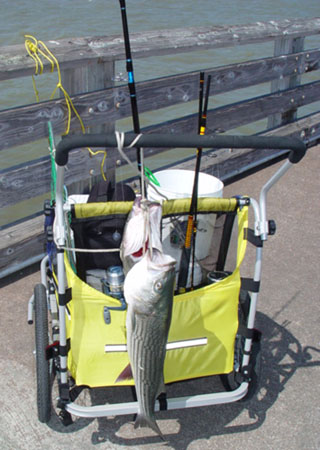
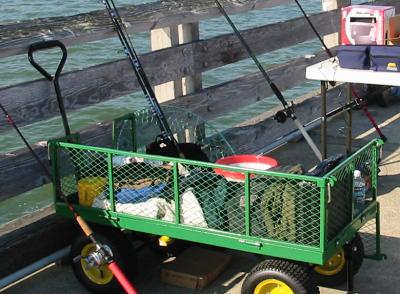
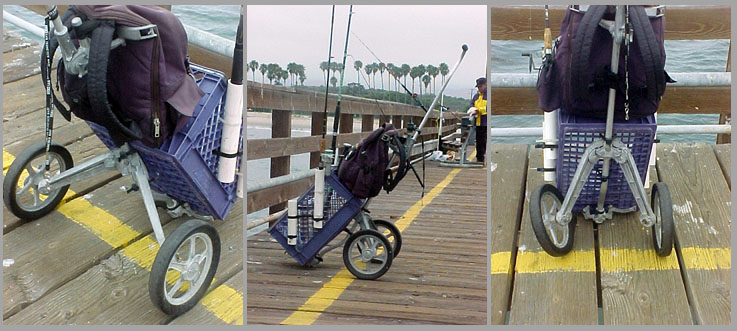
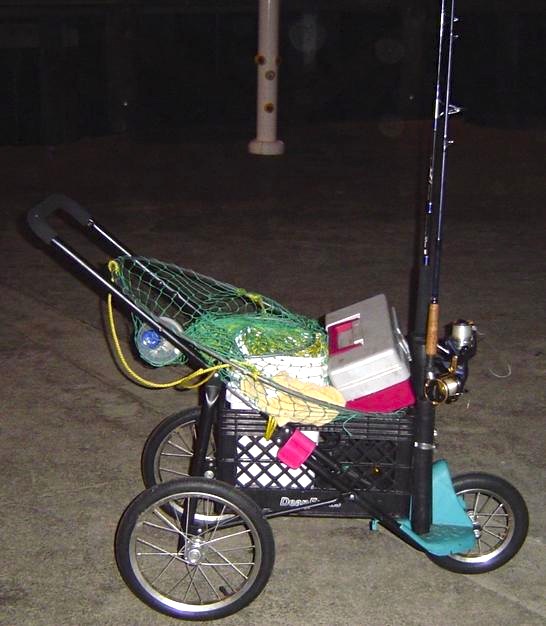
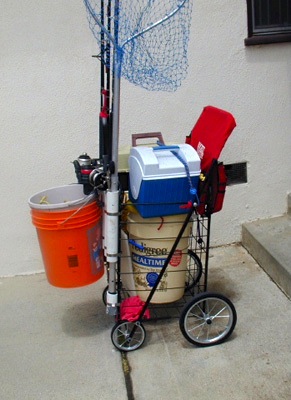
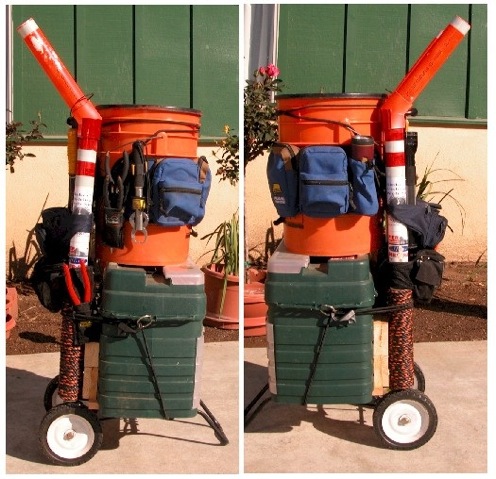
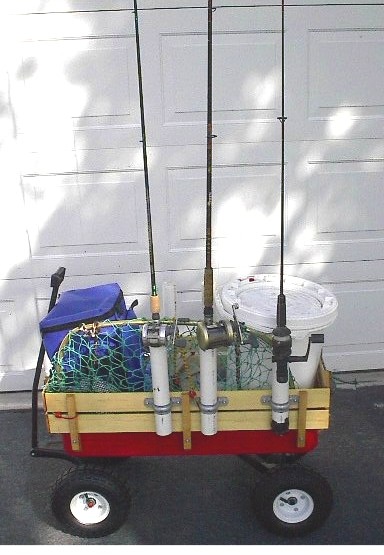
Almost every pier rat that I know, or at least those who frequent the long piers in central and southern California, has a pier cart. It’s needed when you’re loaded down with rods and reels, tackle box, bait bucket, cooler, hoop net, magic potents, good luck charms, and your personal copy of Pier Fishing in California (that seems to weigh several pounds itself). Of course you also need something to help you carry off that 30-pound fish that you’re going to take home for dinner. Some are simple (i.e, old grocery carts), some are commercially available models found at most hardware stores, some are elaborate home-made contraptions containing all sorts of personal innovations. However, simple or complex, inexpensive or expensive, they must do the same thing: provide a platform by which to haul that sometimes fairly heavy equipment out to the end of the pier. And, they must be sturdy enough to be hauled up and down stairs as well as over rough-hewn planks. In addition, they must be able to survive the vicissitudes of car trunk and pick-up truck travel. They’re a MUST HAVE piece of equipment.

One day we had a thread on Pier Fishing in California about pier carts and someone sent in the following title (which I’ve changed for this article). We also received a plethora of pictures of people’s favorite carts.


These first two pictures are of my pier cart (minus the rod holders) and I’ve used this one or similar ones since the ’80s

KJ Pier Cart 2016 at Citizens Dock in Crescent City

Art and his pier cart — Newport Pier

Crabman’s pier cart — Newport Pier

Matty and Gordo Grande — Hermosa Beach Pier

Rockhoppers pier cart — Berkeley Pier

Gyzodude’s “green monster” cart —Berkeley Pier

Kim’s pier cart — Goleta Pier

Dumbarton Dave’s pier cart — Dumbarton Pier

Jason’s pier cart

DompfaBen’s pier cart

Pier cart at Malibu Pier, 2007

Gordo’s pier cart

Unknown pier cart

BigdaddyO57′s pier cart

Jimbojack’s Cart

Riorust’s pier cartReelHabit’s pier cart

Sinker’s small pier cart

Mark and the “Magic Pier Cart” — Oceanside Pier


 Pier cart at the Huntington Beach Pier in 2015

Pier cart at Manhattan Beach Pier in 2006

Pier Cart at the Balboa Pier

Pier Cart at the Port Hueneme Pier

Posted in Pierfishing, Saltwater Fishing · Tagged , , , , , · Leave a comment

The Catalina “Get Togethers” & a few designs over the years —

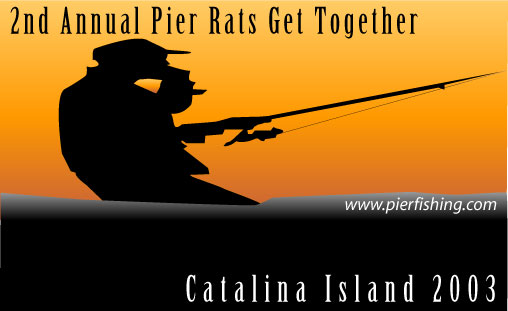
For over a decade the “pier rats” from Pier Fishing In California (pierfishing.com) and United Pier and Shore Anglers of California (UPSAC) got together at Avalon on Catalina Island, caught a few fish, and had a chance to see their friends once again. Every year there was a design for the t-shirts and often there was a contest. Here are some of the designs over the years.

This was the official 2002 winner!

This design was a runner-up in 2003

The winner in 2003

2004 winning entry — a small copy

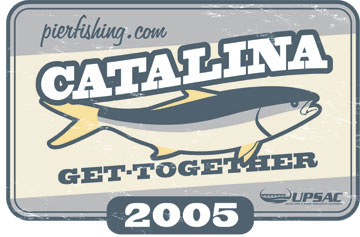
The winning entry in 2005

The winner in 2006

This one wasn’t selected in 2007. Some felt it was in bad taste, some thought it was great.

This was the winning 2007 entry

We had two winners in 2008, a men’s and women’s version

The 2009 winner

The 2010 winner (front)

The 2010 winner (back)

The 2011 Winner

The 2012 winner

The 2013 Winner.

Posted in Daily musings..., Pierfishing, Saltwater Fishing · Tagged , , , , , · Leave a comment

California’s SoCal Bass — #3 — Spotted Sand Bass aka Bay Bass

Sea Basses—Family Serranidae

Spotted sand bass from the Coronado Ferry Landing Pier in 2004

Species: Paralabrax maculatofasciatus (Steindachner, 1868); from the Greek words para (near) and labrax (a European bass), and the Latin words maculato (spotted) and fasciatus  (banded).

Alternate Names: Commonly called bay bass, spotted bay bass, spotted bass, rock bass, red spotted rock bass, spotted, spotty, spotted cabrilla, pinta cabrilla. Also grumpy (large fish), Johnny verde, sand bass and one I don’t understand—nuked fish (San Diego Bay bass). In Mexico it’s called cabrilla de roca.

Identification: Bass-shaped with a dorsal fin similar to that of barred sand bass. Identified by the numerous reddish-brown or black spots that cover the body and fins.

Spotted Sand Bass from Coronado Ferry Landing Pier in 2002

Size: Length is to 23 inches and weight to 7 pounds. Most caught off piers are less than 12 inches. The California record weighed 6 lb 12 oz and was taken at Newport Bay in 1994.

Range: Mazatlan, Mexico and the Gulf of California to Monterey; uncommon north of Cayucos. Very common in Newport Bay, Mission Bay, and San Diego Bay. (Reported from San Francisco Bay in the late 1800s.)

Habitat: Typically found in shallow (2 to 30 feet), warm-water areas in bays and harbors as well as protected inshore environments along the coast. Most commonly found where there is some form of structure—eelgrass, surfgrass or rocks.

Spotted sand bass from the Coronado Ferry Landing Pier in 2004

Piers: Generally caught from piers in bays but seen at almost all southern California piers. Best bets: Coronado Ferry Landing Pier, Embarcadero Marina Park Pier, Shelter Island Pier, Oceanside Harbor Pier, Dana Harbor Pier, Belmont Veterans Memorial Pier, Cabrillo Pier and Redondo Sportfishing Pier. Primarily caught March to November.

Shoreline: One of the main catches for shore anglers fishing in bays in southern California.

Boats: One of the main species for boaters fishing in southern California bays.

Brian and a spotted sand bass from a pier in Newport Harbor in 2006

Bait and Tackle: Adult spotties are opportunistic feeders grabbing whatever seems to look like food. Although they primarily eat crabs and clams, especially jackknife (aka razorback) clams and littleneck clams, they also will snack on ghost shrimp, shrimp, snails, algae, brittle stars and small fish. Since crabs and clams are their main food, both are considered good bait. Other good baits, all fished on the bottom, include ghost shrimp, bloodworms, fresh mussels, other types of clams, and live small fish—anchovies and topsmelt. Tackle should be light with hooks size 6 or 4. They’ll often hit artificial lures like swim baits, grubs and even feathers.

DompfaBen and a spotted sand bass from a pier in Newport Harbor in 2006

Food Value:  If you are lucky enough to land a keeper-size fish you will have a good meal. Spotted sand bass have a mild-flavored meat suitable to almost any kind of cooking. They can be used as fillets, baked whole, or cut into smaller pieces for deep-frying.

A spotted sand bass from the Coronado Ferry Landing Pier in 2004

Comments: In the “don’t know why category.” it’s reported that spotted bass in the Anaheim and Newport Bays reach the legal 12-inch size in 2-3 years. However, the spotties typically can take up to 8 years to reach legal size in San Diego Bay.  Fish from Marina del Rey are also fast growin’ while those from Long Beach Harbor and the Catalina Harbor are somewhat in the midpoint in growth rate. Overall, the average southern California spotty is of legal size by 3 years excepting those poor fish down in San Diego Bay. Of course that does give the “Diego clan” a few more years to enjoy the fun of being caught and returned (we hope) to the water by SoCal anglers.

A spotted sand bass from the Shelter island Pier in 2009

Another spotted sand bass from the Shelter Island Pier in 2009

Spotted Sand Bass from the Coronado Ferry Landing Pier in 2007

Spotted Sand Bass taken by Arvin at the Coronado Ferry Landing Pier in 2002

Spotted sand bass taken at Carlsbad 

Spotted sand bass taken by calaznfisher in 2011

Posted in Pierfishing, Saltwater Fishing · Tagged , , , , , · 3 Comments