


San Simeon Pier and Bay on Thursday — You Had To Be There
 San Simeon Bay is one of those beautiful spots along California’s coast that almost seems to demand that a person stop and take a look around the area. The juxtaposition of sky, land and ocean can grab the attention of the soul, as well as the eye, and provide respite, even if only briefly, to our normal helter-skelter world.
It’s a bay where on a crystal clear day, one kissed by California’s abundant sunshine, a person is presented a beautiful post-card picture for the eye. On a foggy day the horizon can be dim and the scenes impenetrable, but the noises and smells of the sea will invoke a picture in the mind.
San Simeon Point extends out into the sea at the north end of the bay while lush beds of giant kelp and feather boa cover the water at the south edge of the bay. Together they temper the ocean’s forces of disruption—the currents and waves. The bay’s surface is usually mild; the waves that strike the beach are usually tame.
Life in and on the bay’s waters is also generally mild. Some seabirds are always present, some fish are to be found, and onshore tourists and locals go about their duties, the tourists checking out every sight, the locals working to keep the sights available. But the fishing, especially at the pier is also fairly mild. The surf is too light for top-notch perch action, the resident bottom species prefer the kelp beds, and the pelagic forage fish come and go.
 But when the pelagics do enter the bay’s waters the chemistry can change—with dramatic results. Such was the case this week as shoals of sardines entered the bay. Did they enter in response to a bloom of plankton, the essential food for the small fish? Were they simply seeking out some calm and shelter from their usual ocean haunts? No one knows but the response of other species was evident.
Thousand of sea birds converged on the area, large and inelegant pelicans, screeching sea gulls, and the smaller but just as hungry cormorants and terns. In the water were giant rafts of dolphin-imitatin’ sea lions together with their less numerous pinniped cousins—the harbor seals.
 Surprisingly missing were the dolphins themselves and the whales that often visit such buffet gatherings in the sea. It didn’t matter that some species were missing, the ones that were present provided carnage on a scale rarely seen today by most visitors.
I arrived at the pier just before noon; soon had the pier cart set up, and headed out to the pier. A short way out on the south side of the pier stood two gentlemen holding their fishing rods and reels; they looked like locals. “How’s the action, catching anything?” The first angler piped up, “It’s still slow but you should have seen it yesterday, we both caught over fifty sardines.” The second looked north toward the point and nodded, “see the birds over there, that’s where there are at.” In the horizon, several hundred yards away, was a mass of birds hanging over a spot and just barely perceptible was movement in the water; it was like flies hovering over some smelly but tasty trash.
My partners in crime going fishless, I decided to move farther out on the pier. Anglers at the end were also on the south side, the wind was to their back, and they were pulling up empty Sabiki-type bait rigs.
I moved to the mid-pier section. Why fish where others were already proving the futility of their spots? I began the ritual of fishing. Where to cast? Since I wanted my sitting pole to have a taunt line, I needed to cast to the south side; there was a wind and it would keep the line honest. My heavier outfit was baited up and soon after the hooks and bait was sitting on the bottom of the sea. My lighter rod and reel followed suit but was equipped with a Lucky Lura bait rig; if the sardines were around why not see if I could stock the cooler with fresh bait? I would cast this line to the north even though the fish were mainly in the distance. A few stragglers might be in the area.

The first two casts gave good exercise for the arms but no fish. The third cast saw the hooks start to be smacked by the fish and soon the tension increased as fish grabbed what they thought was food. I had to be careful since tendrils of kelp poked their fingers out from the pier. But, I had set up between two hands of the kelp and had a vegetation-free passage of water about twenty feet in width. That passage of water would provide the highway that the sardines would travel to the pier and up to my waiting hands.
Almost every cast was producing a fish and the anglers at the end were starting to look over—but they stayed at their spots. My biggest problem was trying to keep an eye on the pole to my back while working the pole in my hand.
Shortly after arriving at my spot I noticed that the amount of birds near the pier was increasing. Then I saw something I have rarely seen before, giant rafts of sea lions, each raft numbering twenty to thirty sea lions, and all were making a hard swim into the area. Their swim was reminiscent of dolphins as they would dive and emerge, dive and emerge, all at a breakneck pace and all in unison. There were several such rafts with the total numbers exceeding a hundred but the number of birds far dwarfed even that number.

As a student of history it reminded me of the stories of battle, thousands of soldiers marching in orderly fashion into battle against their adversary. Here it was a little less orderly only because the brown pelicans and sea gulls showed individuality in action. The sea lions would attack the shoal of sardines from below, the birds from above. The pelicans would make their cannon ball dive into the water emerging with a mouthful of fish. The sea lions would grab a fish and sometimes toss it into the air only to be enraged when a herring gull would grab it in front of their snout. The terns and cormorants played at the periphery of action but still were well filled.
The water near the pier was now dimpled with fish and the air was filled with raucous sound. Most amazing was the picture in the water when the sardines moved next to the pier. Huge bait balls twenty to thirty feet across would begin to darken the water twisting and turning in unison to avoid the pursuing lions. Some would leap out of the water, most wouldn’t, but all fled instinctively in terror from their pursuer.
As said it was like watching a battle, one filled with death. But the battle was in fast motion; I’ve watched civil war movies that showed the armies in slow motion and soldiers heroically crumpling to the ground. This was more akin to the fast-paced battles seen in Lord of the Ring. As for the number of fish consumed it’s anyone’s guess but it gives glimpse to the number of fish still in the ocean.
There are parts of the world where scenes like this are still common but it seems like you rarely see it today in California. It still happens, but it’s usually more out of sight. I’ve seen similar scenes at Cayucos and at Pacifica, and on a tamer scale at many sites, but I’m not sure if I have ever seen so many sea lions on the hunt in such a fashion.
I talked to a local lady who had come out to see if the sardines were still in the bay. She said she had been out the previous day watching a similar scene and was amazed. She also said that though she had lived in the area nearly thirty years she had never seen such number of fish or predators. I felt privileged that I had decided to visit the pier this day.
As for the fishing, the cooler was soon filled with fresh sardines to be used for bait. Some fish were given to less fortunate/lucky/experienced anglers. A few of the sardines were used to catch nice-sized kingfish on the bottom. My freezer is full and I will not need to buy bait.
 Much more important though is the reminder that Mother Nature can be spectacular. Some view such carnage with distain but to me it simply reflects nature; it was simply the food chain on display. The bigger eat the smaller and of course humans are usually at the top of the chain. Many today reject our role in the mix; they feel we do nothing except disrupt nature. I feel that though we have indeed made many mistakes over the years we also have learned from those mistakes and can practice our skills (such as fishing) in ways more respectful of nature. We still are the top of the food chain and should be able to continue our ways; we just need to do it in a manner that helps preserve the nature that we all love.
 From a post on pierfishing.com — 7/10/2009
Snookie — Balboa Pier


 One of my favorite people is “Snookie,” a “Lady” that I have had the pleasure of fishing with many times and one who has been a reporter for the Pier Fishing In California website for over a decade. I included the following in Pier Fishing In California, 2nd Ed., but it really doesn’t tell how special she is. Although she’s a fantastic angler, she’s also an artist, a nurturing mother (to many), and a person who helps keep an eye of the pier. Just wish we had the ability to clone people because every pier could use a person like Snookie.
From PFIC, 2nd Ed. — The Balboa Pier has a special group of “pier rats” that I’ve had the pleasure to get to know. One of them is “Snookie,” the reporter for my Pier Fishing in California web site. The following newspaper story is about her and her gang of “pier rats.”
 Reeling in the years You should have been at the pier the day Warren hooked a near-keeper halibut. Oh, Warren has hooked plenty of keepers in his time, but he’ll tell you fishing isn’t about what you take, it’s about what keeps you coming back. Anyway: This one halibut a couple of weeks ago–turned out to be 20 inches, two short of legal limit–had Warren moving. Bad hip and all, dang thing, he raced that halibut, staying just ahead of the hooked fish’s efforts to reach the pylons and wrap itself to freedom. Thirty feet below Warren’s bowed fishing rod, the young feisty halibut with the white belly challenged the 81-year-old fisherman, tanned like leather from so many long days in a sun that precocious halibut wouldn’t survive a minute. Noble had a line dropped several feet up the pier (toward Ruby’s) and had to hustle to raise his rig to let Warren and the halibut scamper underneath. Snooky abandoned her reel and went for the drop met. She lowered the net in sync with Warren raising the halibut. Reeling, lowering, reeling, lowering until the flopping captive popped from the water and into the wide, circular net fixed to a thick rope, Snooky’s good with the net. Snooky’s good with everything out here. Out came the measure, up-short came the halibut, over the edge went the 20-incher and back for more bait went Warren, his old, small face lit as if a boy again. Milton was there that day. Cass might have been. Bob wasn’t though; he’s off fishing his way toward Washington or something. And Sunny. Well, she’s not out much this summer. Came out a lot last year and fished from her wheelchair, but even the Queen of the Halibuts has to give it up at some point, and this may be the summer—her 82nd—marked as Sunny’s retirement. If it is Tuesday or Thursday, and if the Balboa Pier is standing, this bunch will be on it. Usually gathered near the second “T” with carts and coolers and buckets and memories that go way back, to the days, even, before sardines got fished out; back to when barges were anchored three miles out and a water taxi would take you to them for two bits and you could catch barracuda so big they called them logs. Oh, yeah. This summer there are about five or six regulars: Snooky, Noble, Warren, Milton, Cass.
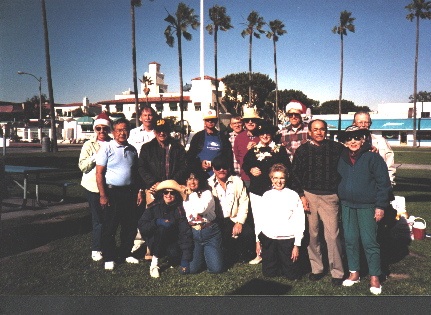
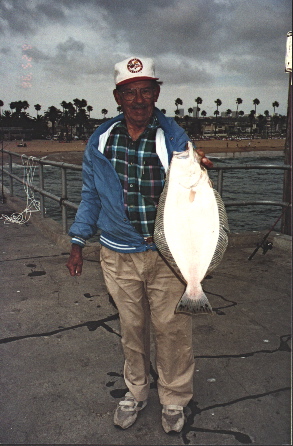 They all have last names. But not out here. Snooky’s thick photo book shows the whole gang that has grown over the years to about 20, sometimes—if the scene of past Christmas parties is accurate. And, being that it’s Snooky’s book, you can bet it is. She’s got another book, without photos but with as many memories. It’s the record book she keeps— the one that cost $12.95 but is worth it because it has tide information for each day of the year. Even shows what time of day is best for fishing, although as Warren says: “I’ve never seen a halibut wearing a wristwatch.” Every summer, Snooky records each halibut caught by her pier peers, and at the end of the season, the person who has caught the most keepers gets…nothing. Midway into the summer Warren and Snooky have four apiece; Cass, two, Noble, three. Milton mostly comes to visit. Snooky, Sunny’s daughter is the baby of the bunch. She’s 60. Warren, you know, is 81. Milton is 80. Noble is 71. Most are retired: from real estate, insurance, nursery management. They get here about 10 A.M., break for their lunch precisely (well, as precisely as retired fishermen) at noon, stay sometimes till late afternoon. This is not a hobby for any of them. Hobby? No. Something else. Something more life giving. Or so it seems. “The camaraderie,” Snooky says she comes for. Which is something, considering how much she likes fishing and how good she is at it. Can’t remember a time when she didn’t fish. Goes to Vegas for international fishing conventions. Said Milton: “I come down to see the gang as much as anything.” Among the gang there are about 300 years of fishing experience, gathered on piers from Belmont Shore to here at Balboa, where they are a well-known sight. After all these years, a pool of anchovies can still excite them. Like last week, when the waters near the pier were darkened with thousands of the smelly baitfish. Milton and Noble and Warren and Snooky left their main rigs propped on the pier railing and gathered their bait-catching lines, aiming leaded monofilament laced with tiny hooks into the school and yanking up cigar-shaped silver that shot sharp reflections at the midday sun. See, game fish like anchovies best, it seems. Better than smelt, anyway. Maybe, Snooky figures, because anchovies have a softer scale. So, when the anchovies come through, the excitement of getting bait is nearly as good as the thrill of a keeper catch. Nearly. You need a lot of bait out here. Not that it’s anything like it was 50 years ago, mind you, but a person who knows what he’s doing can keep busy, This pier fishing is not as passive as you might think. There’s bait to be caught, leaders to be strung, territory to be guarded against the occasional fisherman who wanders out here not knowing that the second “T” is the crowd’s unofficial squat. “If you want nuts,” Warren says, “come to the pier.” The deranged come here, the drugged, the street preachers claiming to be fishers of men. The ill and ill intentioned and the ill-conceit of the well-intentioned mix with those who fish for fun and those who fish for food and those who fish because it’s what they’ve always done. They watch after one another in this group. A few years ago, Snooky says, it got so that if you didn’t keep an eye on your equipment, it would disappear. So now, they all look out for one another and take lunch at the same time so they can watch their gear while they eat.
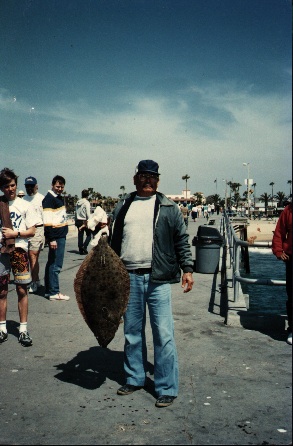
Things change. Things don’t. Warren’s been fishing these waters 72 years and says the thrill at 81 is the same as when he was 9. The same it’ll be at 90. He’s seen a lot out here. Still, he dreams. “It’s always been a dream of mine to go to the Florida Keys and fish for those big tuna,” he says. “Man, to get hold of one of those big things, boy, oh boy…” Man, Boy oh boy. Warren says he wants to die fishing. Almost did. In 1993, he’d just landed a 27-inch halibut, and Snooky was taking a picture when Warren collapsed. Noble and Snooky took him to the hospital. Heart attack. He was back in two weeks, more convinced of how he wants to go out. “I want to die with a 100-pound fish at the end of the line,” Warren says. “For a fisherman, that’s the way to go out…But I’d be happy to get a 10-pound bonito out here.” Fishing, fishing, fishing. Tuesday, Thursday. Tuesday, Thursday. Toss, reel, bait, clean, eat. Visit. Keepers. John Hughes, Subculture, The Orange County Register, August 2, 1997
Snookie says most of the group has been together for over thirty years, although some members have known each other for 55 years. Sunny, Snookie’s mother, was the matriarch of the group (until she died in 2001) and fished on both the Balboa and Newport piers before Snookie was born, a time when you “had to have a license just for catching yellowfin croaker.” Snookie’s daughter also grew up on the piers. “When she was in a stroller on Newport Pier, Grandma Sunny would make her play with live anchovies so she wouldn’t be afraid of them later,” said Snookie. Although all had fished the local piers, they more closely banded together back in the ’80s when thievery was at its height on the piers. Today, as seen in the article, the group is sort of a nurturing, extended family whose togetherness exemplifies what I sometimes affectionately call the Loyal Fraternity of Pier Rats. Their group should serve as a good example for other piers.  By the way, my
first day of fishing with the group, in June of ’99, highlighted several points that have been mentioned before but bear repeating. When Snookie arrived around 10 A.M. she brought with her the nets, live bait buckets, and other materials necessary to be a successful halibut angler these days. Soon Snookie had made some bait—lively small smelt—and the group was fishing. Snookie quickly caught a sub-legal halibut, which was returned to the mighty Pacific. A few minutes later a second halibut was caught, and then a third, while I was still fishless and hoping I wouldn’t be embarrassed. But then my bait, which was patiently swimming in the depression down between some pilings, began to act up, followed by the characteristic strike from a toothy halibut. I hooked the flattie, quickly realized it was a good fish, and asked Snookie to get the net ready. 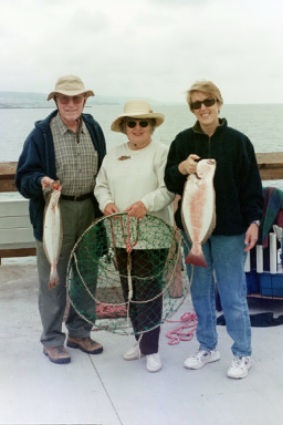
Soon the fish was headed toward a waiting net, it made a final run after spotting the net, and then it was guided into the net. Within a couple of minutes a beautiful, 27-inch keeper halibut was sitting under a wet towel on the pier. Point one was to always have someone present who knows how to correctly use a net or pier gaff to get the bigger fish, and Snookie was an expert at the task. The second point was the great advantage of using live bait. Within a three-hour time span the group of six people caught 10 or 11 halibut (including two by this lucky angler). I didn’t see another angler using live bait, nor did I see another halibut caught. Point three was the simple fact that looks can be deceiving. Most of the halibut were 12-17 inches long and all were returned to the water with the exception of my fish described above. Many anglers looked into our buckets as they headed out toward the end. Since they didn’t see any fish they assumed we hadn’t had much luck. However, nearly everyone in the group had caught at least one halibut, which brings up points four and five. Point four is that regulars like these know how to catch the fish and do so on a regular basis. Point five is that the mid-pier area of the pier, the area where Snookie’s group always fishes, is usually the best area for halibut. It may not produce as many pelagic species as the end areas but it definitely is the best area for the elusive, good-tasting and most-prized flatfish. A point I should repeat is to make sure you have a net (or pier gaff) with you in case you do hook a big fish. 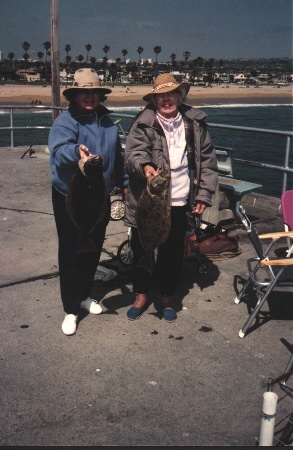 Earlier on the same morning that I met Snookie’s group, I had tried fishing the end area. Not too much was going on except for an occasional mackerel. One of the meat fishermen seeking mackerel was tossing out a multi-hook outfit that had a heavy line and about eight size 2 hooks. On the bottom was a 3 or 4-ounce sinker and a couple of feet above the top hook was a heavy float that kept the rigging floating near the top of the water. The fish (mainly mackerel and a few lizardfish) would hit the bait, his float would disappear under the water, and he would pull in the fish. Since he was using a fairly heavy rod there usually wasn’t much of a fight. However, that would change. One hit yielded resistance that he hadn’t previously seen and it took several minutes before his rig was near the top of the water and the fish could be seen. Imagine his surprise to see two mackerel together with a beautiful salmon that I estimated to weigh 10-12 pounds. Since a net wasn’t present, he tried to hand line the fish to the top of the pier. About half way up to the pier the fish gave a shrug and the line broke. Fish: one, angler: zero. With a net he would have had a rare prize for a southern California pier — though it would have been an illegal fish. As it was, he was left only with the memory.
Ken’s Appearance on Hookin’ Up with Mariko Izumi
Below is a review of the day Brian Linebarger, Robert Gardner and myself spent with Mariko Izumi in San Francisco. This was back in September, 2009.
A few weeks ago I was contacted by Mariko Izumi who does a “travel show with a fishing spin” on the WFN – World Fishing Network. She wondered if I would be willing to take her to a couple of piers and show her some pier fishing in San Francisco. It would provide the fishing segment for the San Francisco show. She would be visiting San Francisco and then be heading on to Portland and Seattle to do two additional shows. With some hesitation, I agreed.
I told her that September was often the best time to visit San Francisco since the weather is usually beautiful in the fall, but I also told her that I was a little concerned that it was a little between the seasons for the various fish. A little late for halibut, a little early for the “World Series” striper bite, a little early for sturgeon, and not the best time for perch. But, it is what it is. She said that it wouldn’t be a problem.
What piers should I take her too? I decided we would visit Pier 7 and the Fort Point Pier. Pier 7 usually has some sharks and rays available as well as jacksmelt, and would provide some great pictures as far as a downtown, urban-type pier. Fort Point always has some perch, usually a pelagic or two (jacksmelt, sardines, and lately mackerel) and perhaps might yield up a striper or halibut. Fort Point also presents great views of the Golden Gate, the Bay, and The City.
I then asked Robert and Brian if they wanted to be part of the show. Both are long time Bay Area regulars and I thought between the three of us we should be able to find Mariko some fish.
Unfortunately it was a really unusual, wild and wacky day.
Saturday morning turned out to be a morning with thunder, lightning, and rain, and that’s what we saw when got to the pier. The three of us were at the pier early, around 7:30, while Mariko and her crew were to join us at 9 AM. Shortly after arrival a decent-sized bat ray was caught at the end along with a legal-size leopard shark. Regulars then began to catch some sardines and small mackerel on the sides of the pier. I joined them with a Sabiki but couldn’t catch a single sardine or mackerel even though fishing next to them. Instead all I got was a small walleye and an anchovy. I’m not sure what Brian and Robert got during that flurry of action but at least it looked like there would be some fish to film.
However, the rain began to come down more heavily and when Mariko arrived at 9AM it was raining too hard to film. She and her crew went off to get some breakfast while the rest of us endured the rain. I’m not sure I had ever seen rain in San Francisco in early September, and certainly not the thunder and lightning that we experienced, but we were willing to put up with it for some fish.
By the time Mariko returned the rain had stopped. However, the fish had also apparently moved on. They certainly weren’t biting. No one on the pier was catching any fish—baitfish or big fish. Even though there were probably fifteen or so big poles lining the front of the pier not a single fish was caught. Nor did any of the Sabiki poles yield a fish. We stuck it out until around 12:30. We tried for different types of fish with different techniques, baits, and spots on the pier, all with no success. However, Mariko turned out to be a charming young lady and we had some nice conversations about Pier 7, pier rats, and pier fishing in general. The crew was also able to interview a number of regulars and tourists alike. In addition, a couple of regulars who had caught mackerel earlier that morning, and then went off to cook them, returned and offered up some cooked mackerel with a sweet and sour sauce—which was great!
We all then headed over to the Fort Point Pier where the action was still slow but at least we were able to manage a few fish. We fished my favorite perch spot, at the inside corner where the pier widens, and managed to get Mariko a striped seaperch, a couple of smallish-sized blue rockfish and a shinerperch. I was able to get a striped seaperch and a rainbow seaperch. Brian got a nice walleye and again I’m not sure what Robert got. But, the film crew was able to film some fish, watch some crabs being taken, watch and film the sea lion hanging by the pier, and even see a jellyfish brought up to the pier. And they interviewed and filmed quite a few visitors to the pier. Although the weather was still a little overcast, they also managed some nice pictures of The City and the bridge (or at least what we could see of it).
We stopped around 4 PM and while the film crew returned to their hotel, and Robert and Brian returned to the East Bay, I began what turned out to be a 4-hour drive back to Fresno. By this morning I had a nice little cold.
I was bummed that the fishing wasn’t better at the piers but according to Mariko there was plenty of film and they would have a nice segment for the show. We’ll see—somewhere around January/February when the show’s segment on San Francisco is aired.
Till then, if you want to see what the show is about visit http://www.wfn.tv/hookinup/index.php
By the way, in reviewing my records I noticed that the day I had taken the pictures of Pier 7 used in Pier Fishing in California, 2nd Ed., was also September 12. However, the year was 1998 and I was primarily taking pictures not fishing. That day saw a number of large leopard sharks and striped bass taken at the pier. Although we didn’t see any stripers yesterday, perhaps the leopards and other larger fish returned as the tides changed.
I want to give Robert and Brian a special thanks for their part in the show; their efforts were really appreciated.
Read the entire thread and comments at pierfishing.com.
Pierfishing 101 – The Basics
 Piers in Santa Monica Bay—South to North
Redondo Beach Pier—Hours: Open 24 hours. Facilities: Lights, benches, restrooms, fish cleaning stations, snack bars, and a bait and tackle shop are all located on the pier. There is a huge parking lot with rates of $.50 an hour with a $2 maximum. How To Get There: From the Pacific Coast Highway, take Torrance Blvd. west to the foot of the pier and the parking lot.
• Redondo Sportfishing Pier—Hours: Usually open dawn to dusk. Facilities: There are restrooms on the pier and some lights but no benches. The Sportfishing landing carries some bait and tackle (though more geared toward boat fishing) as well as limited snacks and drinks. Parking in the adjacent parking lot is $2 an hour although you can get validation at the Sportfishing Landing or at Polly’s. There is limited meter parking on side streets. How To Get There: From the Pacific Coast Highway take Beryl St. west to Harbor Dr. and follow it to the entrance of the Sportfishing parking lot.
Hermosa Beach Pier—Hours: Open 6 A.M. to 10 P.M. Facilities: There are lights, benches, and fish-cleaning stations on the pier. Restrooms are found near the front of the pier. Parking is available adjacent to the pier at a cost of $1 an hour in the parking lot. Some metered parking is also available on nearby streets; most are $.50 an hour with a 2- or 3-hour maximum. How To Get There: Take the Pacific Coast Highway (Hwy.1) to Pier Avenue and follow Pier Avenue west to the pier.
Manhattan Beach Pier—Hours: Open 6 A.M. to midnight. Facilities: Some lights, fish-cleaning stations, benches and restrooms on the pier. Metered parking is available on adjacent streets at a cost of $.25 an hour. There is also a beachfront parking lot that costs $.75 an hour and which has a 5-hour maximum time; it is closed from 9:30 P.M. to 4 A.M. How To Get There: From Sepulveda Boulevard turn west on Manhattan Beach Drive and follow it to the pier.
Venice Pier—Hours: Open from 6 A.M. to midnight. Facilities: The pier includes lights, benches, fish-cleaning stations and restrooms at the end of the pier. Parking is available at the foot of the pier for $6 but be sure to arrive early if you expect a spot. How To Get There: Highway 1 to Washington St., turn west and follow Washington St. to the pier.
Santa Monica Pier—Hours: Open 24 hours a day. Facilities: There are lights, benches, fish-cleaning facilities and restrooms on the pier. There is a bait and tackle shop by the end of the pier. There are several snack shops and restaurants on the pier. There is parking on the pier in a lot; the cost is $5-7 a day. There is metered parking on streets above the pier. How To Get There: From I-405 take Santa Monica Blvd. west to Ocean Ave. Turn left, and go to Colorado Ave., and turn right onto the pier.
Malibu Pier—Hours: The pier is open from 7 A.M. to 6 P.M. Facilities: There are benches on the pier and rod holders have been installed every five feet or so along the railing. Parking here can be a problem. Free and metered parking is available on Highway 1 which fronts the pier, but it is almost always hard to find a spot after the early morning hours. There is a parking lot adjacent to the pier open from 8 A.M. to 5 P.M., cost $5 a day, but it is often full. Out at the end of the pier sit two buildings, the one on the north side is Ruby’s Shake Shack while the one on the south side is Malibu Sportfishing. How To Get There: The pier fronts on the Pacific Coast Highway (Hwy 1).
• Paradise Cove Pier—Hours: Sunup to Sundown. Facilities: A paid parking lot ($25) greets visitors to the cove although there is parking validation at the Paradise Cove Beach Café near the beach; buy $20 worth of food and the admission drops to $3. It is possible to park for free out on PCH, and walk down the mile-long access driveway, but you will stay pay a walk-in fee ($5 per person). There are restrooms in the restaurant and near the beach but basically no facilities on the pier itself. How To Get There: Take Highway 1 to Paradise Cove Dr., turn west, and follow the road back into the parking lot.
• = Private piers that require a California fishing license. The unmarked piers are public piers that do not require a license.
Pier Fish: (1) Inshore—barred surfperch, walleye surfperch, yellowfin croaker, spotfin croaker, leopard sharks, thornbacks. (2) Mid-pier—halibut, sargo, herring (queenfish), tomcod (white croaker), thornbacks, shovelnose guitarfish, bat rays, leopard sharks. (3) End of pier/deeper water—pelagics, i.e., mackerel, bonito (some years), sardines and jacksmelt, bat rays, thresher sharks, sculpin. (4) Piling area—blackperch, walleye surfperch, rubberlip perch, sargo, cabezon.
Seasons/Species: Winter—Barred surfperch, walleye surfperch, pileperch, rubberlip seaperch, jacksmelt. Fewer numbers of croakers, halibut, sharks and rays. Lobsters at some piers. Spring—Surfperch and seaperch on bottom, start of pelagics, start of halibut season, upswing in croakers, sharks and rays, especially leopard sharks. A few white seabass may also show up. Summer—Prime time for most croakers, halibut, pelagics, and sharays including thresher sharks. Fall— Still good for some croakers, halibut, pelagics (including bonito and barracuda some years), sharks and rays.
Tackle: Keep it simple. (1) Rods/Reels—(a) light tackle for perch and croakers; (b) medium-light for perch, croakers, halibut, mackerel; (c) heavier tackle for sharks and rays.
Rigging: (1) High/Low rigs for many species; (2) Carolina rigging for halibut; (3) Sliding rigs for top-water fish including bonito.
Bait: (1) Bloodworms and lugworms; (2) Ghost shrimp; (3) Fresh mussels; (4) Frozen/salted anchovies; (5) Mackerel (6) Sardine; (7) Live bait/fish—smelt, shinerperch, walleye surfperch, herring (queenfish), tomcod (white croaker) and lizardfish.
Pier Fishing Trip Planning Checklist:
1. Appropriate clothing—if you catch fish you are going to get a little dirty and (maybe) a little smelly. This includes sunglasses, preferably polarized.
2. Sun screen—the stronger the better (I recommend at least SPF 30), and remember that foggy days can be worse than sunny days.
3. Camera—to memorialize the fish that you intend to release.
4. Needlennose pliers for removing hooks and cutting line.
5. Sharp bait knife, fillet knife, and cutting board (for some piers).
6. Small ice chest and ice.
7. Small zip-lock bags or baggies to put your fillets in.
8. Old newspaper— to protect your car in case you catch the “big one” and want to carry it home to show it off.
9. Bait net and chum to help you catch bait.
10. A hat light if you intend to fish at night. A lighted magnifying glass if you are of a certain age where you need reading glasses.
11. Net (preferred) or treble-hook gaff to help you land fish.
12. Tackle cart (or friend) to help you carry all of this out to the pier.
13. Tide book.
14. Copy of California Fish and Game Regulations booklet.
15. Proper bait and tackle and your Sherlock Holmes-like ability to analyze the situation and figure out what will work.
16. Fishing license—in case you decide to visit one of the private piers that require a license.
17. Nail clippers—“great line trimmers. Get them at a bait shop for $5 or less than a buck elsewhere.”
18. Tape measure—“the best kind is the loose one you get from a fabric store. It’s waterproof and easy to store.”
19. Elastic thread—“another fabric store offering, and probably half the price at what’s offered at a tackle shop.”
20. Rags—“Any auto parts store will carry cloth towels for a cheap price.”
Blog Archives
- September 2025 (1)
- August 2024 (1)
- September 2023 (1)
- September 2022 (1)
- April 2022 (5)
- September 2021 (1)
- February 2021 (1)
- January 2020 (1)
- August 2019 (1)
- January 2019 (1)
- October 2018 (1)
- September 2018 (2)
- August 2018 (1)
- June 2018 (3)
- April 2018 (10)
- March 2018 (22)
- February 2018 (3)
- January 2018 (4)
- December 2017 (2)
- November 2017 (2)
- September 2017 (3)
- August 2017 (2)
- July 2017 (5)
- June 2017 (3)
- May 2017 (5)
- April 2017 (1)
- March 2017 (4)
- February 2017 (1)
- January 2017 (2)
- December 2016 (5)
- November 2016 (10)
- October 2016 (33)
- September 2016 (13)
- August 2016 (1)
- February 2016 (1)
- January 2016 (1)
- November 2015 (1)
- October 2015 (3)
- September 2015 (4)
- August 2015 (27)
- July 2015 (1)
- May 2015 (7)
- April 2015 (13)
- February 2015 (1)
- January 2015 (1)
- December 2014 (2)
- November 2014 (16)
- October 2014 (4)
- September 2014 (8)
- July 2014 (1)
- June 2014 (1)
- May 2014 (2)
- April 2014 (1)
- February 2014 (3)
- December 2013 (3)
- October 2013 (1)
- September 2013 (1)
- August 2013 (1)
- July 2013 (1)
- June 2013 (1)
- April 2013 (1)
- March 2013 (21)
- February 2013 (2)
- May 2012 (1)
- March 2012 (7)
- February 2012 (5)
- January 2012 (8)
- December 2011 (4)
- October 2011 (4)
- September 2011 (1)
- August 2011 (3)
- July 2011 (5)
- June 2011 (1)
- April 2011 (1)
- March 2011 (5)
- February 2011 (2)
- January 2011 (2)
Support Ken Jones
If you appreciate Ken's writings on fishing, please consider making a donation for this unique content. Your support will help Ken to continue publishing knowledgeable and entertaining articles.
Pier Fishing in California, 2nd Ed.

The ultimate pier fishing resource for Pacific Coast pier anglers with Over 350 new photos and illustrations added to this edition, including detailed, species-specific illustrations of fish-cleaning, rigging illustrations, and maps. The history and culture of each pier is thoroughly covered.
Buy the book from pierfishing.com or Amazon!
Recent Photos


Tags
Avalon
Avila Pier
Balboa Pier
Bat Ray
bat rays
Berkeley Pier
cabezon
cabrillo mole
California halibut
California piers
california scorpionfish
Capitola Wharf
Catalina
cayucos pier
Crystal Pier
Elephant Rock Pier
goleta pier
Goleta Pier Host
Green Pleasure Pier
Hermosa Beach Pier
Kelp Bass
leopard shark
Malibu Pier
Marin Rod & Gun Club
Monterey Wharf #2
Mud Marlin
Mud Marlin Derby
Newport Beach
Newport Pier
Ocean Beach Pier
oceanside pier
Pacific bonito
pierfishing
Pier Fishing in California
Redondo Beach
Redondo Beach Pier
Redondo Beach Sportfishing Pier
saltwater fish
saltwater fishing
San Clemente Pier
sheephead
striped bass
Trinidad Pier
United Pier and Shore Anglers of California
UPSAC