The Environment of Pier Fishing


Understanding the environment of the pier is the most overlooked aspect of pier fishing, and the most critical. The pier fisherman is at the mercy of the pier. One cannot simply move down the beach like a surf fisherman or move to a new rock like a rock fisherman. Nor can a boat, kayak or tube be utilized to follow a school of fish or to locate a new school. The pier fisherman’s domain is the area underneath and around the pier. Because of this, the angler who wishes to be successful must know as much about the pier itself as possible and understand both the techniques and the bait and tackle which are specific for piers.

Luckily, most piers themselves attract fish. Pilings are covered with barnacles and mussels, crabs and tube worms, hydroids, anemones and sea spiders—a plethora of sometimes strange-looking  creatures that represent food for the fish that the anglers seek. In addition, the water under a pier is often calm, sheltered by the various pilings, and it’s frequently full of food dropped from above. The mélange attracts small fish and these attract bigger fish. Fish, of any size, attract fishermen.

The first rule to remember in the Pier Fishing Analects, the most basic rule for pier fishing, is that fishing close to a pier (rather than engaging in a casting contest) usually provides the best results.

If in doubt, ask yourself the following question: why do so many boat anglers try to fish structure areas like piers? Because they realize fish are attracted to structure because of the food and protection offered by that structure.

But do not stop there! Ask yourself and then determine the answers to the following questions:

• What is the base under the pier, is it a sandy beach pier or is it located over mud or rock?

• If it is sand, are there rocks nearby or scattered under the pier?

• Were any artificial reefs constructed around the pier—and if so, where are they located?

• Is the pier short, offering only a surf area fishery, or is it long, offering access to deeper water and more pelagic species?

Answering these questions will give you a clue as to what type of fish can be expected on a particular pier and if that is the pier you wish to visit. Generally, sandy-shore areas offer a smaller variety of fish but often larger schools of these fish, especially schools of the smaller perch. Rocky areas offer a greater variety of fish and often larger fish, but these tend to be non-schooling fish or fish found in smaller schools.

The second rule is that sandy areas, especially where there are also some rocks or reefs nearby, offer a better chance of catching fish. Rocky areas offer a better chance of catching large fish. Piers that are long and poke out into fairly deep water often offer access to pelagic species (which can mean both quantity and quality) and the largest resident species.

Of course, there are exceptions. In southern California some of the largest pier fish are the sandy-area, shallow-water surfperch (barred) and croakers (corbina and spotfin croaker). An important point to remember is that natural food is different in sandy and rocky areas and the angler must match his bait to the natural food found in the area he’s fishing. Match the hatch (as they say in trout circles) and you stand a better chance of catching the species inhabiting the environment.

Posted in Pierfishing, Saltwater Fishing · Tagged , , , , , · Leave a comment

Pier Fishing In California in the news — 1997

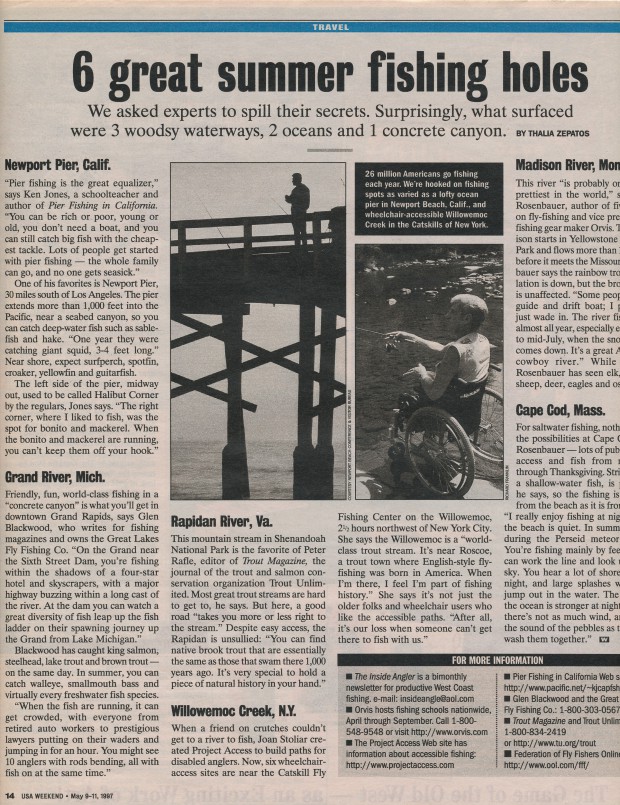
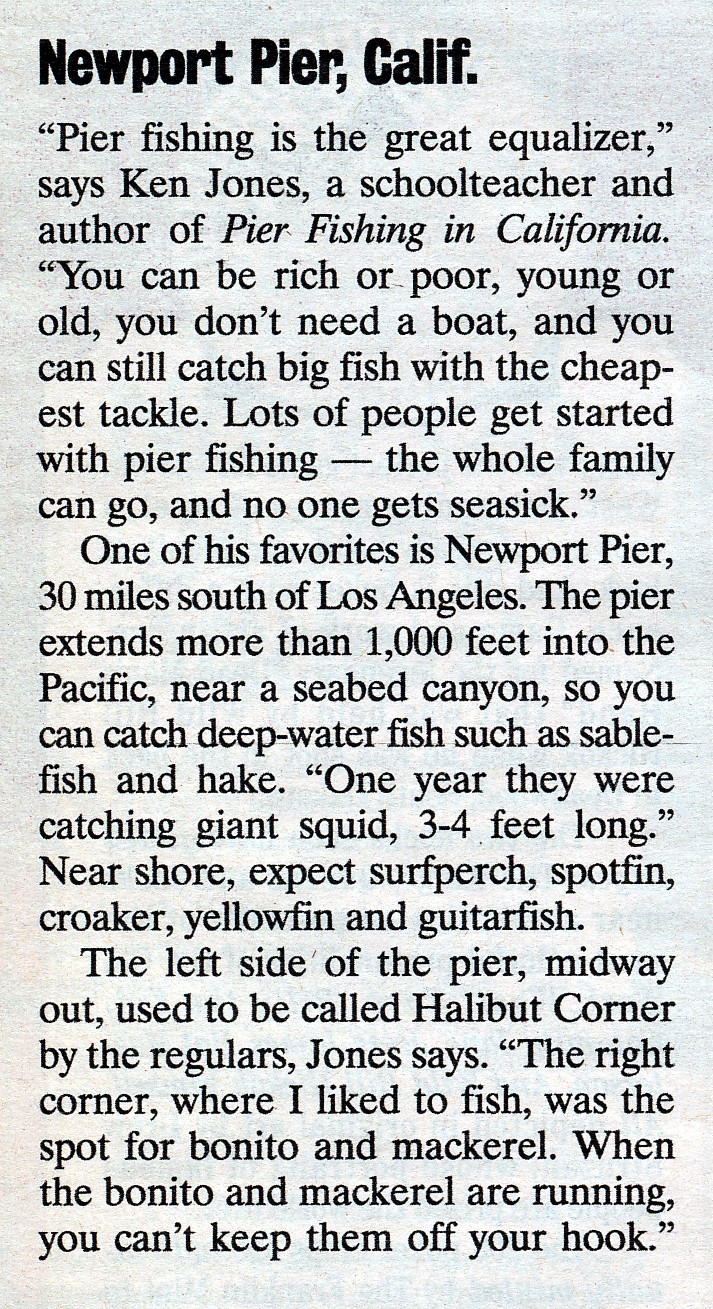
I remember getting a call from a reporter one day who was doing an article on fishing in the USA for USA Weekend magazine. She had noticed the Pier Fishing In California website and wondered if I would make a few comments about my favorite pier. Of course. The article appeared in the May 9, 1997 edition of the magazine and it was, I believe, the first publicity about PFIC.

Posted in Daily musings..., Pierfishing, Saltwater Fishing · Tagged , , , , · Leave a comment

Funny How Things Go Around!

This picture of the Imperial Beach Pier in 1910 shows the “wave energy machines” out at the end of the pier. The idea was to use the “free” energy of the ocean to provide the electrical needs for the local area (see below). Unfortunately it didn’t work. BTW, several other SoCal piers saw similar attempts at”wave energy” but all for one reason of another failed. Today, in 2013, newspapers have reported several “new” schemes to harness the power of the ocean to generate electricity.

From Pier Fishing In California— History of the Imperial Beach Pier

In 1909 a boardwalk was built, as was a 500-foot-long pier at the foot of Date Street. The Imperial Beach Improvement Association built both and the two became the centers of beachfront activity. In 1912 the ferry ceased operation but direct electric inter-urban train service began from San Diego to Imperial Beach—an event that affected the pier. Passengers would ride the San Diego and South Eastern Railway to Otay Junction, today’s Main Street in Chula Vista, where they would transfer to the Mexico and San Diego Railway to finish their journey to Imperial Beach. To power the electric cars, six wave motors, designed by Charles E. Edward, were built on a dogleg extension at the end of the pier, and, so, for a period of time, the pier was called the Edwards’ Wave Motor Pier. The machines were used to power the electric train cars with excess electricity being sold to subscribers. Eventually these wave machines lost favor but the pier continued to be used for recreational fishing until 1941 when the pier was damaged by winter storms. In 1948 storms finally washed the pier away for good and then, in 1953, the boardwalk suffered a similar fate.

Posted in Pierfishing, Saltwater Fishing · Tagged , , , · 1 Comment

THE HAUNTS OF THE BLACK SEA-BASS

                                       A Black Sea Bass from Catalina

By Charles Frederick Holder, 1891

It is said that when the purchase of the Northwest coast was contemplated by the United States Government, an old English raconteur and fly-fisherman remarked, “Oh, let the Yankees have it; the salmon won’t rise to a fly.”

Southern California might go by default in this way, as fly-fishing, compared with that of the East, is not to be had, though the San Gabriel, Aroyo Leco, and other canons have many pools where gleams of light and color flash, telling of the living rainbow lurking in the shadows. If southern California is deficient in black-bass streams and salmon pools, it possesses the finest marine fishing in North American waters; not only in the size and gamy qualities of the fish, but in the variety of forms which follow each other as the seasons advance, adding new and constant zest to the sport.

The striped-bass fishing has its prototype here in the gamy yellow-tail, seriola dorsalis, which attains a weight of forty or fifty pounds, and is as rapid in its movements as the tarpon. An important personage is he who lands a yellow-tail on an ordinary striped-bass rod, reel, and line. Equally gamy as the yellow-tail is the sea-bass, ranging up to sixty pounds, while the barracuda, tuna, albicore, and others afford the sport esteemed by blue fishermen in the East.

From the Santa Barbara Islands to the Coronados, and beyond, is the field of the southern California Walton; the islands of the Santa Barbara channel, particularly famous in the piscatorial annals and the Mecca of lovers of this sport – winter and summer. The island of Santa Catalina is the principal rallying-point, being the largest, possessing the small town of Avalon, a popular summer resort, with numerous bays and harbors protected from the in-shore wind that blows in beneath the steady trade. An ideal spot it is – a series of mountain ranges, from one thousand to twenty-six hundred feet, rising green-hued from the blue waters of the Pacific and extending twenty-two miles down the coast, and an equal distance from it. From the slopes of the Sierra Madre, forty miles away, the island appears formed of two lofty peaks, sloping gently to the sea; but standing upon its highest summit I looked down upon range after range, cutting the island into a maze of canons that wound in every direction to the sea. Near its northern portions two harbors extend in from opposite sides; the island evidently at one time having been separated, the isthmus, as it is called, being but a few hundred feet across; from this it widens out to six miles or more. The island seems in reality a gigantic mountain projecting from the ocean. The cliffs are majestic, beetling, rising sheer from the sea, broken into strange forms, and tinted with folds and splashes of color. The only beaches are at the mouths of the canons or perhaps where the continued falling of rocks in land-slides caused by the winds have formed a vantage-ground for waves. On the west coast the sea assails the cliffs with sullen roar, and the in-shore wind whirls up the canons, beating the fog against the rocks and bearing it aloft, where it is dissipated by the radiating heat of the mountains. On the east the water is calmer and often like glass, affording favorable conditions for boating and fishing.

The air of this island in the sea seems redolent with romance. Three hundred years ago Cabrillo, a Spanish adventurer, cast anchor in one of its harbors and named it La Victoria, after one of his vessels. In 1602 Viscaino visited and gave it the present name of Santa Catalina. Father Ascencion, who accompanied him, describes the inhabitants as sun worshippers, one of whose temples he found near the two harbors. In these early days the island had a large and prosperous native population; every well-watered canon had its village, and I have found evidences of them on some of the highest ranges.

One of my first visits to Santa Catalina was for the purpose of opening some of the ancient graves of these people, and while thinking the matter over with “Mexican Joe,” who has lived thirty years on the island, I took out an old bass-rod that had seen service on the St. Lawrence, and began looking it over.

“What you catch with that?” asked my companion, with a curious look on his strong Indian face.

“Bass, black,” I answered, nonchalantly, whirling the reel and listening to the music.

“What!” retorted Joe, laughing; the, “how much he weigh?”

“Five pounds,” thinking of a certain afternoon on the river.

“Oh! continued Joe, “I thought you mean black sea-bass.”

“Well, how much does he weigh?” I asked.

“How much he weigh? You want catch with that? said Joe, pointing to the rod with scorn. “Why, man, he weigh five hundred pounds. Yes, black sea-bass run from seventy-five to five hundred, seven hundred pounds.”

I ran over in my mind the various heavy-weight tackles — the tarpon, striped-bass, salmon rods, and came to the conclusion that a flag-staff with a donkey-engine reel attachment might do; yet decided, then and there, to take a black sea-bass, if it was among the possibilities. I announced my determination, interrogatively to my guide and oarsman.

“Of course you catch one if you know how. I show you where he live. It take patience, if you have it,” was the reply.

I was well supplied with this necessary, and a few days later found myself gliding away in the deep shadows of the rocks, headed for one of the haunts of the deep-sea bass. The water here was so clear, objects forty feet below could be distinctly seen, glances into the depths showing an almost tropical condition of things. Bright-hued fishes, yellow and orange, darted by, while patches of wiry sea-weed gleamed with blue and iridescent tints. In the watery space, fairy-like medusae moved lazily about, rising and falling, while here, there, and everywhere flashed a veritable gem in red, gold, blue, green, and amber, the minute crustacean sapphirina.

When off a point which juts boldly into the sea, the keeper of the fortunes of the black sea-bass ceased rowing, cast anchor, and we swung in the current that ran along the rocky shores to the north. The tackle produced by my oarsman was not aesthetic. The line was almost as large as that employed in the halibut fisheries of the East, while the hook was perhaps twice as large as a tarpon-hook, arranged with a well-working swivel. Live bait, a white fish which we soon caught, was attached, with a sinker sufficient to carry it down. The line was then dropped over, and that patient waiting, which makes all successful fishermen philosophers, begun.

Black Sea Bass taken from near the Hotel Del Coronado, San Diego

Three hundred — yes, one hundred years ago, a boat could not have dropped anchor here without being the object of hundreds of eyes, and the news would have been flashed from hill-top to canon to the various camps; now the only observers were the shag that flew along near the boat, its long, snake-like neck extended, startling the flying-fish into the air in fright, and a wondering pair of eyes that stared at us, telling of a sea-lion making the grand rounds; while the leaping forms near shore were seals, bound for their rookery around the bend. The whistle of the plumed quail ca,e softly over the crags from the neighboring canon, and the gentle musical ripple of the waves lulled us to fancied repose.

I had been watching the interesting face of my Mexican guide, wondering at his life, when I noticed his eyes suddenly grow large; then he lifted the line gently with thumb and forefinger. It trembled, thrilled like the string of a musical instrument touched by some player beneath the sea. Slowly it took his fingers down to the water’s edge.

A bass? Yes. No snap, no sudden rush, no determined break for liberty as I had seen the black bass make. I was disappointed; a simple drag. But the Mexican smiled and passed me the line, arranging with the other hand the coil in the bottom of the boat.

“He’s a young one,” he remarked. “Pay him out ten feet, then jerk an’ stan’ clear the line.

These instructions took but a few seconds, yet the line was now gliding through my hands like a living thing – four, eight, ten feet. Suddenly it tautened, and for a single second the tension hurled the sparkling drops high in the air; then, leaning forward, I jerked the line with all my strength. I have watched the silvery form of the tarpon as, like a gleam of light, it rushed into the air, shaking, quivering before the fall, and have handled large fish of many kinds, but I was unprepared for the deep-water tactics of this king of the bass. For a brief period there was no response, as if the fish had been stricken with surprise at this new sensation; then a smoke, a succession of snake-like forms rising into the air – nothing but the line leaping from its coil. ” Ah, he only a young one, said Joe; take hold.”

In some way I had lost the line in this rush. Watching my opportunity, I seized it again, and by an effort that thoroughly tested the muscles, brought the fierce rush to an end. Then came heavy blows distinctly given, as from the shoulder, evidently produced as the fish threw its head back in quick succession.

“Take it in!” said my companion, excitedly and bending to the work I brought the line in, fighting for every inch that came; when the Mexican shouted a warning. Whizz! and the coils leaped again into the air. Nothing could withstand the rush – a header directly for the bottom and away.

The anchor had been hauled up by the Mexican at the first strike, and now, with line in hand, we were off, the boat churning through the water, hurling the spray over us, and bearing waves of gleaming foam ahead.

“Take in! cries Joe, who stands by the coil, and again, slowly fighting against the dull blows, the line comes in. Ten feet gained, and, whizz-eee! as many more are lost. In it comes once more, hand over hand, the holder of the line bending this way and that, trying to preserve a balance and that tension which would prevent a sudden break. Now the fish darts to one side, tearing the water into foam, leaving a sheet of silvery bubbles, and swinging the boat around as on a pivot. Now it is at the surface – a fleeting vision followed by a rush that carries the very gunwale under water. This, followed by a sudden slacking of the line, sends despair to the heart; he is gone, the line floats. No, whizz! and away again, down. All the tricks of the sturdy black bass this giant of the tribe indulges in, except the mid-air leaps which gladden the heart of the angler. Quick turns, downward rushes, powerful blows, mighty runs this gamy creature makes, fighting inch by inch, leaving an impression upon the mind of the fisherman that is not soon forgotten.

With a large rope, and by taking turns, the fish could have been mastered, but such methods were not considered sportsman-like here. It must be taken free-handed, a fight at arm’s-length, and being such, the moments fly by; it is half an hour, and we have not yet seen the outline of our game. Gradually the rushes grow less, the blows are lighter, and what is taken is all gain.

“It take your wind,” said Joe, with a low laugh.

So it had, and I stood braced against the gunwale after a final dash-a burst of speed-to see a magnificent fish, black, lowering, with just a soupcon of white beneath, pass swiftly across the line of vision, whirling the boat around end for end.

“You’ve got him,” from astern, is encouraging; yet I have my doubts; an honest opinion would have brought the confession that I was in the toils. But the flurry was the last. Several sweeps around the boat, and the black sea-bass lay alongside, covering boat and men with flying spray with strokes of its powerful tail.

“It is a small one,” ejaculates my man, wiping the spray from his face. Imagine a small-mouthed black bass enlarged, filled out in every direction until it was six feet long, and plump in proportion; tint it in rich dark lines, almost black, with a lighter spot between the pectoral fins; give it a pair of eyes as large as an ox, powerful fins and tail, a massive head, ponderous, toothless jaws, and you have the black sea-bass, or Jew fish – the best fighter, the largest bony deep-sea fish in Pacific waters. Too large to be taken into the boat, it had to be towed in, and finally, after being stunned with an axe after the quieting method applied to muskallonge in the St. Lawrence, we got underway, the huge body floating uncomfortably behind, materially retarding the progress.

The entry to Avalon harbor was one of triumph, as at that time the capture of a bass was a new thing to visitors; and as the magnificent creature was hauled up on the sands by willing hands, the entire population gathered about to listen to the details of the sport. Then came the weighing. “Three hundred and forty-two and a half, sir,” said a Mexican youth who had triced the fish up; “better than average.” Glory enough for one day.

During this summer, at Catalina, about twenty of these fish were caught, ranging from eighty pounds to three hundred and fifty. All were females, ready to spawn, and had come in to Pebble Beach for this purpose, depositing their eggs in August and September. This locality has always been a famous place for them, and ten thousand pounds were taken there in a single day four years ago. At that time there was a systematic fishery, the meat being dried and – tell it not in Gath! sold as boneless cod. My oarsman informed me that the bass had been frightened off. These fishermen killed the fish on the spot, throwing the heads overboard, and so the bass left, only comparatively few having been seen since.

This is a native version. The fish undoubtedly migrate, going into deeper water during the winter, or possibly to the south.

It is often said that there is little pleasure in taking deep-sea fish; but to capture the black sea-bass, free-handed, play it fairly, and bring it to the gaff, is an experience that well compares in sport and excitement with hand-line tarpon fishing on the Gulf coast.

Posted in Saltwater Fishing · Tagged , , , , , · Leave a comment

Stripers… Rest In Peace

A large striper from the Fort Point Pier in San Francisco

This week a judge in the U.S. District Court, Fresno, California, sounded what may be the death knell for striped bass in the not so Golden State. Politics and the fight over water has reared its head once again in California. (See article at the bottom.} It’s a far departure from what was once considered a magnificent, world class fishery.

PACIFIC STRIPERS

Van Campen Heilner, Salt Water Fishing, Alfred A. Knopf, New York, 1953. This was first written for the 1937 edition of his book.

[Van Campen Heilner — one of the pioneers of salt water fishing.]

Homecoming travelers from Europe to the U.S.A., after passing Ambrose Lightship, have sighted rising from the cliffs behind Sandy Hook the twin lights of the Highlands. Flowing inland beneath them are the Shrewsbury and Navesink Rivers, the cradle of striped bass fishing in America.

In the year 1879 there were 107 small striped bass shipped from the Navesink River and liberated in the Carquinez Straits near San Francisco. The size of the first shipment ran from 1 1/2 to 3 inches in length and a few were “medium sized specimens.” You will have to guess at what is meant by “medium sized,” for the records do not give details as to weight or length. In 1882 there were 300 more brought from the Shrewsbury River and released in Suisun Bay, California. This shipment consisted of bass running from 5 to 9 inches in length. From these two shipments originated what is probably the finest striped bass fishing in the world.

Mel and a striper from the Paradise Park Pier

Liberated in waters ideally suited to them, with food in abundance and a climate hardly equaled on the face of the earth, the fish increased with amazing rapidity and to large size. In 1883, four years after the first shipment, a 17-pounder was caught. On March 11, 1884, an 18 1/2-pound fish was taken, and on June 16, 1889, ten years after the first planting was made, a 45-pound striper was netted. These records are probably the most reliable in existence as to the growth of stripers over a period of years. From then on it was a panic. Stripers multiplied so rapidly in the climate-nurtured California waters that commercial fishermen and sportsmen had a field day. The commercial catch increased to such numbers that it far outstripped anything ever brought in on the Atlantic coast. Forty and fifty-pound stripers fell to the anglers’ rods as an almost everyday occurrence. The San Franciscans and their brother anglers north and south of the Peninsula became “striped bass minded” and striped bass mad they still are today.

Two schoolie-sized stripers taken from the Marin Rod and Gun Club Pier in 2013

Then a discordant note crept into this beautiful Elysian symphony. While the bass showed no decrease in numbers they commenced to show a decrease in size. This, as has so often been the case, was found to be due to excessive netting. But by now, so many Californians were fishing for stripers with rod and reel and so powerfully had they branded themselves together that they were able to stop once and for all the sale of striped bass in the Golden State. In presenting their case to the Legislature, one of their arguments was that in one year over $180,000.00 worth of sardines had been sold to sportsmen as bait for stripers alone! Think of it! An amazing and wonderful thing. And as if this was not enough they made it mandatory for salt water anglers to have a fishing license and limited themselves to five a day and nothing under 12 inches. With these rules in force the stripers staged a quick comeback and 40- and 50-pounders were soon as common as they formerly were.

A striper from the Berkeley Pier

A relative of mine used to tell me of catching striped bass around Robbins Reef Lighthouse in New York Harbor in the 1880′s. I’m afraid those days are gone forever. But I have great faith in the Fish and Game Commissions of New York and New Jersey and nothing is impossible.

But for stripers close to a great metropolis, in fact, in it, you have only to go down to Bakers Beach in the very shadow of the Golden Gate Bridge and see enough surf fishermen fishing for stripers to restore your faith in mankind. You’ll find surf fishermen all over the place and to even whisper “stripers” to a San Franciscan is to see his face light up instantly and to have him launch at once into a long discussion as to the hows and whys of his favorite sport.

A striper from the Paradise Park Pier

I had been bargaining for several days with a Chinese friend of mine up on Grant Avenue for a beautiful mandarin coat that he claimed had belonged to a lady-in-waiting to the Empress Dowager of China. It was a beautiful coat, we both agreed on that, with a hundred appliqued butterflies on it, but the one thing we could not agree on was the price. Finally we had reached the point where a compromise looked possible. “I’ll tell you what I’ll do,” I said. “I’m leaving tomorrow night but I’ll come back in the morning and give you my final word on it.” “Ah!” he said, “but I shan’t be here tomorrow morning. I’m going striped bass fishing at Benicia.” And that was that.

He wasn’t the only one that let striped bass fishing interfere with business. At Rio Vista on the Sacramento, in the later part of September, the oldest and original striped bass derby on the Pacific coast is held each year. One year there were 9,000 entrants; the next, 15,000 and I doubt not but in time every man, woman and child in the state of California will be entered. And all for a one-day fishing contest! They shoot off a bomb to start them off and another one to stop them. And the prizes! One year it was a 26-foot cruiser, completely equipped, ready to sail away from the dock; the next, five automobiles for the first five prizes, to say nothing of electric refrigerators, radios and heaven knows what else. And not only that, but each May they hold at San Rafael what is known as a striped bass carnival which is attended by upwards of 30,000 people who come to talk and listen to talks about striped bass and enjoy themselves in every way except fishing.

If you’ve never surf fished along the California coast you have a great treat in store. I’ve done it for years and it’s some of the most beautiful surf fishing in the world. The great mountains running down to the sea, the long lines of breakers thundering in, fresh from the Sandwich Islands, and best of all, the climate. As some of my readers must have guessed by now, I like California. In fact, I’m a confirmed Californiac. It’ as close to heaven as I ever expect to get. There may be a little fog now and then around Frisco (Los Angeles papers please note), but it doesn’t interfere with the striped bass fishing nor with one of the most cosmopolitan and romantic cities that was ever built. And if it wasn’t for the fog they’d never get the moisture to grow some of the biggest potatoes, the tallest trees, the largest fruits and flowers, the longest bridges and the most beautiful women in the world!

I was down at Monterey Bay one time. It’s beautiful there, too. The bay is half-moon shaped and on the north arm you have Santa Cruz and the beautiful mountains behind it. On the southern horn you have Del Monte and Carmel. I couldn’t speak when I first saw Carmel. I felt just like I did when I stood on the cliffs of Ravello near Amalfi and looked down on the Mediterranean and the cypress trees and drank a lot of Lachryma Christi and then shed real tears, it was so beautiful. In between and on the land side of the bay you have the lettuce fields of Salinas, miles of them, stretching under the blue sky, and you have the Salinas River, which if you motor across there, you’ll cross so many times you’ll expect to meet yourself coming back.

There was a gang of us and we camped underneath the railroad bridge alongside the river. There weren’t many trains and when they came by they didn’t bother us. Bert McCloud from Stockton was headman and his seventy-three-year-old father, God bless his soul, was doing the cooking, when he wasn’t surf fishing, and how he could cook! The actinic rays of the sun were so strong that we were forced each day to cover our faces with grease paint, which made us look like a bunch of Indians. We fished the slough at the mouth of the river and though I wasn’t very lucky that trip the others got some fine fish. The sea lions bothered us a lot and we carried a rifle on the beach with us to chase them out of the slough. When they came in the fishing went pfft for the rest of that tide.

A striper from the Malibu Pier in Southern California

We used to catch a lot of interesting little fish called surf fish. They’re transparent and give birth to their young alive and you could see the baby fish inside the mother all nested together waiting to be born. But it was the stripers that we’d come for, and when one of us would hook one it was a pretty sight to see him carried down the beach with the white surf tumbling and foaming in the background and his rod sweeping downward in the long graceful nods. And then he’d get him to the wet sand and maybe he’d be a forty pounder and we’d all gather round and congratulate him and begin to think how Dad McCloud was going to dress him up for us for a dinner.

A striper from the Point Pinole Pier

That was a grand trip. I was subject to some swell nightmares then and used to put on a show for the boys nearly every night. Several years later I was giving a speech in Spanish from station WKAQ in San Juan , Puerto Rico, and one of this same bunch happened to be in a friend’s home in New York listening to the radio and heard me. “I could never forget that voice,” he wrote me, “even if I didn’t understand the language. After the series of performances you gave us under that railroad bridge on the Salinas, I’m afraid to go to sleep at nights for fear you’ll wake me up!”

Stan “The Man’ Low and a striper from the Point Pinole Pier

There were other trips for stripers too. Up in the Carquinez Straits where they used to ferry the whole Overland Limited across on a boat was the home of some mighty stripers. They troll for them up there with spoons and plugs and a big fish from a light boat in that swift tide is something to remember, I can tell you. Right outside the Golden Gate was always a wonderful looking spot to me and I’m going there sometime with Otto and Bill Bassett and the Punkinseed and see what we can see.

One summer I took a car and motored down the whole length of the glorious California coast to the Mexican border. Whenever I saw someone fishing in the surf I stopped and talked to him. They were a friendly lot, those surf fishermen, they always are and they willingly gave of their advice and experience. They were catching surf whiting (Menticirrus undulatus) which is like our eastern surf-kingfish or whiting and yellow-fin and spot-fin croakers. Clams and sand crabs were the favorite baits. In fact at Coronado I was warned not to go swimming in the surf as the sting rays were so numerous as to make bathing dangerous. From the Smith River in the north to the Rajuana in the south I met a sympathetic and hospitable army of anglers standing in the surf or trolling in rivers’ mouths and slues for salmon or stripers, always ready to give helping advice or to take you on a fishing excursion at the drop of a hat.

Striper taken at the Capitola Wharf by Maliyah in 2016

I was born in the City of Brotherly Love on the banks of the Delaware and spent the summers of my childhood on the Jersey coasts and marshes. The surf and sod banks from Barnegat to Cape May form some of my earliest memories. But were I to choose, I should like to spend the twilight of my life somewhere near the shores of Yerba Buena Cove with the sun setting through the glorious Golden Gate and my rod bending and swaying to the rush of a well-hooked striper while behind me the mountains and above me the blue sky bore witness that I was breathing the clean wind-swept Pacific air of – California!

The Good Old Days, mid ’40s in the Delta

Federal Judge To Approve Settlement In Striped Bass Predation Case
March 17, 2011

FRESNO, CA – Today, in U.S. District Court, Judge Oliver Wanger indicated he will approve a settlement agreement in the case filed by the Coalition for a Sustainable Delta and other water users against the California Department of Fish and Game (DFG) related to the management of striped bass, an invasive species that is known to feed upon endangered salmon and delta smelt in the Delta. Judge Wanger’s written ruling will be forthcoming. Under the settlement DFG will collaborate with the National Oceanic and Atmospheric Administration (NOAA) and the United States Fish and Wildlife Service (FWS) to develop a joint regulatory proposal that will address the impacts of sport-fishing regulations on the population of non-native striped bass in the Delta. The lawsuit was filed in late 2008 in the U.S. District Court in Fresno before Judge Wanger.

The settlement was reached after the DFG’s own experts in the case acknowledged that striped bass predation is responsible for the loss of a significant number of protected, native salmon in the Delta. The Department’s experts estimate the take could be as high as 25-50 percent annually of both the endangered Sacramento River winter-run and the threatened Central Valley spring-run Chinook salmon populations within the Delta.

“We applaud the Department of Fish and Game for coming together with us to develop a solution to the significant negative impact striped bass have on the Delta ecosystem,” said Coalition for a Sustainable Delta spokesman Michael Boccadoro. “Predation by non-native species such as the striped bass is one of the most clear-cut stressors on endangered Delta fisheries and addressing this problem is a vital step toward creating a sustainable future for the Delta estuary.”

Striped bass predation has been increasingly identified as a major reason behind salmon and delta smelt fishery declines, but state regulators have repeatedly failed to address the problem. Striped bass are an invasive species that were planted in California as a sport fish in the late 19th century. DFG has long been protecting the voracious predators at the expense of salmon, delta and longfin smelt, and other endangered species through the imposition of size (18 inches minimum) and bag (2 per day) limits. At one point DFG actually stocked the Delta with millions of striped bass in an attempt to further increase their population.

While DFG was taking these actions to protect and increase the striped bass population in the Delta, salmon populations have steadily declined leading to devastating government imposed water pumping restrictions for residents, farms and businesses and the closure of the last three commercial salmon fishing seasons. Hundreds of thousands of acres of productive farmland were fallowed since 2008, resulting in the loss of thousands of jobs and billions of dollars in economic activity. Commercial salmon fishermen have faced a string of tough years that have resulted an estimated loss of $1.4 billion dollars and 23,000 lost jobs.

Under the settlement, a comprehensive proposal to address striped bass predation in the Delta will be developed by state and national fishery management agencies that will include the following components: Appropriate changes to regulations that protect non-native striped bass at the expense of threatened and endangered native fish; Development of an adaptive management plan to research and monitor the overall effects on listed species; and Creation of a $1 million research program focused on predation of protected species.

“This settlement means significant progress for efforts to improve the Delta. While there are a number of different stressors currently affecting the estuary, addressing striped bass predation is a promising step toward achieving long term Delta stability,” said Boccadoro. “But we must continue to address each of the multiple stressors impacting the estuary for long-term success to be achieved. This is another crucial piece in a very complex puzzle.”

http://www.sustainabledelta.com/news/federal-judge-approve-settlement-striped-bass-predation-case.html

Posted in Daily musings..., Saltwater Fishing · Tagged , , , · 2 Comments