Redondo Sportfishing Pier
This is a small (250-foot-long) pier that sits inside of Redondo’s King Harbor. It was built in 1969 and is used by Redondo Sportfishing and its fleet of boats. Often crowded, especially during the summer months, this private pier yields a lot of fish. As a matter of fact, more fish are probably caught per angler than at the larger Redondo Beach Municipal Pier that sits a short distance to the south
Many unusual fish are seen in the harbor and some are caught at the pier. I thought the most unusual visitors were a school of deep-sea skipjack tuna that made an unfortunate mistake and turned into the harbor one day (some sources say they were black skipjack—Euthynnus lineatus). And, the deep-water triggerfish and bullet mackerel that have been caught are pretty intriguing. But then I heard the story of the swordfish (Xiphias gladius). For some reason a young, four-foot-long swordfish ventured into the harbor in 1992 and stayed for nearly a week. It occasionally would surface and attract crowds and eventually four different television stations filmed it. Many people feared it was injured and almost all hoped it would make its way back into the open ocean. It disappeared after a week and has not been seen since.
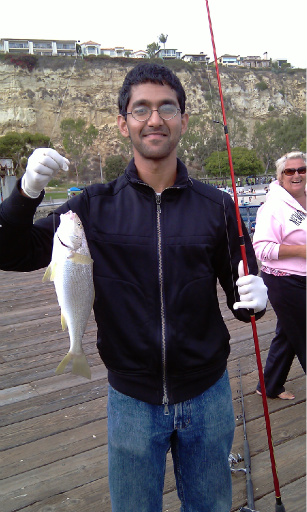
 A sheephead caught from the pier on a whole squid
Another unusual species, one that actually seems to have formed a resident population, is a school of broomtail grouper. The groupers, which are more commonly seen in Baja California, are sighted every winter in the harbor. Most of the fish seem to be between 30-40 pounds (so where are the babies?) but they range to over a hundred pounds and a few will be hooked most years. The best theory I’ve heard so far to explain their appearance (besides the warm water in the harbor) is that they are most evident when the schools of bonito enter the harbor. Even though the bonito are noted for their speed, they are prey for the grouper. After all, if you were a sixty-pound grouper, would you prefer a half-ounce anchovy for lunch or a five-pound bonito? If you do hook one of these monster bass remember that they are illegal and must be returned to the water immediately. Failure to do so means a stiff fine at the very least.
Environment. The pier has a unique environment that produces an olla podrida of large and small fish, common and uncommon species. Most important is the deep-water Redondo Canyon, which sits just outside the entrance to the harbor. The canyon, which drops off to a depth of over 2,000 feet, produces a considerable upwelling much of the year. One result seems to be a funneling of rich nutrients, plankton, baitfish and larger fish directly into the harbor.
 The entrance to the harbor
In addition, this harbor was famous for years due to two warm-water outlets in the harbor (one the famous Bubble Hole) that discharged water from the Southern California Edison generating plant that sits across the street. When in operation the water here was warmer than that outside the harbor in the ocean (five to ten degrees warmer during some winters). The warm water attracted bonito; in fact, the harbor was known as one of the best spots for bonito in southern California (and almost always was the best spot during the winter). Many, many bonito were caught at the pier. Some years also saw fairly good runs of small (firecracker size) yellowtail; a fact that would unnerve some of the deep-sea anglers patiently waiting in line to board a sportfishing vessel and hoping to have a chance to land a yellowtail.
 Firecracker-size yellowtail from the pier
However, a new company took over the plant in 1998 and decided to change the system that the Edison Plant had used for the past 30-40 years—sucking in cold water from the harbor and releasing hot water back into the harbor via the “bubble hole.” Stopping the release of the warm water had, of course, an adverse affect to the harbor’s fish, especially the bonito. Eventually the plant was shut down but then it was resold and reopened. For a while the warm water releases seemed to be occurring again but recently reports say they’ve been shut down. No one knows if the warm water will be released once again into the harbor. If not, there will be far fewer bonito—and yellowtail.
 The famous “Bubble Hole”
Finally, although the pier sits over a sand-and-mud bottom, there are a considerable number of rocks and debris under and around it. One result is that a lot of rocky shore species are caught including seaperch (black, rubberlip, white and rainbow), opaleye, halfmoon, blacksmith, senorita, rock wrasse, kelpfish, salema, sargo, sculpin, bass and even an occasional sheephead. The pier is not a great place to catch the smaller schooling species that prefer sand, species like walleye surfperch, queenfish, or white croaker, but who really cares when you have these more favorable species? In addition, pier anglers also catch quite a few spider crabs and spiny lobster from these waters.
 A rocky shoreline plus rocks under the pier
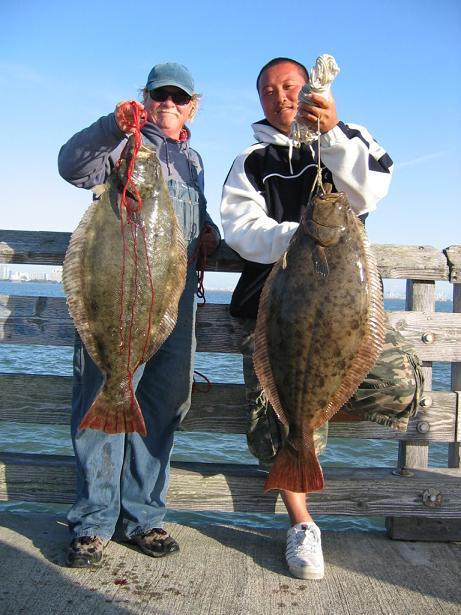
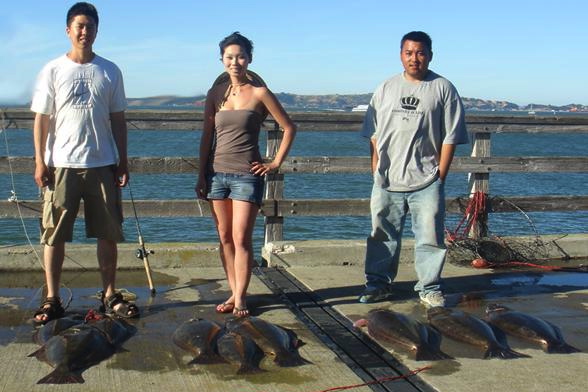
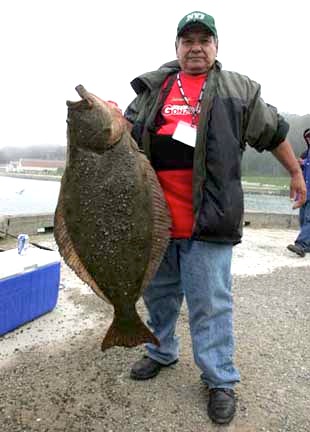
I used to think the pier was poor for halibut, especially when compared to the nearby larger Redondo Pier. However, a 25-pound halibut was caught on a Worm King in July of ’02 and a 40-pound fish was taken on a live sardine in August of 2010. In fact, that August saw a terrific one-week run of halibut that included the large 40-pound fish, a 25-pound fish, and three 20-pound fish. All were taken in one week’s time and all were caught on live sardines. I think the nearby Redondo Pier is still better but I could be wrong.
 Halibut from the pier
Fishing Tips. Anglers here are presented two almost completely different options for fish. Excellent action can take place for the pelagics from the mid-pier area to the end. For these fish, cast out away from the pier (toward the famous Bubble Hole), and use small feathers, spoons, live anchovies and live sardines, or small strips of bait (anchovy or squid) behind a cast-a-bubble. Bonito, Pacific mackerel, jack mackerel, and sometimes barracuda or even yellowtail will be the reward. White seabass make an occasional visit and sometimes they’re good-sized legal fish but you have to hit them when they’re there. The end section has also been reported to be a good area from which to catch spiny dogfish (at least in years past) although I have never seen any of the twisting little sharks in my visits to the pier.
Additional fish taken at the end include sanddabs, needlefish and sheephead. In February of ‘08 a 29.7-pound sheephead was landed at the end of the pier. It was caught on a live squid and topped the 21-pound goat caught in February of 2001. I’ve also caught quite a few white seaperch and pileperch using worms and ghost shrimp from the far right corner of the end (with a diagonal cast from the end).
 A Redondo Sand Bass
This can be an excellent pier for bass—bay bass (spotted sand bass), barred sand bass and calico bass (kelp bass). Kelp bass probably make up 90% of the catch albeit most are under 14-inches, the legal size, but an occasional bigger fish is caught including a 7-pound calico that showed up in June of ’09. Some big sandies are also caught as seen in a hefty 8-pound fish in May of ’09. Regulars say that quite often the bass only show up around 5-7 A.M. in the morning, and then again in the evening (although I’ve caught kelp bass throughout the day), and they hit best on an incoming tide. What to use? Plastics are one answer, especially Worm Kings, Big Hammers and Scampis. Live bait and cut bait (especially anchovies) will also work on the feisty bass. By the way, the trio of local bass has been joined by a few striped bass over the last decade, wanderers who traveled a long way from their northern home.
 An unusual species for the pier — a Striped Bass
Fish the inshore half of the pier, on the bottom and under the pier, or by the inshore rocks, for rocky-shore species. An amazing number and variety of small rock-frequenting species are found here. In fact, this is the only mainland pier that nearly duplicates the catch of the Catalina Island’s piers, albeit in much smaller numbers. For these species, use fresh mussels, bloodworms, lugworms, ghost shrimp or small pieces of shrimp as bait. Remember to keep your hook small, no larger than a number 4, and keep your line light. This is also a good pier for California scorpionfish (sculpin); fish on the bottom with anchovy or strips of squid and be wary of the sculpin’s spines. At times some nice halibut have also been landed although, as noted, the pier has never really been viewed as a prime halibut pier. Live bait is, of course, the key if you’re seeking out the flatties.
 A black seaperch aka buttermouth perch from the pier
Regulars who fish the shoreline area often create a feeding frenzy by throwing bread into the water. Most commonly a mass of opaleye will converge, making a “meatball” of fish one to three feet thick. Once stimulated, the fish will strike at almost any bait. The best method, however, is to cast out a size 8 hook baited with a small piece of bloodworm, a couple of frozen peas, or moss which you have collected. If you just want opaleye, stick to the peas and moss; if you want other fish try the worms, small strips of mussel or squid, or small pieces of shrimp. At times there will be mixed schools of opaleye, blackperch, senorita, rock wrasse, salema, kelp bass, blacksmith and the beautiful, but illegal to keep, garibaldi; these will usually be in the lower levels of the water. Above this school will be a different school made up of topsmelt, jacksmelt and shinerperch. The angler can decide which fish he wants by the bait he uses and depth he fishes. 
The ubiquitous senorita are, by the way, notorious for their bait stealin’ abilities and can drive you nearly crazy at times. The small but feisty fish will attack almost any bait but are especially fond of soft-fleshed baits such as mussels and worms and they can strip the bait from hooks in a matter of seconds. However, they’re a pest that you have to put up with if you want the other, more desirable species. You can try mussels or worms that have been salt-cured to toughen them up but you’ll still lose some bait.
If the tidal conditions aren’t too difficult (you need a mild current), you can also drop your bait down into the crevices and small pools that sit amongst the inshore rocks. You must do it carefully, and be prepared to retrieve instantly when a fish hits your bait or your rigging will likely be lost under a rock. However, the result will often be fish such as opaleye, blackperch, cabezon, and giant kelpfish. I’ve even taken a few fish that are relatively uncommon to most piers—rockpool blenny (Hypsoblennius gilberti), spotted kelpfish (Gibbonsia elegans) and striped kelpfish (Gibbonsia metzi). All were caught fishing down among these rocks,
 A beautiful cabezon from the pier
Special Recommendation. This is a private pier. Make sure you have a license. Don’t get in the way of the Sportfishing operation and buy bait and tackle from them if possible.
 Eugene and a female sheephead
Author’s Note No. 1. Do spider crabs and stingrays hang out together (it would make an interesting bar scene in an aquatic version of Star Wars)? That unusual question arose one early summer day in 1996. I was fishing out at the end of this pier for bonito and mackerel. Unfortunately, those fish were not cooperating. Instead, at the top of the water, there were some good sized jacksmelt and on the bottom a seemingly numberless assemblage of small speckled sanddab. Next to me set a guy crabbing and he had three buckets full of large spider crabs. On one drop to the bottom I hooked something heavy and as I pulled it up realized it must be one of the crabs. Sure enough, it was, but it wasn’t really hooked. Mr. Spider Crab had grabbed hold of a sanddab on my hook and didn’t want to let go. Following about two to three feet behind the crab was a large round stingray. Halfway to the surface of the pier the crab released its pincer-hold on the fish, and the crab, together with his companion, the stingray, drifted slowly out of sight. I had seen a similar occurrence a few years ago at the Port Hueneme Pier. Did the crabs and stingrays have a thing going, were the stingrays just nosy, or was a form of symbiosis taking place between these two quite different species? Unfortunately, I do not have an adequate explanation for these soul-searching questions.
 Daniel and a sheep crab (spider crab)
Author’s Note No. 2. Although the species differed year-to-year, especially cool-water versus warm-water years, an eighteen-year study of the fish found at the nearby harbor jetty recorded 123 different species of fish. It’s not surprising that visitors to the pier see an interesting mix of fish. I’ve only caught a little over thirty species at the pier but if I lived in the southland, and fished the pier more often, I think I could catch an impressive number of species.
 A spotted kelpfish from the pier
Author’s Note No. 3. Barge fishing headquartered on the various “Redondo” piers was a long time tradition. Most operated from the Monstad Pier but the last few barges operated out of this smaller pier. I was lucky enough to fish from the last two barges—the California and the Isle of Redondo.

The Isle of Redondo in 1982
My favorite barge trip took place on the California on July 26-27,1978. My seven-year-old son Mike and I were doing a pier hoppin’ trip along the coast and had fished the morning at the Crystal Pier in San Diego before heading back north. I planned to fish the Redondo Beach Pier and possibly the Hermosa Beach Pier that night but hadn’t made a motel reservation. Instead, I decided to spend the night on the barge as a cheap alternative to a motel so caught the ferry out at 7 p.m. I fished the entire night while Mike fished for a few hours before getting some shut-eye. There was an absolutely amazing amount of fish being caught. Mostly it was medium-sized bocaccio with some mackerel mixed in. People would catch some fish, head over to clean their fish, the guts and remains would be sent down toward the Redondo Submarine Canyon and apparently the waiting maws of fish because their was a steady stream of fishing showed up to partake of our fishy offerings. I managed to reel in 54 bocaccio, 14 mackerel, 5 sablefish, a rosethorn rockfish, a blue rockfish and a misplaced white croaker. I did manage to hook a large shark but after fighting it for quite a while (with undersized rod and line) it wrapped the line around the anchor chain and that was the end of the story.
All told it was 76 fish although I only kept my limit (and yes, I should have stopped fishing much earlier but you learn as you age). Mike and I headed back in to the landing on the morning shore taxi and preceded north to Malibu where we fished the pier a few hours (and had some more great action) before heading on up to Santa Barbara. At Santa Barbara we caught the 1/2 day boat Hornet where I caught 14 additional rockfish— blues, bocaccio, flag, honeycomb, starry, olive and vermilion. We got back in to the dock at 5 p.m. and were quite ready for the motel (and I had a reservation that night).
 The Isle of Redondo
A few years later, in August of 1982, I fished the Isle of Redondo one night from 6:30-11 p.m. but the species were a different mix—48 mackerel, 2 vermilion rockfish and one unusual squarespot rockfish.
Today the barges are gone but you can still hop on a Sportfishing boat from the pier.
 The City of Redondo
History Note. When a breakwater was completed for Redondo Beach in 1939, locals were optimistic that a new harbor would revitalize the area. Instead there was immediate havoc along the waterfront. The breakwater cut off the normal drift of sand and it began to pile up along the north end of the breakwater. Beachfront areas to both the north and south quickly saw a loss of sand and suffered erosion. Money was needed to improve the breakwater (which was difficult to find during World War II) so the area remained an undeveloped harbor for many years. Eventually the problems were worked out and construction of King Harbor began in 1960. It was dedicated on November 19, 1966, and named in honor of Congressman Cecil R. King—although he couldn’t be located during the dedication. Duh!
 A look from the water with the towers in the background
The Redondo Sportfishing Pier was opened on May 1, 1970, as the home base for the Redondo Sportfishing operation but it also soon became a favorite spot for pier anglers. The sportfishing landing has a full range of fishing craft including half day and full day boats. Until the mid-’90s, a barge was also available. The landing’s barge California was the boat from which I had my greatest night of fishing back in 1978, but that’s another story. The Isle of Redondo replaced it in 1980, but today the barges are simply history.
 Breakfast at Polly’s On The Pier
Redondo Sportfishing Pier Facts
Hours: Usually open dawn to dusk, or should I say opens for the morning boats and closes after the last evening boat.
Facilities: There are restrooms on the pier and some lights but no benches. The Sportfishing landing carries some bait and tackle (though more geared toward boat fishing) as well as limited snacks and drinks. Parking in the adjacent parking lot is $2 an hour although you can get validation at the Sportfishing Landing or at Polly’s. There is limited meter parking on side streets. Nearby are a beach, a play area, a shallow-water swimming area, and several restaurants.
 Polly’s On The Pier
Good food is available at Polly’s On The Pier located mid-pier. The restaurant says they’re a local icon and I can’t disagree, There isn’t any doubt that it’s a place where hungry fishermen (and non-angling locals) grab breakfast or lunch. You can sit at your table and eat some good food while you’re watching your fishing pole just a few feet away. It’s open 5AM till 2 PM. Breakfast specialties include a plethora of omelets, biscuits & gravy, banana hotcakes and other such goodies. Lunch items include all the normal sandwiches and hamburgers as well as home made chowder and fish and chips. I’ve had several meals there and they’ve always been good.
Handicapped facilities: None
Location: 33.84333937755767 N. Latitude, 118.39393973350525 W. Longitude
How To Get There: From the Pacific Coast Highway take Beryl St. west to Harbor Dr. and follow it to the entrance of the sportfishing parking lot.
Management: Charles G. Johnston, Inc.
 A fishing buddy — Hashem, and a halfmoon
E-Mail Messages
Date: August 16, 1999
To: PFIC Message Board
From: Joshua
Subject: Can somebody give me some tips for the Redondo Sportfishing Pier and what you can catch?
Posted by Monkfish
In the shallow end, and I mean really shallow, some opaleye can be had using mussels, green peas, or sand crabs. Use a size 8, down to a 12 hook and either a small float or a splitshot and let it drift with the waves. Mid-section, I don’t know…possibly some small bass or a sargo or two. I’ve caught halibut using live bait on the bottom dropped straight down…a long time ago. Sometimes there are silver surfperch there in force, but that’s sometimes, and mussel or shrimp can usually get them about 3-4 feet below the surface. The main fun is bonito when they are in the harbor. The very end and the near end are good places. Sometimes they’ll only hit white, yellow, or chartreuse feather on a splasher bubble with a 2-4 foot leader. Live bait usually works well with light line and a size 6 hook. Also, Krocodiles and small diamond jigs can work well too. Throw ‘em out towards the bubble hole (the whirlpool) and let ‘em sink about half way or more (even to the bottom) and reel in varying retrieves, or throw ‘em out at the very end and do the same. You can also catch macks, especially at night there. Since the pier is lower than most, just fly line a piece of ‘chovy and let it slowly sink. This is all older information. I used to fish the place when I was a kid, when the fishing was much better and you could park behind Red’s Tackle Shop and walk to the pier without having to pay an arm and a leg. Nowadays, the whole area is condo-yuppie city…with nothing but pay meters… but at least that pier still has the same old stinky knotty character it always had.
Date: January 29, 2001
To: PFIC Message Board
From: GO FISH
Subject: Redondo Sportfishing Pier Report 01/29/01
This pier was a first for me and my buddy, and it proved to be a nice change over the slooooooow Santa Monica Pier. Arrived at 7:30 am and bought some squid from the tackle shop. Threw in the lines and waited. Our lines got some nice rips and hooked onto 2 big macs and I managed a 13” Sand Bass. My friend’s pole also nailed a large Sargo Perch with a strip of squid. Witnessed 1 good boil, which I assume was Bonito. There were plenty of nice sized perch along the pylons and a couple of guys next to us pulled in some nice Opaleye and Zebra Perch. Gonna head out there again tomorrow morning!!!
Date: January 2, 2002
To: PFIC Message Board
From: monkfish
Subject: Redondo Sportfishing Pier
Fished the pier from about 2 till dark. Bonito were there off the end. They were lure shy but I got 4 on dead anchovies. I farmed a couple and one better one ran me around the pilings to the left and broke me off on 8 lb. Anyways, they’re still there. I was using a fly bubble with a 2 ft 8 lb. leader, size 4 hooks. They were anchovies I took off a party boat that were frozen. People were catching them with standard frozen anchovies that you get from a baitshop. Just cast out, keep your eye on your float, when it goes down, maybe do a 2-3 count then wind tight and set the hook. Pretty simple, but they would sometimes spit the ‘chovy that’s why the short count.
Caught a few baby Sargo at the shallow end, really small though. After dark saw a huge school of probably Sardines swimming around. (I think they were sardines but I can’t be certain. The way they were swimming, reminds me of schools of sardines I saw in a river in Portugal.)
I still love fishing from this old rickety pier. It’s the only pier I know that sways when the boats are moored up to it.
Date: May 3, 2002
To: PFIC Message Board
From: Ken Jones
Subject: Day 5 – Redondo Sportfishing Pier.
Headed up to the Redondo/Hermosa area after leaving Balboa. Planned to go directly to Hermosa where I was to meet Mola Joe at 5 but I got there early. So, I headed down to this small pier. Figured I could get in, fish a little, and get out—all in a short period of time. Once again however the fishing was slow. About ten anglers lined the rail all wonderin’ where the fish had gone. I think the fish were there, just not biting. Fished under the pier with small hooks and pieces of lugworms. Wrong thing to do; forgot how many senorita are under that pier. Tried it for half an hour but only landed 3 senorita and 1 jacksmelt. Fish stole most of my bait. After witnessing a school of 10-12 bonito casually swim along the water in front of the pier I headed out to the deeper water. Alas no strikes on the top or the bottom. Then a boat comes in, the deckhand comes over with a live sardine, fly-lines it out and proceeds to pull in a 4+pound bonito. Talk about humbling. He offered to let me use some live bait after I lent him my needlenose to unhook the bonehead but I had to head out to Hermosa. Maybe next time?
Date: July 31, 2002
To: PFIC Message Board
From: calicomen505
Subject: Anybody fished Redondo Sportfishing Pier?
Just this Saturday a guy caught a 40-inch Halibut using plastics on the end of the Redondo Sportfishing Pier and they are also catching smelt and sargo at the front of the pier.
Date: October 20, 2002
To: PFIC Message Board
From: gsxr750
Subject: Redondo Sportfishing Pier
Today, my twins and I had our best day pier fishing so far. We went to the Redondo Sportfishing Pier at about 7:30am. At first we were fishing in front of the bait shop. We caught lots of small fish—senoritas, shiners, smelt, and mackerel. I caught two “eating size” black perch. One of my twins caught a Calico Bass, but it was only about nine inches, so it was released, ditto for a small flat fish (not a halibut). My other twin caught an opaleye down by the rocks on a pea; this was big enough to eat so we kept it. Then the bonito started to boil at the end of the pier. I took a Fishtrap with a yellow head down there and cast it in. I got hit hard on the second cast, and spend about 10 minutes fighting a large bonito using my freshwater bass spinning outfit. The fish finally gave up, and I started to pull it up to the pier “hand over hand” style. The line broke about halfway up—lost fish and lure. Oh well, I was probably going to let it go anyway; don’t really like to eat bonito; a little strong for my taste. About five minutes later another guy caught a bonito—looked like roughly the same size has the one I had, but he didn’t loose his. He was also using a plastic lure. He got his on a large bait-casting outfit, so he could horse it in pretty easy.
All in all a great day. The pier was not too crowded, the people were nice, the guys in the baitshop were helpful as usual, and the coffee from Polly’s was excellent. Can’t wait to get back there.
Tally: 2 Black Perch—kept
1 Opaleye—kept
1 Mackerel—used for bait
Many Senoritas—mostly released
Small flatfish—released.
Several smelt—used for bait
Several small shiners (baby perch?) used for bait or released.
1 Bonito—lost halfway up to the pier
Date: November 18, 2002
To: PFIC Message Board
From: gsxr750
Subject: Redondo Beach Sportfishing Pier – Sunday
Spent almost all day at the sportfishing pier Sunday with two of my boys. We fished off the end of the pier the whole time. We were hoping for Bonito—no luck on that but it was a fun day. Early on we had a good run of Macs—they would swoop in and we’d have two or three people with fish on. Great fun with my freshwater spinning outfit. I was using that rig with a Sabiki to catch smelts for bait. It’s kind of a mess if a Mac grabs the top hook on a Sabiki—they start doing those barrel rolls—lol … My kids had fun going for Octopus. They caught two between the pilings at the end of the pier. They had more than that bite, but some of them did not actually get hooked, and they let go on the way up. They also got a lot of conch shell snails. One of my kids cooked the octopi last night and ate some—not bad tasting stuff from what he said.
Tally:b 5 Macs
5-7 Smelts (used for bait)
2 Octopi
The bonito never started boiling. The guy in the bait shop said they had a pretty nice boil on Saturday. I didn’t see anybody catch any bonito at all on Sunday. There were quite a few perch caught in front of the shop.
Date: December 16, 2002
To: PFIC Message Board
From: Ken Jones
Subject: Redondo Sportfishing Pier: 12/10/02
Whenever I have the opportunity I like to check out this pier because of the non-traditional pier species that are available. Unlike most southland piers that present mainly sandy-shore species, this pier almost always has some rocky-shore species lurking under the mid-pier area and by the rocks. In addition, the deep waters out at the end often yield some unusual species.
After an early morning drive down from Lodi, and finding a motel, I arrived at the pier and was set to begin fishing by 1 p.m. Unfortunately, an angler already had the spot I wanted by the rocks and was casting out plastics. So, I moved down the rail and starting fishing with the pile worms I had brought from Stockton. I started to get a few bites but nothing spectacular; in one hour I landed 3 blackperch and 1 blacksmith. Next I moved out to the end where I tried some cut anchovies and ghost shrimp. But nothing seemed interested and after 40 minutes I headed back to the mid-pier area. The angler by the rocks had not had a hit so he decided to leave and, of course, I grabbed the inshore spot. I spotted what appeared to be fairly good-sized opaleye by the rocks so continued with pile worms and pieces of ghost shrimp. Luckily the wave action was moderate and I was able to drop the bait down into the holes and cervices in the rocks without losing my gear. The result was some steady action that included blackperch, opaleye, giant kelpfish, kelp bass, cabezon and a sargo.
Fished: 1:05-5:05 (when they shut the gate and kicked me out).
Gear was two rods and reels: a light action spinning outfit (Penn 4500 SS reel and rod by Ron Crandall), and a medium-action spinning outfit (Penn reel and rod by Ron Crandall). Terminal tackle was two size 6 hooks on 8-pound fluorocarbon line with a 1-ounce torpedo sinker on the lighter rig, a high-low set-up on the larger rig equipped with size 4 hooks and a 2-ounce sinker.
Results:
12 blackperch—mostly 1/3-1/2 pounders
3 opaleye—one weighing an estimated 1 1/2 pounds
2 blacksmith
2 giant kelpfish—one large, one small
1 kelp bass—11 inches
1 cabezon—approximately 1 1/2 – 2 pounds
1 sargo—approximately 1 pound
All in all a nice afternoon with shirtsleeve weather and steady action. Also saw some large and skittish garibaldi scooting around the rocks—truly beautiful fish.
 A sargo from the pier
Date: December 30, 2002
To: PFIC Message Board
From: gsxr750
Subject: More fishing at Redondo Sportfishing Pier
Hi All,
A couple of trips over the last few days: Went to the Sportfishing pier again last Friday. Spent most of the time going for Opaleye and other Perch. Ended up catching four Opaleye between my son and me. Also caught a pretty decent Rubberlip Perch and a couple smaller perch – blacksmith and another one with similar coloring as the rubberlip, but a different mouth. Opaleye were all caught on peas—dropped right into the rock crevices as advised by Ken. The most of the other fish were caught on frozen mussels using a new technique (new for me anyway). I hang a Sabiki under a big bobber (about 8-10 inches below), with a 1 oz weight at the bottom. I cast this out and let it drift towards the rocks. Couldn’t catch any Opaleye this way (tried it with peas), but all of the other perch were caught using this technique with frozen mussels.
Date: May 23, 2003
To: PFIC Message Board
From: gsxr750
Subject: Octopus Fishing
I’ve caught these at the Redondo Sportfishing Pier, and my son has caught LOTS of them there. The trick is to put some BIG hunks of bait on the line and keep it all the way at the bottom. My son was getting them on strips of Mac, and even mac heads. He was using two hooks, and a couple of BIG sinkers, on either side of the hooks so that the hooks would lie flat on the bottom. He caught four of them in one day using that method. Most are returned to the water, but he brought two of them home and cooked them once. I didn’t like them much, but he claimed to like them (hasn’t kept any since, though—lol). By the way, he was getting them off the end of the pier, in between pilings (straight down).
Date: June 21, 2003
To: PFIC Message Board
From: frankythefish
Subject: Redondo Sportfishing Pier 6-21-03
Fished King Harbor with peas again today except I fished off the little sportfishing pier instead of my honey hole on the rocks. It was noon and I wasn’t expecting much. I was just killing time. I chummed a handful of peas and on the first cast; I hook a 12” sargo that wraps me around the piling. I successfully managed to wrestle him out and land him. Next cast… same thing except this time it breaks off because I didn’t retie from the last fish. From there, I proceed to catch 3 more sargo and 3 opaleye all 12”. I also caught about 15 smaller opaleye that ranged from 6″ to 8”, a 12” calico, a 10” senorita fish, and a 10” black perch. All caught on peas and all released. I was the only guy out there from 12-2pm and a few guys showed up the rest of the time but they were on the end of the pier. I was fishing 12lb camo line with 6lb dia./ 13lb strength Trilene Sensithin leader (2 feet long). Carolina rigged with a 1/2 oz. egg sinker and a #16 salmon egg hook. I was fishing in about 13 feet of water and standing right in front of the main door of Polly’s (breakfast joint on the pier) and tossing it straight under the pier. I don’t know if anyone knows what opaleye or sargo eggs look like or if they give live birth or anything, but I got snagged plenty of times as I anticipated, except when I would bring up a clump of seaweed, from time to time I would see little clumps of orange, egg-like bunches. I’m thinking maybe I found a little nesting area and that’s why the opaleye/sargo fishing was so good in that spot. I’m not sure. Just a theory. If anyone has any info or any theories of their own, I would greatly appreciate it. Thanks. Good luck!!!
Date: October 12, 2003
To: PFIC Message Board
From: gsxr750
Subject: Redondo Sportfishing Pier
Went to the Sportfishing pier this morning with one of my sons. Just as we were walking up a guy was taking a legal Calico off of the hook. He caught it on frozen mussel! This guy is a regular at this pier—nice guy. I’ve talked to him a few times. I was fishing mostly with pieces of lugworm that I’ve had in the fridge for about a month (most of them still alive—I was surprised). I was getting lots of small shiner perch on these, which I was using to try to get a calico or halibut. No luck on either. I caught a couple of Senorita fish on whole Lugworms and a bigger hook. One of them was the biggest of these I’ve ever caught—I thought I had a halfmoon or a sargo on the line. A guy down the pier a little ways caught a nice sargo. There was a family next to him that had about 8 Blacksmith perch in a bucket from earlier in the morning—some of them were pretty good size. Most of them I would have released, but to each his own. Nobody had seen any Bonito lately—when I asked the guy who caught the calico about it he said he forgot what they looked like. I guess things are a whole lot better down south for these… Nice sunny morning – lots of people at the pier, both fishing and at the Coffee Shop. Just as I was leaving a guy showed up and told me that he had caught 3 legal calicos on shiner perch yesterday—I guess I had the right idea but the wrong touch, or the wrong time….
Date: August 20, 2006
To: PFIC Message Board
From: ryanhead
Subject: Redondo Sportfishing Pier 8-19-06
Fished from 10-12ish using whole frozen anchovies off the right side of the end of the pier. Lots of bait in the water with 12-18” bonito boiling every 20 minutes or so the whole time. I heard one had been caught right before I arrived. Managed a short halibut and hooked something up that felt like a large shark or very, very, very big halibut. It ran twice taking about 20 yards of line each time and I had no control over the fight whatsoever. It sat on the bottom after each run and if I tugged on the line it would shake its head a little or pull back. I had fresh 6-lb. line on with an 8 lb. leader. I tried pulling it up which resulted in the line breaking just after the hook. The leader was completely frayed. A friend and I had seen an 8 to 9-foot shark/monster/fish swimming around the bait receiver last weekend while fishing on a kayak. Perhaps it was that.
Saw some macks come up as I chummed the rest of my bait before I left. The bass are still around though the bite is certainly not as hot as it had been in weeks past. They got a bait tank and get live bait from the boats periodically. Seems like there’s a million halibut around. I definitely recommend giving it a shot in the near future.
Date: August 28, 2006
To: PFIC Message Board
From: ryanhead
Subject: Redondo Sportfishing Pier 8/25/06
After hooking a supposed monster halibut last weekend I headed out to fish the same spot with the same bait using a 9′-ugly stick with #20-line instead of a trout pole with #6 line. Left an anchovy out with the Baitrunner on and watched for boils. Bonito came in the early afternoon. I got a swimbait bit in half on my first cast and another guy hooked into a really nice sized one on a bubble fly but it came off as he was handlining it up the pier. The school left as quickly as it came. When the boat docked in the late afternoon we got some live bait, which they threw in their newly built bait tank. Pinned a sardine on my heavy rig and threw it back out where I’d hooked the halibut last weekend. Less than a minute later the reel starts screaming. Like, screaming like I’ve never heard a reel scream before. Grabbed the pole, set the hook and it stuck. I was so stoked. But the reel kept screaming. I kept tightening the drag and the reel kept screaming. I tightened the drag further than was safe to with #20 line… and the reel kept screaming. Whatever it was was as strong as a couple hundred pound bat ray and as fast as albacore and it kept running and running and I was starting to run out of line. The line went slack after about 30 seconds and 100 yards and I bought up a clean hook and a leader with no nicks in it, pretty much ruling out a shark or seal. The general consensus was that it was a several hundred pound broomtail grouper that apparently do live in the harbor and like to run really fast in a straight line as my fish did. I suppose I didn’t have much of a chance against it then, but it sure was fun! Some big macks came by as the sun was setting and quite a few were brought up. The same guy who hooked the bonito landed a 47” leopard on a live sardine.
Sunday was no fun. There were people everywhere and the parking lots were all full and the pier was crowded and the fishing was pretty poor. Managed a few short calicos. The only other fish i saw caught over about 4 hours were senoritas and smelt. Saw no boils despite a ridiculous amount of bait in the water. Heard some 2 foot bonito were being caught on the big pier.
The Black Pearl from Pirates of the Caribbean tied down in the harbor on Friday as I was fishing. It was real cool but the entire harbor is now a crazy tourist attraction, which is making it very difficult to fish. Unless it’s a weekday, I suggest fishing elsewhere to avoid the crowds and getting your gear kicked around. Good luck.
Date: March 19, 2007
To: PFIC Message Board
From: ryanhead
Subject: Redondo Harbor 3-17-07
An old fishing buddy from high school was back in town for the weekend. We headed out to the sportfishing pier with some hot sandwiches from Rinaldi’s to catch up and hopefully get a few fish. There weren’t too many fishermen out, the water was clear and there were lots of fish visible. It would have been an amazing day if it hadn’t been so cold and foggy. In any case, we grabbed a bag of anchovies and threw them out on Carolina rigs in front of the bathroom door for about an hour. A million senoritas tore the baits apart and neither of us had any decent bites. We moved a little deeper, in front of the shop door, and tried again. The senoritas didn’t pester us as much and we got a few good hits but nothing stuck. We had to leave, so we diced up and chummed half a dozen anchovies and each of us hooked one on. I got picked up after a minute. I let it run for a few yards and set the hook on what turned out to be a 16″ halibut. It was a fun fight on 4-pound line. It was lip hooked and quickly and safely released to grow another six inches.
My fish was caught on #4 line with a 3/8-ounce sinker, #8 mono leader, size 1 hook and a whole anchovy. The other rod was #8, 1/2 ounce sinker, #12 mono leader, and size one hook. Fishing deeper really helped keep the bait on the hook for any decent amount of time.
An old couple brought up a lot of senoritas and a few small blue perch using squid tipped Sabiki rigs. One guy on the end got bit on a big piece of squid. He wasn’t paying attention and the fish was off by the time he got to his pole. If I had to take a guess at what it was, perhaps a big guitarfish? I heard reports of quite a few halibuts and lots of calicos in the last week or so. Live anchovies are supposedly the hot bait if you can get a hold of some. Unfortunately, it didn’t look like any were in the water. Good luck all!
 Another “firecracker” yellowtail from the pier
Pier Fishing In California Fishing Reports
March 1997 — Matt at Redondo Beach Sportfishing reports a continued hot bite for bonito off the pier. As is common most winters, the warm harbor water (5-10 degrees warmer than in the open ocean due to two warm-water outlets from the nearby Southern California Edison plant) is producing the best bonito bite in southern California. Anglers are also catching a lot of Pacific mackerel, and both fish are falling for the live anchovies that are available at the pier. Bottom fishermen continue to pull in a mixed bag sculpin (California scorpionfish) as well as perch or perch-like fish. Included in the catch are blacksmiths, blue perch (halfmoon), and opaleye—as well as a few blackperch. Most of these fish are falling for mussels or shrimp. An interesting catch a couple of weeks ago was a California sheephead that weighed in at about 4 1/2 pounds (they are not common at the pier but also are not that rare). Quite a few spider crabs are also falling to those anglers seeking the ugly beasts. Finally, illegal broomtail grouper continue to be sighted by anglers at the harbor. Apparently this is from a resident school of the fish (which are normally found in Baja waters). Since they mainly seem to show up at wintertime, a logical question might be—are they there to feed on the wintertime bonito? If you hook and land one, be sure to return it to the water (as in stiff fine if you don’t). Most of the fish look to be in the 30-60 pound range and most that are hooked eventually break off.
April 1997 — Matt at Redondo Beach Sportfishing says the bonito continue to bite and most are nice fish up to around five pounds in weight. (As I mentioned last month, this is the best place to fish for bonito in California during the cold-water months. Two warm-water outlets from the nearby Southern California Edison plant warm the harbor waters and produce temperatures 5-10 degrees warmer than in the open ocean.) Most of the bonito are falling for the live bait that is available on the pier. Bottom fishermen continue to pull in a mixed bag of fish, mostly perch and perch-like species but also a few bass and sculpin. Matt says he has seen opaleye, blacksmith, and blue perch (halfmoon) recently as well as a spotted sand bass that weighed nearly 4 pounds. There has also been a continued good catch of spider crabs at the pier. Lastly, Matt corrected me. I had written of the broomtail grouper that have become residents in the harbor. I mentioned that most seemed to be 30-60 pounds in weight; Matt says he has seen several that would easily top 100 pounds in weight. I keep having visions of catching a 100-pound grouper and then telling my wife how I had to toss it back because it was illegal. I can see the look on her face now. Nevertheless, if you do hook one of the fish remember to put it back, the fish need to live and the alternative is also a very costly fine.
June 1997 — TC at Redondo Beach Sportfishing says that live anchovies have been the key at the pier. Anchovies are available on the weekend and on those days the anglers out toward the end of the pier (and only 8-10 will fit) are almost guaranteed their 5-fish limit. On weekdays, when the live anchovies are unavailable, few bonito will be hooked—although a few will be landed on lures. Pacific mackerel continue to fill buckets during early morning and evening hours; the macks will hit almost any bait but seem to be driven away during the daylight hours by the sea lions. Bay bass (spotted sand bass) are being caught by anglers tossing out plastic lures—but they’re also primarily being caught during the morning and evening hours. Inshore, the action is a little slow although a number of opaleye (up to 4-pounds) have been landed recently on fresh mussels, as well as a few sargo.
November 1997 — Kevin, at Redondo Sporfishing, says almost all the action is on the bottom. Water temperature remains high and the bonito, and mackerel for the most part, have deserted the harbor for the open ocean. About the only mackerel have been a few flurries around sunset. Still, anglers fishing on the bottom with mussels, shrimp or small pieces of squid, are pulling in nice strings of sargo (up to 3 pounds), blue perch (halfmoons), and opaleye. Kevin says netters also continue to catch a lot of spider crabs but he really hasn’t seen too many lobsters.
March 1998 — Kevin, at Redondo Sportfishing, says that there is a nice run on large, 2-3+ pound sargo, and that good numbers of buttermouth perch (blackperch), rubberlip seaperch, and opaleye perch are also being landed on the right bait. The right bait is live ghost shrimp and it’s available at the shop. Most other species are slow although a few sand bass are also entering into the mix. The wintertime run on bonito has not materialized this year and they’re beginning to wonder if the boneheads will even show up.
April 1998 — Tim (TC), at Redondo Sportfishing, says that there has been a good run of sargo recently at the pier. (In fact, the morning I called it was too rough for the boats to go out so several anglers decided to fish from the pier. Lo and behold, they pulled in a plethora of 1/2 to 2 1/2 pound sargo. The bait to use for the sargo seems to be live ghost shrimp (which are available at the shop). In addition, opaleye are still hitting as are a few spotted sand bass and barred sand bass (although more of the barred sand bass are being caught from the adjacent rocks). The bass are also hitting on ghost shrimp. A few forktail perch (pileperch) are being landed on mussels and worms. The bonito never really showed up this year which TC attributes to the great number of sea lions in the harbor waters. With the severe El Nino-generated storms, the seals and sea lions have seemed to use the harbor as a safe haven and over populated the waters to the detriment of fishing. Whenever bonito or mackerel tried to make an appearance they were quickly chased away (or eaten?).
July 1998 — Tim (TC), at Redondo Sportfishing (on the pier), says that the mackerel action has heated up, mostly in the late afternoon, and anglers can catch all they want. Some bonito have also been seen, but so far they aren’t biting. The bait of choice remains live anchovies and small sardines—and they’re available on the pier. There has also been good fishing recently for bay bass (spotted sand bass) and sand bass. They only show up around 5-7 a.m. in the morning, and then again in the evening, and hit best on an incoming tide. What to use? Plastics are the answer, especially Worm Kings. There’s also some perch and smelt under the pier but they’re getting harder and harder to get. Finally, those big 60-80 pound broomtail grouper that have adopted the harbor as home base continue to hang out under the bait barge. Tim says the little submarine that gives the tour around the harbor sees them every day. I guess they are also hungry! The day I called they had been so anxious to get some spilled anchovies that they had actually splashed the bait boys on the barge. Guess they were REALLY hungry. AND REMEMBER, IT IS ILLEGAL TO CATCH BROOMTAIL GROUPER SO DON’T EVEN THINK ABOUT IT.
October 1998—Ron, at Redondo Sportfishing (on the pier), reports that bonito and mackerel continue to be caught in good numbers from the pier along with some sand bass. The bonito are being caught on cast-a-bubbles with feathers. As usual, there are also a lot of the smaller fish under the pier—blackperch, opaleye, senoritas, etc. He said he was recently surprised when he hooked a large blue perch (California halfmoon) while fishing out the back window from the bait shop. Said it fought like a bonito at first
December 1998—T.J., at Redondo Sportfishing (on the pier), reports lots of rough water the last few days. Anglers are still getting some opaleye (to 1 1/2 pounds), sargo, and blue perch on mussels and bloodworms under the pier. Some bonito are also being caught on anchovies and sardines. Remember that the rougher the weather and ocean outside the bay, the better the fishing in the harbor.
February 1999—TC, at Redondo Sportfishing (on the pier), reports some good news and some BAD news. On the good side, anglers are regularly pulling in opaleye perch, buttermouth perch and sargo from the pier. The opaleye hit on frozen peas, the buttermouth and sargo on mussels, ghost shrimp or pieces of shrimp. In addition, two striped bass were taken at the pier in the last two weeks—the first he has ever seen. The fish, 16-18 inches long, appeared to be in excellent condition and both were released. The BAD news is the lack of bonito, even though live anchovies are available for bait. The famous “bubble hole” has been non-existent for the past month and the water temperature in the harbor is 55 degrees, the same as outside the harbor.
March 1999—Nancy, at Redondo Sportfishing (on the pier), reports that things are slow at the pier. About all that anglers are catching are the usual mix of fish found under the pier by the rocks—senorita, opaleye, blackperch and other fairly small species. As reported last month, the power company that took over the Edison plant has evidently turned off the “bubble hole” which means the temperature of the water in the bay is the same as the ocean, and the bonito, which should be in the bay this time of the year, are absent. Two striped bass were also caught at the pier, both around 2-pounds in size.
November 1999—TC, at Redondo Sportfishing (on the pier), reported that an angler had just hooked a bonito when I called but he managed to lose it on line that looked to be at least ten years old. The good news is that the hot water bubble is back in business and bonito are starting to show in the harbor area. Yellowtail have even been cruising above the bubble but few are being hooked. TC also said there is a good mackerel bite during the evening hours. Under the pier, anglers are hooking opaleye, buttermouth perch (blackperch), and a few sargo on mussels. He said it was amazing the day I called; not a single angler was fishing from the rocks around the harbor. Ten years ago the rocks would have been lined with anglers trying for bonito. But, as mentioned, the hot water is back on and the bonito are beginning to show.
June 2000—Nancy, at Redondo Sportfishing (on the pier), reports a pretty good bite on sand bass up to about 2 pounds in size. Surprisingly there have also been a few halibut landed, the largest a nice 12-pound fish. Mackerel are also showing up in good numbers but it is almost totally an evening fishery at this point; few are seen during the day. Perch fishing has been slow. Asked her about the bay’s resident school of broomtail groupers and she said they’re still there. However, most are seen out by the bait barge.
July 2000—John, at Redondo Sportfishing (on the pier), reports good runs of mackerel, especially in the evening, a few bass (sand, kelp and spotted), and the usual small perch species under the pier. He’s also seen quite a few needlefish taken recently, most by anglers using live bait (smelt).
November 2000—Andy, at Redondo Sportfishing (on the pier), reports that the main action is still on bonito (using splashers and feathers) but most are being taken in the early morning, before 8 a.m. He’s also seeing some nice-sized sand bass and calicos (kelp bass). Anglers using fresh mussels and ghost shrimp are landing some sargo and opaleye. He said there are also a few mackerel around. Under the pier it is the normal small species—perch, blacksmith, smelt, senorita, etc. I asked him if they had seen any grouper recently and he said they had, just the day before. It was seen under the pier and then apparently grabbed a bonito (I didn’t clarify if the bonito was on someone’s line). Andy said there is pretty good pier fishing right now.
January 2001—Andy at Redondo Sportfishing (on the pier), says that fishing is good right now for anglers that know what they are doing. Some big opaleye and sargo are being taken by anglers using green peas, fresh mussels and ghost shrimp with the best bite mid-morning, 7-10 a.m. A few mackerel are still around as are some buttermouth perch (blackperch) but only a couple of bonito per day are showing at the pier.
March 2001—Barney at Redondo Sportfishing (on the pier), says that anglers are getting some nice opaleye and blue perch (halfmoon) under the pier using peas and moss while quite a few sargo are being caught on ghost shrimp. A few bonito continue to fall to Rapalas and live bait while a few halibut, mostly small, continue to be caught on the bottom.
April 2001—Andy, at Redondo Sportfishing (on the pier), says there’s been a real good bite on white sea bass at night with at least a couple of legal-size fish (up to 15 pounds) every night—and lots of shorts. Best fishing is usually on an incoming tide and the bait of choice is a live mackerel taken from the pier. There’s also a wide-open mackerel run (at times) from all around the pier. A few bonito also are showing up and falling to Rapalas or live bait when it is available. Ditto some halibut, mostly taken on lures such as small 3” Worm Kings or Big Hammers. Perch are still available under the pier but the sargo bite is beginning to drop off (use worms or ghost shrimp).
May 2001—Julio, at Redondo Sportfishing (on the pier), says there’s been a good run of mackerel and sargo lately. Best baits are strips of squid for the mackerel, ghost shrimp, bloodworms or mussels for the sargo. Bonito are also available if you bring along some live anchovies. Under the pier the usual species are still present–opaleye, blacksmith and other small perch. Good numbers of bass are also being taken (on squid strips) but most are short. Two less common species are also showing up in good numbers: (1) needlefish are thick and being taken on anchovies, and (2) barracuda, mostly shorts but some of bigger size. The key for the barracuda has been using Krocodile or similar flashy spoons.
August 2001—Andy at Redondo Sportfishing on the pier, reports that things have picked up lately. Anglers are picking up a few bonito and he says they are all big fish. One angler also got a small 6-pound yellowtail off the pier using a live smelt as bait. And, while the mackerel action has died down, there is real good action on jacksmelt. Anglers fishing the bottom with bloodworms are doing good on buttermouth perch (blackperch) and rubberlip perch.
February 2002—Mike at Redondo Sportfishing on the pier, reports a good mackerel bite every day late in the afternoon. There are also lots of bonito in the harbor but most aren’t biting—they’re too stuffed from the smelt that are also thick in the harbor. A few perch are also being taken under the pier: brown perch (blackperch?) and forktails (white seaperch?). He says there’s also an occasional sargo. A few white seabass showed up last week but the water temperature dropped and now they’re gone
August 2002—Cory at Redondo Sportfishing on the pier reports anglers are getting bonito on live bait, bubbles with feathers, and Krocodiles. A 25-pound halibut was also landed from the pier by an angler using a Worm King. He says there are lots of sargo, opaleye and blue perch (halfmoon) under the pier. A few mackerel are also showing up.
April 2003—Mike at Redondo Sportfishing on the pier says that the bubble was turned back on in the harbor and as a result the water temperature is rising. The last few days has seen good mackerel fishing together with the usual smaller species—senorita, sargo, buttermouth, etc. Anglers are seeing good numbers of bonito swimming by the pier (to about 7 pounds) but the fish are apparently stuffed with the sardines that are also in the harbor. The result is a dearth of bonito strikes even though the fish are present. Mike has also seen a few short bass taken and one keeper halibut—on a plastic lure.
August 2004—Juan, at Redondo Sportfishing on the pier, says things have been dead. He says it caused by the release of high chlorine water intro the adjacent swimming lagoon. He says it’s killing the fishing through the harbor.
October 2004—Frankythefish has been reporting decent catches of sargo, calico bass (kelp bass), small opaleye and senorita on most visits. The opaleye are being caught on peas. Bonito are also thick in the harbor. When bonitolover, who said he’d been catching the boneheads on Krocodile spoons (shiny chrome with orange stripe), asked for additional advice, Mola Joe (who’s THE EXPERT) chipped in: “Krocs do work, but nothing catches bonito in this harbor like a broken-back 3 to 4 inch floating Rapala with a black back. The trick is casting such a light lure from the rocks (fishing it from the pier is hard, but not impossible). Fished on a light, long, fast taper rod is the ticket. Something in the 8-foot range with 8-pound line works great. Slow retrieve right on top or just below the surface will outfish Krocs and splasher and feather. Krocs will outfish Rapalas if you need distance to reach fish. For the most part, schools of bonito cruise very close to the rocks in this harbor. Releasing fish with Rapalas is tougher than with Krocs, but you can make it a lot easier if you remove the front trebles. A few years back I watched Shorepounder nail bonito after bonito on bass spinnerbaits, so trying different stuff is worth while at times. Another bass bait called ‘Little George’ (hard heavy body with a small spinner in the rear) is another killer bait that a few locals fish. Still, a Rapala would be my #1 choice in this harbor. As far as color on your Kroc, straight chrome has always worked for me.”
Dompfa Ben added “blue mackerel is another hot color this year. Informal surveying of a number of people, as well as personal experience, has demonstrated that the bonito seem to be keying in on that blue/chrome Kroc this year. My cousin Andy was hooking three fish for every one I hooked last week. We were using identical Krocs, except he was fishing the blue mackerel pattern, and I was fishing the green.” CST added “I have a Rattle Trap in blue and chrome with a mack pattern, that thing totally owns all the bonito, mackerel and calicos that come in its path.”
June 2006—Renee, at Redondo Sportfishing, on the pier, says it’s mostly short calicos (kelp bass), sargo and opaleye along with the other small perch and perch-like species under the pier. Mackerel are only so so at the pier. PFIC reports indicate a few sanddabs and lizardfish also being present.
April 2007—The good news is that there are a few legal size kelp bass (calicos) around although most fish of the fish that are caught are under-sized. Some halibut are even present. The bad news is that you have to get through about 4,374,207 senorita to get to them. The cigar-shaped bait stealers are thick and will tear apart almost any bait except for squid/octopus. So use something tough or use artificials. And the usual perch and perch-like species are under the pier—opaleye, halfmoon, blacksmiths, buttermouth, and even a few illegal garibaldi (don’t keep them if you hook them).
March 2008—Kelsey at the Redondo Sportfishing office said the big news recently was a 29.7-pound sheephead taken from the end of the pier. It hit on squid. Another sheepie, a 10-15-pounder, is seen daily hanging under the pier but so far no one has been able to hook it. He said there is also a good calico bass bite and quite a few blue perch (halfmoon).


 Oceanside Pier — 2008
 Oceanside Pier —1920
 Oceanside Pier — 1935
 During the late ’40s and ’50s, before the harbor area was developed, saw the barge fishing that was headquartered on the pier resume in the forms of the Lazy Daze and the Morfun. The pier also served as home base for a number of Sportfishing boats including the Calypso. A 1953 report on Oceanside by the Fish and Game Department said that “No commercial fishing power boats operate here but 6 to 10 men fish from skiffs and deliver to a market at the Oceanside Pier… In 1952 three party boats and four charter boats operated here with two barges anchored off the town.”
 Oceanside Pier — 1987
 People who supported the pier
 Oceanside Pier — 2010