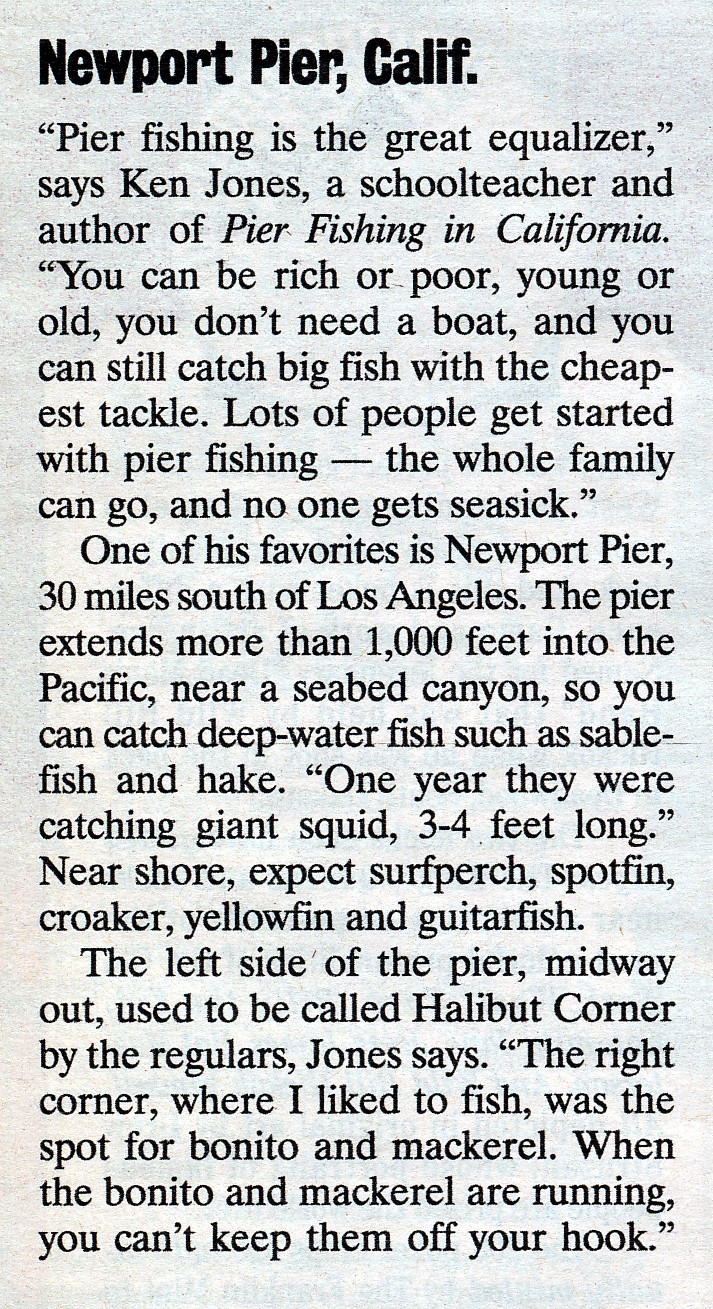
The Nitty Gritty California Pier Trivia Quizzes —

If you have read Pier Fishing in California you should be able to answer the following questions without breaking a sweat. If you can’t, I expect you to sleep the next seven nights with the book under your pillow. Just pretend it’s a love letter from your first boyfriend, girlfriend — or whatever.  By the way, the answers will be given at the bottom. And shame on those who do not have the book, you should get it.  

You will need to write your answers on a piece of paper.

Nitty Gritty California Pier Trivia Quiz #1

Citizen’s Dock                      Imperial Beach Pier              Berkeley Pier

Elephant Rock Pier              Seacliff State Beach Pier

Leopard Shark                      Round Stingray                    Bat Ray

            Brown Smoothhound Shark           Common Thresher Shark               

1. The end of this pier  is a sunken “concrete ship.”

2. This pier calls itself the most “southwesterly pier in the United States.”

3. This pier was built by the citizens of the town after a tidal wave washed away their former wharf.

4. This pier was the first to be funded and renovated by the California Wildlife Conservation Board.

5. When built, this pier was supposed to be reserved for kids.

6. Populations very dependent on water temperature; as the water temperature rises so does the presence of these fish.

7. These can be pests in areas that grow oysters commercially.

8. Extremely common in San Francisco Bay; one of the most numerous fish at some piers.

9. Caught throughout California but most common in San Francisco Bay.

10. Typically found in deep water but ventures surfside at night (so they can visit the piers).

Nitty Gritty Pier Trivia Quiz  #2

            Vallejo Pier              Newport Pier           Paradise Cove Pier  

                        Aliso Beach Pier                               Green Pleasure Pier

            Striped Bass                          Senorita                     Cabezon        

Candlestick Point Pier                     Belmont Shores Pier

1. Only twenty yellow snake eels have ever been landed in California. The largest ever taken of the species was a 34 1/2 inch specimen landed on a California pier.  On which pier was it landed

2. Although many piers have appeared in movies, television shows, and commercials, only one, to my knowledge, has been the home (sort of) to a television series. Hint: think of Jim Garner and the Rockford Files. Which pier?

3. Although fishing can be excellent from this pier, it is almost always empty of anglers during many Sundays in the Fall. Which pier and why?

4. A 194-pound, eight-foot-long white sturgeon was taken at this pier in 1980. Which pier?

5. This pier sits next to the last commercial dory fishing fleet on the West Coast. Which pier?

6. This pier is probably the best  is California from which to catch halfmoons (blue perch) or moray eels. Which pier?

7. This pier was built in a diamond shape so that anglers would be offered more railing space (they could fish in the middle of the pier).

8. Sometimes people don’t eat the meat of this fish because it is green or blue colored when they clean the fish. They’re missing a treat! Upon cooking, the meat turns white and is delicious. The roe however, is poisonous.

9. Although primarily known as a saltwater fish, the California record for the species was caught in a freshwater lake.

10. These fish are probably the best “bait stealers” in the state.

                      Nitty Gritty California Pier Trivia Quiz  #3

            Santa Monica Pier                Ocean Beach Pier                  Pier 7 

                        Capitola Wharf                                San Mateo Pier

     Manhattan Beach Pier         Crystal Pier               Adorni Fishing Pier            

Candlestick Point Pier                     South Beach Harbor Marina Pier

1. The Round House Marine Lab sits out at the end of this pier.

2. This is the only pier on the West Coast with cabins built over the blue Pacific.

3. The Pacific Park amusement park is located on this pier.

4. This pier sits next to Pac Bell Park, the home of the San Francisco Giants.

5. This pier is supposed to be the longest concrete pier in the world.

6. This pier sits within the oldest seaside resort on the Pacific Coast.

7. This pier is part of a beautiful recreation center.

8. A common name given to this pier by anglers who fish this pier is the shark pier. What is the real name.

9. This pier sits next to the former home of the San Francisco Giants.

10. More commercials are filmed at this pier than any other pier in northern California.

Answers to Nitty Gritty California Pier Trivia Quiz #1

(1)  Seacliff State Beach Pier  (2)  Imperial Beach Pier (3)  Citizen’s Dock  (4)  Berkeley Pier (5) Elephant Rock Pier (6) Round Stingray (7) Bat Rays  (8)  Brown Smoothhound Shark  (9) Leopard Shark (10) Common Thresher Shark

Answers to Nitty Gritty California Pier Trivia Quiz #2

(1) Belmont Shores Pier (2)  Paradise Cove Pier  (3) Candlestick Point Pier     (4) Vallejo Pier (5) Newport Pier (6) Green Pleasure Pier — Avalon (7) Aliso Beach Pier ( 8) Cabezon (9) Striped Bass (10) Senorita

Answers to Nitty Gritty California Pier Trivia Quiz #3

(1)  Manhattan Beach Pier (2) Crystal Pier (3) Santa Monica Pier (4) South Beach Harbor Marina Pier (5) Ocean Beach Pier (6) Capitola Wharf (7) Adorni Fishing Pier ( 8) San Mateo Pier (9) Candlestick Point Pier (10) Pier 7

Posted in Daily musings..., Pierfishing, Saltwater Fishing · Tagged , , , , , , , , , · Leave a comment

Pebble Beach & the Stillwater Cove Pier (aka Matthew & Mimi Jenkins Pier)

After watching the last round of today’s Pebble Beach Pro-Am, I thought what better day to post some facts about the pier that kept showing up on the screen?

Stillwater Cove Pier

The view from the pier is stunning! Look slightly to the west and you’ll see the Pescadero Rocks, the rocky pinnacle and strands of kelp that give shelter to this cove and truly provide, on most days, water that seems almost motionless. Look to your right and you’ll see Pescadero Point and the large pink structure known as the “Castle House,” perhaps the most famous—and expensive—house in Pebble Beach (and site of several movies). Look to your left and you’ll glimpse Arrowhead Point and mystical Carmel; shift your attention just a little to the right and you’ll see Point Lobos and the beginnings of the Big Sur coastline, one of the world’s most scenic areas. Turn around (do a whirling dervish) and look inshore and you’re confronted with an attractive beach, the exclusive Beach and Tennis Club, and one of the world’s more famous and beautiful golf courses—the Pebble Beach Golf Course. In fact, the 4th hole sits next to the shoreline by the pier and holes 5-7 effectively circle the cove. The 17th hole sits just the other side of the Beach and Tennis Club. It’s kind of interesting—when the fishing is slow—to keep an eye on the golfers to see how they’re doing. And, you never know who might be on the links; it’s home to the rich and famous.

Looking south

However, I’ve often thought that perhaps it’s just a tad too pretty a postcard setting to also be a good fishing pier and my results have tended to confirm that thought. On most days you’ll have the pier to yourself, at least as far as fishing. There is a boat hoist on the pier, and a limited number of divers are allowed to depart from the pier (10 a day), but I’ve never seen more than a couple of anglers on the pier. In fact, you’ll usually have the pier to yourself; about the only regulars are workers from the nearby club.

Carmel off in the distance

Environment. Although part of the Carmel Bay Ecological Reserve, sport fishing for fin fish is allowed as a sign at the front of the pier points out. The water here is shallow and, as mentioned, generally very calm due to Pescadero Point and the Pescadero Rocks, the outcropping of rocks that sit somewhat south of the Point and help protect the area from northwest swells. 

Stillwater Cove

Although fish-enticing rocks define much of the cove’s bottom, and line the shoreline area on one side of the cove, they’re just a little too far away from the pier to give it a rocky environment. Instead, the bottom surrounding the pier itself is mostly sand that transitions into rock rubble as you get into deeper water. The pier pilings are concrete, with very little fish attracting growth on them, while heavy masses of seaweed and kelp are spread from the pier throughout the cove; giant kelp in the deeper waters, feather boa kelp in the shallows. 

Kelp

Due to the shallow-water, sandy-bottom environment around the pier, and a general lack of water movement, what looks so promising at first glance often leads to disappointment when measured strictly in terms of fish. Perhaps it’s better just to enjoy the setting and let the fishing be secondary in nature.

Stillwater Cove Pier

Somewhat surprisingly, two rocky-habitat species—blackperch and striped seaperch, seem to be the most common fish taken from the pier. In addition a few rockfish do show up, as well as a few cabezon and lingcod. Mostly though these hang around the nearby kelp and reefs rather than being residents of the pier area. As for the sandy shore species, a few are taken—barred, calico, walleye, spotfin and silver surfperch, but their numbers seem limited. Common, at times, are jacksmelt and when a school heads by the rocks it can provide some steady action. In addition, the mix may also see a few more solitary species, flatfish, as well as a few leopard sharks and bat rays.

A non-fish species that does seem to be resident is harbor seals, I’ve rarely had a visit when at least a few of the pinnipeds weren‘t bobbing around in the water. Sea otters may also make an appearance and when they do they can be quite amusing.

Make sure you enjoy the scenery because most days, as said, are not that great as far as fishing. Better fishing can be found from nearby shoreline areas, especially Arrowhead Point, but much of the area is restricted.

 Fishing Tips. Primary species are the aforementioned perch—black and striped—joined by lesser numbers of rubberlip and rainbow seaperch, all probably having wandered over from the nearby rocks. They will be joined by barred surfperch, calico surfperch and walleye surfperch, species that prefer the sandy bottom around the pier. Joining them will be flatfish such as sand sole, starry flounder, sanddabs and perhaps a halibut (but you need the right bait or lures). A few leopard sharks are reported from the pier and a few rays. Add in some small to medium-size rockfish (mostly grass rockfish), a stray cabezon or two, and an occasional lingcod, and you have a decent variety. Just don’t expect a lot of fish every day.

Blackperch from the pier

As for the perch, stick to the basics—pile worms, fresh mussels, ghost shrimp, or small pieces of market shrimp (all of which you will have to bring with you). For the barred surfperch you can try the sandy-shore area and try sand crabs (if you can find them), fresh mussels, pile worms or ghost shrimp. Like many areas, anglers are also beginning to use plastics—a variety of grubs and swim baits—for the perch.  

A striped seaperch from the pier

The aforementioned baits will also attract the small to medium-size rockfish (that are often called rock bass by the locals). However, strips of squid can also be effective and may lure in a sole or shark. If seeking out the rockfish, cabezon, and lingcod, I suggest following the words of MB, a local who fishes the pier fairly often. His advice: “casting toward the 17th hole is where the rocky bottom and kelp bed begins to grow and where I catch all of my rockfish/cabezon from the pier (but you have to cast far and be prepared with heavy gear for snags). Even though there are pockets of kelp throughout, only perch seem to inhabit those areas.” As I always say, follow the advice of the locals. Do be prepared for some snags because you’ll probably get them. No pain no gain, right?

Some large leopard sharks and bat rays are also found in these waters so be sure to bring along a net. Problem here is keeping the bigger creatures from encircling bits of kelp with the line. As always, a bit of luck is needed if you hook a big fish. However, the pier is small and if necessary a fish can often be walked down to the sandy beach at the front of the pier or to the dock that is tethered to the end of the pier during the summer. 

Again, don’t bring great expectations because they rarely will be filled. That is unless your expectations center on the ambiance of the spot, the sheer beauty, and its peaceful nature. All of those are great in contrast to rather drab fishing (on most days). As one local angler said, “It’s not a great pier since it doesn’t have deep water, but it’s almost automatic for perch and great for kids.”

Looking toward the 4th Green

Note No. 1. Sometimes I wish I were a diver! Although the top-of-the-water view here is beautiful, the underwater scene must be amazing. In an article by Bruce Watkins (Dive Spot Monterey County), he describes that undersea world: “The prominent feature of Stillwater Cove is the mass of rocks in the center of the cove. Known as Pescadero Rocks, most divers concentrate their activities around the rocks and in the reef directly south of the rocks…

Pescadero Rocks

These rocks are covered with all of the colorful marine life that makes California diving so interesting—carpets of red corynactis anemones, giant green and blood red telia anemones, and yellow and cobalt sponges.  Monkey-faced eels are abundant here but often go unnoticed. Their distorted faces are a bit grotesque but, nonetheless, interesting to photograph… Also, not a true eel, wolf eels inhabit Stillwater Cove. These strong-jawed fish feed on sea urchins and shellfish. Wolf eels are far less threatening than their name or appearance would suggest, are very shy, and rarely bother divers. As one gets nearer Pescadero Rocks the bottom juts up from 40 to 30 feet in a massive wall that runs nearly 100 yards. On the north side of the wall is a float marking the location of an underwater statue. At the base of the wall are a number of shallow caves, ledges and swim throughs. The walls are adorned with encrusting sponges in hues of cobalt red and yellow, and the nooks and crannies of the wall harbor an assortment of photogenic invertebrates… In the shallow water around Pescadero Rocks live an abundance of hermit and decorator crabs. This shallow area is also a great place to observe and photograph nudibranchs. The simple dorids, such as the lemon and Monterey nudibranch, are here in abundance. Just to test your photographic skill there are also more photogenic species. Photos of orange and white clown nudibranchs, gaudy red and white Phidianas and ostentatious Dendronotids will wow your friends.”

Golfers on the adjacent Pebble Beach Golf Course

Note No. 2. Stillwater Cove and the nearby Coast Guard Pier in Monterey are the only two sites in California where sea otters have been observed attacking and eating birds (it’s also been observed in Alaska). Species attacked included western grebes, cormorants, surf scooters, common loons, and gulls. Otters have been observed approaching birds from under the water as the birds rested on the surface, then dragging the birds underwater while wrestling with them and biting them. Attacks lasted up to fifteen minutes before the bird was eaten. At the same time female otters have been observed carrying around a bird carcass on their chest for an hour or more. Scientists aren’t quite sure what to make of the phenomenon.

Note No. 3. Although the cove and setting have a rather “pristine” feel to them, looks can be deceiving. Heal the Bay, a Santa Monica-based group that monitors water quality at 370 locations along the coast, rated Stillwater Cove as one of the three dirtiest beaches (“Beach Bummers”) in Northern California along with Campbell Cove State Beach in Sonoma County and Pillar Point Harbor in Half Moon Bay. At least that was the finding in 2005.

“For the fourth year in a row, Stillwater Cove at the Beach and Tennis Club scored markedly worse than all other monitored Monterey County beaches by receiving an F grade. Stillwater Cove, as its name implies, has poor circulation and little tidal flushing. In addition, this location tends to be a favorite of marine mammals and birds. The only other known source in the area is a constantly running storm drain, which mostly services the local golf course.”

                                    —Heal the Bay, 2004-2005, 15th Annual Report

 The good news is that Stillwater Cove received “A’s” on the 2008 and 2009 report cards given by Heal the Bay so evidently things are improving.

The beach at Stillwater Cove

Note No. 4. Like many of California’s piers and their beaches, this cove and pier was used in a movie—Captain January (1936).

The Beach

Note No. 5. Rescuers struggle to save amazing giant squid —

 Humboldt Squid

WHILE NOT quite of the gargantuan proportions of Jules Verne’s famous giant squid, a group of Humboldt squid that washed ashore at Stillwater Cove in Pebble Beach last week were certainly mysterious and fascinating — and huge.

When Joey Guilatco arrived for work at the Beach and Tennis Club at 5 Friday morning, he was told that a club member walking her dog had found several squid stranded on the nearby beach.

With a flashlight, Guilatco went down to the beach and searched in the early morning darkness. And while almost everyone else was still peacefully dreaming in bed, he came across a sight that did not seem to belong to the waking world — more than a dozen of the largest squid he’d ever seen, many still alive, scattered along the beach.

They were “moving, breathing, and spewing some kind of saliva,” Guilatco said.

It was their size that struck him most. Including their tentacles, some were five feet long. They weighed about 10 pounds each, which Guilatco learned as he and other P.B. employees tried to lug the living animals back to the ocean.

He called the Moss Landing Marine Laboratory to report the incident and see if the experts could explain the bizarre event. They instructed Guilatco to preserve the dead ones in ice while they considered sending a scientist to investigate.

Guilatco and the other employees collected the squid and put them on a bed of ice on a picnic table at the beach. Souvenirs? The Moss Landing people never came, but the squid did not go to waste. By the end of the day, all but one had been taken.

—Regan Carey, The Carmel Pine Cone, October 16, 2003

History Note.  It’s a little hard to imagine today but the cove and its shoreline once served as home for a Chinese fishing village. The Chinese had fished Carmel Bay since 1851 when they set up a camp in Point Lobos; soon after two additional camps were established, one at Pescadero (today’s Stillwater Cove), and one at Point Alones (near Cannery Row).  By 1853 a settlement was recorded at Cabrillo Point (China Point), the site of today’s Hopkins Marine Station.  It would be the main Chinese settlement for many years.

The Chinese were skillful fisherman and a large part of the Monterey fishing industry for many years but eventually they came into conflict with other immigrant groups, especially the Italian-American fishermen. Increasingly restrictive laws made it hard to fish and process their catch, and when combined with a mysterious fire at the China Point settlement in 1906, the decline of the “Chinese fishing villages” almost seemed inevitable. The Pescadero camp itself apparently came to an end in 1912. 

In 1916 the Monterey Cypress newspaper reported plans for a pier and bathhouse at the cove. Just a few years later, in 1919, the small fishing lodge had grown to be  “one of the finest fishing clubs in the country.” That lodge was the forerunner for today’s Beach & Tennis Club building that sits near the front of the pier.

“The Seventeen-Mile Drive curves through the spacious homes and gardens of Pebble Beach… at 14 m. is the junction with a paved road; R. 03m. to Stillwater Cove with its arch rock offshore, its fishing club and bathing beach, yacht harbor and marine gardens (glass-bottom boats, 50¢).”

—California, A Guide To the Golden State, Federal Writers Project, Works Progress Administration, 1939

By 1948 the original pier was beginning to show its age and a new pier was needed. The new pier would be built by the Stillwater Yacht Club, a deed commemorated by a small sign near the entrance to the pier: “Matthew & Mimi Jenkins Pier. First Commodore & First Lady. Stillwater Yacht Club. Est. 1948.”

Not mentioned is the fact that Matthew Jenkins was also one of the developers of Pebble Beach and that the Jenkin’s had bought the 5.5 acre parcel overlooking Stillwater Cove in 1943 for $43,000. Their purchase, and refusal to sell it to Samuel Morse who developed Pebble Beach Golf Links, prevented his plan for a shoreline hole No. 5. The building of the shoreline hole would not take place until 1999 when the heirs to Mimi Jenkins sold her property.

As happens to all coastal piers, the sea and weather take a toll. Sooner or later wood (especially the pilings) deteriorates and repair or a rebuild is necessary. In this case, the pier was condemned in 1980. Another new pier was needed but the story of the new pier would take several interesting twists before completion. 

In 1977 the Del Monte Properties Company had reincorporated as Pebble Beach Corporation and then, in 1979, the company was bought by Marvin Davis who owned Twentieth Century Fox. It was during his tenure as owner that The Inn & Links at Spanish Bay was developed (in part, as rumor has it, to increase needed cash flow).

Davis needed the approval of the Coastal Commission to build the new resort and they were agreeable with a number of conditions, one being that “Public Access” be gained for Stillwater Cove.

However, the property at the cove was owned by Mimi Jenkins (following the death of Matthew her husband). As matriarch of her family, and still involved with the yacht club, she was agreeable to the public access with several additional conditions that she had her attorney add to the mix. The Pebble Beach Corporation company would build a new pier and put a hoist on the pier. In addition, they would have a Harbor Master on duty part of the year (May 15-September 15). 50 visitors would be allowed to visit the cove (and pier) per day but no more than 10 divers a day and they would no longer be allowed to shoot fish under water, only observe and/or photograph them. The cove and pier would remain open to all residents of Pebble Beach. The corporation and the coastal commission agreed to the conditions and a new pier was constructed (for a relatively modest $500,000).

The Pebble Beach Corporation would go through further change and ownership, but the pier with its special conditions has remained relatively unchanged since 1984 (although a new hoist is planned for the pier).

Stillwater Cove Pier Facts

Hours: Open daylight hours. Access is through the parking lot of the Beach & Tennis Club

Facilities: Few, since this pier was not designed as a fishing pier. There is a limited amount of coastal access parking near the entrance to the club‘s parking lot. Look for the tall hedge and you’ll see (ten spaces) that are gone quickly given the number of divers who visit the area. Always call 831-625-8536 to reserve a space if you intend to visit. Restrooms are found near the front of the pier.

Handicapped Facilities: Handicapped parking (one space) but non-handicapped restrooms. The pier surface is wood planking with a rail height of 43 inches; an 8-inch curb runs along the entire length of the pier making access to the railing difficult. Not posted for handicapped.

How To Get There: From Highway 1 take the Pebble Beach Exit. As soon as you exit you will see a toll station and the entrance to the famous 17-Mile Drive. Pay roughly $10 (it keeps going up) to traverse these hollowed grounds and follow the drive about three miles to the Beach & Tennis Club turnoff. Turn left onto Palmero Way, .24 miles turn left onto Cypress Drive, look for tall cypress tress and a narrow parking lot that is reserved for public access—just up the street from the club.

Stillwater Cove Pier

The Beach & Tennis Club

Pescadero Rocks and the rocks on the north end of the cove

Posted in California Piers · Tagged , , , , , , · 5 Comments

Pacific Bonito — a true fighting fish

Bonito — Venice Pier

Mackerel and Tuna—Family Scombridae

Species: Sarda chiliensis (Cuvier, 1832); from the Greek word sarda  (an ancient name for an European species of bonito) and chiliensis (in reference to Chile, South America, where the species was first recognized). Subspecies (those in California): Sarda chiliensis lineolata.


Bonito — Ben Acker (DompfaBen), Cabrillo Mole, Avalon, Catalina Island

Alternate Names: Most commonly called bonehead but also given the names bone, boner, bonefish, flasher, Laguna tuna, magneto, bongo, striped tuna and little tuna. One of my favorites—from the PFIC Message Board—Mr. Bojangles. Called bonito del Pacífico oriental in Mexico.

Bonito — Venice Pier

Identification: Tuna-shaped, elongated and pointed at both ends; a series of 6 to 8 finlets that follow the second dorsal fin and anal fin. Coloring dark blue above with greenish reflections and a metallic luster shading into silver below; several dark oblique lines on the back.

Bonito with usual striping caught by Mahigeer (Hashem Nahid), Cabrillo Mole,  2016

Unusual striped bonito caught by Mahigeer, (Hashem Nahid), Cabrillo Mole, 2016

Size: To 40 inches although most caught from piers are less than 24 inches. For years the  California record fish was listed as a fish that was caught in Malibu Cove in 1978 with a weight of 22 lb 3 oz. Today the record is listed as a 21 lb 5 oz. fish taken at the 181 Spot in 2003. I’m not sure why the new, lighter fish is the record (and I haven’t been able to find out).

Bonito — Scott Geerds, Cabrillo Mole, Avalon, Catalina Island

Range: There are two subspecies. One, the northern population, Sarda chiliensis lineolata, is found from Southern Baja California and Gulf of California to Copper River in Alaska. The southern population, Sarda chiliensis chiliensis, is found in the subtropical eastern Pacific, Peru to Chile, and off Japan. As a general rule they’re only found north of Point Conception during El Niño, warm-water conditions (and I witnessed several large bonito, all over ten pounds, being caught off of Elk in Mendocino County during the El Niño year of 1983).

Bonito — Rita Magdamo, Cabrillo Mole, Avalon, Catalina Island

Habitat: Pelagic, although enters bays, especially those with warm water outlets.

Bonito — James Liu (GDude), Cabrillo Mole, Avalon, Catalina Island

Piers: Common at most southland piers during and after warm-water years, both those in bays and those at oceanfront spots. Best bets: Ocean Beach Pier, Oceanside Pier, San Clemente Pier, Balboa Pier, Newport Pier, Cabrillo Mole (Avalon)—#1, Redondo Beach Pier, and the Hermosa Beach Pier. Stearns Wharf (Santa Barbara) and Goleta Pier can be decent, especially in the fall.

Bonito — Mike Donahue (SD Pier Rat), Ocean Beach Pier, San Diego

Shoreline: Sometimes taken by shore anglers fishing from jetties in southern California, especially the jetty at Redondo Beach.

Bonito — Mike Granat, Balboa Pier

Boats: One of the favored boat species although the numbers can show a drastic change year-to-year depending upon water temperature.

Angie and her first bonito — Balboa Pier

Bait and Tackle: Bonito primarily feed on fish and squid and are taken on a variety of baits and lures. The best bait is live anchovies or small sardines fished on a sliding leader or with a cast-a-bubble. The best lure is a bonito feather affixed to either a cast-a-bubble, a wooden float, a Styrofoam float, or a golf ball—the bubble/float/golf ball causes commotion on the surface which attracts the bonito and keeps the lure near the top.

Bonito — Scott Geerds, Cabrillo Mole, Avalon, Catalina Island

Food Value:  Bonito are considered fairly good quality but require cleaning soon after capture. If bled quickly, or even better if filleted and then put on ice, the flesh can be quite tasty. However, if allowed to warm up in a gunnysack on the nice hot surface of a pier the flesh can be almost inedible (which is true with many fish). Some parts of the flesh are dark colored—bloody and strong flavored. Remove those parts of the flesh unless you desire them for smoking. Given the high oil content of the flesh, the best cooking methods are broiling or bar-b-cuing the meat; the worst are methods like deep-frying that would add more oil. In addition, smoked bonito and pickled bonito are also very good.

When I was young, and lived in San Diego, I would often go out on the half-day boats to catch some bonito. Most of the bonito (in the gunnysacks) would wind up as fertilizer for my mom’s roses. However, a couple of the cooks on the boats would cook up some of the fresh-caught fish. A favorite method was to cut thin slices of meat from the head of the bonito (up behind the eyes) and then lightly cook the slices on a grill using just a little butter. Flavored with soy sauce, it was delicious.

Today, given that we’ve all become goumands, we would probably serve the thin slices raw as sashimi and include a little dipping sauce, i.e., wasabi paste and soy sauce draped over a daikon radish. One recommended dipping sauce even includes fish flakes from bonito, it’s a sauce made from shōyu (a type of soy sauce), mirin (a sweet cooking wine) and the bonito flakes.

Bonito — Hashem Nahid (Mahigeer), Cabrillo Mole, Avalon, Catalina Island

Comments: Many people feel that bonito are among the strongest fighting fish, pound for pound, in the sea. For many years the place to go for bonito was the Redondo Sportfishing Pier in Redondo Harbor. This was especially true during the colder-weather, winter months. That narrative was altered when the nearby power plant changed ownership and changed procedures. Instead of always being on, and sending a steady stream of hot water into the harbor (where it emerged at the famous “bubble hole”), it became a sporadic occurrence. Visitors never knew when the hot water, or the bonito, would be showing up.  Locals learned to check out the tall towers to see if they were emiting smoke. If they were, the hot water would be bubbling up in the harbor and bonito probably would be present. Today the pier is closed but hopefully will be rebuilt. Many also hope the warm water will return to the harbor.

Bonito or bonita? The correct spelling is bonito but a surprisingly high number of people over the years, including journalists and writers who should know better, have used bonita as the moniker for these fish. One day on the Pier Fishing in California message board someone said his daughter had been called a bonito and she got upset until someone told her that the name meant pretty in Spanish. People then chimed in that she should have been called a bonita since that was the feminine name and bonito was the masculine name. As for the fish, given the strong, powerful fight they typically put up, I think I will stick with bonito as the name.

Bonito — San Clemente Pier

Bonito —Stecve Barcellos (SteveO), Cabrillo Mole, Avalon, Catalina Island

Bonito — Imperial Beach Pier

Bonito — Adam Cassidy (Baitfish), Cabrillo Mole, Avalon, Catalina Island

Bonito — Kyle Pease, Cabrillo Mole, Avalon, Catalina Island

Bonito — Kyle Pease, Avalon, Catalina Island

Bonito — Rita Magdamo, Cabrillo Mole, Avalon, Catalina Island

Bonito — Ken Jones (The Pier Fisherman), Cabrillo Mole, Avalon, Catalina Island

Bonito — Steve Barcellos (SteveO), Cabrillo Mole, Avalon, Catalina Island

“Tres Bonitos” — Rita Magdamo, Ross Kestin (GordoGrande), and Kyle Pease, Cabrillo Mole, Avalon, Catalina Island

Bonito caught at the  Goleta Pier in 2016 by seabass.seeker

My son Mike with a good-sized bonito and small yellowtail

A big bonito caught on the “Sea Wolf”

____________________________________________________________________________________

“Stuck in Catalina With the Bonito Blues Again”


Written for and dedicated to Hashem aka Mahigeer when he was seeking out his first bonito at Catalina in 2006. Although the rest of the UPSAC/PFIC gang was pulling in the bonies, Hashem just couldn‘t seem to hook one. Today he’s learned the “Tao of Bonito.”

Bonito —Hashem Nahid (Mahigeer), Cabrillo Mole, Avalon, Catalina Island

Oh, the Dompha, he draws circles
Up and down the mole.
I’d ask him what the matter was
But I know that he don’t talk.
And the anglers treat me kindly
And furnish me with line,
But deep inside my heart
I know I can’t escape.
Oh, Mama, can this really be the end,
To be stuck in Catalina
With the bonito blues again.

Well, Ken, he’s in the alley
With his pointed shoes and his bells,
Speaking to some French girl,
Who says she knows me well.
And I would send a message
To find out if she’s talked,
But the tackle store’s been stolen
And the tackle box is locked.
Oh, Mama, can this really be the end,
To be stuck in Catalina
With the bonito blues again.

Gordo tried to tell me
To stay away from that Catalina mole
He said that all those older fishermen
Just drink up your blood like wine.
An’ I said, “Oh, I didn’t know that,
But then again, there’s only one I’ve met
An’ he just smoked my eyelids
An’ punched my cigarette.”
Oh, Mama, can this really be the end,
To be stuck in Catalina
With the bonito blues again.

Grandpa died last week
And now he’s buried in the kelp,
But everybody still talks about
How badly they were shocked.
But me, I expected it to happen,
I knew he’d lost control
When he built a fire on the mole
And shot it full of holes.
Oh, Mama, can this really be the end,
To be stuck in Catalina
With the bonito blues again.

Now the GDude came down here
Showing ev’ryone his rod,
Handing out free tickets
To the gathering on the mole.
An’ me, I nearly got busted
An’ wouldn’t it be my luck
To get caught without a license
And be discovered beneath a trunk.
Oh, Mama, can this really be the end,
To be stuck in Catalina
With the bonito blues again.

Now Baitfish looked so baffled
When I asked him why he dressed
With twenty pounds of feathers
Stapled to his chest.
But he cursed me when I proved it to him,
Then I whispered, “Not even you can hide.
You see, you’re just like me,
I hope you’re satisfied.”
Oh, Mama, can this really be the end,
To be stuck in Catalina
With the bonito blues again.

Now Mahigeer gave me two cures,
Then he said, “Jump right in.”
The one was Persian medicine,
The other was just plain Raki gin.
An’ like a fool I mixed them
An’ it strangled up my mind,
An’ now people just get uglier
An’ I have no sense of time.
Oh, Mama, can this really be the end,
To be stuck in Catalina
With the bonito blues again.

When Rita says come see her
In her honky-tonk lagoon,
Where I can watch her waltz for free
‘Neath her Avalonian moon.
An’ I say, “Aw come on now,
You must know about my debutante.”
An’ she says, “Your debutante just knows what you need
But I know what you want.”
Oh, Mama, can this really be the end,
To be stuck in Catalina
With the bonito blues again.

Now the bricks lay on Metropole
Where the neon madmen climb.
They all fall there so perfectly,
It all seems so well timed.
An’ here I sit so patiently
Waiting to find out what price
You have to pay to get new balls and feathers
After losing them more than twice.
Oh, Mama, can this really be the end,
To be stuck in Catalina
With the bonito blues again.

(With apologies to Bob Dylan and “Stuck Inside of Mobile With The Memphis Blues Again)


Posted in Pierfishing, Saltwater Fishing · Tagged , , , , , , , , , , , , , , , · 11 Comments

The Point Mugu Pier — Gone But Not Forgotten

The Point Mugu Pier

A locally popular fishing pier was one that existed for years at the Naval Air Station at Pt. Mugu. As to be expected, access was limited to military personnel and their dependents but apparently it was an excellent pier for many species including deep-water fish from time to time. Unfortunately the winter storms of 1993 not only destroyed the pier but also hammered and rearranged the entire beach area. Today both pier and beach are gone but the Pt. Mugu Lagoon bears witness to an area that once was a favored source of recreation.

Sinker, (Tm Durham) one of the original leaders on the Pier Fishing in California  Message Board fondly remembers the pier: “The (Pt. Mugu) pier was located on the Naval Air Station, Pt. Mugu—U.S. Navy Base. It was actually the second pier built on the base. The first was destroyed during an early storm but they chose not to rebuild that one as they put in a jet engine test facility in that area. They did build another one though, which is what I am familiar with. This pier is listed in my biography as my father and I spent many, many hours and days there. When I returned from New York I went to fish that pier only to find that the last bad El Nino not only took it out but also the Officers Club, the Beach Cabins and the Beach Motel. They used to have beaches on either side of the pier (one for enlisted and one for officers). The Officers Beach no longer exists as the natural lagoon has overtaken the large beach area. I used to fish the entrance to the lagoon for sharks with great success and the pier saw absolutely incredible fishing. From my Biography, under Favorite Pier: ‘this pier was incredible—halibut, croaker, bonito, smelt, queenfish, bass, rockfish, perch, sharks, rays, crabs, lobsters—you name it, this pier has pretty well seen it. This pier is where I learned the most about fishing, technique, presentation, knots, fish identification, proper and safe handling of fish (for myself and them), how to clean a fish, how to keep my area clean and safe—all this from my FATHER. We spent countless days and nights on that pier where he taught me what I now know and shared the secrets of life, listened to my problems and helped me make them better…’ I am not sure why this pier produced such a wide variety of fish species but it did include many warmer water species and unfortunately a lot of bullheads. I do know there is a deep submarine channel out there and maybe that brought in some fish. We also got lots of halibut and I caught my first squid on that pier. I loved watching them spit at you when you got them out of the water; Î also caught my first octopus there. They now have a memorial for the Alaskan Air Liner that went down off the Mugu Coast. The lagoon, being one of the last natural lagoons in Southern California, is completely restricted and has also now become a refuge for sea lions and the such.”

The pier’s history apparently dates back to the early 20th Century when the Mugu Fish Camp was built along with a 200-foot-long pier (see below). That pier was heavily damaged in the storms of 1939 that damaged many of the southern California piers.

The pier was rebuilt and would last until the storms of the ‘80s and ’90s once again damaged the pier—this time for good. Today it’s only a memory.

Two fishing barges are recorded as operating from Point Mugu, the Pt. Mugu I and the Pt. Mugu II, both in the 1930s.

As far as fish from the pier, the largest I have been able to track down was a 41-pound white seabass taken from the pier in August of 1959 by Charles Leonard, a chief aviation machinist’s mate at Point Mugu Naval Air Station. As recorded by the local paper, “Chief Leonard said he lured the ‘big fellow’ with live bait, but withheld the type of bait as his trade secret.”

Not too far offshore is located the submarine, deepwater canyon usually simply called the Mugu Trench, a canyon that can funnel deepwater fish into the inshore area. One notable fish was a louvar (Luvarus imperialis) that was caught on the Point Mugu Beach in 1939. The 13 3/4-pound fish was one of only a handful of the fish that have been seen in California.

The Point Mugu Fish Camp — The (Mostly) Good Old Days

Finds Fish Camp Most Restful Vacation Spot

Ted Diefenbach is home from a week’s vacation, which was the most restful and delightful that he has yet enjoyed. He spent it at the Point Mugu fishing camp, where he enjoyed swimming, boating, fishing, hiking and has attained a beautiful coat of tan. “That’s the place for a restful vacation,” Ted says. Board and room may he secured at the camp besides many are living in tents. The fishing camp is located about 10 or 12 miles from Oxnard on the strand beyond the Point Mugu lagoon, which will be the next big development in this section, according to some.

—Oxnard Daily Courier, Oxnard, California, July 25, 1927

The Point Mugu Fish Camp has secured a large Live Bait Fishing Boat, The Star Light. And are now ready to take passengers on trips to the Anacapa, Santa Cruz or other points of interest to Sportsmen or Fisherman. Will Charter for Private parties. Fisherman are now bringing in Jew Fish, Halibut, Rock Cod, White Fish, Bass and other varieties freely the last few days. Also good fishing on the Barges outside.

—Oxnard Daily Courier, Oxnard, California, June 5, 1929

 Fishermen Break Pt. Mugu Camp Record

Fishermen from Santa Paula and Venture broke the halibut record at Point Mugu this week for season and gave local anglers something “big” to aim for. Harvey Schuyler, 139 Oak street, Santa Paula, last Sunday landed a 53-pound halibut from the barge, the largest so far for 1935. The halibut measured 56 inches in length and 22 inches in width. W. J. Stuart, 222 ½ Vince street, Ventura, on the same day, topped the previous pier record of 31 pounds by taking a 33 pounder. However, Los Angeles anglers seem to favor the big ones, as Ray Darsie, Griffith Park Golf course, on July 30, landed from the barge a 400 pound jewfish. This makes more than a dozen large jewfish landed this season from the barge, practically all by Los Angeles fishermen.

During the past week halibut fishing slowed up somewhat in quantity but on average were larger. Sunday crowds continue to fill the pier, while there is elbow room for those who are able to do so, throughout the week days.

—Oxnard Daily News, August 3, 1935

The angriest sea in the county’s history took a toll of fishing boats and lives. The Sportfishing boat Spray went aground on Point Mugu with a loss of 23 lives, the Point Mugu Fish Camp was a shambles and the Coast Guard was kept busy helping several boats in distress.

—Oxnard Press-Courier, Oxnard, California, October 3, 1939

The Point Mugu Fish Camp announced the opening of a new all-electric restaurant, along with the rebuilt camp, specializing in fish dinners.

—Oxnard Press-Courier, Oxnard, California, June 28, 1940

The [Oxnard] district boasts the Southlands leading fishing center—Point Mugu Fish Camp—which is the haven for surf, pier and deep sea fishing. Almost daily, parties of fishermen leave the piers at the harbor and at Point Mugu. The channel between here and the islands long has been the favorite winters for fisherman.

—Oxnard Press-Courier, Oxnard, California, July 2, 1940

Famed Movie Setting—The Point Mugu Fish Resort not only is well known to fisherman of the Southland, but is well known, too, to the movieland. Above is the area when it was used as the setting for the Philippine Islands during the Spanish-American war.

—Oxnard Press-Courier, Oxnard, California, July 2, 1940

Point Mugu Pier — 1979

POINT MUGU — Where once there were fishermen, now there are warriors.

At the Point Mugu Naval Air Weapons Station north of Malibu, archeologists have spent the last week unearthing the remains of a once-thriving fishing village founded by a Japanese businessman at the turn of the century.

During its heyday in the 1930s, the Mugu Fish Camp just off Pacific Coast Highway was a popular playground for movie executives from Hollywood, who cruised up the coastal highway to hunt waterfowl at Mugu Lagoon, fish off a 200-foot wooden pier and luxuriate in a Japanese-style communal bath.

“I think at the time it was like going to Vegas,” said base archaeologist Steve Schwartz, the man who instigated the dig. “If you were a big shot, that’s what you did. And it’s been totally forgotten.”

The fish camp had been forgotten until the brutal winter storms of 1995 broke through a massive sea wall built by the Navy 30 years ago, pummeling the beach-side buildings that had been constructed on top of the site. The military planned to tear down the buildings and remove what remains of the sea wall.

That gave Schwartz an idea. He had seen plenty of photographs of the old fishing village–black and white images of wooden cabins, the tackle store, the concrete bait tanks that lined the entry to the pier. But he wanted to see what lay under the Navy’s former laundry.

Armed with a $175,000 Navy grant and the help of a San Diego firm that specializes in historical research and archaeological digs, Schwartz is getting just what he wanted.

“So the first thing we did was find the bait tanks,” Schwartz said with satisfaction, leading a tour of the sandy site, where the concrete foundations of three tanks stand exposed in a neat row, a fourth crumbling into the sand. The bottoms still have traces of the original bluish-gray paint.

When the fish camp was booming, sportsmen could pick up tackle and sundries at the little store on the other side of the pier, then mosey over to the tanks to select their bait. A trained seal lived in a fifth tank, now lost to time and the sea.

Schwartz said Japanese businessman Frank Kubota founded the village, building the store, cafe, six wooden cabins and a series of tent cabins along the beach. The date of the construction is uncertain, but Schwartz said the first photographs he has seen of Kubota’s village are from 1912.

Kubota also built a bridge across the marshy, wildlife-filled lagoon as an entryway to the camp from Pacific Coast Highway. It was a toll bridge, costing 25 cents to walk across and a $1 to drive across.

From what Schwartz has learned, Kubota went to jail for bootlegging at some point in the 1930s, turning over operation of the fish camp to Walter and Marguerite Welton. In 1939, Kubota sold the camp and returned to Japan, taking with him the profits from his business and leaving behind its remnants for archaeologists to find decades later.

In a week of digging, archaeologists have turned up sake bottles, rice bowls, pieces of the hurricane lamps that lighted the camp at night, whiskey bottles and an alarm clock caked with rust and missing its face.

On Wednesday, the diggers came upon a real find–the remains of the communal Japanese bath. Brushing away years of accumulated sand, they found pipes for hot and cold water. Schwartz believes the concrete foundation was once capped by a redwood tub. Tired fisherman would lounge in the tub, probably sipping sake or whiskey.

“Pretty relaxing after a day of gutting fish,” Schwartz said.

The entire fish camp had to be rebuilt after a storm of hurricane intensity hit the coast in September 1939, killing 28 passengers on a pleasure boat as it attempted to return to the camp from a trip to Anacapa Island.

During World War II, after the devastation from the storm and the rebuilding effort, the Navy took over to build a base. The fish camp’s cafe became a mess hall and the cabins were used for storage. Bit by bit, most of the camp was built over, until only the pier and cabins remained. The pier was damaged by storms in 1988 and capsized last year in the same storms that destroyed all but one of the cabins.

When the dig is completed in another week, the Navy plans to establish a museum in that last cabin, now relocated to a safe spot across the road. The archaeologists are videotaping the dig and photographing everything they find.

With the ocean always advancing, Navy officials say there is little point in trying to preserve the unearthed foundations except on film.

“They’re not going to last,” Schwartz said. “They’re already beginning to be washed out.”

But this time, he said he hopes that the fishing village won’t be forgotten.

—Mary F. Pols, Line to the Past, Los Angeles Times. July 26, 1996

Point Mugu Pier —1972

Point Mugu to be honored with historic site designation

How times have changed since the Mugu Fish Camp and pier at Point Mugu was a serene recreational destination for Ventura County residents and people from the inland areas of Southern California. To be sure, the drone of propeller-driven airplanes probably prompted a quick look from visitors, but the thunderous roar of supersonic jets was still well beyond their imagination.

So, no doubt, was the thought that the area would one day be called a historic site. That designation will come this afternoon.

Built about 1929-30 on a sand spit between the ocean and Mugu Lagoon, the camp offered local fishing from the pier and deep-water fishing from chartered boats.

Eventually, the area grew to include tent cabins, small houses, a store and cafe. Movies such as “The Real Glory” with Gary Cooper and “A Yank in the RAF” with Tyrone Power were shot near the lagoon.

And then, on Dec. 7, 1941, America was pulled into World War II. The military cocked its covetous eye at the land and coastal possibilities offered by Mugu and, slowly, everything began to change.

By 1942, a military camp was taking shape on some 4,000 acres of beach and tidal marshlands around the lagoon. Army anti-aircraft batteries and Seabees began training there, the Seabees building the first runway, 5,000 feet long, with metal Marsden mats.

Loons, American versions of the German V-1 rockets, were test-fired at the base. A dirt knoll was built on the beach that had a Loon launch pad, catapult and operations building.

In 1946, President Truman approved the building of the Naval Air Missile Test Center at Point Mugu. Three years later, the Naval Air Station was established to provide the test center with logistical and operational support. Since then, the base has undergone several organizational overhauls and testing has evolved with developing technology, but the mission has been steadfast: to put the best weapons possible in the Navy’s arsenal.

—John Mitchell, The Ventura County Star, November 14, 2003


Posted in Pierfishing, Saltwater Fishing · Tagged , , , , · 13 Comments

MLPA and the Emerald Waters —

When The Ship Comes In

Oh the time will come up

When the winds will stop

And the breeze will cease to be breathin’.

Like the stillness in the wind

‘Fore the hurricane begins,

The hour when the ship comes in.

Oh the seas will split

And the ship will hit

And the sands on the shoreline will be shaking.

Then the tide will sound

And the wind will pound

And the morning will be breaking.

Oh the fishes will laugh

As they swim out of the path

And the seagulls they’ll be smiling.

And the rocks on the sand

Will proudly stand,

The hour that the ship comes in.

And the words that are used

For to get the ship confused

Will not be understood as they’re spoken.

For the chains of the sea

Will have busted in the night

And will be buried at the bottom of the ocean.

A song will lift

As the mainsail shifts

And the boat drifts on to the shoreline.

And the sun will respect

Every face on the deck,

The hour that the ship comes in.

Then the sands will roll

Out a carpet of gold

For your weary toes to be a-touchin’.

And the ship’s wise men

Will remind you once again

That the whole wide world is watchin’.

Oh the foes will rise

With the sleep still in their eyes

And they’ll jerk from their beds and think they’re dreamin’.

But they’ll pinch themselves and squeal

And know that it’s for real,

The hour when the ship comes in.

Then they’ll raise their hands,

Sayin’ we’ll meet all your demands,

But we’ll shout from the bow your days are numbered.

And like Pharaoh’s tribe,

They’ll be drownded in the tide,

And like Goliath, they’ll be conquered.

Bob Dylan, 1963

 __________________________________________________________________

North Coast 2027

Alan ducked his head as another bit of salty ocean sweat lashed his face. It was a black brow’d night and the sea seemed to be in a snarly, growly sort of mood. It wasn’t a pleasant night to be strolling on the beach near Gualala but habits are hard to break and Alan had taken a walk on the beach almost every night for twenty years. Small bits of sea salad and big clumps of bull kelp were pushed ashore by the incoming tide but he had learned to walk quite gingerly many, many years before. The flotsam and jetsam that washed ashore were amazing, sad, and sometimes dangerous. Shoreline detritus that seemingly was settled safely in the thirsty sand could trip you up while unsuspected waves could knock you down; Mother Ocean sometimes had her temper fits.

            But Alan knew the beach. He knew the gnarly old cypress tree that would grab unsuspecting visitors with its scaly limbs. He knew the hollow log that harbored a family of unwelcoming skunks. He knew the shallow stream that looked so safe but harbored a spot of quicksand so soft that it could swallow up an intruder as fast as the more famous sands protecting Mont. Saint-Michel. And he knew when it was time to leave.

            His mood was strange this night, and perhaps a little too muddled due to the pale ale, but the mood seemed to fit the weather. He stopped and studied the sliver of a moon that peeked behind the clouds (peek a boo, I see you!). Most nights he might have given thought as to the beauty and majesty of the sea but not this night. Tonight was an anniversary and slowly he remembered back to the night of the tent, the miracles, and the conversions.

            It was a night long remembered by those who were there, but the story and its conclusions seemed so different as to be almost surreal. In Alan’s mind the only appropriate analogy was religion and the faith that is needed in any religion. Only faith can accommodate the travails and uncertainties that accompany a journey, and only faith could sustain those that had stood, hand in hand, under the tent that night.

            But faith to be effective must be complete and unswerving; the faith evinced that night was spontaneous, immature and uneven. So too were the subsequent results. Did a lack of faith cause the uneven results or did the skepticism only reflect reality and the weakness of what is, after all, an often necessary but blind faith?  That conundrum is, of course, unanswerable.

_______________________________________________________________________________

North Coast 2007

Life along the North Coast was inexorably tied to the region’s geography: the ocean, the redwoods, the rolling hills and the distance from populated centers of activity. There was a time when fish and fishing were a steady and sometimes profitable business adventure. For many, the profitable part of the equation had ended years ago even while the passion and love of the ocean, its fish, and fishing remained. Most fishermen were resigned to their fate, simply hopeful to hang on until it was their choice to retire.

Logging was much the same. Most of the big trees were now gone, or preserved in parks; the slender stalks now taken for lumber were trees that the old timers would have ignored. Loggers now knew that many of their practices had been wrong and they had been forced to change. But the new regulations made it harder each year and, like the fishermen, few saw their way of life being handed down to the younger generation.

Agriculture remained strong but it too had changed. Once, small farms had grown apples, pears, prunes and hops; ranches had raised sheep and cattle.  The farms and ranches were family enterprises and the children could be expected to carry on the family tradition.  That tradition had ended.

The sons and daughters of Mendocino and Sonoma, at least most, were now faced with low paying jobs catering to the rich tourists who oohed and awed in the cathedral forests by the sea. The visitors would stop at the wineries that had replaced the apple orchards, stay at the country inns that had replaced the sheep ranches, and perhaps even sample some of the local pot—the one industry that seemed impervious to governmental control. Pot had become a big business and the source of cash for those unwilling or unable to live in the service economy becoming predominant in the region. New jobs, good paying jobs, were few and far between.

Life too could be a little different in an area where the nearest shopping center was two hours away, where people had to be sent by helicopter to the hospital, where cell phone reception was virtually non-existent. In many ways the emerald triangle on the North Coast was akin to the Appalachians—beautiful, distant and lacking in amenities—while providing a squalid existence for many, a rich existence for a few. It was true that the area was also populated by a diverse group of artists, writers, and “brains” that could compete against many urban settings. It was also the weekend retreat for some of the wealthiest families in the world. Unfortunately though, the average person growing up in the area, especially if they were a member of the older, middle class families that had arrived in the early to mid 1900s, seemed stuck in a life offering little in the way of hope for the future.

Hope though was the message promised one morning in a flyer sitting next to the cash register at the Ab Shell, the local coffee shop where the regulars met to caffeinate their minds before the grinds of the day.  The flyer showed a tent, and a truck, and on the side of the truck were the words “Signs, Wonders, and Miracles.” A large sign in front of the tent showed a picture of the ocean and a setting sun with rays emanating from the sun. Above the sun were the words “Salvation & Healing.” A box at the bottom of the flyer announced the fact that “Manifest Life and Precious Acts” would be coming to town on October 15 at the headlands. 7 PM don’t miss it! Encapsulating the entire contents was a stream of fish that included the species common to the area.  Nowhere was religion even mentioned but Lucas assumed that was the gig. He rolled his eye and decided he could do without the flyer or the meeting.

But later, when he stopped by the small post office to pick up his mail, he noticed another flyer on a nearby pole.  He walked over, gave it a quick glance and then tore it down from the pole. Doubtful, but somewhat curious, he stuck it in his pocket.

He had forgotten about the flyer when he returned home that night but upon emptying his pockets found the flyer. “Connie come here, look at this.” His wife was as doubtful as Lucas but she did say it might be more interesting than simply plopping down in front of the TV, their all too frequent form of nightly entertainment.   Lucas had to agree.

October 15 was a cold and blustery day with an early rain and though he considering going up to the point and putting the boat in the water the group at the Ab Shell convinced him it didn’t make much sense.  Conditions were bad, in fact dangerous, and he wouldn’t catch any fish in this water. Maybe he could do a few of the “honey do” projects that always seemed to be pushed to the back burner until they were forgotten—at least forgotten by Lucas.

Back home he took a quick glance at the logs piled near the house and silently cursed himself; it might be too small a stack if it was going to be a long winter. Plus, now that the rain had started, it was going to be a little hard getting to his cuttin’ spot. But it was just one more thing in a litany of bad luck projects that was beginning to wear him down.

Soon he had a roaring fire going in the fireplace and the coffee was a brewing. He decided to attack the stack of bills that sat on the mantle place. It wasn’t a matter of paying the bills, it was a matter of deciding which bills could be paid. What was it the guy had told him about not being late with his payments? It was easy to give Lucas that advice, he wasn’t the one who had to pay the bills. Soon Lucas began to wonder if a couple of beers might be better than the coffee.

            That night, when Connie returned home from work she found a house that was a little too warm and a husband that had apparently worn himself out paying bills. Lucas was curled on the couch with the dog and both were snoring up a storm.  She hated to wake him but they had to get ready for the show.

The Revival

On the headland above the beach set an old-fashioned tent, a revival tent that duplicated those that had occasionally visited the area back in the ‘50s. It was a new concept to Lucas and reminded him of the circus tent in Dumbo, although he was pretty sure he wasn’t going to see any big-eared elephants flying around. At least, he told himself, he wasn’t going to see no floppy-eared beasts until later that night when he was home and was samplin’ his recent gift of imported brews. He chuckled.

Two tall poles held the tent aloft and a series of bright, white lights hung in streams from the poles, encircling the tent itself. The effect was startling; it almost seemed like Christmas had come early to the town. Next to the tent set the truck Lucas had seen in the flyer along with its promises—“Signs, Wonders, and Miracles.” Amazing to Luke was the small miracle already in evidence. The weatherman had predicted a deluge from a trans-Pacific “Pineapple Express,” a storm that would continue unabated for at least three to four days and drop 6-9 inches of rain on the Mendocino redwoods. Instead, the rains had stopped and a beautiful sunset with not one but two rainbows backed the tent. On the highest pole sat a large seabird, a type unknown to Lucas.

Looking around it seemed like the whole town had made the pilgrimage to the headlands and the tent. Included were several of their friends. Near the entrance stood his fishing buds—Josh, Mike, Jay, Paul and Flatland Jim. Birdman Bob, Sam, and Doc formed a trio by the inner section of the seats while Craig, Kellyx, and Irina were talking to a longhaired lady wearing a simple robe. A number of young people, also wearing robes, were scattered about the tent helping people to find seats. Saints and sinners, all were there.

Lucas and Connie decided to sit near the back, they weren’t exactly sure what to expect and wanted to be able to leave unnoticed if they so desired. They could see their friends after the show.

On the stage were an assortment of instruments—a piano, several guitars, a violin, an accordion, and several tambourines. It looked like there would at least be a little music. Hanging above the stage was a banner declaring “Manifest Life and Precious Acts.”

It took a while but soon the curious, the seekers, and the believers filled the tent. There too were the agnostic and non-believers, those who wanted proof before commitment. Lucas wondered what would follow. Soon the lights flickered and the attendants hurried to the stage to grab the myriad instruments that had littered the stage.

Almost immediately the lights went out except for a sole spotlight focused on the young and energetic group on stage that performed a number of songs, all non-religious but containing a common theme—love and the coastal environment. Lucas was now truly confused but decided the music was good so why leave?

After roughly thirty minutes of music the lights were turned back on and instead of a collection plate the attendants passed around refreshments for the entire audience. Lucas wasn’t quite sure what the liquid was in the glass but it tasted good and gave him a slight buzz; nothing wrong with that.

Again the lights flickered, glasses were collected, and the attendants scattered to the edge of the tent before darkness once again descended on the mass.

The Reverend

            A bright spotlight shone on the stage and now a single figure appeared on the stage: a man slight in physical stature but somehow exuding confidence and strength. His hair was a jet black and his suit was white with a huge lapis lazuli-colored ring on one finger that matched his shirt. In his hand was a book, perhaps a Bible, but Lucas couldn’t really tell.

He started speaking but his delivery was so low that the crowd, almost in unison, leaned forward to hear his words. “I am Brother John, but you can call me The Fisherman for I am a fisher of folk, and I am here to help you meet your dreams.  We ask nothing tonight but your belief and commitment. No tithes will be collected but your commitment will be judged. Only you can decide your fate but I can show you the way to unsuspected wealth—if you but have faith.”

Lucas noticed that the man’s delivery was now stronger and he held the crowd’s undivided attention. “My brothers and sisters the choice is yours, you can decide to let your lives drift along, confronting obstacles along the path of life, sometimes defeating those obstacles, sometimes suffering defeat.  Or, we can walk the path together and follow the plan. For some, you may suffer a slight pain at first but soon you will happy and as rich in life as Minos and Pasiphaë in ancient Crete. But your power will not come from an ancient God like Zeus; your power will come from within because you, and only you, hold the power to change the future. Just listen and follow our plan—Manifest Life and Precious Acts.”

Immediately the lights were extinguished and a series of maps were revealed on a hereto hidden screen. The maps showed an area well know to Lucas, the adjacent coastline, and on the maps were some areas marked MPAs while others were left untouched. “My brothers and sisters, your waters have had less and less fish for the past century and you who rely on those waters have had less and less profit for your endeavors. Some of you continue to journey out into the Pacific but all too often those who return do so with meager catch; life just gets harder and harder. Let us rebuild the stocks!” Lucas nodded his head to that, he sometimes wondered how long he would be able to keep his boat and do his fishing given the increasing regulations, the strict limits, and decreasing catch combined with increasing costs. Could this man’s plan work?

The fervor of John’s delivery increased and now his hands stabbed the air in staccato fashion while sweat poured from his brow. His eyes seemed to glow as he described the benefits to be gained from his plan and he nearly shouted—“just have faith!” The message was repeated time and again as if in a mantra: “Anything can happen if you simply believe. Have faith and give heart to the acts and the acts will multiply and bring you unimagined peace and wealth. Just believe, have faith and the goodness of the acts will bath you and comfort you. Accept and you will be at peace.” Tears streamed down the face of John as he spoke and his arms stretched out to the audience that he now held in his grip.

The Conversions

The lights now were returned and Lucas saw that John had been joined by the longhaired lady—Sister Melissa, as well as many that he soon would know—Ken, Scott, Eric, Susan, Mary, and others too numerous to list. They held out their hands and gestured for those in the audience to join them down at the stage where the commitment and conversions took place.

Lucas noticed many of his friends heading down to the alter.  Sam, Birdman Bob, Doc and Frederick led the pack while usually cautious Karen followed at a slight distance. They were joined by Craig, Kellyx, and Irina. All were soon in animated discussion with the staff from “Manifest Life and Precious Acts.”

Lucas had always been slow to accept the admonitions of others; he preferred to work out life’s mysteries in his own fashion. But now he was drawn to the front, his legs moving his body while his mind seemed to question what was going on. Was it hypnosis, did the drink somehow affect his reasoning, or had the message simply contained too much truth—as well as hope—to allow him to sit back? Connie too steered to the front holding the hand of Lucas tightly in her grip.  He noticed Josh, Jay, Paul and Flatland Jim in heated discussion near the back but noticed Mike had slowly journeyed to the stage.

He was soon engaged in harmonious if not ecstatic conversation with the staff but his questions were few; if you have faith you do not ask questions.  He did ask about the miracles and the healing. Melissa said, “they will come my brother Lucas, they will come.” At last the tearful group kneeled down and, in a quiet prayer led by Brother John, committed themselves to do the work of the Manifest Life and Precious Acts.” If John was the prophet, they were his believers, if not disciples.

            As if in a daze, Lucas rose and joined the congregation as it began to exit the tent.  The drive home was quiet and mechanical; later he would not even remember getting into the car or the drive itself. At home Luke and Connie simply kissed before Connie prepared for bed. Lucas sat before the home fire until nearly 3AM in the morning without ever saying a word or sipping a drink of the imported brews he had so seemingly coveted.

__________________________________________________________________

Wake Me Up

Wake me up when it’s over,

Wake me up when it’s done,

When he’s gone away and taken everything,

Wake me up.

 Wake me up when the skies are clearing,

When the water is still,

’cause I will not watch the ships sail away so,

Please say you will.

If it were any other day,

This wouldn’t get the best of me.

But today I’m not so strong,

So lay me down with a sad song,

And when it stops then you know I’ve been,

Gone too long.

But don’t shake me awake,

Don’t bend me or I will break,

Come find me somewhere between my dreams,

With the sun on my face.

I will still feel it later on,

But for now I’d rather be asleep.

Norah Jones, 2007

_________________________________________________________________

 True believers—Go to Ending #1

 Agnostics—GO to Ending #2

 Disbelievers—Go to Ending #3

_________________________________________________________________

Ending #1—North Coast 2027

Lucas looked down from the bridge of the Falcon and laughed as his daughter bridged the short distance to the wharf. The season was nearly over and one more full load was ready to be unloaded at the landing. Lucas tossed Leia the rope; bollard and boat were soon connected.  Leia was as good a fisherman as any in the fleet and though he hated to lose his first mate, he would soon have a present for her on her 21st birthday, a new boat. Leia did not know it but soon there would also be a new company, L&L Fishers, which he hoped would help insure her future in the industry.

That night as he sipped his wine he thought back to that night twenty years previous when the town had placed their hope in a silly dream. But the dream had come true; the offshore reserves had led to the rebirth of the coastal stocks of fish—and the rebirth of the fishing fleet. True they never took as many fish as the “old” days but the fishing was consistent and the fish were of a good size.  In addition, other species and organisms also seemed to thrive; the entire ocean seemed to become more alive and vibrant.

The reserves along with the sensible regulations allowed men like Luke to make a good living. And, they allowed the sons and daughters to stay in the area and make a good living as well.

Lucas had experienced some doubts but had also been willing to make commitment. What was the choice? He had known that to continue down the same path that his father and other fishermen had followed would probably lead to nothing but loss. And while it had taken a few years, he had been able to see the young fish and soon knew that the reverend was right.

The growth in the ocean in many ways mirrored the growth of his young daughter. Only one year old at the time of the meeting, Leia had grown beautiful over the years, from a gangly young girl to a young but mature woman.  Her physical beauty was apparent but only those who knew her knew of her inner beauty, her goodness and the richness that defined her thought and action. Lucas could not explain how his daughter had become such a wonderful person but wonderful she was, and he loved her as only a father can love a daughter.

He thought in many ways it was the same for the reserves. It had taken a few years but now the waters in those reserves were beautiful to behold. He could see it from his boat but was also amazed at the pictures that the divers were able to show of the undersea life in all its God-like manifestations.

He was glad that he had visited that tent, made that commitment, and shared in the acts that were able to help his world become more beautiful.

 __________________________________________________________________

Ending #2—North Coast 2027

Josh stared out at the grays, mother and child, heading by the point on their way to Alaska. Josh loved the ocean and the variety of life it held but he no longer spent his days on that ocean. His boat, Palo, was one more victim of the decrease in the number of commercially accessible fish; a decrease that had remained unabated regardless of the reserves and the draconian regulations intended to help.

He had once hoped that the marine protected areas that had been established along his stretch of coast would bring the fish back and allow commercial fishermen like himself to once again fish for a living.

But while the reserves did indeed seem to now hold a few big fish, there was never the anticipated benefit to nearby areas. Instead, the increased number of larval fish was simply consumed by the avian hordes that had increased dramatically under the protection of the reserves. The bigger fish were simply consumed by the increasing number of pinnipeds (seals and sea lions) that also lived under a variety of protection acts and regulations.

The reserves had helped some species of fish but the numbers had never increased to such a level that fishermen were able to benefit—neither commercial guys like Josh or the hum-drum recreational guys out in their weekend craft. Some improvement, but not nearly enough to help the fishermen. The result was a not-so-gradual decrease in the number of fishermen along the coast; indeed it seemed the only species to suffer from the reserves was the human species.

What Josh regretted most was the loss of his son Kyle. Oh he was still around, but he had been forced to choose a different career even though he had worked on the family boat throughout his youth. He too loved the sea but was forced to take a job inland. When you have a family you have to support them and fishing no longer was seen as sufficient support. Josh regretted the fact that he would never be able to turn the Palo over to his son or perhaps see a Palo II but those days were over.

Better to move on and try not to be bitter but it seemed that the deck had perhaps been stacked against him from the start. Yes, there were some improvements in nearby waters, but the only ones to benefit seemed to be the sea birds and the sea dogs. Unless of course you also counted the big time commercial boats that fished outside the waters and had taken over the contracts once given to the locals.

Artisan anglers like Josh were no longer needed but would instead become the center of attention at various coastal museums. In an old building near the Bolinas Lagoon was a room devoted to what had once been the Bolinas Fleet, a diverse mixture of boats mostly small in stature; a mosquito fleet able to traverse the waters and treacherous depths encountered along this wild coast. Amidst the pictures under glass was one of the Palo. On the bow stood a much younger Josh holding up a large king salmon and grinning like a kid. People would stare at the picture and marvel at the size of the fish. Perhaps a better picture would have been the one taken the day his boat had been sold. There was no grin that day.

__________________________________________________________________

Ending #3—North Coast 2027

Jim had long wondered about that bird he had seen on the tent back in’07. Then one day up at the pier by the point he saw a sign and a picture of an albatross, a Laysan Albatross. Perhaps it had been a warning but few had heeded the sign.

Jim had never trusted the MPAs and his belief had been proven right. On-shore practices continued to degrade the streams while wineries and their vineyards sucked up the available water; local salmon and steelhead were history.

The increasing population in the area, along with the refuse from the numberless tourists, had led to problems of pollution in the ocean waters themselves.  Alien species, stronger and more destructive than the native species, had been allowed to crowd out natives.

Wave energy machines effectively created new reserves that blocked off considerable swathes of water originally left free of MPAs. Prohibition on boats going through the reserves had even led to new federal laws and longer trips for the boats and tankers even though it meant additional fuel and pollution. Threats had even been made in regard to the possible “problems” presented by the overseas cable linking Point Arena and the Hawaiian islands.

Preferential treatment for ‘da birds, ‘da seals, and ‘da great whites had led to total reserves that helped those species while hurting no species but one—the human species.  “No noise” disturbance had eventually led to no molestation. Eventually many reserves allowed no human interaction of any type—fishing, diving, sight seeing by boat or kayak, etc.  Even the “eco tours” and whale watching boats had been restricted and most had gone out of business.

Jim had given up diving and fishing many years ago; the risk just didn’t seem to warrant the effort. Although the reserves had not produced the increase in fish as promised, their placement had resulted in an increase in the number of accidents.  Many boaters now had to make longer trips outside the reserves and had to run “against” the wind and currents as they returned to their ports. Treacherous conditions along with the always-unpredictable fog in the region had led to many deaths. On shore, several easy-access, safe-terrain areas had been lost and as happens people had tried to use different access points. Many of the new areas were less safe. Unfortunately, the areas were also unsafe terrain for the rescue personnel and this often led to fatal delays.

It just wasn’t worth it! Society had become an assemblage of dilettantes content to watch the ocean from afar. Access now meant the ability to see the ocean, not feel, experience, and love it. It was TV life as far as Jim was concerned. He just didn’t care any more. As far as he was concerned you could build a huge fence across the coast and declare it all a no use zone.  He didn’t care, or at least that’s what he told himself and others!

But the moisture in Jim’s eyes betrayed his heart. Someone once wrote that the human condition seems to demand broken hearts. And while Jim could posture disinterest with imagined puffery, his heart and those tears betrayed the lie.

His thoughts turned to the lyrics of one of his favorite songs: “This Land Is Your Land.”

“This land is your land, this land is my land

From California to the New York Island

From the Redwood Forest to the Gulf Stream waters

This land was made for you and me.”

Jim guessed those days were over, wondered if good old Woody Guthrie was turning over in his grave, and wondered most of all how he had allowed this to happen.

___________________________________________________________________________

The Gates of Eden

Of war and peace the truth just twists

Its curfew gull just glides

Upon four-legged forest clouds

The cowboy angel rides

With his candle lit into the sun

Though its glow is waxed in black

All except when ‘neath the trees of Eden

The lamppost stands with folded arms

Its iron claws attached

To curbs ‘neath holes where babies wail

Though it shadows metal badge

All and all can only fall

With a crashing but meaningless blow

No sound ever comes from the Gates of Eden

The savage soldier sticks his head in sand

And then complains

Unto the shoeless hunter who’s gone deaf

But still remains

Upon the beach where hound dogs bay

At ships with tattooed sails

Heading for the Gates of Eden

With a time-rusted compass blade

Aladdin and his lamp

Sits with Utopian hermit monks

Side saddle on the Golden Calf

And on their promises of paradise

You will not hear a laugh

All except inside the Gates of Eden

Relationships of ownership

They whisper in the wings

To those condemned to act accordingly

And wait for succeeding kings

And I try to harmonize with songs

The lonesome sparrow sings

There are no kings inside the Gates of Eden

The motorcycle black madonna

Two-wheeled gypsy queen

And her silver-studded phantom cause

The gray flannel dwarf to scream

As he weeps to wicked birds of prey

Who pick up on his bread crumb sins

And there are no sins inside the Gates of Eden

The kingdoms of Experience

In the precious wind they rot

While paupers change possessions

Each one wishing for what the other has got

And the princess and the prince

Discuss what’s real and what is not

It doesn’t matter inside the Gates of Eden

The foreign sun, it squints upon

A bed that is never mine

As friends and other strangers

From their fates try to resign

Leaving men wholly, totally free

To do anything they wish to do but die

And there are no trials inside the Gates of Eden

At dawn my lover comes to me

And tells me of her dreams

With no attempts to shovel the glimpse

Into the ditch of what each one means

At times I think there are no words

But these to tell what’s true

And there are no truths outside the Gates of Eden

Bob Dylan, 1965

Written in 2007 following a MLPA meeting held in the North Coast town of Gualala — Dedicated to my friends on the “Emerald Team” as well as those on the larger committee who tried to make sense out of the proposals and counter proposals during our time as members of the Stakeholders Group of the California North Central Coast Marine Life Protection Act Committee in 2007-2008. We often had opposing views, and heated arguments were not uncommon, but we emerged as friends who respected one another even while we agreed to disagree.  It’s rare today to see such diverse groups and proponents of such varied viewpoints willing to work together and trying to reach consensus, but for once it worked. Ultimately we still disagreed on many issues but I think we all enlarged  our understanding of those issues and recognized  that a synergistic effort and growth had taken place.
Emerald members: Bob Breen (Marine biology teacher), Josh Churchman (Commercial fisherman, Bolinas), Henry Fastenau (Boating Safety Officer, Bodega Marine Laboratory), Rick Johnson (Docent, Tomales Bay), Ken Jones (President United Pier and Shore Anglers of California), Irena Kogan (Resource Protection Specialist, Gulf of the Farallones National Marine Sanctuary), Samantha Murray (Program Manager, Ocean Conservancy), Kellyx Nelson (Executive Director, San Mateo County Resource Conservation District), Paul Pierce (Member, Coastside Fishing Club), Craig Swolgaard (Environmental Scientist, California Deptartment of Parks and Recreation), Jay Yokomizo (Captain, Emeryville Sportfishing

Other KEY Committee members (some who appear in the story) — Richard Charter (Defenders of Wildlife), Karen Garrison (Co-Director, Natural Resources Defense Council  Ocean Program), Tom Mattusch (Captain, Huli Cat), Don Neubacher, (Superintendant, Point Reyes National Seashore), Santi Roberts (California Project Manager, Oceana), Ben Slkeeter, (Political Advocate/Scientist, Coastside Fishing Club), Frederick Smith (Executive Director, Environmental Action Committee of West Marin), Ed Travasieff (Secretary, Pacific Fisheries Enhancement Foundation), Robert Wilson (Policy Liaison, Marine Mammal Center)

KEY MLPA Staff members (some who appear in the story)  —  Melissa Miller-Henson (MLPAI), Scott McCreary (CONCUR), Eric Poncelet (CONCUR), John Ugoretz (Lead Science Advisor, Marine Biologist, California Department of Fish and Game), Ken Wiseman (MLPA Initiative Executive Director)

Also in the story—Jim Martin (West Coast Regional Director, The Recreational Fishing Alliance)

Story—Ken Jones

Pictures — All pictures taken by Ken Jones on the way to and from the Gualala MLPA meeting excepting the first, which was taken from the Pier Fishing In California Message Board.

Posted in Daily musings..., Fishing Politics, Saltwater Fishing · Tagged , , , , , , , · Leave a comment