Commendation —Boyd Grant and UPSAC

http://kenjonesfishing.com/support-boyd-grant

It was a great day in Santa Barbara when the Board of Supervisors recognized Boyd Grant and UPSAC for the work done at the Goleta Pier. It’s hard to believe that less than a year later some in the SB Parks Dept. want him out (see above).

Santa Barbara County Board of Supervisors

S.B. Park Director Erik Axelson, Santa Barbara County Supervisor Janet Wolf, KJ, and Boyd Grant

Goleta Beach Year in Review — 2008/2009 — Boyd Grant

Larry Austin shared a recent email from Erik Axelson requesting feedback on significant accomplishments of the past year within the Park system and a request for initiatives for the coming year to better serve the public.

I thought it might be helpful to review some of the successes achieved here at Goleta from the point of view  of a volunteer and the organization, United Pier and Shore Anglers of California (UPSAC), I represent.

Back in August of 2006 I had a discussion with Larry Austin and Paul Voyen about the conditions at the Pier at Goleta and what assistance UPSAC and myself might offer.  These discussions were positive and they freely shared some of their concerns. I offered to begin cleaning the Pier (trash pickup and bench cleaning) on a daily basis and was enrolled as a volunteer.

The following year the subject of the on pier bathrooms came up since they had become a nexus for local gang activity and were increasingly becoming  more difficult to maintain. Both rangers suggested that I explore the possibility of an ‘adaptive reuse’ of the existing building and with their encouragement I submitted a proposal  to the Parks commission in July.  By September the project had received approval by the Parks Commission and funding by the Board of Supervisors.  The Goleta Pier Angler Center was officially opened in September of 2008.

Since I live in my RV full-time I requested and subsequently received approval for a new position as a resident volunteer Pier Host and currently reside at the Park where I am available on a 24/7 basis.  I want to list here the contributions made possible by this new position since its inception in order to underline the many accomplishments made possible by the local Ranger’s initial positive response to my volunteer activities and their continuing support:

1. Daily Pier cleaning including removal of discarded fish line and hooks thus reducing the number of seabird entanglements which previously cause considerable public concern.

2.  On Pier point of contact for the local Wildlife Rescue Network and Marine Mammal Rescue organizations resulting in successful recovery of multiple injured birds and stranded marine mammals.

3. Installation of fish line recycling containers to further reduce the amount discarded fishing line and hooks from the Pier.

4.  Annual underwater Pier and adjacent pipeline reef cleaning by both the Paradise Dive Club and the California Lost Fishing Gear Recovery Project from UC Davis.

5.  Ethical angler education classes for local youth organizations to mitigate some of the negative impacts of irresponsible angling practices.

6. Worked with the County Lifeguard’s to provide additional Pier signage to discourage the formerly prevalent practice of Pier diving and swimming in restricted areas .

7.  Establishment of a maintenance page on the Internet for real time reporting of maintenance needs at the Pier.

8. New “Do Not Feed the Birds” signage for the Pier to help reduce the amount of guano encrusting the deck and railings which could be considered a public health hazard and certainly discourages an expanded use of the Pier.

9.  Daily on site presence providing additional “eyes and ears”  to advise the local rangers of of problems and conditions they might not have had a chance to become aware of.

Additionally we have been able to successfully refer the majority of the formerly illegal overnight beach campers to Santa Barbara’s Safe Parking program where they can receive help with their ongoing housing and other needs.

Currently Goleta Beach has two host positions.  Since funding limitations severely impact the Park’s ability to meet the public’s needs I strongly urge the establishment of additional positions within the Park system. The positive reception afforded me by both Larry Austin and Paul Voyen were key to my continued involvement and represent an ideal partnership relationship … one in which I have found to be personally satisfying and which encourages  even more contributions on my part.

Ideally a Park Host should serve as a local community ombudsman … identifying problems and working out acceptable solutions including researching possible “out of the box’ funding sources and actively enlisting the support of various community groups.

Thank you all for providing a memorable three years as a volunteer. I am eagerly looking  forward to working with you in the coming years and am excited as to upcoming possibilities.

Boyd Grant
Pier Host – Goleta Beach County Park.

Boyd, always the teacher —

Teachers and Students at Goleta

The opening of the Angler Center — 2008

Boyd cleaning the pier at the crack of dawn!


Posted in Pierfishing · Tagged , , , , · Leave a comment

Humboldt Squid visit the piers —

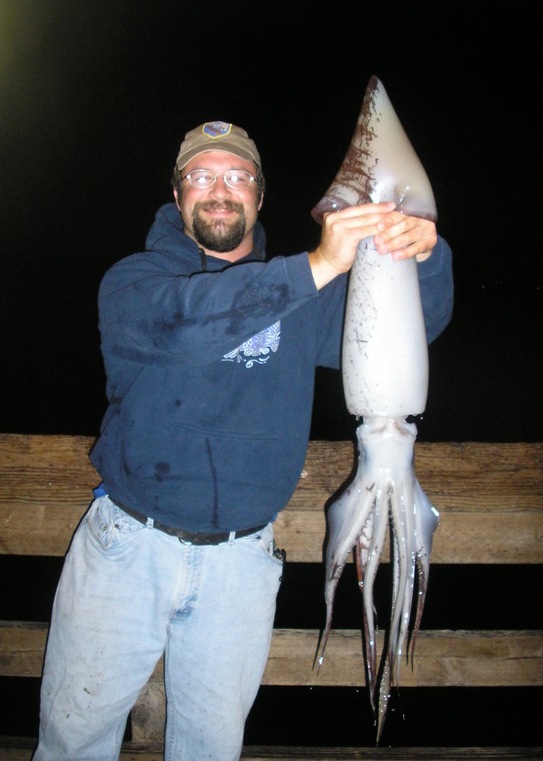
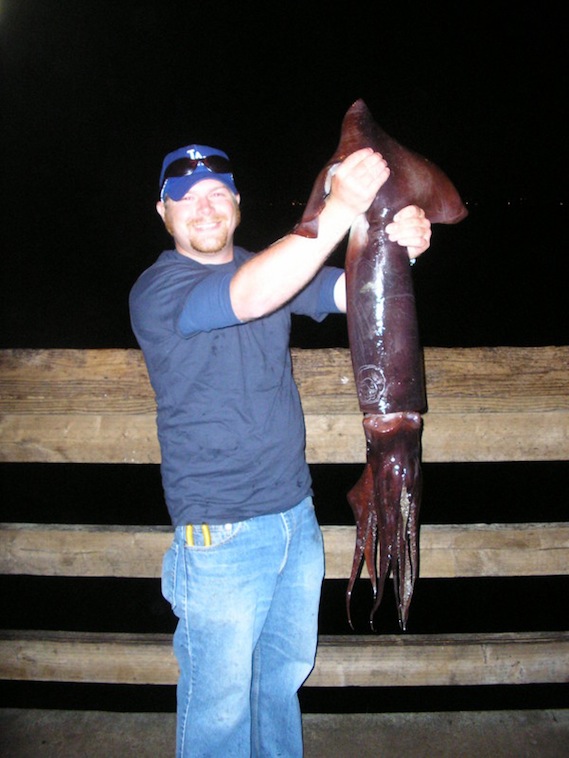
Humboldt squid have returned to the Balboa and Newport Piers this week, much as they did in 2002 and 2007. Whenever they visit, the crowds of anglers increase and the frenzied mob tries to catch a few of the huge cephalopods while avoiding getting squirted by ink when the gnarly beasts reach the top of the pier.

Their arrival at the pier also brings back memories of the Pier Fishing in California  Message Board report by my friend Ben Acker during a visit in 2007— and the fictional story that resulted.

DOMPFA Ben with a jumbo squid caught from Balboa Pier. Ben is  6’3″

Date: May 29, 2007

To: PFIC Message Board

From: dompha ben

Subject: Jumbo Squid Invasion at Balboa!

Around 3:30, we… drove around to Balboa Pier. When we arrived, there were only a few families at the end, enjoying a wide-open mackerel bite. I split-shotted a small piece of mackerel and kept a few of the cannibals for bait. Almost all were released; those that didn’t look like they would make it (eye injuries, etc.) were given away to folks.

As the afternoon turned to evening, more and more people showed up at the end of the pier. By the time the sun was setting, it was shoulder to shoulder, with people wrapping all the way around Ruby’s.

As dusk fell, I saw the first squid cruise under the lights. At first, I thought it was a baby seal, but I noted the erratic pulsing movement, and realized what it was. Soon, there were hundreds of the huge critters flashing in the water. Bryan and I tossed out squid jigs, and immediately hooked up. Everyone on the end of the pier was bendo…it was incredible! I haven’t seen that much excitement on a pier for a long time.

After a solid 40 minutes of wide-open squidding, they seemed to vanish just as quickly as they had arrived. I didn’t keep any of the beasts, as I have a few slabs of calamari in my freezer from a squid my brother Dan gave me a few weeks ago. Instead, the squid we caught are going home with some of the nice families with whom we fished tonight, including a couple of people that didn’t manage to land any squid of their own. I don’t like to give away my catch as a rule, but in the case of squid, which don’t release well, I didn’t mind.

All told, the pier probably landed around 50 squid by 9:15, with over 100 lost due to light line, pulled jigs, inexperience, and unpreparedness. I had one of only three nets at the end of the pier, and it was being passed around like community property… I didn’t mind, actually, and stopped catching squid for a while so I could help people net theirs.

My hoop net was in high demand tonight…Did I mention…BRING A NET!

Yes…that’s my net.

Everyone was appreciative, and no one fought, complained, or acted too greedy. I can see why people think Balboa is the “friendliest” pier in SoCal.

Word has it the last few nights have had similar showings of the big squid at Huntington, Newport, Balboa, Oceanside, and Dana Point. Don’t forget a landing net… these squid are BIG. By the way, I’m not blowing up the spot. It’s already blown up, and the number of people using cell phones to call in their buddies tonight was almost comical. As we walked down the pier leaving, there were hoards of people coming in with coolers and buckets. I hope the squid came back to give them a repeat performance…because they were gone when we left. Happy hunting…

Calstar Bryan poses with an angry squid at Balboa Pier. If you do catch a big squid, stay clear of the tentacles and the sharp beak. They can do damage to your flesh, and give you a painful experience!

Posted by Calstar Bryan

Hi Everybody- Thanks for all the kind responses. The squid were (no pun intended) a blast to catch. As for rod and reel combos, I was using an 8ft. jig stick coupled with a Daiwa Sealine 30 tossing 30lb. test and they were still ripping drag and putting tons of bend-o in the rod.

Ben seemed to take top honors in “Fight of the Night” fishing an Abu 6500 on an 8ft. 15lb. rod with 50lb. Power Pro. I can’t tell you how jealous sick I was watching him fight those freight trains on that light gear.

As for jigs, Ben was rigged pretty traditional for squirts, working a plastic squid jig 12 inches above a four-ounce torpedo sinker. I threw a painted glow-in-the-dark torpedo sinker with squid hooks and that seemed to work well too. Anglers fishing neon glow sticks (green or purple) were hooking up pretty consistently. Unfortunately, as Ben mentioned, some squid unbuttoned due to pulling the jig, inexperience and/or too light of line. It was kinda’ entertaining though seeing some of the broken-off glow sticks breeze through the water then disappear into the depths.

I’ve never seen such excitement on a pier in all my life. People were cheering and high-fiving while others patiently played out the big cephalopods waiting for a landing net to be lowered. Complete strangers encouraged their fellow anglers on throughout their fights as fresh ones were being hooked up around the entire end of the pier. Oh to be a patron of Ruby’s, witnessing all this from a booth, must have amazing. The experience was truly awesome.  If my brother reads this…Brady sorry I inked up your jeans.

Ben, being a great writer,  could not resist a short fictional account of what could happen on a crowded pier.

Pier Collapse Prompts Investigation

by B. Russell Acker, Staff Writer

May 31, 2007

NEWPORT BEACH– In what is being called a freak accident, the Balboa Pier collapsed under the incredible weight of a large crowd of fishermen, and plunged into the roiling surf, late Wednesday night. While no one was killed in the incident, scores were hurt, and hundreds have already filed claims against the city for their injuries and loss of fishing gear.

Nick Tripodes, a local merchant, witnessed the ordeal.

“I heard a loud snap, followed by screams and a tremendous splash,” recounts Tripodes. “You could hear all those people swimming for shore in the dark. It was awful.”

Newport Beach Police Sgt. Raymond Devonian cites eyewitness accounts that suggest the pier collapse was caused by giant cephalopods.

“When the giant squid come in, the pier loads up with [anglers],” stated Devonian. An avid angler himself, Devonian empathized with the calamari-crazed fishermen. Still, he encourages anglers to be safe.

“It’s just not designed to support that many people,” Devonian said about the pier, now little more than a concrete and wood jetty jutting out from the shoreline at a right angle. “What we’re going to do with the tons of squid jigs that are washing up on the beach I really have no idea,” said Devonian.

Initial reports from the Army Corps of Engineers suggest that over 17,000 people were on the pier Wednesday night at the time of collapse.

“That’s astronomical,” said Ken Jones, author of Pier Fishing in California. “It’s not the kind of thing we [pier anglers] take lightly. When this sort of thing takes place, there’s really only one question: Where’s the tartar sauce?”

Jones’ comments were merited by how rare it is for the tasty cephalopods to swim en masse this close to a pier.

It is unclear at this time if last winter’s cold weather spared enough of California’s lemon crop to meet the demand of calamari anglers. “Let’s just hope the price of lemons makes these eight squid I caught last night worth it,” stated one soaked angler. He did not wish to be identified, but added, “Balboa is still the friendliest pier in California. I’ll be back.”

Several organizations are calling for a probe into Wednesday’s catastrophe. Governor Arnold Schwarzenegger (R-CA) exercised his executive powers early Thursday morning, declaring a state of emergency, which makes many anglers eligible to apply for federal aid to replace lost fishing gear.

At a press conference, Schwarzenegger’s comments were short, but hit a sour note among California’s pier anglers.

“You are mine now! You belong to me!” exclaimed Schwarzenegger. It was not clear if Schwarzenegger was speaking about the Balboa pier collapse, or if he was simply quoting lines from the 1990 film, Kindergarten Cop.

What is clear is that the Governor has called for the immediate closure of all piers in the state, until such time as they can be inspected and deemed safe.

When asked when the piers might be reopened, Schwarzenegger only stated, “You forgot the second rule in a crisis situation…”

He did not comment further, leaving many pier anglers and residents of the quiet Newport Beach community to wonder about their beloved pier.

The 2011 squid were a little smaller —


Posted in Pierfishing · Tagged , , , , , , , · 2 Comments

Opaleye

Sea Chubs—Family Kyphosidae

A chubby opaleye taken at the Cabrillo Mole in 2009

Species: Girella nigricans (Ayres, 1860); from the French word girelle (a derivative of julis, an old word used to denote a number of small wrasse in Europe), the Latin word nigr (dark) and the Greek word ikanos (becoming, in reference to its pleasing appearance).

Alternate Names: Blue-eye perch, green perch, opaleye perch, bluefish, blue bass, greenfish, Jack Benny, Catalina perch, button-back, button-eye, and button bass. Called chopa verde in Mexico.

An opaleye from the Oceanside Harbor Pier caught in 2009

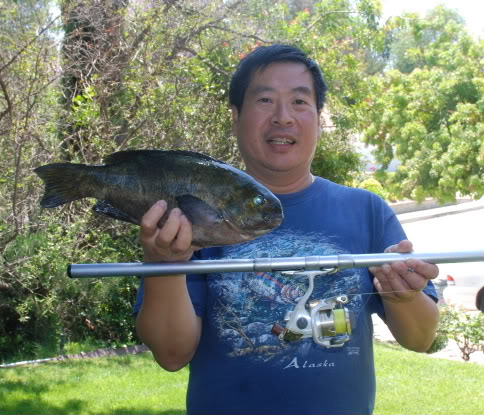
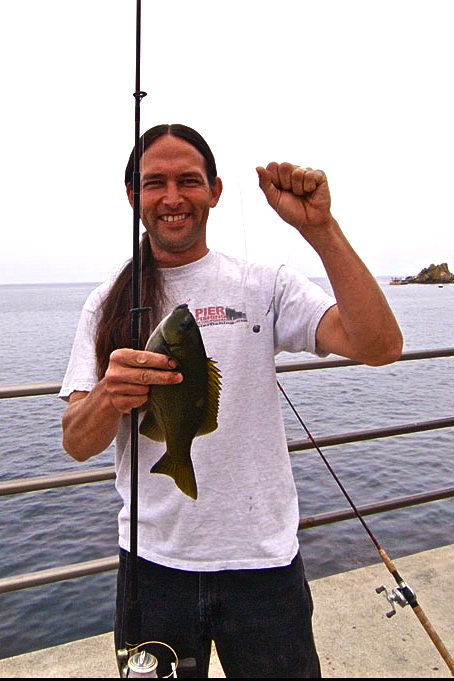
Identification: Opaleye are perch-shaped but heavier bodied. Their coloring is usually dark olive green and commonly they have two light spots at the base of the dorsal fin. Some fish are pale green or bluish-green while a few almost all white fish have been observed. The eyes are distinctive: large and an opalescent, blue-green color.

An opaleye’s head

Size: To 25.4 inches and 13.46 pounds (a 10-11 year old fish that was speared by David Williams off south Laguna Beach (near Aliso) in 1964). That monster-sized fish, more than double the size of the previous state record, shattered the belief of biologists who had felt that opaleye only reached about six pounds in size. It may be a freakish-record that stands for a long, long time. The California “rod and reel record” fish weighed 6 lb 4 oz and was taken near Los Flores Creek in Malibu in 1956. Most opaleye caught from piers are less than 14 inches in length.

KJ and an opaleye caught at the Cabrillo Mole in 2007

Range: Cabo San Lucas, southern Baja California and the Gulf of California to Otter Rock, Oregon. Uncommon north of Point Conception.

Habitat: Shallow-water, rocky areas and kelp beds.

Minnow Magnet and a nice opaleye taken from the Cabrillo Mole in 2009

Piers: Can be caught from almost any pier in southern California located near rocks, reefs, or kelp. Less common north of Point Conception although taken occasionally at piers in Morro Bay. Uncommon north of Cayucos but a population seems established near the Coast Guard Pier in Monterey. Considered rare north of Monterey. Best bets: Shelter Island Pier, Ocean Beach Pier (inshore), Oceanside Pier, Oceanside Harbor Pier, Dana Harbor Pier, Cabrillo Pier (jetty side), the Green Pleasure Pier and Cabrillo Mole (Avalon), Redondo Sportfishing Pier, and Paradise Cove Pier. Most of the fish caught at SoCal piers are fairly small to mid-size opaleye. The exceptions are the two piers in Avalon that almost always have good-sized fish available for the opaleye-seekers.

An opaleye from the Green Pleasure Pier in Avalon, 2017

Shoreline: One of the main goals of rocky shore anglers in sourthern California.

Boats: An inshore species rarely taken by boaters unless targeting them at places such as jetties and breakwaters.

Bait and Tackle: Some anglers specialize in opaleye, and many of them swear that moss or frozen peas are the best bait. I’ve actually caught more on ghost shrimp but I must admit that I’ve watched, many a morning, while a group of opaleye “pros” from Los Angeles (I recognize them by now) were filling large coolers with opaleye at the Cabrillo Mole and they almost always use moss as their bait du jour. I think all three baits are excellent for opaleye (although the ghost shrimp are more expensive). Fresh mussels, pile worms, bloodworm, and small rock crabs also make good bait. I also managed to hook a few opaleye using garden snails during an experiment testing different baits at Catalina in 2005. Medium tackle works fine but use a light line, small hooks, and fish the bait under a float of some type since the opaleye will be a mid-depth.

Opaleye caught at the Green Pleasure Pier by Mahigeer in 2011

Food Value:  A good eating fish that is generally fried.

Comments: Primarily herbivores (vegetarians), opaleye eat a variety of plants including feather boa kelp, giant kelp, sea lettuce and coralline algae. Evidently they also grab organisms attached to seaweed as they’re making their rounds, tasty little items like tube worms and red crabs. Opaleye are a favorite of many anglers; they’re hard to hook but once hooked put up a very good fight for their size.

The crystal-clear waters at Avalon present quite a challenge for the sagacious, line-shy opaleye. Big schools of 2-4 pound fish hang around the Green Pleasure Pier and the Cabrillo Mole but they can be very hard to catch. They seem more cautious of line at the Green Pleasure Pier but if you use a light line, perhaps 2-4 pound fluorocarbon, you might get them. (Actually, to be fair, I catch them every year at the Pleasure Pier and I usually am using 8-10 fluorocarbon). Of course the 1,794 ropes, tangled lines, pilings, floats, shore boats and yellow submarines that surround and hang under the GPP might also get your line.

At the Mole it’s the long fronds and blades of the giant kelp that sway (tidally) in or out near the railing. If the opaleye are allowed to encircle the kelp it’s pretty much over. As soon as they are hooked apply pressure and try to keep them coming toward you while having a person ready with a net. You need to use light line but can also pay the consequences if you’re unwilling to apply enough pressure.

A large opaleye taken at the Cabrillo Mole in 2014

The opaleye “pros” who come over to Catalina from Los Angeles take the ferry over for one day, fish exclusively at the Mole, fish for one species—opaleye, and are almost always successful (coolers are crammed with fish). You learn from such experts and a few things should be mentioned. The first is that the opaleye are typically at a mid-water depth, five to ten feet under the surface of the water depending upon the depth of the water. They are rarely caught on top and infrequently caught on the bottom (although I’ve caught several fishing on the bottom at night and they are often caught on the bottom by anglers casting out from jetties). Second is that if you want to fish the correct depth a float is desirable and long slip-line floats are the preferred tackle for the opaleye hunters (although bobbers will also work). Third is when you see the float go down, strike and, as mentioned, try to keep the fish out of the kelp. Fourth is that light line (preferably fluorocarbon) and small hooks (size 6 or smaller) are key.

An opaleye from the Cabrillo Mole in Avalon in 2016

Opaleye, especially the older, larger fish can be frustratingly difficult to catch. Chum with peas and a whole school may come up to check out the bait and fish after fish will approach the bait before turning away in seeming disapproval. But, the challenge of out smarting the fish is part of the fun.

An opaleye caught by Amanda at the Cabrillo Mole in 2013

KJ and an opaleye caught at the Green Pleasure Pier in 2014

Mahigeer and an opaleye taken at the Green Pleasure Pier in 2010

Opaleye taken at the South T-Pier in Morro Bay in 2018

Large opaleye taken at the Palos Verde rocks by dcc in 2008

Large opaleye taken at the Palos Verde rocks by dcc in 2008

Four pictures of opaleye taken from the Palos Verde rocks by dcc in 2009

KJ and an opaleye from the Green Pleasure Pier in Avalon in 2015

Jimbojack and an opaleye from the Cabrillo Mole in 2006

Brightly colored opaleye from the Shelter Island Pier in San Diego in 2009

Less colorful opaleye from the Redondo Sportfishing Pier in 2002

Posted in Pierfishing, Saltwater Fishing · Tagged , , , , , , , , · 3 Comments

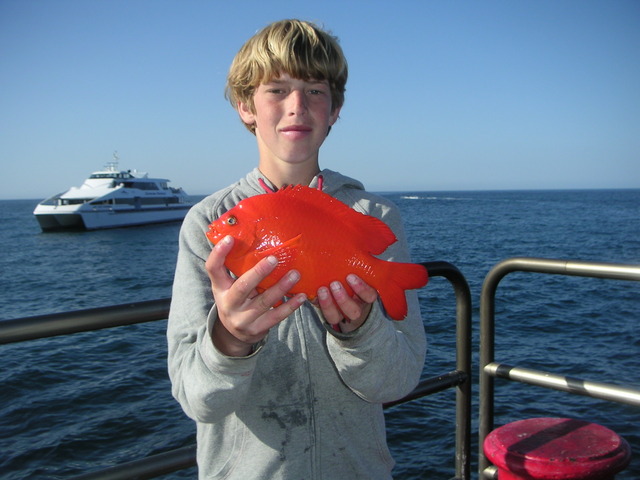
Garibaldi aka Ocean Goldfish — “Don’t keep ‘em”

Garibaldi

Species: Hypsypops rubicundus (Girard, 1854); from the Greek word hypsypops (high area below the eye) and the Latin word rubicunda (red).

Alternate Names: Golden perch, ocean sunfish and ocean goldfish. In Mexico called jaqueta garibaldi. As for the name garibaldi, it apparently was a name bestowed upon the fish by California’s Italian commercial fishermen in the 1800s. Giuseppe Garibaldi was one of the main leaders in the unification movement to create an Italian nation and his followers were known as the “Redshirts” for the bright red shirts they wore. He was considered a hero to Italians throughout the world and apparently the fish, at least to some, were reminiscent of those red shirts.

Identification: Garibaldi are easily distinguished by the brilliant golden-orange coloring on the whole body and are considered by many the prettiest fish in our coastal waters. They are perch-shaped but very deep-bodied with large fins. The young (up to about 6 inches in length) are reddish orange with bright blue spots.

A juvenile garibaldi

Size: To 14 inches (some books say 15 inches) but most pier-caught fish are under a foot in length.

Range: Bahia Magdalena, southern Baja California to Monterey Bay. Uncommon north of Santa Barbara and rare north of Point Conception. Very common at Catalina Island (which is sometimes referred to as “Garibaldi Central” by scientists and divers).

My daughter Kim and a garibaldi at the Mole in 2003

Habitat: Generally found in shallow-water, rocky-shore areas although they have been encountered down to a depth of almost 100 feet. Fitch and Lavenberg, Tidepool and Nearshore Fishes of California, report that “A wide variety of food items has been found in garibaldi stomachs, including sponges, sea anemones, bryozoans, algae, worms, crustaceans, clams and mussels, snail eggs, and their own eggs.”  No wonder it is sometimes hard to keep them off a hook even though they’re illegal to keep.

Piers: Often hooked at southern California piers located near kelp beds or rocky reefs. Best bets: Oceanside Harbor Pier, Dana Harbor Pier, Redondo Harbor Sportfishing Pier, and the three main piers on Catalina island—the Green Pleasure Pier and Cabrillo Mole at Avalon (where it’s hard not to hook them), and the Isthmus Pier at Two Harbors.

My son-in-law Dave and a garibaldi at the Mole in 2003

Bait and Tackle: None since they are illegal to take.

Food Value: None since you can’t keep them (and they aren’t supposed to taste very good anyway)!

Minnow Magnet with a garibaldi at the Mole in 2009

Comments: Although pretty to look at, they are pugnacious, strong, and not the friendliest fish. They are extremely territorial and will defend fairly large areas. This is especially true during the spring-summer spawning season when males will build a nest and defend it against intruders, both fellow male garibaldi and other species (including humans). Apparently the cute little missy garibaldi are an exception and allowed to invade those spaces and deposit their eggs.

It is illegal to keep these fish, but why? As related to me by a Fish and Game official, the campaign to make them illegal originated in Avalon. It seems that the glass bottom boats, a popular attraction at Avalon on Catalina Island, were worried that anglers (actually divers) were taking far too many of the beautifully colored fish and that it was bad for their business (since garibaldi are one of the most viewable fish from the boats).

According to records, in January 2, 1953 the California Department of Fish and Game presented proposals to “prohibit skin dive fishing along the waterfront of Avalon, Santa Catalina Island.” The proposal was based upon a similar proposal from the Santa Catalina Island Company. That proposal was met with opposition from spear fishermen so the proposed regulation was modified into a statewide prohibition on the recreational take of garibaldi. On January 30, 1953 the California Fish and Game Commission adopted the prohibition against the take or possession of garibaldi by angling or diving (Title 14, CCR, 28.05).

Thus the take of garibaldi by anglers in California has been illegal for over 60 years. However, a limited commercial take of garibaldi was permitted until 1995 when the legislature passed a bill (which Governor Wilson signed) placing a three-year ban on the commercial collection of garibaldi. Eventually the ban was made permanent.

The 1995 legislation also made the garibaldi the official “marine” or saltwater fish of California. Golden trout remain the “freshwater” fish.

Today, most anglers return the fish to the water if they’re mistakenly hooked. Nevertheless, some continue to be speared illegally. It seems colorful fish are required at the wedding dinner tables of some Pacific Islanders and garibaldi are a favorite. Once again long-time cultural tradition clashes with today’s rules.

Yours truly and a garibaldi at the Cabrillo Mole

The Finny Bachelor by W. E. Cortissoz

 I know a little garden, Beneath a green-gold sea

Where bright, bronze plants are growin’, And grow so gracefully.

 Amidst their undulations, A flash of gold I spied;

And in and out the waving, Kelp it seemed to hide.

 It was a little gold-fish, Who lived there all alone,

In this most lovely garden, In the Bay of Avalon.

 Day after day I find him, Alone in his domains;

He darts, then lingers, to and fro, And in his garden reigns.

 I see that he is happy, And that—his praise’ to One,

Who caused his life to happen, In the Bay of Avalon.

“Neath the music of the waters, In his garden of the sea,

Long may that garden denizen, Enjoy immunity.

 Immunity from humans, And maws of ev’ry gauge;

I want my little goldfish, To pass away from age!

 Catalina Islander, March 26, 1924

Posted in Pierfishing, Saltwater Fishing · Tagged , , , , · Leave a comment

White Sturgeon — America’s Largest Freshwater Fish

White Sturgeon — From Pier Fishing in California, 2nd Ed.

Species: Acipenser transmontanus (Richardson, 1836); from the Latin words Acipenser (bony cartilage), trans (across), and montes (mountains).

Alternate Names: Pacific sturgeon, Sacramento sturgeon, Oregon sturgeon and Columbia sturgeon. Called esturión blanco in Mexico.

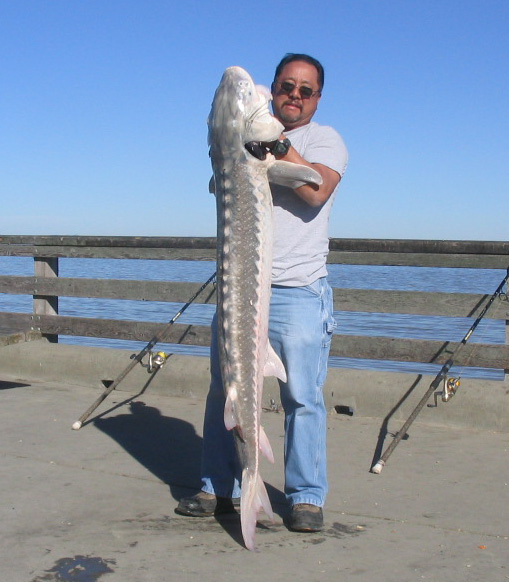
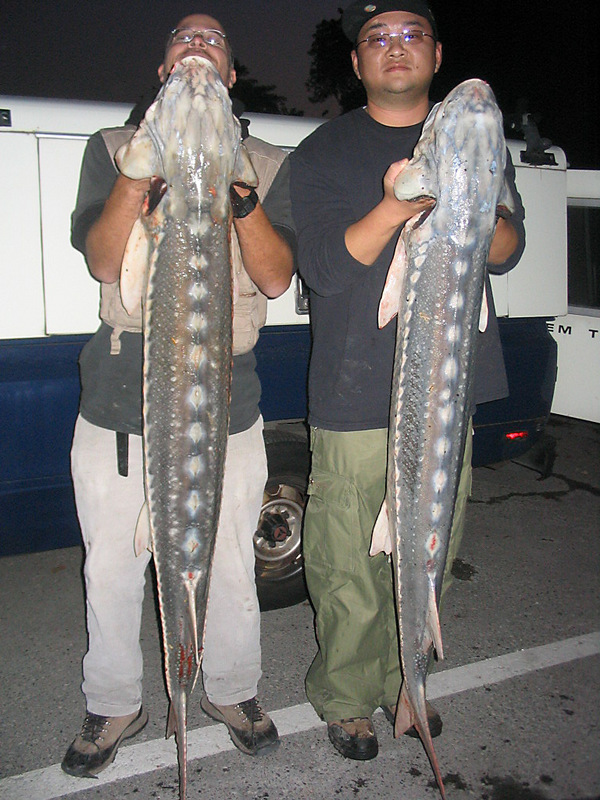
Identification: White sturgeon have a long, streamlined body with a broad, flattened head, blunt snout, tiny eyes, and a shark-like tail, all features that help it maintain position in large, fast flowing water conditions. Sturgeon do not have scales, instead they have five rows of scutes (bony plates) on the body, one row on the back, one at the middle of each side, and one on each side of the belly. White sturgeon have 11-14 dorsal scutes, 38-48 midlateral scutes, and 9–12 ventral scutes. There are four whiskers (barbels) located on the underside of the snout, closer to the tip of the snout than to the mouth. Their dorsal color is gray, pale olive, or gray-brown, the fins are a dusky, opaque gray, and the underside is white.

Size: Recorded to nearly 20 feet in length and 1,800 pounds although few are seen today longer than ten feet in length. Most caught from piers are less than 100 pounds. The California record fish weighed 468 pounds and was caught in San Pablo Bay by Joey Pallotta in 1983. It’s a record that cannot be broken since California’s slot limit now requires the release of the bigger fish.

This is the largest freshwater fish in North America and third largest sturgeon in the world. The beluga (Huso huso), found primarily in the Caspian and Black Sea basins, and occasionally in the Adriatic Sea, is the largest sturgeon reaching 24 feet in length and 3,250 pounds. (Although a monster measuring 28-feet long and weighing 4,570 pounds was reportedly taken from the Volga River near the Russian city of Astrakhan in 1736 but there is no verification of that fish). The Kaluga sturgeon (Huso dauricus), found in the Amur River basin, is the second largest sturgeon (22.6 feet and 2,200 pounds).

Range: From Ensenada, northern Baja California, to Cook Inlet, Gulf of Alaska. Although rare to the south, and less prevelant in saltwater than green sturgeon, a 47.9 inch (14-pound cleaned-weight) fish was taken at Isla de Todod Santos near Ensenada in March of 2003. Another white sturgeon, 75.7 inches long (45.2 pounds) was collected at Flat Rock, Rancho Palos Verdes in Los Angeles County on April 24, 2003.

Habitat: Anadromous, meaning they spend part of their lives in fresh water (where they spawn) and part in salt water; unlike most fish they may make the journey from fresh to salt water and back many times. They spend most of their lives in brackish bays, estuarine areas, and slow-moving rivers. Sturgeon are considered “benthic cruisers” that roam the bottom searching for food. The food is rarely detected by sight. Instead, they use the sensitive barbels under the snout, and ampullary (electric) organs, also located under the snout, to detect prey/food. The sturgeon feel and taste the food first and then suck it up into their bottom-oriented mouth by way of their “protruisible jaw” that can quickly shoot out (extend) and suck in whatever food they’ve chosen.

Young sturgeon feed mainly on insects, worms, amphipods (shrimp-like crustacea), and other small invertebrates such as copepods and mysid shrimp (opossum shrimp). Older fish become true gourmands feeding on a wide variety of bottom dwelling crustaceans and mollusks (crabs, shrimp, clams) as well as whatever fish are convenient (can they grab them?). Although they will often feed on the more sentinent, bottom-hugging fish (i.e., gobies and sculpins), they also include in their menu such species as herring (and herring eggs), shad, striped bass and salmon. Given the poor eyesight of sturgeon, and their manner of detecting food, it’s theorized that most of the fish eaten by sturgeon are captured at night. Countering the gourmand claim are those that say sturgeon are nothing more than indiscrimate bottom-feeders, akin to Uncle Ed’s “Fish-style” vacuum cleaner, sucking up anything that seems edible. Given that house cats, squirrels, seal pups, waterfowl, and carcasses of spawned-out salmon have been found in sturgeon stomachs, they may be right. Of note was the horse’s head supposedly found in a Russian beluga sturgeon. Don’t know if the horse head had anything to do with the Russian mafia. Nor is it easy to imagine how big that beluga’s mouth had to be to swallow a horse head. Questions, questions, questions.

Piers: In California, sturgeon are only common to San Francisco Bay Area piers, the piers in the Sacramento-San Joaquin Delta, and, to a much less extent, piers in Humboldt Bay. Best Bets: Point Pinole Pier, Eckley Pier, Martinez Pier, Point Benicia Pier, Antioch Marina Pier, Antioch Pier, McNear Park Pier, Paradise Park Pier and Elephant Rock Pier. Seasonally common at the Candlestick Point Pier, Brisbane Pier, Oyster Point Pier, and the Dumbarton Pier.

Bait and Tackle: Caught with heavy tackle, a sliding bait leader, and live bait such as ghost, mud, or grass shrimp. Large Kahle hooks can be used and several shrimp can be impaled on the hook. When herring are spawning in nearby areas, herring and herring eggs make excellent bait. Use eel when crabs are are in full force and grabbing softer bait. Am told the best way to use the eel is to cut off a 2-3-inch-long chunk. Then cut the chunk into four strips before attaching to the hook. The strips will flutter and hopefully attract Mr. Sturgeon.

Surprisingly, given their size and manner of sucking in food, sturgeon have a very gentle bite that is hard to detect. Regulars seem to acquire the ability to spot the subtle “pumps” that indicate a bite but it can take newbies time to figure out when to strike.

Food Value:  Excellent, mild-flavored meat that contains no bones and cuts up nicely into steaks for broiling, baking or frying.

Comments: Many sturgeon are hooked from Bay Area piers but hooking them is just part of the battle. An angler must have stout tackle, knowledge, a bit of luck, and the understanding of how to get the fish onto the pier, assuming it hasn’t stripped the reel of line or wrapped the line around a piling. However, large sturgeon are indeed landed: George Gano landed a 194-pound, eight-foot-long sturgeon while fishing from the old Vallejo Pier and a 170-pound fish was reported from the McNear Park Pier.

Philosopher fish? Sturgeon are considered very special fish by many people. Why? (1) They are considered an ancient fish that have changed little over the past 175 million years. (2) Though classified as a bony fish, they are more cartilaginous than bony, with an internal bone structure similar to that of sharks. (3) They can reach over 100 years of age. (4) They can reach a very large size and are desired by both sports and commercial fishermen. (5) They are a valuable species due to their eggs (caviar), a high priced delicacy for many people. (6) Although reaching an old age, sturgeon in California do not spawn until middle age, typically 10-15 years of age for males (3.6-6 feet long) and 12-20 years of age for females (4.6-6.6 feet long). And while females may spawn more than once it occurs only about every 4 to 10 years. Over fishing (often illegal poaching) in many areas of the world has led to an alarming decrease in the number of females and juvenile fish. (7) Almost all species of sturgeon are endangered, including several sub-species of white strurgeon, and many are close to extinction.

For all of these reasons sturgeon rank high in the hierarchy of piscatorial species as seen in the following:

One thinks of the sturgeon as a kind of philosopher among fishes, as if its ancient lineage had bred, over the thousands of centuries, a curious old wisdom and a quiet acceptance of change. The sturgeon has seen more years when it first spawns than many fish see in a lifetime.

—Howard Walden, Familiar Freshwater Fishes of America

Posted in Pierfishing, Saltwater Fishing · Tagged , , , , , · Leave a comment